DryMerge Review (2026): CDP Pricing, Limits & Alternatives
Bottom line
DryMerge is a Web SaaS tool for CDP (Customer Data Platform & Journey Orchestration) in Lifecycle & CDP. Pricing: Free plan · $0/mo · Enterprise plan. Best suited to B2B SaaS and Marketing & Growth Teams. Editor ratings: AI autonomy L3 (conditional automation); moat score 3.6/5.0 (Proprietary moat). Fact-checked by Jagmeet Sine on Oct 16, 2026.
Autonomous CRM hygiene and workflow automation agent that syncs email, calendar, and call activity into Salesforce and HubSpot without manual data entry.
DryMerge buyer fit verdict: when to choose vs. when to walk away
Choose DryMerge if (Best Fit)
- Target ICP & Stack Fit: You operate as B2B SaaS and Marketing & Growth Teams requiring a Web SaaS deployment for CDP, with verified ecosystem connectivity for Salesforce, HubSpot, Gong, Slack.
- L3 Architecture & Defensibility: Automating bidirectional CRM record updates and cross-app task execution across 50+ integrations embeds directly into daily revenue operations and sales hygiene.
- Commercial Model Fit: Your procurement budget aligns with Free plan · $0/mo · Enterprise plan and want a self-serve free tier for zero-cost initial validation.
Walk away from DryMerge if (Deal-Breakers)
- Walk away if your workflow requires uncapped enterprise volume on the Free plan · $0/mo · Enterprise plan entry plan without upgrading tiers.
- Walk away if your workflow cannot tolerate custom CRM schema mapping friction: Organizations with heavily customized Salesforce objects, validation rules, and required picklists can encounter field-validation errors during automated agent writes, creating an onboarding configuration bottleneck.
- Walk away if task quota consumption on high-volume inboxes is a deal-breaker for your team: Because automated triggers consume monthly task allocations per executed workflow step, high-velocity outbound teams syncing thousands of cold emails can hit task-quota bottlenecks on entry tiers.
DryMerge key facts & scorecard
| Pricing | Free plan · $0/mo · Enterprise planVendor pricing page |
|---|---|
| Free plan | Yes |
| Delivery | Web SaaS |
| Audience | B2B SaaS, Marketing & Growth Teams |
| AI autonomy level | L3 · Conditional automationEditor-verified |
| Moat tier & score | 3.6 / 5.0 · Proprietary moatEditor-verified |
| Funding | Seed |
| Total funding | $2.7M |
| Founders | Edward Frazer, Samuel Brashears |
| Company size | 2-10 employees |
| Ecosystem integrations | Salesforce, HubSpot, Gong, Slack, Gmail, Microsoft Outlook |
| Governance & docs | API & Docs ↗ · DPA ↗ · Terms ↗ · Privacy ↗ |
| Headquarters | San Francisco, California |
| Founded | 2023 |
| Last verified |
DryMerge pros & cons: strengths vs. operational limitations
Pros: core strengths & capabilities
- Automated CRM data entry: syncing email inbox, calendar, and meeting context into Salesforce and HubSpot
- Natural-language AI workflow builder: automating repetitive cross-app tasks across 50+ integrations
- Deal stage tracking, contact: enrichment, and automated post-meeting follow-up drafting
- Multi-seat team governance and: custom enterprise CRM synchronization pipelines
Cons: operational limitations & risks
- Custom CRM Schema Mapping Friction: Organizations with heavily customized Salesforce objects, validation rules, and required picklists can encounter field-validation errors during automated agent writes, creating an onboarding configuration bottleneck.
- Task Quota Consumption on High-Volume Inboxes: Because automated triggers consume monthly task allocations per executed workflow step, high-velocity outbound teams syncing thousands of cold emails can hit task-quota bottlenecks on entry tiers.
- Autonomous Write Governance Barrier: Granting an AI agent write permissions over production CRM deal stages and revenue forecast fields introduces an audit and data-governance barrier for enterprise RevOps leaders.
DryMerge TCO & deal-breaker stress test
Simulate 12-month stepped TCO, hidden cost multipliers, contract lock-in exposure, and stack failure modes using only facts verified by Jagmeet Sine on · Capture SHA da62ccde.
DryMerge is viable for 5 seats, but requires commercial or technical verification on the flagged items below.
| Plan / Tier | Verified Rate | Scale Fit | Scope & Quota Notes |
|---|---|---|---|
| Free / Sandbox | $0 | Unlimited seats (capped credits) | Entry free tier with capped usage or feature quotas for initial workflow testing. |
| Entry / Starter | $25/mo | Unlimited seats (Entry credits) | Ideal for individuals who want custom AI agents |
| Enterprise / Custom | Custom quote | Unlimited seats (Enterprise SLA) | Sales-negotiated annual contract for custom volume, SSO/RBAC governance, and dedicated SLA. |
- Moat Score
- 3.6 / 5.0
- AI Autonomy
- L3
- Free Tier / Trial
- Free plan
Triggered audit signals & failure modes
- Opaque Enterprise Quoting vs. SMB/Mid-Market BudgetVerified Pricing Ledger
DryMerge does not disclose a public self-serve floor (Free plan · $0/mo · Enterprise plan). Buyers with a $800/mo cap face high sales-qualification friction.
- Published Self-Serve Entry FloorVerified Pricing Ledger
DryMerge publishes a transparent entry point (Free plan · $0/mo · Enterprise plan) with a free tier for initial validation before committing.
- Primary Operational Bottleneck: Custom CRM Schema Mapping FrictionAudit by Jagmeet Sine
Organizations with heavily customized Salesforce objects, validation rules, and required picklists can encounter field-validation errors during automated agent writes, creating an onboarding configuration bottleneck.
Hidden TCO Multipliers & Quota Gates
- Custom CRM Schema Mapping Friction: Organizations with heavily customized Salesforce objects, validation rules, and required picklists can encounter field-validation errors during automated agent writes, creating an onboarding configuration bottleneck.
- Task Quota Consumption on High-Volume Inboxes: Because automated triggers consume monthly task allocations per executed workflow step, high-velocity outbound teams syncing thousands of cold emails can hit task-quota bottlenecks on entry tiers.
When to Walk Away & Negotiation Levers
- Walk away if your workflow requires uncapped enterprise volume on the Free plan · $0/mo · Enterprise plan entry plan without upgrading tiers.
- Walk away if your workflow cannot tolerate custom CRM schema mapping friction: Organizations with heavily customized Salesforce objects, validation rules, and required picklists can encounter field-validation errors during automated agent writes, creating an onboarding configuration bottleneck.
- Walk away if task quota consumption on high-volume inboxes is a deal-breaker for your team: Because automated triggers consume monthly task allocations per executed workflow step, high-velocity outbound teams syncing thousands of cold emails can hit task-quota bottlenecks on entry tiers.
- Validate exact quota thresholds (seats, credits, or API calls) included in DryMerge's Free plan · $0/mo · Enterprise plan tier before converting from monthly to annual billing.
- Require a sandbox proof-of-concept testing custom CRM schema mapping friction against your live CRM/data schema before annual sign-off.
Ask a custom procurement or TCO stress-test question about DryMerge
Lower 5-seat floor (~$12/mo vs. Custom Quote)
Lower 5-seat floor (~$82/mo vs. Custom Quote)
DryMerge key entities, modules & ecosystem stack
DryMerge moat & subtrack positioning
Automating bidirectional CRM record updates and cross-app task execution across 50+ integrations embeds directly into daily revenue operations and sales hygiene.
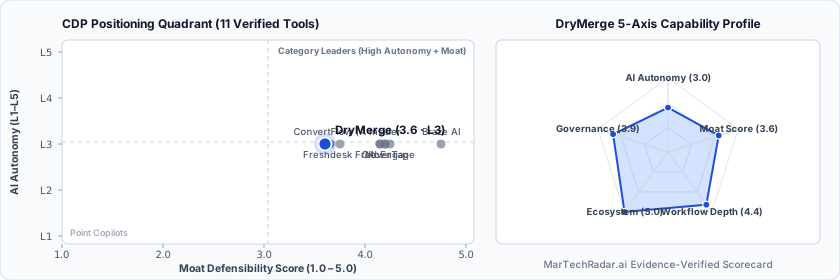
Editorial review
Fact-checked by Jagmeet Sine (Senior MarTech Infrastructure & Agentic Workflow Architect) on .
Background
Founded in 2023 by Edward Frazer and Samuel Brashears and headquartered in San Francisco, California, DryMerge (drymerge.com) is an AI CRM automation and workflow orchestration platform built for B2B sales teams, revenue operations (RevOps) managers, and business operators. Operating with a team of 2 to 10 employees and backed by $2.7M in Seed funding from Y Combinator (W24), Goodwater Capital, Garage Capital, Ritual Capital, and JJ Fliegelman, the company eliminates manual CRM data entry and repetitive operational tasks by connecting autonomous AI agents to a company's communication and system-of-record stack.
How DryMerge works
DryMerge operates at Level 3 autonomy through an event-driven LLM orchestration engine and connector hub spanning more than 50 business applications, including Salesforce, HubSpot, Gmail, Outlook, Google Calendar, and Slack. When a sales representative exchanges emails with a prospect or completes a calendar meeting, DryMerge automatically parses the unstructured conversation, extracts deal progression signals, creates or updates contact and opportunity fields in the CRM, and drafts follow-up actions. Beyond CRM hygiene, users can describe custom multi-step automations in plain English, and DryMerge compiles and executes the underlying API triggers continuously.
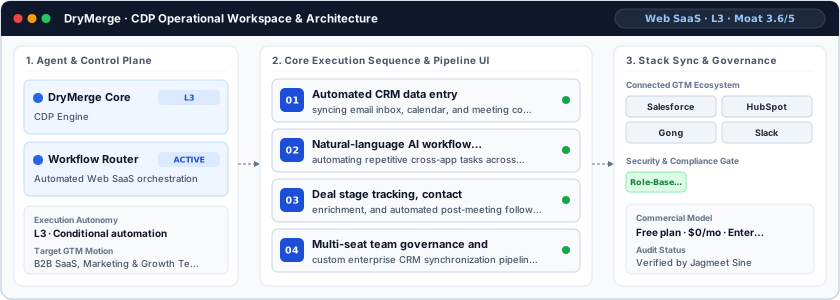
Limitations
Operational limitations and technical trade-offs include:
- Custom CRM Schema Mapping Friction: Organizations with heavily customized Salesforce objects, validation rules, and required picklists can encounter field-validation errors during automated agent writes, creating an onboarding configuration bottleneck.
- Task Quota Consumption on High-Volume Inboxes: Because automated triggers consume monthly task allocations per executed workflow step, high-velocity outbound teams syncing thousands of cold emails can hit task-quota bottlenecks on entry tiers.
- Autonomous Write Governance Barrier: Granting an AI agent write permissions over production CRM deal stages and revenue forecast fields introduces an audit and data-governance barrier for enterprise RevOps leaders.
DryMerge pricing
DryMerge offers both self-serve platform plans and quote-based CRM automation tiers. On the self-serve platform (drymerge.com/pricing/platform), the Free tier ($0/mo) includes 10 tasks per month, while the Individual plan is priced at $25/mo for 1 seat, 500 tasks per month, and access to 50+ app connections. Custom Business and dedicated CRM automation packages (Basic and Professional, scaling inbox, calendar, and Salesforce/HubSpot update allocations) are scoped via sales consultation.
How DryMerge compares
Within the Customer Data Platform & Journey Orchestration and RevOps Automation category, DryMerge competes against AI workflow and CRM hygiene alternatives such as Ergo, Coffee, and Zapier Central. Versus heavyweight enterprise revenue suites like Gong or static rule-based connectors like traditional Zapier, DryMerge differentiates itself by combining natural-language agentic workflows across 50+ apps with dedicated automated CRM data entry for Salesforce and HubSpot. Lean B2B sales teams and RevOps managers choose DryMerge to keep pipeline records accurate without manual admin work.
Frequently asked questions about DryMerge
How much does DryMerge cost and what pricing tiers are available?
Published pricing summary for DryMerge: Free plan · $0/mo · Enterprise plan. DryMerge includes a free tier or sandbox entry point. Verified tier schedule: Free / Sandbox ($0 for Unlimited seats (capped credits)); Entry / Starter ($25/mo for Unlimited seats (Entry credits)); Enterprise / Custom (Custom quote for Unlimited seats (Enterprise SLA)). DryMerge offers both self-serve platform plans and quote-based CRM automation tiers. On the self-serve platform (`drymerge.com/pricing/platform`), the Free tier ($0/mo) includes 10 tasks per month, while the Individual plan is priced at $25/mo for 1 seat, 500 tasks per month, and access to 50+ app connections.
How does DryMerge work and how autonomous is its AI architecture?
Autonomous CRM hygiene and workflow automation agent that syncs email, calendar, and call activity into Salesforce and HubSpot without manual data entry. Within CDP (Customer Data Platform & Journey Orchestration), MarTechRadar rates its execution architecture at L3 · Conditional automation with a verified Moat Score of 3.6 / 5.0 (Proprietary moat). Automating bidirectional CRM record updates and cross-app task execution across 50+ integrations embeds directly into daily revenue operations and sales hygiene. Corporate profile: Founded by Edward Frazer, Samuel Brashears, operating at 2-10 employees scale.
What are the main limitations of DryMerge and when should buyers walk away?
Based on our editorial technical audit, key operational considerations and boundaries for DryMerge include: (1) Custom CRM Schema Mapping Friction: Organizations with heavily customized Salesforce objects, validation rules, and required picklists can encounter field-validation errors during automated agent writes, creating an onboarding configuration bottleneck. (2) Task Quota Consumption on High-Volume Inboxes: Because automated triggers consume monthly task allocations per executed workflow step, high-velocity outbound teams syncing thousands of cold emails can hit task-quota bottlenecks on entry tiers. (3) Autonomous Write Governance Barrier: Granting an AI agent write permissions over production CRM deal stages and revenue forecast fields introduces an audit and data-governance barrier for enterprise RevOps leaders. Primary procurement walk-away rule: Walk away if your workflow requires uncapped enterprise volume on the Free plan · $0/mo · Enterprise plan entry plan without upgrading tiers.
What integrations, compliance certifications, and contract terms apply to DryMerge?
Verified ecosystem and stack integrations include Salesforce, HubSpot, Gong, Slack, Gmail, Microsoft Outlook, Zapier. First-party governance and developer endpoints verified on domain include: API Docs (https://docs.drymerge.com/legal-policies/privacy-policy/page), DPA (https://docs.drymerge.com/legal-policies/data-processing-agreement/page). Key TCO multiplier to watch: Custom CRM Schema Mapping Friction (Organizations with heavily customized Salesforce objects, validation rules, and required picklists can encounter field-validation errors during automated agent writes, creating an onboarding configuration bottleneck.) Before signing a contract, procurement teams should validate exact quota thresholds (seats, credits, or API calls) included in DryMerge's Free plan · $0/mo · Enterprise plan tier before converting from monthly to annual billing.
What are the best DryMerge alternatives and head-to-head competitors in 2026?
Top fact-checked alternatives to DryMerge in CDP (Customer Data Platform & Journey Orchestration) include Ergo (Pricing not disclosed), MoEngage (Custom / enterprise pricing), ConvertFlow (AI) (From $12/mo), Socialinsider (From $82/mo). Within the Customer Data Platform & Journey Orchestration and RevOps Automation category, DryMerge competes against AI workflow and CRM hygiene alternatives such as Ergo, Coffee, and Zapier Central.
Verified sources & evidence trail
- Official product domain: https://www.drymerge.com
- Commercial pricing verification: https://drymerge.com/pricing/platform
- Verified corporate entity profiles (
sameAs): LinkedIn Company Profile · Crunchbase Entity Record - First-party governance & documentation links: API & Docs · DPA · Terms · Privacy
- Editorial audit sign-off: Fact-checked by Jagmeet Sine on under the MarTechRadar Evidence-Ledger Protocol.