ConvertFlow (AI) Review (2026): CDP Pricing, Limits & Alternatives
Bottom line
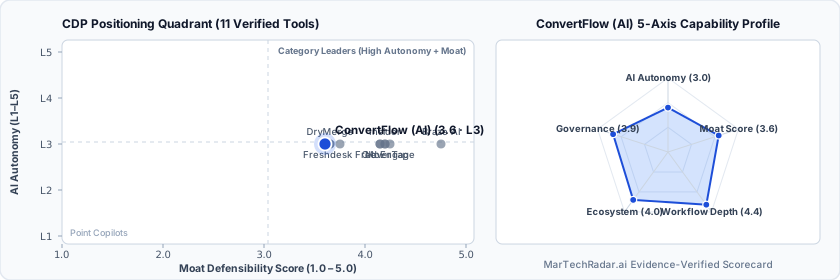
ConvertFlow (AI) is a Web SaaS tool for CDP (Customer Data Platform & Journey Orchestration) in Lifecycle & CDP. Pricing: From $12/mo. Best suited to DTC / eCommerce. Editor ratings: AI autonomy L3 (conditional automation); moat score 3.6/5.0 (Proprietary moat). Fact-checked by Anthony Hay on Oct 14, 2026.
On-site funnel builder and journey orchestration platform leveraging generative AI agents to deploy targeted popups, multi-step forms, and quizzes.
ConvertFlow (AI) buyer fit verdict: when to choose vs. when to walk away
Choose ConvertFlow (AI) if (Best Fit)
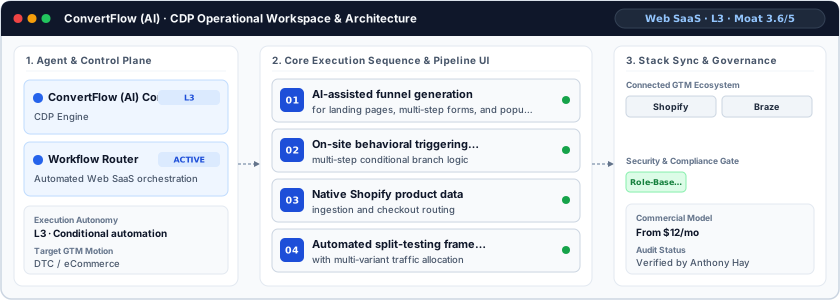
- Target ICP & Stack Fit: You operate as DTC / eCommerce requiring a Web SaaS deployment for CDP, with verified ecosystem connectivity for Shopify, Braze.
- L3 Architecture & Defensibility: ConvertFlow pairs pre-built funnel templates with an integrated AI agent to programmatically assemble multi-step lead capture sequences, reducing front-end engineering overhead for e-commerce and lead-generation operations.
- Commercial Model Fit: Your procurement budget aligns with From $12/mo.
Walk away from ConvertFlow (AI) if (Deal-Breakers)
- Walk away if your workflow requires uncapped enterprise volume on the From $12/mo entry plan without upgrading tiers.
- Walk away if your workflow cannot tolerate client-side script overhead: Injecting complex conditional rendering scripts directly into the DOM can introduce render-blocking latency and cumulative layout shifts on content-heavy web pages.
- Walk away if cross-domain identity persistence is a deal-breaker for your team: Visitor journey stitching degrades significantly when users cross unlinked subdomains or navigate within strict third-party cookie-blocking browser environments.
ConvertFlow (AI) key facts & scorecard
| Pricing | From $12/moVendor pricing page |
|---|---|
| Free plan | No / not disclosed |
| Delivery | Web SaaS |
| Audience | DTC / eCommerce |
| AI autonomy level | L3 · Conditional automationEditor-verified |
| Moat tier & score | 3.6 / 5.0 · Proprietary moatEditor-verified |
| Funding | Bootstrapped |
| Total funding | $140K |
| Founders | Ethan Denney, Jonathan Denney |
| Company size | 2-10 employees |
| Ecosystem integrations | Shopify, Braze |
| Governance & docs | Trust & Security ↗ · API & Docs ↗ |
| Headquarters | Miami, Florida, United States |
| Founded | 2016 |
| Last verified |
ConvertFlow (AI) pros & cons: strengths vs. operational limitations
Pros: core strengths & capabilities
- AI-assisted funnel generation: for landing pages, multi-step forms, and popups
- On-site behavioral triggering and: multi-step conditional branch logic
- Native Shopify product data: ingestion and checkout routing
- Automated split-testing framework: with multi-variant traffic allocation
Cons: operational limitations & risks
- Client-Side Script Overhead: Injecting complex conditional rendering scripts directly into the DOM can introduce render-blocking latency and cumulative layout shifts on content-heavy web pages.
- Cross-Domain Identity Persistence: Visitor journey stitching degrades significantly when users cross unlinked subdomains or navigate within strict third-party cookie-blocking browser environments.
- Downstream Webhook Rate Limiting: Sudden traffic spikes leading to burst submissions risk queue throttling and data ingestion failures across external CRM API endpoints lacking asynchronous buffering.
ConvertFlow (AI) TCO & deal-breaker stress test
Simulate 12-month stepped TCO, hidden cost multipliers, contract lock-in exposure, and stack failure modes using only facts verified by Anthony Hay on · Capture SHA 00faa6a1.
ConvertFlow (AI) aligns with your 5-seat / $800/mo profile. Review the walk-away triggers and contract levers below before deployment.
| Plan / Tier | Verified Rate | Scale Fit | Scope & Quota Notes |
|---|---|---|---|
| Entry / Starter | $12/mo | 1–2 seats | Multiple logins. Broken reporting. Usage fees multiply. No ownership |
| Growth / Professional | $25/mo | 5 seats | Remix 400+ templates with AI. Host on your custom domain |
| Scale / Advanced | $299/mo | 15 seats | One subscription. Onboarding team builds first funnel. AI optimizes |
- Moat Score
- 3.6 / 5.0
- AI Autonomy
- L3
- Free Tier / Trial
- None disclosed
Triggered audit signals & failure modes
- Published Self-Serve Entry FloorVerified Pricing Ledger
ConvertFlow (AI) publishes a transparent entry point (From $12/mo) for initial validation before committing.
- Tier Fit for 5-Seat Scale: Growth / Professional ($25/mo)Verified Tier Schedule
Remix 400+ templates with AI. Host on your custom domain
- Primary Operational Bottleneck: Client-Side Script OverheadAudit by Anthony Hay
Injecting complex conditional rendering scripts directly into the DOM can introduce render-blocking latency and cumulative layout shifts on content-heavy web pages.
Hidden TCO Multipliers & Quota Gates
- Annual Billing Headline vs. Monthly Premium: Headline entry rates reflect annual billing commitments; month-to-month flexibility carries a higher effective monthly rate or requires annual prepayment.
- Credit & Usage Burn Multiplier: Automated workflows consume metered credits/usage quotas; multi-step enrichment, voice minutes, or high-frequency agent runs can trigger mid-cycle top-up packs.
- Enterprise Governance & Add-On Gating: Advanced capabilities such as Single Sign-On (SSO), custom role permissions, or specialized analytics modules are gated behind upper tiers or paid add-ons.
When to Walk Away & Negotiation Levers
- Walk away if your workflow requires uncapped enterprise volume on the From $12/mo entry plan without upgrading tiers.
- Walk away if your workflow cannot tolerate client-side script overhead: Injecting complex conditional rendering scripts directly into the DOM can introduce render-blocking latency and cumulative layout shifts on content-heavy web pages.
- Walk away if cross-domain identity persistence is a deal-breaker for your team: Visitor journey stitching degrades significantly when users cross unlinked subdomains or navigate within strict third-party cookie-blocking browser environments.
- Validate exact quota thresholds (seats, credits, or API calls) included in ConvertFlow (AI)'s From $12/mo tier before converting from monthly to annual billing.
- Require a sandbox proof-of-concept testing client-side script overhead against your live CRM/data schema before annual sign-off.
Ask a custom procurement or TCO stress-test question about ConvertFlow (AI)
Fits within $800/mo budget (From $82/mo)
Lower 5-seat floor (~$19/mo vs. $25 / mo)
ConvertFlow (AI) key entities, modules & ecosystem stack
ConvertFlow (AI) moat & subtrack positioning
ConvertFlow pairs pre-built funnel templates with an integrated AI agent to programmatically assemble multi-step lead capture sequences, reducing front-end engineering overhead for e-commerce and lead-generation operations.
Editorial review
Fact-checked by Anthony Hay (Senior SEO, Search Intelligence & Content Operations Editor) on .
Background
Architectured as an on-site conversion infrastructure, ConvertFlow (AI) bridges front-end visitor interactions with downstream martech pipelines. Headquartered in Miami, Florida, United States, and established in 2016, the company operates with $140K in early-stage funding. The platform targets growth marketers, digital acquisition teams, and e-commerce operators seeking to deploy interactive capture mechanisms without custom front-end development. Functioning within journey orchestration ecosystems, it converts unstructured session traffic into structured lead profiles through automated on-site touchpoints.
How ConvertFlow (AI) works
At the architectural layer, the system autonomy, ConvertFlow utilizes a client-side JavaScript container that parses real-time session attributes, URL parameters, and custom cookies to execute conditional campaign triggers. When visitors trigger an interaction boundary, an AI agent system parses page metadata and predefined conversion objectives to generate dynamic forms, product recommendation quizzes, or targeted modals. Downstream webhooks and native connectors synchronize captured form attributes and behavioral tags directly into integrated email service providers and CRM databases.
Limitations
Operational considerations and platform boundaries include:
- Client-Side Script Overhead: Injecting complex conditional rendering scripts directly into the DOM can introduce render-blocking latency and cumulative layout shifts on content-heavy web pages.
- Cross-Domain Identity Persistence: Visitor journey stitching degrades significantly when users cross unlinked subdomains or navigate within strict third-party cookie-blocking browser environments.
- Downstream Webhook Rate Limiting: Sudden traffic spikes leading to burst submissions risk queue throttling and data ingestion failures across external CRM API endpoints lacking asynchronous buffering.
ConvertFlow (AI) pricing
ConvertFlow offers a tiered subscription model indexed against monthly funnel view volumes and active campaigns. Entry packages start from $12/month when billed annually, moving to $25 for higher-capacity personal tiers with custom domain routing. Higher-volume commercial plans scale across tiers up to $299, accommodating larger e-commerce operations. All paid tiers include core funnel analytics, campaign experimentation features, and access to automated remix agents without transactional commissions.
How ConvertFlow (AI) compares
While enterprise orchestration platforms like Bloomreach Loomi, Braze AI, and CleverTap focus on omni-channel messaging across native mobile apps and email infrastructure, ConvertFlow concentrates exclusively on on-site acquisition and checkout funnels. It lacks the complex unified data warehousing native to Bloomreach or the cross-channel push capabilities of Braze. Consequently, the software best fits mid-market e-commerce merchants and performance marketing agencies that require rapid front-end capture experimentation without maintaining dedicated engineering resources.
Frequently asked questions about ConvertFlow (AI)
How much does ConvertFlow (AI) cost and what pricing tiers are available?
Published pricing summary for ConvertFlow (AI): From $12/mo. A permanent free plan is not disclosed for ConvertFlow (AI). Verified tier schedule: Entry / Starter ($12/mo for 1–2 seats); Growth / Professional ($25/mo for 5 seats); Scale / Advanced ($299/mo for 15 seats). ConvertFlow offers a tiered subscription model indexed against monthly funnel view volumes and active campaigns. Entry packages start from $12/month when billed annually, moving to $25 for higher-capacity personal tiers with custom domain routing.
How does ConvertFlow (AI) work and how autonomous is its AI architecture?
On-site funnel builder and journey orchestration platform leveraging generative AI agents to deploy targeted popups, multi-step forms, and quizzes. Within CDP (Customer Data Platform & Journey Orchestration), MarTechRadar rates its execution architecture at L3 · Conditional automation with a verified Moat Score of 3.6 / 5.0 (Proprietary moat). ConvertFlow pairs pre-built funnel templates with an integrated AI agent to programmatically assemble multi-step lead capture sequences, reducing front-end engineering overhead for e-commerce and lead-generation operations. Corporate profile: Founded by Ethan Denney, Jonathan Denney, operating at 2-10 employees scale.
What are the main limitations of ConvertFlow (AI) and when should buyers walk away?
Based on our editorial technical audit, key operational considerations and boundaries for ConvertFlow (AI) include: (1) Client-Side Script Overhead: Injecting complex conditional rendering scripts directly into the DOM can introduce render-blocking latency and cumulative layout shifts on content-heavy web pages. (2) Cross-Domain Identity Persistence: Visitor journey stitching degrades significantly when users cross unlinked subdomains or navigate within strict third-party cookie-blocking browser environments. (3) Downstream Webhook Rate Limiting: Sudden traffic spikes leading to burst submissions risk queue throttling and data ingestion failures across external CRM API endpoints lacking asynchronous buffering. Primary procurement walk-away rule: Walk away if your workflow requires uncapped enterprise volume on the From $12/mo entry plan without upgrading tiers.
What integrations, compliance certifications, and contract terms apply to ConvertFlow (AI)?
Verified ecosystem and stack integrations include Shopify, Braze. First-party governance and developer endpoints verified on domain include: Trust/Security (https://trust.convertflow.com), API Docs (https://developers.convertflow.com). Key TCO multiplier to watch: Annual Billing Headline vs. Monthly Premium (Headline entry rates reflect annual billing commitments; month-to-month flexibility carries a higher effective monthly rate or requires annual prepayment.) Before signing a contract, procurement teams should validate exact quota thresholds (seats, credits, or API calls) included in ConvertFlow (AI)'s From $12/mo tier before converting from monthly to annual billing.
What are the best ConvertFlow (AI) alternatives and head-to-head competitors in 2026?
Top fact-checked alternatives to ConvertFlow (AI) in CDP (Customer Data Platform & Journey Orchestration) include MoEngage (Custom / enterprise pricing), DryMerge (Free plan · $0/mo · Enterprise plan), Socialinsider (From $82/mo), Insider (Custom / enterprise pricing). While enterprise orchestration platforms like Bloomreach Loomi, Braze AI, and CleverTap focus on omni-channel messaging across native mobile apps and email infrastructure, ConvertFlow concentrates exclusively on on-site acquisition and checkout funnels.
Verified sources & evidence trail
- Official product domain: https://www.convertflow.com
- Commercial pricing verification: https://www.convertflow.com/pricing
- Verified corporate entity profiles (
sameAs): LinkedIn Company Profile · Crunchbase Entity Record - First-party governance & documentation links: Trust & Security · API & Docs
- Editorial audit sign-off: Fact-checked by Anthony Hay on under the MarTechRadar Evidence-Ledger Protocol.