ParkourNote Review (2026): Open-Source Marketing Agents Pricing, Pros & Cons
Bottom line
ParkourNote is a Web SaaS tool for Open-Source Marketing Agents (Open-Source Marketing Agents & Prompts) in Agent & Marketing Ops. Pricing: Custom / enterprise pricing. Best suited to B2B SaaS. Editor ratings: AI autonomy L2 (workflow copilot); moat score 1.5/5.0 (Thin wrapper). Fact-checked by MarTechRadar Research Desk on Oct 16, 2026.
Open-source agent orchestration framework and structured prompt repository designed for marketing engineering teams automating programmatic copy.
Is ParkourNote worth it in 2026? Buyer fit & when to walk away
Choose ParkourNote if (Best Fit)
- Target ICP & Stack Fit: You operate as B2B SaaS requiring a Web SaaS deployment for Open-Source Marketing Agents.
- L2 Architecture & Defensibility: Maintains low architectural lock-in via transparent prompt blueprints and modular LLM execution chains, though defensibility relies primarily on developer community adoption and structured prompt versioning rather than proprietary foundational models.
- Commercial Model Fit: Your procurement budget aligns with Custom / enterprise pricing.
Walk away from ParkourNote if (Deal-Breakers)
- Walk away if you need published self-serve pricing: ParkourNote is sold by custom quote.
- Walk away if your workflow cannot tolerate context window drift and schema maintenance: Complex prompt chains often suffer from variable schema drift when integrated with dynamic upstream product catalogs, requiring continuous manual maintenance of input definitions.
- Walk away if downstream API rate limiting is a deal-breaker for your team: Synchronous batch generations trigger upstream LLM provider throttling and downstream content management API rate limits, as the core runner lacks distributed queuing mechanisms out of the box.
ParkourNote pricing, free plan & scorecard at a glance
| Pricing | Custom / enterprise pricing |
|---|---|
| Free plan | No / not disclosed |
| Delivery | Web SaaS |
| Audience | B2B SaaS |
| AI autonomy level | L2 · Workflow copilotEditor-verified |
| Moat tier & score | 1.5 / 5.0 · Thin wrapperEditor-verified |
| Funding | Undisclosed |
| Headquarters | United States |
| Last verified | Oct 16, 2026 |
ParkourNote pros & cons: strengths vs. operational limitations
Pros: core strengths & capabilities
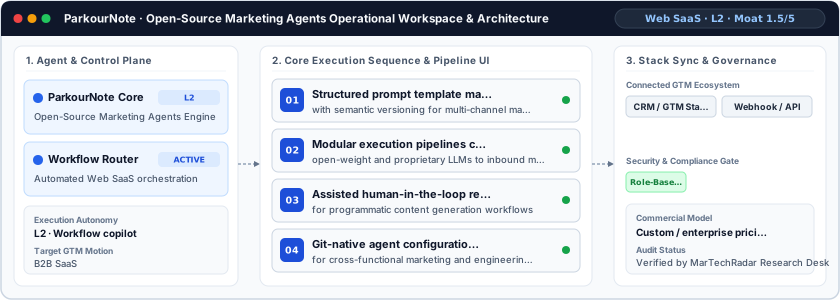
- Structured prompt template management: with semantic versioning for multi-channel marketing campaigns
- Modular execution pipelines connecting: open-weight and proprietary LLMs to inbound marketing data
- Assisted human-in-the-loop review interfaces: for programmatic content generation workflows
- Git-native agent configuration tracking: for cross-functional marketing and engineering alignment
Cons: operational limitations & risks
- Context Window Drift and Schema Maintenance: Complex prompt chains often suffer from variable schema drift when integrated with dynamic upstream product catalogs, requiring continuous manual maintenance of input definitions.
- Downstream API Rate Limiting: Synchronous batch generations trigger upstream LLM provider throttling and downstream content management API rate limits, as the core runner lacks distributed queuing mechanisms out of the box.
- Observability and Evaluation Latency: Lacking native real-time automated scoring harnesses, teams must build custom eval pipelines to detect model hallucination or brand voice degradation across high-volume batch executions.
ParkourNote TCO & deal-breaker stress test
Simulate 12-month stepped TCO, hidden cost multipliers, contract lock-in exposure, and stack failure modes using only facts verified by MarTechRadar Research Desk on 2026-10-16.
ParkourNote triggers high-severity friction under your 5-seat / $800/mo constraints. Benchmark the verified subtrack alternatives below before committing.
- Moat Score
- 1.5 / 5.0
- AI Autonomy
- L2
- Free Tier / Trial
- None disclosed
Triggered audit signals & failure modes
- Opaque Enterprise Quoting vs. SMB/Mid-Market BudgetVerified Pricing Ledger
ParkourNote does not disclose a public self-serve floor (Custom / enterprise pricing). Buyers with a $800/mo cap face high sales-qualification friction.
- Sales-Gated Contract TermsFact-checked by MarTechRadar Research Desk
Commercial access is structured around private enterprise licensing and professional services.
- Primary Operational Bottleneck: Context Window Drift and Schema MaintenanceAudit by MarTechRadar Research Desk
Complex prompt chains often suffer from variable schema drift when integrated with dynamic upstream product catalogs, requiring continuous manual maintenance of input definitions.
Test a custom ParkourNote budget or stack constraint
Lower 5-seat floor (~$20/mo vs. Custom Quote) · Transparent self-serve entry without mandatory annual lock-in
ParkourNote AI moat & Open-Source Marketing Agents positioning
Maintains low architectural lock-in via transparent prompt blueprints and modular LLM execution chains, though defensibility relies primarily on developer community adoption and structured prompt versioning rather than proprietary foundational models.
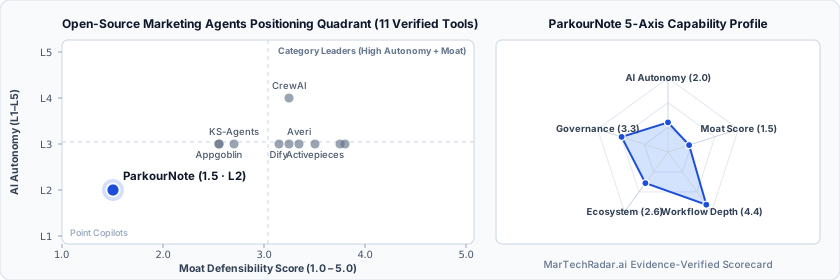
ParkourNote in-depth review, pricing & architecture analysis
Editor sign-off: Oct 16, 2026. How profiles are made.
What is ParkourNote? Overview & background
Marketing engineering teams frequently struggle to standardize generative prompts across distributed content workflows without introducing brittle, hard-coded scripts. Headquartered in the United States, ParkourNote addresses this gap by providing an open-source marketing agent orchestration framework and structured prompt management environment. Designed for technical marketing operators, prompt engineers, and growth technologists, the platform centralizes prompt design, programmatic execution pipelines, and campaign logic into auditable repositories, providing teams with reproducible generative workflows across cross-functional marketing stacks.
How ParkourNote works: architecture & workflow
ParkourNote operates as an L2 assisted automation framework, combining declarative prompt templating with modular language model connectors. The ingestion layer consumes structured campaign briefs, product metadata, and audience parameters via JSON schemas or flat files, passing them into an orchestration graph. Here, prompts are dynamically populated with contextual variables and dispatched to configured model endpoints. Outputs are parsed through deterministic validation rules to ensure brand taxonomy adherence before staging drafts into review queues for final human verification and deployment.
ParkourNote limitations, drawbacks & risks
Operational considerations and platform boundaries include:
- Context Window Drift and Schema Maintenance: Complex prompt chains often suffer from variable schema drift when integrated with dynamic upstream product catalogs, requiring continuous manual maintenance of input definitions.
- Downstream API Rate Limiting: Synchronous batch generations trigger upstream LLM provider throttling and downstream content management API rate limits, as the core runner lacks distributed queuing mechanisms out of the box.
- Observability and Evaluation Latency: Lacking native real-time automated scoring harnesses, teams must build custom eval pipelines to detect model hallucination or brand voice degradation across high-volume batch executions.
ParkourNote pricing, plans & cost breakdown
Commercial access is structured around private enterprise licensing and professional services. Pricing is available on request through tailored enterprise sales quotes based on organizational scale, active administrative seats, and dedicated support requirements, while self-hosted foundational modules remain accessible through community open-source channels.
| Plan / Tier | Verified Price & Billing | Included Scope & Contract Terms |
|---|---|---|
| Enterprise / Custom | Custom quote | Custom-quoted plan; terms come from the vendor's sales team. |
How ParkourNote compares vs. competitors & alternatives
Within the marketing prompt and agent ecosystem, ParkourNote competes against frameworks such as Alphie, Appgoblin, and Arda. While Alphie emphasizes automated workflow execution and Arda focuses on specialized data enrichment architectures, ParkourNote prioritizes modular prompt portability and code-level transparency. Appgoblin concentrates on granular growth analytics scripts, whereas ParkourNote is suited for technical growth teams seeking customizable agent execution scaffolds without vendor-locked foundational layers.
Frequently asked questions about ParkourNote
Does ParkourNote publish pricing or require an enterprise quote?
ParkourNote pricing: Custom / enterprise pricing. No free plan is publicly disclosed. Commercial access is structured around private enterprise licensing and professional services.
What are the top ParkourNote alternatives in Open-Source Marketing Agents?
Verified Open-Source Marketing Agents alternatives include Drift (Custom / enterprise pricing), Appgoblin (From $99/mo), Alphie (Custom / enterprise pricing), HubSpot Breeze (Custom / enterprise pricing). Within the marketing prompt and agent ecosystem, ParkourNote competes against frameworks such as Alphie, Appgoblin, and Arda.
What are the main limitations and trade-offs of ParkourNote?
Operational considerations and platform boundaries include: Context Window Drift and Schema Maintenance: Complex prompt chains often suffer from variable schema drift when integrated with dynamic upstream product catalogs, requiring continuous manual maintenance of input definitions. Walk away if you need published self-serve pricing: ParkourNote is sold by custom quote.
Verified sources & evidence trail
- Official product domain: https://note.parkourlabs.io/
- Commercial pricing verification: Verified against official vendor pricing policy (Custom / enterprise pricing)
- Editor sign-off: Oct 16, 2026 (how profiles are made).
