Microsoft AutoGen Review (2026): AI Marketing Agent Pricing, Pros & Cons
Bottom line
Microsoft AutoGen is a Open Source Repo tool for AI Marketing Agent (Autonomous Marketing Agents & Digital Coworkers) in Agent & Marketing Ops. Pricing: Free. Best suited to B2B SaaS. Editor ratings: AI autonomy L3 (conditional automation); moat score 1.7/5.0 (Thin wrapper). Fact-checked by MarTechRadar Research Desk on Oct 15, 2026.
Open-source multi-agent programming framework from Microsoft Research for building cooperative LLM agents that plan, chat, and run code.
Is Microsoft AutoGen worth it in 2026? Buyer fit & when to walk away
Choose Microsoft AutoGen if (Best Fit)
- Target ICP & Stack Fit: You operate as B2B SaaS requiring a Open Source Repo deployment for AI Marketing Agent.
- L3 Architecture & Defensibility: Strong open-source developer community (61.7k+ GitHub stars) and multi-agent conversational design patterns, though Microsoft has archived the repository into maintenance-free reference status.
- Commercial Model Fit: Your procurement budget aligns with Free and want a self-serve free tier for zero-cost initial validation.
Walk away from Microsoft AutoGen if (Deal-Breakers)
- Walk away if your workflow cannot tolerate repo archived by microsoft: Microsoft has archived `microsoft/autogen` and no longer ships bug fixes, security patches, or new features, so teams must manage security risks on their own.
- Walk away if runaway token loops is a deal-breaker for your team: Back-and-forth agent chats can get stuck in long loops, burning through OpenAI or Anthropic API tokens and slowing down runs.
Microsoft AutoGen pricing, free plan & scorecard at a glance
| Pricing | Free |
|---|---|
| Free plan | Yes |
| Delivery | Open Source Repo |
| Audience | B2B SaaS |
| AI autonomy level | L3 · Conditional automationEditor-verified |
| Moat tier & score | 1.7 / 5.0 · Thin wrapperEditor-verified |
| Funding | Venture-backed |
| Headquarters | United States |
| Last verified | Oct 15, 2026 |
Microsoft AutoGen pros & cons: strengths vs. operational limitations
Pros: core strengths & capabilities
- Multi-agent conversation patterns: enabling autonomous inter-agent dialogue and task decomposition
- Sandboxed code execution environments: for verifiable script testing and automated debugging
- Dynamic human-in-the-loop intervention protocols: for programmatic approvals
- AutoGen Studio visual prototyping: interface and .NET / Python multi-language SDKs
Cons: operational limitations & risks
- Repo Archived by Microsoft: Microsoft has archived `microsoft/autogen` and no longer ships bug fixes, security patches, or new features, so teams must manage security risks on their own.
- Runaway Token Loops: Back-and-forth agent chats can get stuck in long loops, burning through OpenAI or Anthropic API tokens and slowing down runs.
- Requires Coding Skills: Unlike no-code marketing tools, AutoGen is a Python and .NET code library that needs custom scripts, Docker sandboxes, and API key setup.
Microsoft AutoGen TCO & deal-breaker stress test
Simulate 12-month stepped TCO, hidden cost multipliers, contract lock-in exposure, and stack failure modes using only facts verified by MarTechRadar Research Desk on 2026-10-15.
Microsoft AutoGen aligns with your 5-seat / $800/mo profile. Review the walk-away triggers and contract levers below before deployment.
- Moat Score
- 1.7 / 5.0
- AI Autonomy
- L3
- Free Tier / Trial
- Free plan
Triggered audit signals & failure modes
- Published Self-Serve Entry FloorVerified Pricing Ledger
Microsoft AutoGen publishes a transparent entry point (Free) with a free tier for initial validation before committing.
- Primary Operational Bottleneck: Repo Archived by MicrosoftAudit by MarTechRadar Research Desk
Microsoft has archived `microsoft/autogen` and no longer ships bug fixes, security patches, or new features, so teams must manage security risks on their own.
Test a custom Microsoft AutoGen budget or stack constraint
Fits within $800/mo budget (From $149/mo)
Offers a free tier (Custom / enterprise pricing)
Microsoft AutoGen AI moat & AI Marketing Agent positioning
Strong open-source developer community (61.7k+ GitHub stars) and multi-agent conversational design patterns, though Microsoft has archived the repository into maintenance-free reference status.
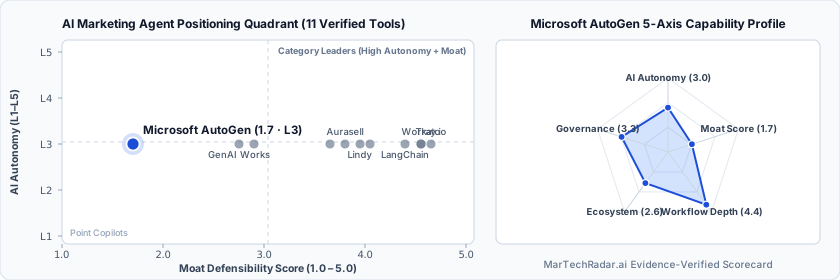
Microsoft AutoGen in-depth review, pricing & architecture analysis
Editor sign-off: Oct 15, 2026. How profiles are made.
What is Microsoft AutoGen? Overview & background
Created by Microsoft Research in the United States, Microsoft AutoGen (github.com/microsoft/autogen, 61.7k+ GitHub stars) is an open-source framework for building multi-agent AI apps. It serves software engineers, AI builders, and technical marketing ops teams. Teams use it when they want multiple LLM agents to work together on code, data analysis, and research tasks. Note that Microsoft has archived the repository as a reference project with no active upkeep.
How Microsoft AutoGen works: architecture & workflow
Operating at Level 3 (L3) autonomy, AutoGen lets developers set up distinct agents—such as planners, Python coders, critics, and human proxy agents—that solve tasks by chatting with each other. A manager agent breaks a big goal into smaller steps and passes messages between workers. It then runs Python or .NET code inside Docker or local sandboxes. Builders can also use AutoGen Studio to test multi-agent flows visually and add human approval steps.
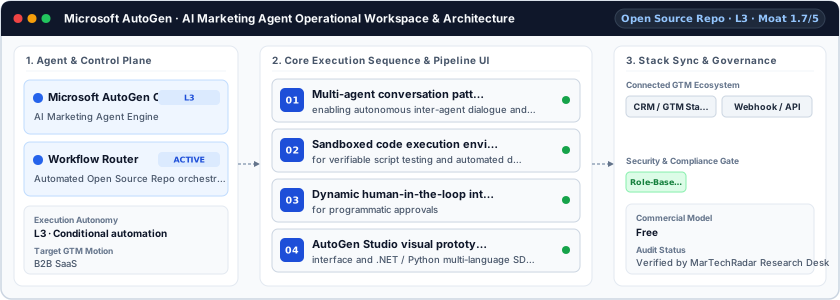
Microsoft AutoGen limitations, drawbacks & risks
Limitations and trade-offs to weigh before choosing Microsoft AutoGen:
- Repo Archived by Microsoft: Microsoft has archived
microsoft/autogenand no longer ships bug fixes, security patches, or new features, so teams must manage security risks on their own. - Runaway Token Loops: Back-and-forth agent chats can get stuck in long loops, burning through OpenAI or Anthropic API tokens and slowing down runs.
- Requires Coding Skills: Unlike no-code marketing tools, AutoGen is a Python and .NET code library that needs custom scripts, Docker sandboxes, and API key setup.
Microsoft AutoGen pricing, plans & cost breakdown
Microsoft AutoGen is free, open-source software on GitHub with no license fees or paid sales plans. Users pay only their own cloud server costs and third-party LLM API bills (such as Azure OpenAI, OpenAI, or Anthropic).
| Plan / Tier | Verified Price & Billing | Included Scope & Contract Terms |
|---|---|---|
| Free / Sandbox | $0 | Free plan or free tier offered by the vendor. |
How Microsoft AutoGen compares vs. competitors & alternatives
In multi-agent AI tools and workflow builders, Microsoft AutoGen competes against code libraries like LangGraph, CrewAI, and Semantic Kernel, plus low-code builders like n8n, Gumloop, and Relevance AI. Because Microsoft has archived the AutoGen repo, teams starting new projects today often pick active tools like LangGraph, CrewAI, or Semantic Kernel instead.
Frequently asked questions about Microsoft AutoGen
Does Microsoft AutoGen publish pricing or require an enterprise quote?
Microsoft AutoGen pricing: Free. A permanent free plan is available. Microsoft AutoGen is free, open-source software on GitHub with no license fees or paid sales plans. Users pay only their own cloud server costs and third-party LLM API bills (such as Azure OpenAI, OpenAI, or Anthropic).
What are the top Microsoft AutoGen alternatives in AI Marketing Agent?
Verified AI Marketing Agent alternatives include CrewAI (Custom / enterprise pricing), LangChain (Custom / enterprise pricing), Menteo (From $149/mo), Micro (Usage-based pricing). In multi-agent AI tools and workflow builders, Microsoft AutoGen competes against code libraries like LangGraph, CrewAI, and Semantic Kernel, plus low-code builders like n8n, Gumloop, and Relevance AI.
What are the main limitations and trade-offs of Microsoft AutoGen?
Limitations and trade-offs to weigh before choosing Microsoft AutoGen: Repo Archived by Microsoft: Microsoft has archived `microsoft/autogen` and no longer ships bug fixes, security patches, or new features, so teams must manage security risks on their own. Walk away if your workflow cannot tolerate repo archived by microsoft: Microsoft has archived `microsoft/autogen` and no longer ships bug fixes, security patches, or new features, so teams must manage security risks on their own.
Verified sources & evidence trail
- Official product domain: https://github.com/microsoft/autogen
- Commercial pricing verification: Verified against official vendor pricing policy (Free)
- Editor sign-off: Oct 15, 2026 (how profiles are made).
