Tray.io Review (2026): AI Marketing Agent Pricing, Pros & Cons
Bottom line
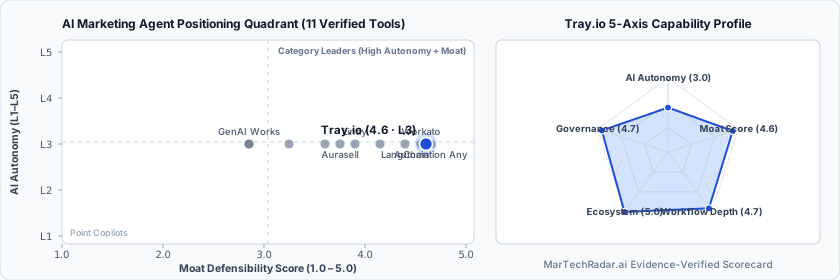
Tray.io is a Web SaaS tool for AI Marketing Agent (Autonomous Marketing Agents & Digital Coworkers) in Agent & Marketing Ops. Pricing: Custom / enterprise pricing. Best suited to B2B SaaS, DTC / eCommerce and Enterprise Brands. Editor ratings: AI autonomy L3 (conditional automation); moat score 4.6/5.0 (Proprietary moat (category leader)). Fact-checked by MarTechRadar Research Desk on Oct 14, 2026.
Enterprise integration and automation platform orchestrating autonomous agent workflows, API integrations, and low-code data operations across GTM stacks.
Is Tray.io worth it in 2026? Buyer fit & when to walk away
Choose Tray.io if (Best Fit)
- Target ICP & Stack Fit: You operate as B2B SaaS, DTC / eCommerce and Enterprise Brands requiring a Web SaaS deployment for AI Marketing Agent, with verified ecosystem connectivity for Salesforce, HubSpot, Slack, Snowflake.
- L3 Architecture & Defensibility: Tray.io pairs an established integration substrate of 700+ connectors with a governed runtime (Helix) supporting modern AI development interfaces like Model Context Protocol (MCP) and developer CLIs, bridging deterministic enterprise iPaaS with non-deterministic agent workflows.
- Commercial Model Fit: Your procurement budget aligns with Custom / enterprise pricing.
Walk away from Tray.io if (Deal-Breakers)
- Walk away if you need published self-serve pricing: Tray.io is sold by custom quote.
- Walk away if your workflow cannot tolerate large batch timeouts: Deeply branched workflows with heavy JSON loops can hit speed limits or timeouts during huge batch data syncs.
- Walk away if custom API upkeep is a deal-breaker for your team: While 700+ connectors come built in, internal company APIs still need custom REST setup and schema fixes when endpoints change.
Tray.io pricing, free plan & scorecard at a glance
| Pricing | Custom / enterprise pricing |
|---|---|
| Free plan | No / not disclosed |
| Delivery | Web SaaS |
| Audience | B2B SaaS, DTC / eCommerce, Enterprise Brands |
| AI autonomy level | L3 · Conditional automationEditor-verified |
| Moat tier & score | 4.6 / 5.0 · Proprietary moat (category leader)Editor-verified |
| Funding | Undisclosed |
| Total funding | $149.1M |
| Founders | Alistair Russell, Dominic Lewis, Rich Waldron |
| Company size | 201-500 employees |
| Ecosystem integrations | Salesforce, HubSpot, Slack, Snowflake, WordPress, Adobe Marketo |
| Compliance & governance | HIPAA |
| Governance & docs | Trust & Security ↗ · System Status ↗ · Changelog ↗ · DPA ↗ · Terms ↗ · Privacy ↗ |
| Headquarters | San Francisco, California |
| Founded | 2012 |
| Last verified | Oct 14, 2026 |
Tray.io pros & cons: strengths vs. operational limitations
Pros: core strengths & capabilities
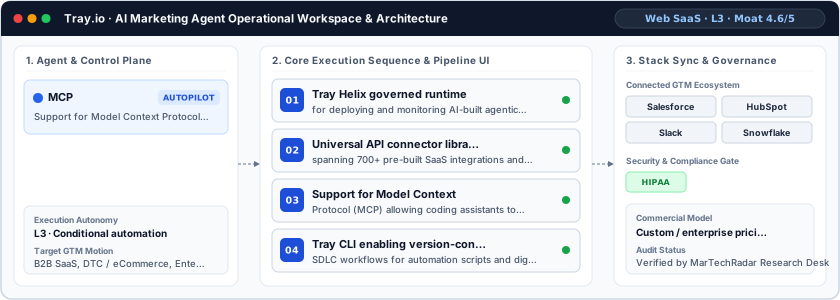
- Tray Helix governed runtime: for deploying and monitoring AI-built agentic applications
- Universal API connector library: spanning 700+ pre-built SaaS integrations and custom endpoints
- Support for Model Context: Protocol (MCP) allowing coding assistants to interface with enterprise tools
- Tray CLI enabling version-controlled: SDLC workflows for automation scripts and digital coworkers
Cons: operational limitations & risks
- Large Batch Timeouts: Deeply branched workflows with heavy JSON loops can hit speed limits or timeouts during huge batch data syncs.
- Custom API Upkeep: While 700+ connectors come built in, internal company APIs still need custom REST setup and schema fixes when endpoints change.
- Downstream Rate Caps: Fast AI agent loops can hit strict per-minute API rate limits on connected CRM or LLM accounts, pausing queued tasks.
Tray.io TCO & deal-breaker stress test
Simulate 12-month stepped TCO, hidden cost multipliers, contract lock-in exposure, and stack failure modes using only facts verified by MarTechRadar Research Desk on 2026-10-14.
Tray.io triggers high-severity friction under your 5-seat / $800/mo constraints. Benchmark the verified subtrack alternatives below before committing.
- Moat Score
- 4.6 / 5.0
- AI Autonomy
- L3
- Free Tier / Trial
- None disclosed
Triggered audit signals & failure modes
- Opaque Enterprise Quoting vs. SMB/Mid-Market BudgetVerified Pricing Ledger
Tray.io does not disclose a public self-serve floor (Custom / enterprise pricing). Buyers with a $800/mo cap face high sales-qualification friction.
- Sales-Gated Contract TermsFact-checked by MarTechRadar Research Desk
Tray.io sells custom annual contracts on request across three tiers: Pro (3 workspaces and Universal API Builder access), Team (up to 20 workspaces, multi-region hosting, and sandboxes), and Enterprise (unlimited workspaces, SSO/SAML, HIPAA controls, and 24/7 support), plus optional Tray Helix and MCP Agent Gateway add-ons.
- Usage / Credit Burn VolatilityCommercial Model Audit
Tray.io uses credit or usage-metered billing (Custom / enterprise pricing). High-volume automated workflows across 5 seats can trigger mid-cycle overage charges.
- Primary Operational Bottleneck: Large Batch TimeoutsAudit by MarTechRadar Research Desk
Deeply branched workflows with heavy JSON loops can hit speed limits or timeouts during huge batch data syncs.
Test a custom Tray.io budget or stack constraint
Lower 5-seat floor (~$100/mo vs. Custom Quote) · Transparent self-serve entry without mandatory annual lock-in
Lower 5-seat floor (~$20/mo vs. Custom Quote) · Transparent self-serve entry without mandatory annual lock-in
Tray.io integrations, API, security & compliance stack
Support for Model Context Protocol allowing coding assistants to interface with enterprise tools
Tray.io AI moat & AI Marketing Agent positioning
Tray.io pairs an established integration substrate of 700+ connectors with a governed runtime (Helix) supporting modern AI development interfaces like Model Context Protocol (MCP) and developer CLIs, bridging deterministic enterprise iPaaS with non-deterministic agent workflows.
Tray.io in-depth review, pricing & architecture analysis
Editor sign-off: Oct 14, 2026. How profiles are made.
What is Tray.io? Overview & background
Founded in 2012 and based in San Francisco, California, Tray.io (now operating as Tray.ai at tray.ai) is an enterprise iPaaS and AI workflow platform backed by $149.1M in total funding. Built for IT architects, rev-ops leads, and technical marketing teams, the platform connects deterministic APIs with LLM agents across multi-step business data pipelines.
How Tray.io works: architecture & workflow
At Level 3 autonomy, Tray.io runs an event-driven workflow engine with over 700 pre-built SaaS connectors and webhook listeners. Its managed AI runtime, Tray Helix, works with the Tray CLI and an Agent Gateway that supports the Model Context Protocol (MCP). Incoming data events are cleaned and routed through logic branches where AI agents call approved API tools, transform JSON data, and write updates with rollback safety. Native links connect with Salesforce, HubSpot, Slack, Snowflake, WordPress, Marketo, and Zendesk under HIPAA controls.
Tray.io limitations, drawbacks & risks
Key platform limits and trade-offs include:
- Large Batch Timeouts: Deeply branched workflows with heavy JSON loops can hit speed limits or timeouts during huge batch data syncs.
- Custom API Upkeep: While 700+ connectors come built in, internal company APIs still need custom REST setup and schema fixes when endpoints change.
- Downstream Rate Caps: Fast AI agent loops can hit strict per-minute API rate limits on connected CRM or LLM accounts, pausing queued tasks.
Tray.io pricing, plans & cost breakdown
Tray.io sells custom annual contracts on request across three tiers: Pro (3 workspaces and Universal API Builder access), Team (up to 20 workspaces, multi-region hosting, and sandboxes), and Enterprise (unlimited workspaces, SSO/SAML, HIPAA controls, and 24/7 support), plus optional Tray Helix and MCP Agent Gateway add-ons. Pricing scales by annual task volume and compute usage rather than per-seat fees.
| Plan / Tier | Verified Price & Billing | Included Scope & Contract Terms |
|---|---|---|
| Enterprise / Custom | Custom quote | Custom-quoted plan; terms come from the vendor's sales team. |
How Tray.io compares vs. competitors & alternatives
In the enterprise iPaaS and AI automation market, Tray.io competes with Workato, Zapier, Make, n8n, and Activepieces. Self-serve tools like Zapier and Make offer low-cost entry plans for simple task zaps. Tray.io stands out with its governed Tray Helix AI runtime, MCP Agent Gateway, and Git-based CLI controls for mid-market and enterprise IT and RevOps teams.
Direct competitors & market radar
Top algorithmic competitors based on category positioning, capability overlap, and ICP alignment.
Frequently asked questions about Tray.io
Does Tray.io (Tray.ai) publish self-serve monthly pricing in 2026?
No. Tray.ai sells sales-quoted annual contracts across Pro (3 workspaces), Team (up to 20 workspaces and regional data residency), and Enterprise (unlimited workspaces, SSO/SAML, HIPAA, and 24/7 support), with optional Tray Helix and Agent Gateway for MCP modules.
When should RevOps pick Make, Activepieces, or Workato over Tray.io?
Pick Make (Free; $12–$38/mo) or Activepieces (Free; $20/mo for 5 users; $200/mo for 25 users + SSO, MIT open-source) when you want transparent self-serve workflows under $200/mo. Benchmark Workato (Free sandbox; $100/mo entry + enterprise recipes) when comparing governed IT-grade iPaaS suites.
Verified sources & evidence trail
- Official product domain: https://tray.io
- Commercial pricing verification: Verified against official vendor pricing policy (Custom / enterprise pricing)
- Verified corporate entity profiles (
sameAs): LinkedIn Company Profile · Crunchbase Entity Record - First-party governance & documentation links: Trust & Security · System Status · Changelog · DPA · Terms · Privacy
- Editor sign-off: Oct 14, 2026 (how profiles are made).
