Loops Review (2026): Email Marketing Pricing, Pros & Cons
Bottom line
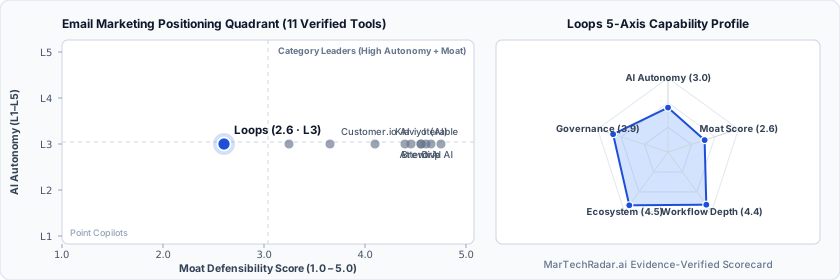
Loops is a Web SaaS tool for Email Marketing (AI Email Marketing & Lifecycle Journeys) in Lifecycle & CDP. Pricing: Free plan · From $49/mo · Enterprise plan. Editor ratings: AI autonomy L3 (conditional automation); moat score 2.6/5.0 (Workflow-embedded). Fact-checked by MarTechRadar Research Desk on Oct 26, 2026.
AI-ready email sending platform unifying marketing broadcasts, behavioral product lifecycle journeys, and transactional API email for SaaS teams.
Is Loops worth it in 2026? Buyer fit & when to walk away
Choose Loops if (Best Fit)
- Target ICP & Stack Fit: You operate as Email Marketing teams requiring a Web SaaS deployment for Email Marketing, with verified ecosystem connectivity for Twilio Segment, Notion, Stripe.
- L3 Architecture & Defensibility: Loops builds a strong developer-and-product email moat for SaaS companies through its unified marketing-plus-transactional architecture, agent-accessible REST API, and $3.2M Seed backing from Craft Ventures, Y Combinator, and BoxGroup.
- Commercial Model Fit: Your procurement budget aligns with Free plan · From $49/mo · Enterprise plan and want a self-serve free tier for zero-cost initial validation.
Walk away from Loops if (Deal-Breakers)
- Walk away if your workflow requires uncapped enterprise volume on the Free plan · From $49/mo · Enterprise plan entry plan without upgrading tiers.
- Walk away if your workflow cannot tolerate primary operational trade-off: In practical deployments, the primary trade-off is that Loops is intentionally streamlined around SaaS product events and clean email typography, meaning it lacks the complex multi-object relational database schemas and branching visual canvas depth found in heavyweight enterprise marketing clouds.
- Walk away if functional scope boundary is a deal-breaker for your team: Loops is not built for D2C e-commerce merchants requiring native Shopify cart-abandonment product grids, SMS coupon broadcasting, or brick-and-mortar POS loyalty tracking.
Loops pricing, free plan & scorecard at a glance
| Pricing | Free plan · From $49/mo · Enterprise planVendor pricing page |
|---|---|
| Free plan | Yes |
| Delivery | Web SaaS |
| Audience | — |
| AI autonomy level | L3 · Conditional automationEditor-verified |
| Moat tier & score | 2.6 / 5.0 · Workflow-embeddedEditor-verified |
| Funding | Seed |
| Total funding | $3.2MBacked by BoxGroup, SV Angel, Craft Ventures, Y Combinator, Liquid 2 Ventures |
| Founders | Adam Kaczmarek, Chris Frantz |
| Company size | 2-10 employees |
| Ecosystem integrations | Twilio Segment, Notion, Stripe |
| Headquarters | Beaverton, Oregon, United States |
| Founded | 2022 |
| Last verified | Oct 26, 2026 |
Loops pros & cons: strengths vs. operational limitations
Pros: core strengths & capabilities
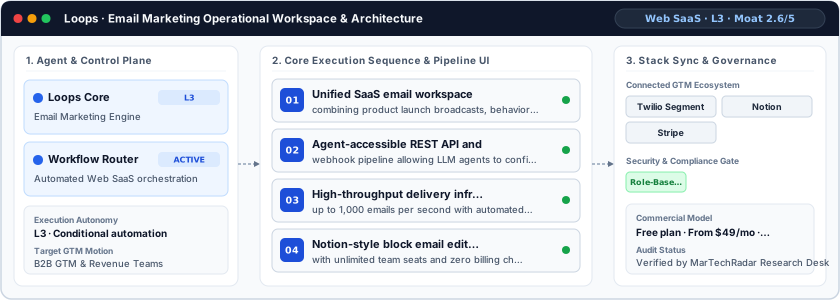
- Unified SaaS email workspace: combining product launch broadcasts, behavioral onboarding journeys, and transactional API receipts
- Agent-accessible REST API and: webhook pipeline allowing LLM agents to configure workflows, segments, and JSON payloads autonomously
- High-throughput delivery infrastructure scaling: up to 1,000 emails per second with automated DKIM/SPF authentication
- Notion-style block email editor: with unlimited team seats and zero billing charges for unsubscribed contacts
Cons: operational limitations & risks
- Primary Operational Trade-Off: In practical deployments, the primary trade-off is that Loops is intentionally streamlined around SaaS product events and clean email typography, meaning it lacks the complex multi-object relational database schemas and branching visual canvas depth found in heavyweight enterprise marketing clouds.
- Functional Scope Boundary: Loops is not built for D2C e-commerce merchants requiring native Shopify cart-abandonment product grids, SMS coupon broadcasting, or brick-and-mortar POS loyalty tracking.
- Deployment & Governance Considerations: Additionally, because behavioral lifecycle triggers rely on clean event telemetry from the host application or Segment/Stripe webhooks, engineering teams must instrument consistent user event properties during onboarding to avoid misfired automation loops.
Loops TCO & deal-breaker stress test
Simulate 12-month stepped TCO, hidden cost multipliers, contract lock-in exposure, and stack failure modes using only facts verified by MarTechRadar Research Desk on 2026-10-26 · Capture SHA 530d3b8b.
Loops aligns with your 5-seat / $800/mo profile. Review the walk-away triggers and contract levers below before deployment.
- Moat Score
- 2.6 / 5.0
- AI Autonomy
- L3
- Free Tier / Trial
- Free plan
Triggered audit signals & failure modes
- Published Self-Serve Entry FloorVerified Pricing Ledger
Loops publishes a transparent entry point (Free plan · From $49/mo · Enterprise plan) with a free tier for initial validation before committing.
- Primary Operational Bottleneck: Primary Operational Trade-OffAudit by MarTechRadar Research Desk
In practical deployments, the primary trade-off is that Loops is intentionally streamlined around SaaS product events and clean email typography, meaning it lacks the complex multi-object relational database schemas and branching visual canvas depth found in heavyweight enterprise marketing clouds.
Test a custom Loops budget or stack constraint
Lower 5-seat floor (~$14/mo vs. From $49 / mo)
Fits within $800/mo budget (Free plan · $49–$95/mo · Enterprise plan)
Loops integrations, API, security & compliance stack
Loops AI moat & Email Marketing positioning
Loops builds a strong developer-and-product email moat for SaaS companies through its unified marketing-plus-transactional architecture, agent-accessible REST API, and $3.2M Seed backing from Craft Ventures, Y Combinator, and BoxGroup.
Loops in-depth review, pricing & architecture analysis
Audited by MarTechRadar Research Desk (Evidence-Ledger Verified) on Oct 26, 2026.
What is Loops? Overview & background
Loops is an AI-ready email marketing, product lifecycle, and transactional sending platform built specifically for SaaS founders, product growth engineers, and lifecycle marketers. Founded in 2022 by Adam Kaczmarek and Chris Frantz and headquartered in Beaverton, Oregon, the Y Combinator alumnus operates with a lean team of 2 to 10 employees and has raised $3.2M in Seed funding backed by BoxGroup, SV Angel, Craft Ventures, Y Combinator, and Liquid 2 Ventures. The platform consolidates waitlist management, product release newsletters, behavioral onboarding sequences, and API-triggered transactional receipts into a single workspace, while running active paid acquisition on X (Twitter) Ads targeting software teams searching for a modern saas email marketing platform, transactional and lifecycle email software, and loops email alternatives.
How Loops works: architecture & workflow
At the technical core of Loops is an event-driven email orchestration architecture and a developer-first REST API pipeline that allows both human marketers and autonomous AI agents to configure lifecycle workflows programmatically. An LLM or coding agent can interact directly with the Loops API integration to create an onboarding workflow triggered when a contact is added, configure a payment receipt transactional email with dynamic JSON payload variables, schedule a product launch broadcast to an active customer segment, and stage a win-back workflow as a draft. The underlying sending model supports burst throughput of up to 1,000 emails per second on paid tiers while automatically managing domain authentication, DKIM/SPF records, and suppression lists to protect inbox deliverability.
Loops limitations, drawbacks & risks
Operational considerations and platform boundaries include:
- Primary Operational Trade-Off: In practical deployments, the primary trade-off is that Loops is intentionally streamlined around SaaS product events and clean email typography, meaning it lacks the complex multi-object relational database schemas and branching visual canvas depth found in heavyweight enterprise marketing clouds.
- Functional Scope Boundary: Loops is not built for D2C e-commerce merchants requiring native Shopify cart-abandonment product grids, SMS coupon broadcasting, or brick-and-mortar POS loyalty tracking.
- Deployment & Governance Considerations: Additionally, because behavioral lifecycle triggers rely on clean event telemetry from the host application or Segment/Stripe webhooks, engineering teams must instrument consistent user event properties during onboarding to avoid misfired automation loops.
Loops pricing, plans & cost breakdown
Loops publishes transparent, contact-based pricing on its official pricing page (loops.so/pricing) with all core features unlocked on every plan and zero per-seat charges. The Free tier costs $0 per month and includes up to 1,000 subscribed contacts, 4,000 total marketing and transactional sends per rolling 30-day window, and up to 10 emails per second with a Powered by Loops footer. The Growth tier starts at $49 per month for up to 5,000 subscribed contacts, removing Loops branding and unlocking unlimited marketing sends, unlimited transactional sends, and throughput up to 1,000 emails per second, while custom Enterprise plans support 1.5 million+ contacts with dedicated migration support.
| Plan / Tier | Verified Price & Billing | Target Seat / Scale Fit | Included Scope & Contract Terms |
|---|---|---|---|
| Free / Sandbox | $0 | 1–2 seats (Evaluation) | Entry free tier with capped usage or feature quotas for initial workflow testing. |
| Growth | $49/mo | 1–2 seats | Verified $49/mo Growth tier from vendor pricing schedule. |
| Enterprise / Custom | Custom quote | 15–50+ seats (Enterprise SLA) | Sales-negotiated annual contract for custom volume, SSO/RBAC governance, and dedicated SLA. |
| Contract Watchout: Profile / Workspace Quota Ceilings | Base tiers cap the number of connected profiles, workspaces, or contact records, forcing tier upgrades before seat limits are reached. | ||
How Loops compares vs. competitors & alternatives
In the SaaS lifecycle and transactional email market, Loops competes with Customer.io, Resend, Postmark, and Intercom within the SaaS Email Marketing segment, alongside verified subtrack peers such as MessageGears and Beehiiv. Compared to legacy stacks that force startups to maintain Mailchimp for newsletters alongside SendGrid for transactional receipts, Loops differentiates itself by unifying marketing, lifecycle, and transactional sending in one agent-accessible API platform. Early-stage through growth-stage SaaS teams should evaluate Loops to consolidate their email stack and ship product-triggered lifecycle journeys faster.
Frequently asked questions about Loops
How much does Loops cost in 2026?
Loops pricing: Free plan · From $49/mo · Enterprise plan. A permanent free plan is available. Published tiers: Free / Sandbox ($0); Growth ($49/mo); Enterprise / Custom (Custom quote). Loops publishes transparent, contact-based pricing on its official pricing page (`loops.so/pricing`) with all core features unlocked on every plan and zero per-seat charges.
What are the top Loops alternatives in Email Marketing?
Verified Email Marketing alternatives include MessageGears (Pricing not disclosed), beehiiv (Free plan · $49–$95/mo · Enterprise plan), Campaigner (From $14/mo), Zaymo (From $170/mo). In the SaaS lifecycle and transactional email market, Loops competes with Customer.io, Resend, Postmark, and Intercom within the SaaS Email Marketing segment, alongside verified subtrack peers such as MessageGears and Beehiiv.
Verified sources & evidence trail
- Official product domain: https://loops.so
- Commercial pricing verification: https://loops.so/pricing
- Verified corporate entity profiles (
sameAs): LinkedIn Company Profile · Crunchbase Entity Record - Editorial audit sign-off: Audited by MarTechRadar Research Desk (Evidence-Ledger Verified) on Oct 26, 2026.
