MessageGears Review (2026): Email Marketing Pricing, Pros & Cons
Bottom line
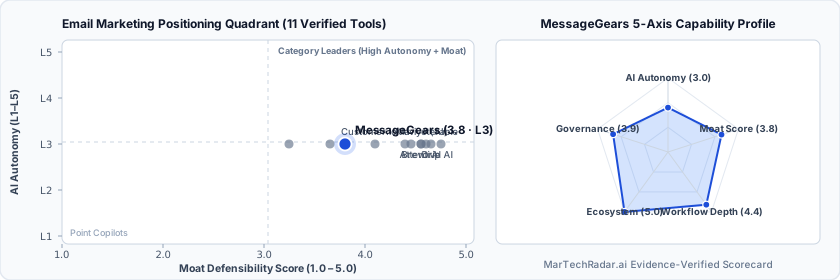
MessageGears is a Web SaaS tool for Email Marketing (AI Email Marketing & Lifecycle Journeys) in Lifecycle & CDP. Pricing: Pricing not disclosed. Editor ratings: AI autonomy L3 (conditional automation); moat score 3.8/5.0 (Proprietary moat). Fact-checked by MarTechRadar Research Desk on Oct 26, 2026.
Warehouse-native cross-channel customer engagement and email marketing platform activating live enterprise data directly from cloud data warehouses.
Is MessageGears worth it in 2026? Buyer fit & when to walk away
Choose MessageGears if (Best Fit)
- Target ICP & Stack Fit: You operate as Email Marketing teams requiring a Web SaaS deployment for Email Marketing, with verified ecosystem connectivity for Snowflake, Google BigQuery, Databricks, Amazon Redshift.
- L3 Architecture & Defensibility: MessageGears holds a strong enterprise lifecycle marketing moat through its zero-copy warehouse-native architecture for Snowflake, Databricks, BigQuery, and Redshift, backed by $88M in growth capital from Long Ridge Equity Partners and Argentum Capital.
- Commercial Model Fit: Your procurement budget aligns with Pricing not disclosed.
Walk away from MessageGears if (Deal-Breakers)
- Walk away if you require transparent self-serve monthly billing or your budget ceiling is under $1,000/mo (MessageGears requires sales-gated custom quoting).
- Walk away if your workflow cannot tolerate primary operational trade-off: In practical enterprise deployments, the primary trade-off is that MessageGears requires an existing modern cloud data warehouse such as Snowflake, Databricks, BigQuery, or Redshift to serve as its underlying customer database, meaning organizations without centralized warehouse tables cannot deploy it as a standalone database.
- Walk away if functional scope boundary is a deal-breaker for your team: MessageGears is not built for small business newsletter blogging, cold B2B outbound sales prospecting, or social media creator management.
MessageGears pricing, free plan & scorecard at a glance
| Pricing | Pricing not disclosed |
|---|---|
| Free plan | No / not disclosed |
| Delivery | Web SaaS |
| Audience | — |
| AI autonomy level | L3 · Conditional automationEditor-verified |
| Moat tier & score | 3.8 / 5.0 · Proprietary moatEditor-verified |
| Funding | Venture-backed |
| Total funding | $88MBacked by Long Ridge Equity Partners, Argentum Capital For Growth, Atlanta Ventures, Bridge Bank, Michael Cohn |
| Founders | Dan Roy, Michael Robinson, Taylor Jones |
| Company size | 51-200 employees |
| Ecosystem integrations | Snowflake, Google BigQuery, Databricks, Amazon Redshift, Google Ads |
| Headquarters | Atlanta, Georgia, United States |
| Founded | 2010 |
| Last verified | Oct 26, 2026 |
MessageGears pros & cons: strengths vs. operational limitations
Pros: core strengths & capabilities
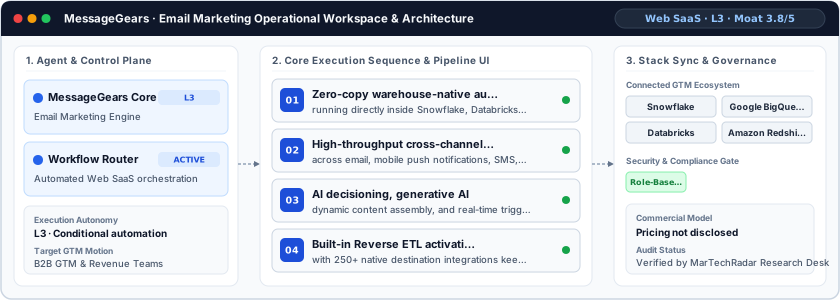
- Zero-copy warehouse-native audience segmentation: running directly inside Snowflake, Databricks, Google BigQuery, and Amazon Redshift
- High-throughput cross-channel campaign orchestration: across email, mobile push notifications, SMS, and web personalization
- AI decisioning, generative AI: dynamic content assembly, and real-time trigger experimentation without CDP data sync latency
- Built-in Reverse ETL activation pipeline: with 250+ native destination integrations keeping sensitive PII inside the enterprise cloud perimeter
Cons: operational limitations & risks
- Primary Operational Trade-Off: In practical enterprise deployments, the primary trade-off is that MessageGears requires an existing modern cloud data warehouse such as Snowflake, Databricks, BigQuery, or Redshift to serve as its underlying customer database, meaning organizations without centralized warehouse tables cannot deploy it as a standalone database.
- Functional Scope Boundary: MessageGears is not built for small business newsletter blogging, cold B2B outbound sales prospecting, or social media creator management.
- Deployment & Governance Considerations: Additionally, initial implementation requires coordinated collaboration between IT security, cloud data warehouse administrators, and lifecycle marketing teams to configure in-place compute permissions, IP warming schedules, and schema governance.
MessageGears TCO & deal-breaker stress test
Simulate 12-month stepped TCO, hidden cost multipliers, contract lock-in exposure, and stack failure modes using only facts verified by MarTechRadar Research Desk on 2026-10-26.
MessageGears triggers high-severity friction under your 5-seat / $800/mo constraints. Benchmark the verified subtrack alternatives below before committing.
- Moat Score
- 3.8 / 5.0
- AI Autonomy
- L3
- Free Tier / Trial
- None disclosed
Triggered audit signals & failure modes
- Opaque Enterprise Quoting vs. SMB/Mid-Market BudgetVerified Pricing Ledger
MessageGears does not disclose a public self-serve floor (Pricing not disclosed). Buyers with a $800/mo cap face high sales-qualification friction.
- Sales-Gated Contract TermsFact-checked by MarTechRadar Research Desk
Pricing available on request.
- Primary Operational Bottleneck: Primary Operational Trade-OffAudit by MarTechRadar Research Desk
In practical enterprise deployments, the primary trade-off is that MessageGears requires an existing modern cloud data warehouse such as Snowflake, Databricks, BigQuery, or Redshift to serve as its underlying customer database, meaning organizations without centralized warehouse tables cannot deploy it as a standalone database.
Test a custom MessageGears budget or stack constraint
Lower 5-seat floor (~$49/mo vs. Custom Quote) · Transparent self-serve entry without mandatory annual lock-in
Lower 5-seat floor (~$49/mo vs. Custom Quote) · Transparent self-serve entry without mandatory annual lock-in
MessageGears integrations, API, security & compliance stack
MessageGears AI moat & Email Marketing positioning
MessageGears holds a strong enterprise lifecycle marketing moat through its zero-copy warehouse-native architecture for Snowflake, Databricks, BigQuery, and Redshift, backed by $88M in growth capital from Long Ridge Equity Partners and Argentum Capital.
MessageGears in-depth review, pricing & architecture analysis
Audited by MarTechRadar Research Desk (Evidence-Ledger Verified) on Oct 26, 2026.
What is MessageGears? Overview & background
MessageGears is a warehouse-native cross-channel marketing and customer engagement platform built for enterprise Chief Marketing Officers, lifecycle marketing directors, and data engineering leaders at consumer brands with millions of customer profiles. Founded in 2010 by Dan Roy, Michael Robinson, and Taylor Jones and headquartered in Atlanta, Georgia, the company operates with 51 to 200 employees and has raised $88M in venture and growth funding backed by Long Ridge Equity Partners, Argentum Capital For Growth, Atlanta Ventures, Bridge Bank, and Michael Cohn. It solves the chronic data-sync latency and security exposure of legacy marketing clouds by connecting directly to an enterprise's internal cloud data warehouse, while running active Google Ads campaigns targeting buyers searching for a warehouse native email marketing platform, enterprise cross-channel marketing software, and MessageGears alternatives.
How MessageGears works: architecture & workflow
At the technical core of MessageGears is a hybrid warehouse-native architecture where the audience segmentation and personalization pipeline executes directly inside the customer's own Snowflake, Databricks, Google BigQuery, or Amazon Redshift environment. Because SQL and visual audience queries run in place against live first-party tables, zero data synchronization lag occurs between a transaction happening in the warehouse and a triggered campaign firing. The platform's AI decisioning model and generative AI content engine dynamically assemble personalized email, mobile push, and SMS payloads at high throughput via a cloud delivery API and over 250 native data activation integration connectors. By keeping personally identifiable information inside the client's governed cloud perimeter until the exact moment of message rendering, the workflow satisfies strict enterprise data residency and privacy mandates.
MessageGears limitations, drawbacks & risks
Operational considerations and platform boundaries include:
- Primary Operational Trade-Off: In practical enterprise deployments, the primary trade-off is that MessageGears requires an existing modern cloud data warehouse such as Snowflake, Databricks, BigQuery, or Redshift to serve as its underlying customer database, meaning organizations without centralized warehouse tables cannot deploy it as a standalone database.
- Functional Scope Boundary: MessageGears is not built for small business newsletter blogging, cold B2B outbound sales prospecting, or social media creator management.
- Deployment & Governance Considerations: Additionally, initial implementation requires coordinated collaboration between IT security, cloud data warehouse administrators, and lifecycle marketing teams to configure in-place compute permissions, IP warming schedules, and schema governance.
MessageGears pricing, plans & cost breakdown
Pricing available on request. MessageGears structures its commercial engagements through custom multi-year enterprise contracts scoped during a consultative architecture review based on annual email, SMS, and mobile push delivery volumes, active warehouse connection modules, and dedicated IP infrastructure requirements.
| Plan / Tier | Verified Price & Billing | Target Seat / Scale Fit | Included Scope & Contract Terms |
|---|---|---|---|
| Enterprise / Custom | Custom quote | 15–50+ seats (Enterprise SLA) | Sales-negotiated annual contract for custom volume, SSO/RBAC governance, and dedicated SLA. |
| Contract Watchout: Primary Operational Trade-Off | In practical enterprise deployments, the primary trade-off is that MessageGears requires an existing modern cloud data warehouse such as Snowflake, Databricks, BigQuery, or Redshift to serve as its underlying customer database, meaning organizations without centralized warehouse tables cannot deploy it as a standalone database. | ||
How MessageGears compares vs. competitors & alternatives
In the enterprise lifecycle marketing and warehouse-native engagement market, MessageGears competes with Braze, Iterable, Salesforce Marketing Cloud, and Hightouch within the Lifecycle Marketing segment, alongside verified subtrack peers such as Loops and Beehiiv. Compared to traditional marketing clouds that require expensive CDP replication and hours of ETL syncing before campaigns can launch, MessageGears differentiates itself through direct zero-copy warehouse execution and combined cross-channel delivery plus Reverse ETL activation. Data-mature enterprise consumer brands should evaluate MessageGears to eliminate data-sync bottlenecks and scale real-time cross-channel personalization.
Frequently asked questions about MessageGears
Does MessageGears publish pricing or require an enterprise quote?
MessageGears pricing: Pricing not disclosed. No free plan is publicly disclosed. Pricing available on request.
What are the top MessageGears alternatives in Email Marketing?
Verified Email Marketing alternatives include Loops (Free plan · From $49/mo · Enterprise plan), beehiiv (Free plan · $49–$95/mo · Enterprise plan), Kit (ConvertKit) (Custom / enterprise pricing), AxleAuto.ai (Custom / enterprise pricing). In the enterprise lifecycle marketing and warehouse-native engagement market, MessageGears competes with Braze, Iterable, Salesforce Marketing Cloud, and Hightouch within the Lifecycle Marketing segment, alongside verified subtrack peers such as Loops and Beehiiv.
Verified sources & evidence trail
- Official product domain: https://messagegears.com
- Commercial pricing verification: Verified against official vendor pricing policy (Pricing not disclosed)
- Verified corporate entity profiles (
sameAs): LinkedIn Company Profile · Crunchbase Entity Record - Editorial audit sign-off: Audited by MarTechRadar Research Desk (Evidence-Ledger Verified) on Oct 26, 2026.
