Mailchimp Intuit Assist Review (2026): Email Marketing Pricing, Pros & Cons
Bottom line
Mailchimp Intuit Assist is a Web SaaS tool for Email Marketing (AI Email Marketing & Lifecycle Journeys) in Lifecycle & CDP. Pricing: $13–$350/mo. Best suited to DTC / eCommerce and Creators / Solo. Editor ratings: AI autonomy L3 (conditional automation); moat score 3.7/5.0 (Proprietary moat). Fact-checked by MarTechRadar Research Desk on Oct 10, 2026.
Embedded generative AI assistant within Mailchimp that synthesizes commerce data, generates multi-channel marketing campaigns, and automates subscriber.
Is Mailchimp Intuit Assist worth it in 2026? Buyer fit & when to walk away
Choose Mailchimp Intuit Assist if (Best Fit)
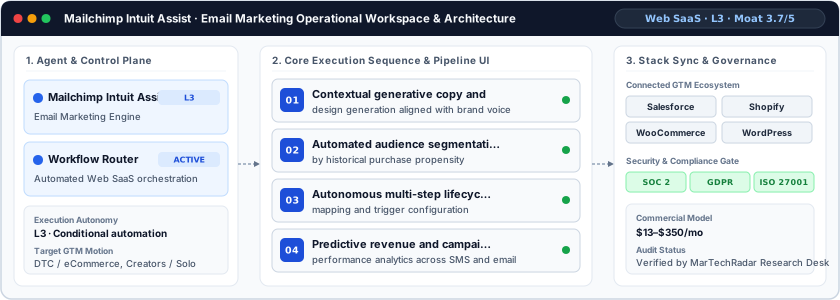
- Target ICP & Stack Fit: You operate as DTC / eCommerce and Creators / Solo requiring a Web SaaS deployment for Email Marketing, with verified ecosystem connectivity for Salesforce, Shopify, WooCommerce, WordPress.
- L3 Architecture & Defensibility: Integration within Intuit GenOS combining proprietary financial and commerce graphs from QuickBooks and connected e-commerce platforms with vast historical email engagement datasets.
- Commercial Model Fit: Your procurement budget aligns with $13–$350/mo.
Walk away from Mailchimp Intuit Assist if (Deal-Breakers)
- Walk away if your workflow cannot tolerate commerce schema rigidness: Generative recommendations depend on rigid transaction taxonomies, degrading synthesis quality when custom e-commerce database structures diverge from standard catalogs.
- Walk away if cross-platform event latency is a deal-breaker for your team: External webhook synchronization introduces processing lags that delay real-time behavioral automation triggers across high-velocity sales funnels.
Mailchimp Intuit Assist pricing, free plan & scorecard at a glance
| Pricing | $13–$350/moVendor pricing page |
|---|---|
| Free plan | No / not disclosed |
| Delivery | Web SaaS |
| Audience | DTC / eCommerce, Creators / Solo |
| AI autonomy level | L3 · Conditional automationEditor-verified |
| Moat tier & score | 3.7 / 5.0 · Proprietary moatEditor-verified |
| Funding | Acquired |
| Total funding | $12.0B |
| Ecosystem integrations | Salesforce, Shopify, WooCommerce, WordPress, Twilio Segment, Zapier |
| Compliance & governance | SOC 2, GDPR, ISO 27001 |
| Governance & docs | Trust & Security ↗ · System Status ↗ · API & Docs ↗ · Changelog ↗ · Terms ↗ |
| Headquarters | Atlanta, Georgia |
| Founded | 2001 |
| Last verified | Oct 10, 2026 |
Mailchimp Intuit Assist pros & cons: strengths vs. operational limitations
Pros: core strengths & capabilities
- Contextual generative copy and design generation aligned with brand voice
- Automated audience segmentation driven: by historical purchase propensity
- Autonomous multi-step lifecycle journey: mapping and trigger configuration
- Predictive revenue and campaign: performance analytics across SMS and email
Cons: operational limitations & risks
- Commerce Schema Rigidness: Generative recommendations depend on rigid transaction taxonomies, degrading synthesis quality when custom e-commerce database structures diverge from standard catalogs.
- Cross-Platform Event Latency: External webhook synchronization introduces processing lags that delay real-time behavioral automation triggers across high-velocity sales funnels.
- Cold-Start Attribution Gaps: Predictive audience segmentation lacks accuracy on newly launched accounts lacking sufficient historical engagement records.
Mailchimp Intuit Assist TCO & deal-breaker stress test
Simulate 12-month stepped TCO, hidden cost multipliers, contract lock-in exposure, and stack failure modes using only facts verified by MarTechRadar Research Desk on 2026-10-10.
Mailchimp Intuit Assist aligns with your 5-seat / $800/mo profile. Review the walk-away triggers and contract levers below before deployment.
- Moat Score
- 3.7 / 5.0
- AI Autonomy
- L3
- Free Tier / Trial
- None disclosed
Triggered audit signals & failure modes
- Published Self-Serve Entry FloorVerified Pricing Ledger
Mailchimp Intuit Assist publishes a transparent entry point ($13–$350/mo) for initial validation before committing.
- Primary Operational Bottleneck: Commerce Schema RigidnessAudit by MarTechRadar Research Desk
Generative recommendations depend on rigid transaction taxonomies, degrading synthesis quality when custom e-commerce database structures diverge from standard catalogs.
Test a custom Mailchimp Intuit Assist budget or stack constraint
Lower 5-seat floor (~$9/mo vs. From $13 / mo)
Lower 5-seat floor (~$10/mo vs. From $13 / mo)
Mailchimp Intuit Assist integrations, API, security & compliance stack
Mailchimp Intuit Assist AI moat & Email Marketing positioning
Integration within Intuit GenOS combining proprietary financial and commerce graphs from QuickBooks and connected e-commerce platforms with vast historical email engagement datasets.
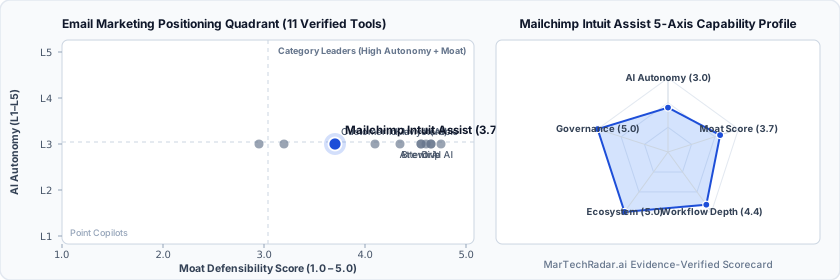
Mailchimp Intuit Assist in-depth review, pricing & architecture analysis
Editor sign-off: Oct 10, 2026. How profiles are made.
What is Mailchimp Intuit Assist? Overview & background
Operating within Intuit's broader financial and commerce ecosystem, Mailchimp Intuit Assist embeds generative intelligence directly into email automation workflows. Headquartered in Atlanta, Georgia and founded in 2001, the company expanded its enterprise footprint following Intuit's $12.0B acquisition. Intended for growth marketers, e-commerce operators, and digital agencies, the engine converts transactional signals into structured audience campaigns without requiring manual copy orchestration.
How Mailchimp Intuit Assist works: architecture & workflow
The platform functions on Intuit GenOS, linking commercial telemetry from systems like Shopify, WooCommerce, and QuickBooks directly into email and SMS orchestration pipelines. Ingestion algorithms process real-time customer transactional data, order cadence, and engagement telemetry to construct dynamic subscriber clusters. Its natural language interface then produces multi-variant subject lines, body copy, and segment triggers, dynamically assembling targeted lifecycle paths at Level 3 execution autonomy, alongside native workflow integrations for Salesforce, Zapier, and WordPress under verified SOC 2, GDPR, and ISO 27001 governance controls.
Mailchimp Intuit Assist limitations, drawbacks & risks
Operational considerations and platform boundaries include:
- Commerce Schema Rigidness: Generative recommendations depend on rigid transaction taxonomies, degrading synthesis quality when custom e-commerce database structures diverge from standard catalogs.
- Cross-Platform Event Latency: External webhook synchronization introduces processing lags that delay real-time behavioral automation triggers across high-velocity sales funnels.
- Cold-Start Attribution Gaps: Predictive audience segmentation lacks accuracy on newly launched accounts lacking sufficient historical engagement records.
Mailchimp Intuit Assist pricing, plans & cost breakdown
Commercial pricing spans between $13 and $350 monthly, scaling strictly across contact database volumes and monthly send allocations. Lower-tier commitments cater to early-stage merchants requiring foundational generative copy, while higher allowances unlock expanded generative drafting, multi-variant testing, and high-volume delivery capabilities across expanded contact pools.
How Mailchimp Intuit Assist compares vs. competitors & alternatives
While 10Web AI targets autonomous website generation, AB Tasty focuses on client-side experimentation, and Ability.ai centers on autonomous media buying, Mailchimp Intuit Assist differentiates via direct synchronization with native accounting and transactional ledgers within the Email Marketing segment. Organizations seeking an all-in-one messaging ecosystem benefit from this data density, whereas brands requiring dedicated experiment design or independent infrastructure may favor specialized testing frameworks.
Direct competitors & market radar
Top algorithmic competitors based on category positioning, capability overlap, and ICP alignment.
Frequently asked questions about Mailchimp Intuit Assist
How much does Mailchimp Intuit Assist cost in 2026?
Mailchimp Intuit Assist pricing: $13–$350/mo. No free plan is publicly disclosed. Commercial pricing spans between $13 and $350 monthly, scaling strictly across contact database volumes and monthly send allocations.
What are the top Mailchimp Intuit Assist alternatives in Email Marketing?
Verified Email Marketing alternatives include Ability.ai (Custom / enterprise pricing), Brevo AI (Free plan · $9–$499/mo), Constant Contact ($10–$68/mo), Turgo AI (From $100/mo). While 10Web AI targets autonomous website generation, AB Tasty focuses on client-side experimentation, and Ability.ai centers on autonomous media buying, Mailchimp Intuit Assist differentiates via direct synchronization with native accounting and transactional ledgers within the Email Marketing segment.
What are the main limitations and trade-offs of Mailchimp Intuit Assist?
Operational considerations and platform boundaries include: Commerce Schema Rigidness: Generative recommendations depend on rigid transaction taxonomies, degrading synthesis quality when custom e-commerce database structures diverge from standard catalogs. Walk away if your workflow cannot tolerate commerce schema rigidness: Generative recommendations depend on rigid transaction taxonomies, degrading synthesis quality when custom e-commerce database structures diverge from standard catalogs.
Verified sources & evidence trail
- Official product domain: https://mailchimp.com
- Commercial pricing verification: https://mailchimp.com/pricing
- First-party governance & documentation links: Trust & Security · System Status · API & Docs · Changelog · Terms
- Editor sign-off: Oct 10, 2026 (how profiles are made).
