Ability.ai Review (2026): Email Marketing Pricing, Limits & Alternatives
Bottom line
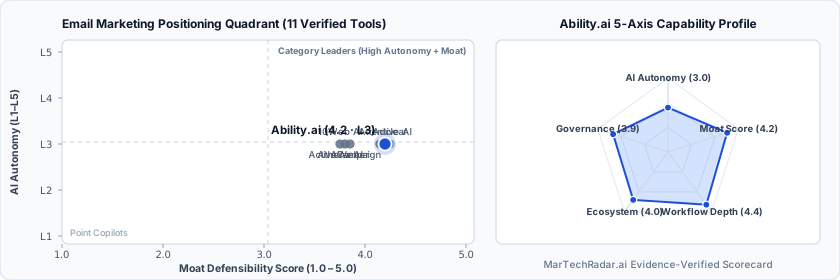
Ability.ai is a Web SaaS tool for Email Marketing (AI Email Marketing & Lifecycle Journeys) in Lifecycle & CDP. Pricing: Custom / enterprise pricing. Best suited to CRM & Lifecycle Marketers, eCommerce Growth Teams and Customer Experience Directors. Editor ratings: AI autonomy L3 (conditional automation); moat score 4.2/5.0 (Proprietary moat). Fact-checked by Anna Xia on Oct 12, 2026.
Ability.ai develops Trinity, an agentic operating system that builds, deploys, and manages autonomous AI agents for growth workflows and multi-channel.
Ability.ai buyer fit verdict: when to choose vs. when to walk away
Choose Ability.ai if (Best Fit)
- Target ICP & Stack Fit: You operate as CRM & Lifecycle Marketers, eCommerce Growth Teams and Customer Experience Directors requiring a Web SaaS deployment for Email Marketing, with verified ecosystem connectivity for Slack, ActiveCampaign.
- L3 Architecture & Defensibility: Ability.ai differentiates through its owned-infrastructure paradigm and specialized multi-agent architecture (Trinity), bypassing conventional seat-based SaaS models to offer proprietary deployment ownership.
- Commercial Model Fit: Your procurement budget aligns with Custom / enterprise pricing.
Walk away from Ability.ai if (Deal-Breakers)
- Walk away if you require transparent self-serve monthly billing or your budget ceiling is under $1,000/mo (Ability.ai requires sales-gated custom quoting).
- Walk away if your workflow cannot tolerate custom workflow implementation overhead: Initial implementation requires tailored workflow scoping and manual configuration of agent decision boundaries, extending integration timelines relative to turn-key marketing applications.
- Walk away if context window boundary failures is a deal-breaker for your team: Complex multi-touch lifecycle sequences risk context decay across extended orchestration horizons, occasionally requiring manual intervention to realign agent memory with shifting business rules.
Ability.ai key facts & scorecard
| Pricing | Custom / enterprise pricing |
|---|---|
| Free plan | No / not disclosed |
| Delivery | Web SaaS |
| Audience | CRM & Lifecycle Marketers, eCommerce Growth Teams, Customer Experience Directors |
| AI autonomy level | L3 · Conditional automationEditor-verified |
| Moat tier & score | 4.2 / 5.0 · Proprietary moatEditor-verified |
| Funding | Undisclosed |
| Total funding | $1.2MBacked by Google for Startups |
| Founders | Eugene Vyborov |
| Company size | 2-10 employees |
| Ecosystem integrations | Slack, ActiveCampaign |
| Governance & docs | Terms ↗ · Privacy ↗ |
| Headquarters | Global |
| Founded | 2023 |
| Last verified |
Ability.ai pros & cons: strengths vs. operational limitations
Pros: core strengths & capabilities
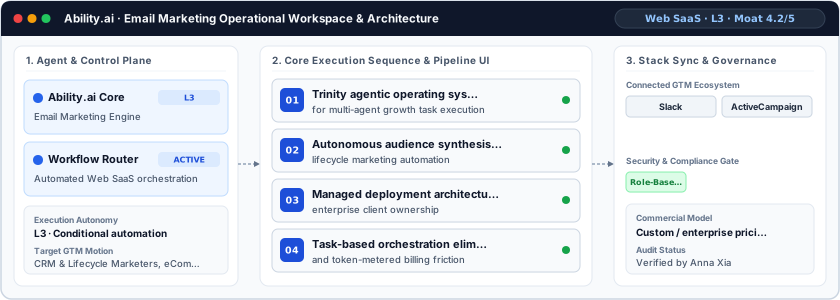
- Trinity agentic operating system: for multi-agent growth task execution
- Autonomous audience synthesis and: lifecycle marketing automation
- Managed deployment architecture allowing: enterprise client ownership
- Task-based orchestration eliminating seat: and token-metered billing friction
Cons: operational limitations & risks
- Custom Workflow Implementation Overhead: Initial implementation requires tailored workflow scoping and manual configuration of agent decision boundaries, extending integration timelines relative to turn-key marketing applications.
- Context Window Boundary Failures: Complex multi-touch lifecycle sequences risk context decay across extended orchestration horizons, occasionally requiring manual intervention to realign agent memory with shifting business rules.
- Data Pipeline Dependency: Execution fidelity depends strictly on the quality and freshness of connected enterprise data sources, with unstandardized schemas inducing task orchestration errors.
Ability.ai TCO & deal-breaker stress test
Simulate 12-month stepped TCO, hidden cost multipliers, contract lock-in exposure, and stack failure modes using only facts verified by Anna Xia on · Capture SHA 3c84498b.
Ability.ai triggers high-severity friction under your 5-seat / $800/mo constraints. Benchmark the verified subtrack alternatives below before committing.
| Plan / Tier | Verified Rate | Scale Fit | Scope & Quota Notes |
|---|---|---|---|
| Enterprise / Custom | Custom quote | 15–50+ seats (Enterprise SLA) | Sales-negotiated annual contract for custom volume, SSO/RBAC governance, and dedicated SLA. |
- Moat Score
- 4.2 / 5.0
- AI Autonomy
- L3
- Free Tier / Trial
- None disclosed
Triggered audit signals & failure modes
- Opaque Enterprise Quoting vs. SMB/Mid-Market BudgetVerified Pricing Ledger
Ability.ai does not disclose a public self-serve floor (Custom / enterprise pricing). Buyers with a $800/mo cap face high sales-qualification friction.
- Sales-Gated Contract TermsFact-checked by Anna Xia
Commercial access departs from recurring per-seat and per-token meters, utilizing a project-scoped deployment model where clients own the resulting system architecture.
- Primary Operational Bottleneck: Custom Workflow Implementation OverheadAudit by Anna Xia
Initial implementation requires tailored workflow scoping and manual configuration of agent decision boundaries, extending integration timelines relative to turn-key marketing applications.
Hidden TCO Multipliers & Quota Gates
- Per-Seat Linear Scaling: Ability.ai prices licenses on a per-user/seat basis (Custom / enterprise pricing); expanding from 2 to 15+ operators multiplies base recurring spend linearly.
- Credit & Usage Burn Multiplier: Automated workflows consume metered credits/usage quotas; multi-step enrichment, voice minutes, or high-frequency agent runs can trigger mid-cycle top-up packs.
When to Walk Away & Negotiation Levers
- Walk away if you require transparent self-serve monthly billing or your budget ceiling is under $1,000/mo (Ability.ai requires sales-gated custom quoting).
- Walk away if your workflow cannot tolerate custom workflow implementation overhead: Initial implementation requires tailored workflow scoping and manual configuration of agent decision boundaries, extending integration timelines relative to turn-key marketing applications.
- Walk away if context window boundary failures is a deal-breaker for your team: Complex multi-touch lifecycle sequences risk context decay across extended orchestration horizons, occasionally requiring manual intervention to realign agent memory with shifting business rules.
- Demand a 30- to 60-day paid pilot opt-out clause in the Ability.ai order form before signing a 12-month enterprise commitment.
- Require a sandbox proof-of-concept testing custom workflow implementation overhead against your live CRM/data schema before annual sign-off.
Ask a custom procurement or TCO stress-test question about Ability.ai
Lower 5-seat floor (~$15/mo vs. Custom Quote) · Transparent self-serve entry without mandatory annual lock-in
Lower 5-seat floor (~$13/mo vs. Custom Quote) · Transparent self-serve entry without mandatory annual lock-in
Ability.ai key entities, modules & ecosystem stack
Ability.ai moat & subtrack positioning
Ability.ai differentiates through its owned-infrastructure paradigm and specialized multi-agent architecture (Trinity), bypassing conventional seat-based SaaS models to offer proprietary deployment ownership.
Editorial review
Fact-checked by Anna Xia (Senior B2B GTM & Revenue Systems Analyst) on .
Background
Backed by $1.2M in pre-seed and accelerator funding, Ability.ai was established in 2023 as a Global distributed company targeting growth marketers and operations leaders. Operating through its proprietary Trinity operating system, the organization positions itself as an applied artificial intelligence lab engineering autonomous agent workforces. Rather than selling surface-level wrapping tools, Ability.ai targets technical marketing teams seeking to orchestrate multi-step campaign operations through dedicated agent architectures that enterprises directly control and own.
How Ability.ai works
At its architectural core, Ability.ai operates at an L3 conditional autonomy tier utilizing Trinity to coordinate specialized agent clusters. The platform ingests business rules, behavioral cohorts, and lifecycle objectives, decomposing them into discrete operational tasks across messaging and campaign execution. Specialized LLM-driven agents evaluate inbound user signals, synthesize targeted creative variations, and trigger programmatic API calls across communication endpoints. The execution loop operates within predefined parameter guardrails, escalating ambiguous decisions to human supervisors while continuously optimizing lifecycle touchpoints against conversion milestones, alongside native workflow integrations for Slack.
Limitations
Operational considerations and platform boundaries include:
- Custom Workflow Implementation Overhead: Initial implementation requires tailored workflow scoping and manual configuration of agent decision boundaries, extending integration timelines relative to turn-key marketing applications.
- Context Window Boundary Failures: Complex multi-touch lifecycle sequences risk context decay across extended orchestration horizons, occasionally requiring manual intervention to realign agent memory with shifting business rules.
- Data Pipeline Dependency: Execution fidelity depends strictly on the quality and freshness of connected enterprise data sources, with unstandardized schemas inducing task orchestration errors.
Ability.ai pricing
Commercial access departs from recurring per-seat and per-token meters, utilizing a project-scoped deployment model where clients own the resulting system architecture. Commercial pricing is available on request through tailored enterprise sales quotes based on organizational scale and seats, structured around fixed-scope starter implementations followed by managed operational agreements.
How Ability.ai compares
In the Email Marketing landscape, ability.ai competes against lifecycle platforms like ActiveCampaign AI, conversion optimization tools like AB Tasty, and automation builders like 10Web AI. While ActiveCampaign AI provides structured, template-driven journeys within standard CRM parameters, Ability.ai deploys autonomous agents capable of independent multi-step workflow execution. Unlike AB Tasty's focus on statistical front-end testing, Ability.ai unifies back-end campaign coordination. It is optimal for mid-market to enterprise marketing operations teams requiring bespoke, owned agent infrastructure rather than shared multi-tenant SaaS interfaces.
Direct competitors & market radar
Top algorithmic competitors based on category positioning, capability overlap, and ICP alignment.
Frequently asked questions about Ability.ai
How much does Ability.ai cost and does it require a custom enterprise quote?
Published pricing summary for Ability.ai: Custom / enterprise pricing. A permanent free plan is not disclosed for Ability.ai. Commercial access departs from recurring per-seat and per-token meters, utilizing a project-scoped deployment model where clients own the resulting system architecture.
How does Ability.ai work and how autonomous is its AI architecture?
Ability.ai develops Trinity, an agentic operating system that builds, deploys, and manages autonomous AI agents for growth workflows and multi-channel. Within Email Marketing (AI Email Marketing & Lifecycle Journeys), MarTechRadar rates its execution architecture at L3 · Conditional automation with a verified Moat Score of 4.2 / 5.0 (Proprietary moat). Ability.ai differentiates through its owned-infrastructure paradigm and specialized multi-agent architecture (Trinity), bypassing conventional seat-based SaaS models to offer proprietary deployment ownership. Corporate profile: Founded by Eugene Vyborov, operating at 2-10 employees scale.
What are the main limitations of Ability.ai and when should buyers walk away?
Based on our editorial technical audit, key operational considerations and boundaries for Ability.ai include: (1) Custom Workflow Implementation Overhead: Initial implementation requires tailored workflow scoping and manual configuration of agent decision boundaries, extending integration timelines relative to turn-key marketing applications. (2) Context Window Boundary Failures: Complex multi-touch lifecycle sequences risk context decay across extended orchestration horizons, occasionally requiring manual intervention to realign agent memory with shifting business rules. (3) Data Pipeline Dependency: Execution fidelity depends strictly on the quality and freshness of connected enterprise data sources, with unstandardized schemas inducing task orchestration errors. Primary procurement walk-away rule: Walk away if you require transparent self-serve monthly billing or your budget ceiling is under $1,000/mo (Ability.ai requires sales-gated custom quoting).
What integrations, compliance certifications, and contract terms apply to Ability.ai?
Verified ecosystem and stack integrations include Slack, ActiveCampaign. Key TCO multiplier to watch: Per-Seat Linear Scaling (Ability.ai prices licenses on a per-user/seat basis (Custom / enterprise pricing); expanding from 2 to 15+ operators multiplies base recurring spend linearly.) Before signing a contract, procurement teams should demand a 30- to 60-day paid pilot opt-out clause in the Ability.ai order form before signing a 12-month enterprise commitment.
What are the best Ability.ai alternatives and head-to-head competitors in 2026?
Top fact-checked alternatives to Ability.ai in Email Marketing (AI Email Marketing & Lifecycle Journeys) include Klaviyo (AI) (Custom / enterprise pricing), Mailchimp Intuit Assist ($13–$350/mo), ActiveCampaign AI (From $15/mo), AB Tasty (Custom / enterprise pricing). In the Email Marketing landscape, ability.ai competes against lifecycle platforms like ActiveCampaign AI, conversion optimization tools like AB Tasty, and automation builders like 10Web AI.
Verified sources & evidence trail
- Official product domain: https://www.ability.ai/
- Commercial pricing verification: Verified against official vendor pricing policy (Custom / enterprise pricing)
- Verified corporate entity profiles (
sameAs): LinkedIn Company Profile · Crunchbase Entity Record - First-party governance & documentation links: Terms · Privacy
- Editorial audit sign-off: Fact-checked by Anna Xia on under the MarTechRadar Evidence-Ledger Protocol.