Drip Review (2026): Email Marketing Pricing, Pros & Cons
Bottom line
Drip is a Web SaaS tool for Email Marketing (AI Email Marketing & Lifecycle Journeys) in Lifecycle & CDP. Pricing: From $39/mo. Best suited to DTC / eCommerce. Editor ratings: AI autonomy L3 (conditional automation); moat score 4.6/5.0 (Proprietary moat (category leader)). Fact-checked by MarTechRadar Research Desk on Oct 12, 2026.
E-commerce customer lifecycle and email automation platform synchronizing store telemetry into event-driven segmentation and revenue campaigns.
Is Drip worth it in 2026? Buyer fit & when to walk away
Choose Drip if (Best Fit)
- Target ICP & Stack Fit: You operate as DTC / eCommerce requiring a Web SaaS deployment for Email Marketing, with verified ecosystem connectivity for Shopify, WooCommerce, Twilio Segment.
- L3 Architecture & Defensibility: Pre-built e-commerce event ingestion connectors, visual workflow canvas for transactional triggers, and deterministic contact list data models tailored for direct-to-consumer storefronts.
- Commercial Model Fit: Your procurement budget aligns with From $39/mo.
Walk away from Drip if (Deal-Breakers)
- Walk away if your workflow cannot tolerate throughput and API delays: High-volume flash sales introduce telemetry ingestion latency across webhook queues, causing synchronization lags in cart abandonment triggers.
- Walk away if multi-store relational mapping is a deal-breaker for your team: Data schema structures do not natively resolve identities across fragmented international storefronts or divergent product catalog architectures.
Drip pricing, free plan & scorecard at a glance
| Pricing | From $39/moVendor pricing page |
|---|---|
| Free plan | No / not disclosed |
| Delivery | Web SaaS |
| Audience | DTC / eCommerce |
| AI autonomy level | L3 · Conditional automationEditor-verified |
| Moat tier & score | 4.6 / 5.0 · Proprietary moat (category leader)Editor-verified |
| Funding | AcquiredAcquired by Leadpages |
| Total funding | $1MBacked by Seed Investors |
| Founders | Rob Walling |
| Company size | 51-200 employees |
| Ecosystem integrations | Shopify, WooCommerce, Twilio Segment |
| Governance & docs | System Status ↗ · API & Docs ↗ · Changelog ↗ · Terms ↗ · Privacy ↗ |
| Headquarters | Minneapolis, Minnesota |
| Founded | 2012 |
| Last verified | Oct 12, 2026 |
Drip pros & cons: strengths vs. operational limitations
Pros: core strengths & capabilities
- Core capability: Event-driven e-commerce workflow automation engine
- Core capability: Dynamic RFM and behavioral segmentation
- Storefront telemetry synchronization: for cart and purchase data
- Multi-channel transactional and marketing: email delivery
Cons: operational limitations & risks
- Throughput and API Delays: High-volume flash sales introduce telemetry ingestion latency across webhook queues, causing synchronization lags in cart abandonment triggers.
- Multi-Store Relational Mapping: Data schema structures do not natively resolve identities across fragmented international storefronts or divergent product catalog architectures.
- Deliverability Cold Starts: Shared IP deliverability pools require deliberate domain warm-up cycles to avoid mailbox provider rate limits during sudden promotional spikes.
Drip TCO & deal-breaker stress test
Simulate 12-month stepped TCO, hidden cost multipliers, contract lock-in exposure, and stack failure modes using only facts verified by MarTechRadar Research Desk on 2026-10-12 · Capture SHA 155c3da2.
Drip aligns with your 5-seat / $800/mo profile. Review the walk-away triggers and contract levers below before deployment.
- Moat Score
- 4.6 / 5.0
- AI Autonomy
- L3
- Free Tier / Trial
- None disclosed
Triggered audit signals & failure modes
- Published Self-Serve Entry FloorVerified Pricing Ledger
Drip publishes a transparent entry point (From $39/mo) for initial validation before committing.
- Primary Operational Bottleneck: Throughput and API DelaysAudit by MarTechRadar Research Desk
High-volume flash sales introduce telemetry ingestion latency across webhook queues, causing synchronization lags in cart abandonment triggers.
Test a custom Drip budget or stack constraint
Lower 5-seat floor (~$9/mo vs. From $39 / mo)
Lower 5-seat floor (~$7/mo vs. From $39 / mo)
Drip integrations, API, security & compliance stack
Drip AI moat & Email Marketing positioning
Pre-built e-commerce event ingestion connectors, visual workflow canvas for transactional triggers, and deterministic contact list data models tailored for direct-to-consumer storefronts.
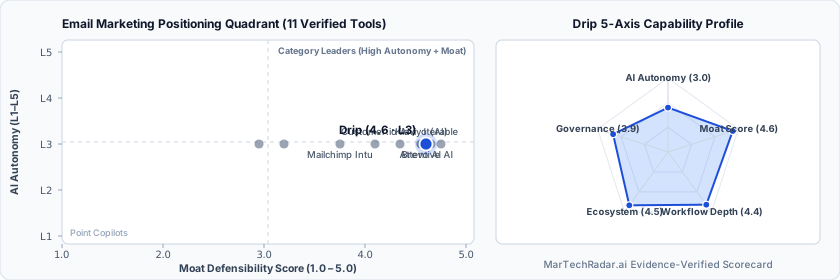
Drip in-depth review, pricing & architecture analysis
Editor sign-off: Oct 12, 2026. How profiles are made.
What is Drip? Overview & background
Established in 2012 in Minneapolis, Minnesota, Drip entered the customer relationship sector backed by $1M in venture capital before expanding its presence across independent retail. The platform provides direct-to-consumer e-commerce merchants with lifecycle journey automation, targeting growth marketers seeking alternatives to complex enterprise customer data platforms. Operating within digital commerce ecosystems, Drip processes transactional events into direct automated customer communications.
How Drip works: architecture & workflow
Drip operates on an event-driven ingestion pipeline connecting store APIs like Shopify, BigCommerce, and WooCommerce. The engine continuously syncs behavioral telemetry—including catalog views, abandoned carts, and purchase histories—mapping them to customer profiles. These data streams feed a visual automation builder that executes deterministic branching workflows, custom webhooks, dynamic liquid templating, and RFM-based audience segmentation without manual engineering intervention, alongside native workflow integrations for Zapier, WordPress, and Klaviyo under verified GDPR governance controls.
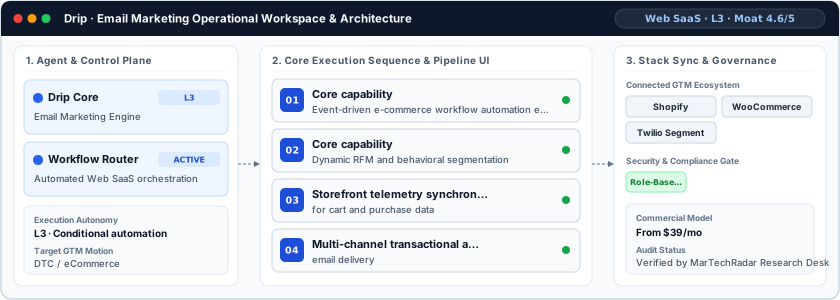
Drip limitations, drawbacks & risks
Operational considerations and platform boundaries include:
- Throughput and API Delays: High-volume flash sales introduce telemetry ingestion latency across webhook queues, causing synchronization lags in cart abandonment triggers.
- Multi-Store Relational Mapping: Data schema structures do not natively resolve identities across fragmented international storefronts or divergent product catalog architectures.
- Deliverability Cold Starts: Shared IP deliverability pools require deliberate domain warm-up cycles to avoid mailbox provider rate limits during sudden promotional spikes.
Drip pricing, plans & cost breakdown
Drip employs a list-size tiered pricing model starting at $39 per month, which supports up to 2,500 active contacts. This standard tier includes unlimited email sends, dynamic segmentation, and baseline integration access. As addressable subscriber lists scale beyond initial volumes, monthly billing adjusts progressively based on hosted contact capacity.
How Drip compares vs. competitors & alternatives
Within automated engagement workflows, Drip focuses strictly on transactional and behavioral e-commerce messaging, contrasting with 10Web AI's site-building tools, AB Tasty's client-side experimentation framework, and Ability.ai's multi-channel agentic operations within the Email Marketing segment. Mid-market online retailers benefit from Drip's structured store event models, though brands requiring real-time web experimentation or autonomous cross-channel attribution must augment its core transactional stack.
Direct competitors & market radar
Top algorithmic competitors based on category positioning, capability overlap, and ICP alignment.
Frequently asked questions about Drip
How much does Drip cost in 2026?
Drip pricing: From $39/mo. No free plan is publicly disclosed. Drip employs a list-size tiered pricing model starting at $39 per month, which supports up to 2,500 active contacts. This standard tier includes unlimited email sends, dynamic segmentation, and baseline integration access.
What are the top Drip alternatives in Email Marketing?
Verified Email Marketing alternatives include Klaviyo (AI) (Custom / enterprise pricing), Brevo AI (Free plan · $9–$499/mo), Moosend (From $7/mo), Drift (Custom / enterprise pricing). Within automated engagement workflows, Drip focuses strictly on transactional and behavioral e-commerce messaging, contrasting with 10Web AI's site-building tools, AB Tasty's client-side experimentation framework, and Ability.ai's multi-channel agentic operations within the Email Marketing segment.
What are the main limitations and trade-offs of Drip?
Operational considerations and platform boundaries include: Throughput and API Delays: High-volume flash sales introduce telemetry ingestion latency across webhook queues, causing synchronization lags in cart abandonment triggers. Walk away if your workflow cannot tolerate throughput and API delays: High-volume flash sales introduce telemetry ingestion latency across webhook queues, causing synchronization lags in cart abandonment triggers.
Verified sources & evidence trail
- Official product domain: https://drip.com
- Commercial pricing verification: https://www.drip.com/pricing
- Verified corporate entity profiles (
sameAs): LinkedIn Company Profile · Crunchbase Entity Record - First-party governance & documentation links: System Status · API & Docs · Changelog · Terms · Privacy
- Editor sign-off: Oct 12, 2026 (how profiles are made).
