Scout Review (2026): Marketing Mix Modeling Pricing, Limits & Alternatives
Bottom line
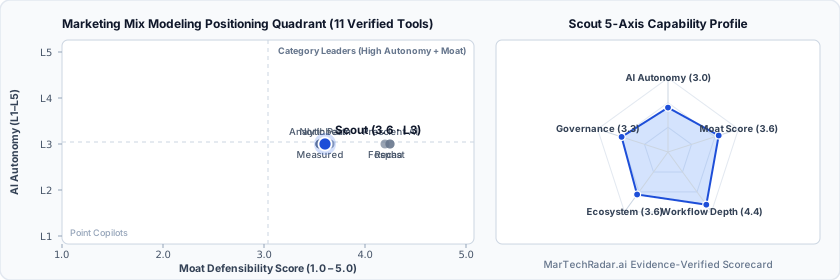
Scout is a Web SaaS tool for Marketing Mix Modeling (Marketing Mix Modeling & Incremental Lift) in Analytics & Attribution. Pricing: Pricing not disclosed. Best suited to B2B SaaS and Marketing & Growth Teams. Editor ratings: AI autonomy L3 (conditional automation); moat score 3.6/5.0 (Proprietary moat). Fact-checked by Anthony Hay on Oct 16, 2026.
AI retail insights and workflow platform for CPG brands turning POS, retailer portal, and syndicated data into forecasting and trade actions.
Scout buyer fit verdict: when to choose vs. when to walk away
Choose Scout if (Best Fit)
- Target ICP & Stack Fit: You operate as B2B SaaS and Marketing & Growth Teams requiring a Web SaaS deployment for Marketing Mix Modeling, with verified ecosystem connectivity for Shopify.
- L3 Architecture & Defensibility: Harmonizing incompatible retailer portal exports and syndicated SPINS or NielsenIQ feeds directly into automated forecasting, replenishment, and trade promotion workflows creates strong vertical stickiness.
- Commercial Model Fit: Your procurement budget aligns with Pricing not disclosed.
Walk away from Scout if (Deal-Breakers)
- Walk away if you require transparent self-serve monthly billing or your budget ceiling is under $1,000/mo (Scout requires sales-gated custom quoting).
- Walk away if your workflow cannot tolerate syndicated data licensing bottleneck: A primary commercial limitation is that Scout operates on top of a brand's authorized retailer and syndicated data feeds; early-stage CPG brands that have not yet licensed SPINS or NielsenIQ data face an upstream data availability bottleneck.
- Walk away if new category cold start limitation is a deal-breaker for your team: Predictive demand forecasting and promotional lift models struggle with cold start accuracy when launching net-new SKU lines with zero historical store-level velocity.
Scout key facts & scorecard
| Pricing | Pricing not disclosed |
|---|---|
| Free plan | No / not disclosed |
| Delivery | Web SaaS |
| Audience | B2B SaaS, Marketing & Growth Teams |
| AI autonomy level | L3 · Conditional automationEditor-verified |
| Moat tier & score | 3.6 / 5.0 · Proprietary moatEditor-verified |
| Funding | Seed |
| Company size | 2-10 employees |
| Ecosystem integrations | Shopify |
| Governance & docs | Trust & Security ↗ · Privacy ↗ |
| Headquarters | San Francisco, CA |
| Founded | 2023 |
| Last verified |
Scout pros & cons: strengths vs. operational limitations
Pros: core strengths & capabilities
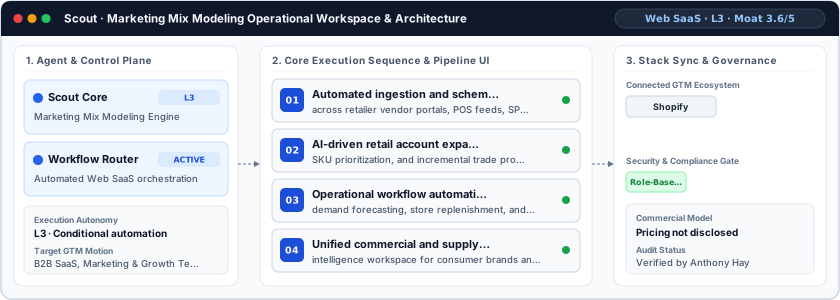
- Automated ingestion and schema harmonization: across retailer vendor portals, POS feeds, SPINS, and NielsenIQ
- AI-driven retail account expansion,: SKU prioritization, and incremental trade promotion lift analytics
- Operational workflow automation covering: demand forecasting, store replenishment, and purchase ordering
- Unified commercial and supply-chain: intelligence workspace for consumer brands and retail operators
Cons: operational limitations & risks
- Syndicated Data Licensing Bottleneck: A primary commercial limitation is that Scout operates on top of a brand's authorized retailer and syndicated data feeds; early-stage CPG brands that have not yet licensed SPINS or NielsenIQ data face an upstream data availability bottleneck.
- New Category Cold Start Limitation: Predictive demand forecasting and promotional lift models struggle with cold start accuracy when launching net-new SKU lines with zero historical store-level velocity.
- Retailer Portal Schema Governance Barrier: Maintaining automated connectors across frequently changing retailer vendor portals and enterprise ERP systems introduces synchronization latency, credential management friction, and an IT governance barrier.
Scout TCO & deal-breaker stress test
Simulate 12-month stepped TCO, hidden cost multipliers, contract lock-in exposure, and stack failure modes using only facts verified by Anthony Hay on · Capture SHA 8177fa55.
Scout triggers high-severity friction under your 5-seat / $800/mo constraints. Benchmark the verified subtrack alternatives below before committing.
| Plan / Tier | Verified Rate | Scale Fit | Scope & Quota Notes |
|---|---|---|---|
| Enterprise / Custom | Custom quote | 15–50+ seats (Enterprise SLA) | Sales-negotiated annual contract for custom volume, SSO/RBAC governance, and dedicated SLA. |
- Moat Score
- 3.6 / 5.0
- AI Autonomy
- L3
- Free Tier / Trial
- None disclosed
Triggered audit signals & failure modes
- Opaque Enterprise Quoting vs. SMB/Mid-Market BudgetVerified Pricing Ledger
Scout does not disclose a public self-serve floor (Pricing not disclosed). Buyers with a $800/mo cap face high sales-qualification friction.
- Sales-Gated Contract TermsFact-checked by Anthony Hay
Pricing is available on request through enterprise sales quotes, with customized tiers based on seat counts or usage volume.
- Primary Operational Bottleneck: Syndicated Data Licensing BottleneckAudit by Anthony Hay
A primary commercial limitation is that Scout operates on top of a brand's authorized retailer and syndicated data feeds; early-stage CPG brands that have not yet licensed SPINS or NielsenIQ data face an upstream data availability bottleneck.
Hidden TCO Multipliers & Quota Gates
- Syndicated Data Licensing Bottleneck: A primary commercial limitation is that Scout operates on top of a brand's authorized retailer and syndicated data feeds; early-stage CPG brands that have not yet licensed SPINS or NielsenIQ data face an upstream data availability bottleneck.
- New Category Cold Start Limitation: Predictive demand forecasting and promotional lift models struggle with cold start accuracy when launching net-new SKU lines with zero historical store-level velocity.
When to Walk Away & Negotiation Levers
- Walk away if you require transparent self-serve monthly billing or your budget ceiling is under $1,000/mo (Scout requires sales-gated custom quoting).
- Walk away if your workflow cannot tolerate syndicated data licensing bottleneck: A primary commercial limitation is that Scout operates on top of a brand's authorized retailer and syndicated data feeds; early-stage CPG brands that have not yet licensed SPINS or NielsenIQ data face an upstream data availability bottleneck.
- Walk away if new category cold start limitation is a deal-breaker for your team: Predictive demand forecasting and promotional lift models struggle with cold start accuracy when launching net-new SKU lines with zero historical store-level velocity.
- Demand a 30- to 60-day paid pilot opt-out clause in the Scout order form before signing a 12-month enterprise commitment.
- Require a sandbox proof-of-concept testing syndicated data licensing bottleneck against your live CRM/data schema before annual sign-off.
Ask a custom procurement or TCO stress-test question about Scout
Lower 5-seat floor (~$125/mo vs. Custom Quote)
Verified Marketing Mix Modeling peer (Pricing not disclosed · Moat 3.8/5.0)
Scout key entities, modules & ecosystem stack
Scout moat & subtrack positioning
Harmonizing incompatible retailer portal exports and syndicated SPINS or NielsenIQ feeds directly into automated forecasting, replenishment, and trade promotion workflows creates strong vertical stickiness.
Editorial review
Fact-checked by Anthony Hay (Senior SEO, Search Intelligence & Content Operations Editor) on .
Background
Founded in 2023 by Sasha Zhang, Scout (cpgscout.com) is an AI retail insights and operational workflow platform built for consumer packaged goods (CPG) companies, retail account managers, and supply-chain planning teams. Operating with a team of 2 to 10 employees and backed by institutional accelerator investor Y Combinator (W24), the company turns fragmented point-of-sale (POS), retailer portal, and syndicated market datasets into automated commercial and supply-chain execution.
How Scout works
Scout operates at Level 3 autonomy through an automated retail ETL connector suite, cross-retailer SKU harmonization engine, and predictive econometric modeling pipeline. Consumer brands connect their disparate retailer portals (such as Walmart, Target, or Kroger vendor portals) alongside syndicated market feeds from SPINS and NielsenIQ. Scout's normalization layer reconciles incompatible store hierarchies, UPC mappings, and time windows into a unified data model. Its AI workflows then execute demand forecasting, automated replenishment and ordering diagnostics, SKU velocity ranking, and promotional lift decomposition—separating true incremental promotional volume from subsidized baseline sales so commercial teams know exactly where to expand distribution.
Limitations
Operational limitations and technical trade-offs include:
- Syndicated Data Licensing Bottleneck: A primary commercial limitation is that Scout operates on top of a brand's authorized retailer and syndicated data feeds; early-stage CPG brands that have not yet licensed SPINS or NielsenIQ data face an upstream data availability bottleneck.
- New Category Cold Start Limitation: Predictive demand forecasting and promotional lift models struggle with cold start accuracy when launching net-new SKU lines with zero historical store-level velocity.
- Retailer Portal Schema Governance Barrier: Maintaining automated connectors across frequently changing retailer vendor portals and enterprise ERP systems introduces synchronization latency, credential management friction, and an IT governance barrier.
Scout pricing
Pricing is available on request through enterprise sales quotes, with customized tiers based on seat counts or usage volume. Prospective consumer brands and retailers can schedule a live demonstration through the Scout website to evaluate the platform directly on their own POS and syndicated datasets.
How Scout compares
Within the Business Intelligence (BI) & AI Data Analyst Copilots category, Scout competes against retail and commercial analytics alternatives such as Corvera, Polar Analytics, and Haus. Versus digital DTC analytics platforms like Polar Analytics or causal media geo-lift tools like Haus, Scout differentiates itself by unifying brick-and-mortar syndicated data (SPINS, NielsenIQ) with operational retail replenishment, forecasting, and trade promotion workflows. Omnichannel and retail-first CPG brands adopt Scout to automate topline and supply-chain analytics, whereas pure-play Shopify stores rely on ecommerce dashboards.
Frequently asked questions about Scout
How much does Scout cost and does it require a custom enterprise quote?
Published pricing summary for Scout: Pricing not disclosed. A permanent free plan is not disclosed for Scout. Pricing is available on request through enterprise sales quotes, with customized tiers based on seat counts or usage volume. Prospective consumer brands and retailers can schedule a live demonstration through the Scout website to evaluate the platform directly on their own POS and syndicated datasets.
How does Scout work and how autonomous is its AI architecture?
AI retail insights and workflow platform for CPG brands turning POS, retailer portal, and syndicated data into forecasting and trade actions. Within Marketing Mix Modeling (Marketing Mix Modeling & Incremental Lift), MarTechRadar rates its execution architecture at L3 · Conditional automation with a verified Moat Score of 3.6 / 5.0 (Proprietary moat). Harmonizing incompatible retailer portal exports and syndicated SPINS or NielsenIQ feeds directly into automated forecasting, replenishment, and trade promotion workflows creates strong vertical stickiness. Corporate profile: operating at 2-10 employees scale.
What are the main limitations of Scout and when should buyers walk away?
Based on our editorial technical audit, key operational considerations and boundaries for Scout include: (1) Syndicated Data Licensing Bottleneck: A primary commercial limitation is that Scout operates on top of a brand's authorized retailer and syndicated data feeds; early-stage CPG brands that have not yet licensed SPINS or NielsenIQ data face an upstream data availability bottleneck. (2) New Category Cold Start Limitation: Predictive demand forecasting and promotional lift models struggle with cold start accuracy when launching net-new SKU lines with zero historical store-level velocity. (3) Retailer Portal Schema Governance Barrier: Maintaining automated connectors across frequently changing retailer vendor portals and enterprise ERP systems introduces synchronization latency, credential management friction, and an IT governance barrier. Primary procurement walk-away rule: Walk away if you require transparent self-serve monthly billing or your budget ceiling is under $1,000/mo (Scout requires sales-gated custom quoting).
What integrations, compliance certifications, and contract terms apply to Scout?
Verified ecosystem and stack integrations include Shopify. First-party governance and developer endpoints verified on domain include: Trust/Security (https://www.cpgscout.ai/security). Key TCO multiplier to watch: Syndicated Data Licensing Bottleneck (A primary commercial limitation is that Scout operates on top of a brand's authorized retailer and syndicated data feeds; early-stage CPG brands that have not yet licensed SPINS or NielsenIQ data face an upstream data availability bottleneck.) Before signing a contract, procurement teams should demand a 30- to 60-day paid pilot opt-out clause in the Scout order form before signing a 12-month enterprise commitment.
What are the best Scout alternatives and head-to-head competitors in 2026?
Top fact-checked alternatives to Scout in Marketing Mix Modeling (Marketing Mix Modeling & Incremental Lift) include Corvera (Pricing not disclosed), Haus (Pricing not disclosed), Polar Analytics (Pricing not disclosed), Sellforte (Custom / enterprise pricing). Within the Business Intelligence (BI) & AI Data Analyst Copilots category, Scout competes against retail and commercial analytics alternatives such as Corvera, Polar Analytics, and Haus.
Verified sources & evidence trail
- Official product domain: https://cpgscout.ai/
- Commercial pricing verification: Verified against official vendor pricing policy (Pricing not disclosed)
- Verified corporate entity profiles (
sameAs): LinkedIn Company Profile - First-party governance & documentation links: Trust & Security · Privacy
- Editorial audit sign-off: Fact-checked by Anthony Hay on under the MarTechRadar Evidence-Ledger Protocol.