Corvera Review (2026): Marketing Attribution Pricing, Limits & Alternatives
Bottom line
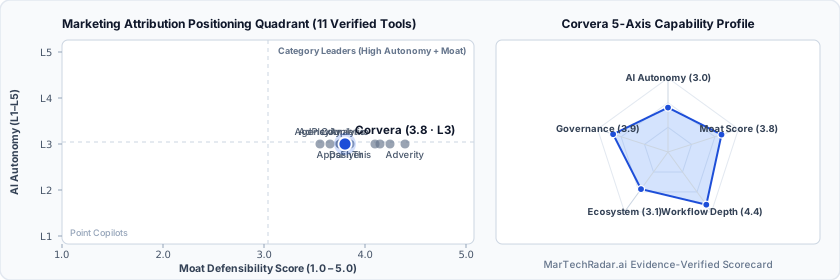
Corvera is a Web SaaS tool for Marketing Attribution (Multi-Touch Attribution & eCommerce Dashboards) in Analytics & Attribution. Pricing: Pricing not disclosed. Best suited to B2B SaaS and Marketing & Growth Teams. Editor ratings: AI autonomy L3 (conditional automation); moat score 3.8/5.0 (Proprietary moat). Fact-checked by Anthony Hay on Oct 16, 2026.
AI sales growth agent for CPG brands that ingests fragmented distributor and retailer data to rank daily revenue-generating actions for lean sales teams.
Corvera buyer fit verdict: when to choose vs. when to walk away
Choose Corvera if (Best Fit)
- Target ICP & Stack Fit: You operate as B2B SaaS and Marketing & Growth Teams requiring a Web SaaS deployment for Marketing Attribution.
- L3 Architecture & Defensibility: Normalizing messy multi-distributor depletion reports and store-level velocity feeds into ranked daily field-sales workflows builds deep vertical data and execution lock-in for CPG brands.
- Commercial Model Fit: Your procurement budget aligns with Pricing not disclosed.
Walk away from Corvera if (Deal-Breakers)
- Walk away if you require transparent self-serve monthly billing or your budget ceiling is under $1,000/mo (Corvera requires sales-gated custom quoting).
- Walk away if your workflow cannot tolerate upstream distributor feed latency: A primary data limitation in wholesale CPG is that regional distributors often deliver depletion exports on delayed weekly or monthly cycles, creating an upstream ingestion latency bottleneck that limits real-time out-of-stock alerting.
- Walk away if unstandardized sku mapping friction is a deal-breaker for your team: Harmonizing inconsistent store addresses and SKU identifiers across dozens of independent wholesale distributors struggles with messy legacy spreadsheets, introducing initial onboarding friction.
Corvera key facts & scorecard
| Pricing | Pricing not disclosed |
|---|---|
| Free plan | No / not disclosed |
| Delivery | Web SaaS |
| Audience | B2B SaaS, Marketing & Growth Teams |
| AI autonomy level | L3 · Conditional automationEditor-verified |
| Moat tier & score | 3.8 / 5.0 · Proprietary moatEditor-verified |
| Funding | Seed |
| Total funding | $6.2M |
| Founders | Christopher Kong, Dirk Breeuwer, Matthew Collins |
| Company size | 2-10 employees |
| Governance & docs | API & Docs ↗ · Changelog ↗ · Privacy ↗ |
| Headquarters | San Francisco, California |
| Founded | 2025 |
| Last verified |
Corvera pros & cons: strengths vs. operational limitations
Pros: core strengths & capabilities
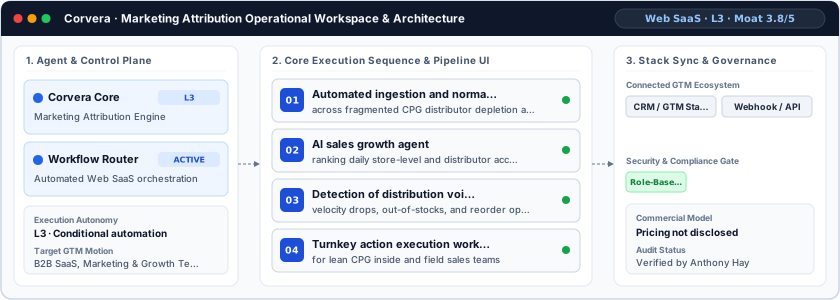
- Automated ingestion and normalization: across fragmented CPG distributor depletion and retailer portals
- AI sales growth agent: ranking daily store-level and distributor account actions by revenue impact
- Detection of distribution voids,: velocity drops, out-of-stocks, and reorder opportunities across 20,000+ doors
- Turnkey action execution workflows designed: for lean CPG inside and field sales teams
Cons: operational limitations & risks
- Upstream Distributor Feed Latency: A primary data limitation in wholesale CPG is that regional distributors often deliver depletion exports on delayed weekly or monthly cycles, creating an upstream ingestion latency bottleneck that limits real-time out-of-stock alerting.
- Unstandardized SKU Mapping Friction: Harmonizing inconsistent store addresses and SKU identifiers across dozens of independent wholesale distributors struggles with messy legacy spreadsheets, introducing initial onboarding friction.
- Field Broker Adoption Learning Curve: Transitioning traditional CPG field sales reps and external retail broker networks from intuition-driven route planning to AI-ranked daily queues introduces a workflow learning curve and data-sharing governance barrier.
Corvera TCO & deal-breaker stress test
Simulate 12-month stepped TCO, hidden cost multipliers, contract lock-in exposure, and stack failure modes using only facts verified by Anthony Hay on · Capture SHA 0cfa5249.
Corvera triggers high-severity friction under your 5-seat / $800/mo constraints. Benchmark the verified subtrack alternatives below before committing.
| Plan / Tier | Verified Rate | Scale Fit | Scope & Quota Notes |
|---|---|---|---|
| Enterprise / Custom | Custom quote | 15–50+ seats (Enterprise SLA) | Sales-negotiated annual contract for custom volume, SSO/RBAC governance, and dedicated SLA. |
- Moat Score
- 3.8 / 5.0
- AI Autonomy
- L3
- Free Tier / Trial
- None disclosed
Triggered audit signals & failure modes
- Opaque Enterprise Quoting vs. SMB/Mid-Market BudgetVerified Pricing Ledger
Corvera does not disclose a public self-serve floor (Pricing not disclosed). Buyers with a $800/mo cap face high sales-qualification friction.
- Sales-Gated Contract TermsFact-checked by Anthony Hay
Pricing is available on request through enterprise sales quotes, with customized tiers based on seat counts or usage volume.
- Primary Operational Bottleneck: Upstream Distributor Feed LatencyAudit by Anthony Hay
A primary data limitation in wholesale CPG is that regional distributors often deliver depletion exports on delayed weekly or monthly cycles, creating an upstream ingestion latency bottleneck that limits real-time out-of-stock alerting.
Hidden TCO Multipliers & Quota Gates
- Upstream Distributor Feed Latency: A primary data limitation in wholesale CPG is that regional distributors often deliver depletion exports on delayed weekly or monthly cycles, creating an upstream ingestion latency bottleneck that limits real-time out-of-stock alerting.
- Unstandardized SKU Mapping Friction: Harmonizing inconsistent store addresses and SKU identifiers across dozens of independent wholesale distributors struggles with messy legacy spreadsheets, introducing initial onboarding friction.
When to Walk Away & Negotiation Levers
- Walk away if you require transparent self-serve monthly billing or your budget ceiling is under $1,000/mo (Corvera requires sales-gated custom quoting).
- Walk away if your workflow cannot tolerate upstream distributor feed latency: A primary data limitation in wholesale CPG is that regional distributors often deliver depletion exports on delayed weekly or monthly cycles, creating an upstream ingestion latency bottleneck that limits real-time out-of-stock alerting.
- Walk away if unstandardized sku mapping friction is a deal-breaker for your team: Harmonizing inconsistent store addresses and SKU identifiers across dozens of independent wholesale distributors struggles with messy legacy spreadsheets, introducing initial onboarding friction.
- Demand a 30- to 60-day paid pilot opt-out clause in the Corvera order form before signing a 12-month enterprise commitment.
- Require a sandbox proof-of-concept testing upstream distributor feed latency against your live CRM/data schema before annual sign-off.
Ask a custom procurement or TCO stress-test question about Corvera
Lower 5-seat floor (~$15/mo vs. Custom Quote) · Transparent self-serve entry without mandatory annual lock-in
Lower 5-seat floor (~$79/mo vs. Custom Quote) · Transparent self-serve entry without mandatory annual lock-in
Corvera moat & subtrack positioning
Normalizing messy multi-distributor depletion reports and store-level velocity feeds into ranked daily field-sales workflows builds deep vertical data and execution lock-in for CPG brands.
Editorial review
Fact-checked by Anthony Hay (Senior SEO, Search Intelligence & Content Operations Editor) on .
Background
Founded in 2025 by Christopher Kong, Dirk Breeuwer, and Matthew Collins and headquartered in San Francisco, California, Corvera (corvera.ai) is an AI sales growth agent built specifically for consumer packaged goods (CPG) brands and wholesale retail revenue teams. Operating with a team of 2 to 10 employees and backed by $6.2M in Seed funding led by Y Combinator (W26), The Twenty Minute VC, 6 Degrees Capital, Firstminute Capital, and Rebel Fund, the company solves the severe store-to-rep ratio bottleneck faced by growing CPG brands managing tens of thousands of retail doors across dozens of regional distributors with a handful of salespeople.
How Corvera works
Corvera operates at Level 3 autonomy through a vertical data ingestion pipeline, entity-resolution schema mapper, and predictive prioritization engine. CPG sales teams connect their existing distributor depletion spreadsheets, retailer vendor portal exports, and syndicated store telemetry into Corvera's data hub. Rather than presenting another passive BI dashboard that requires hours of pivot-table slicing, the platform's AI agent cross-references store-level velocity, reorder cadence, and distribution gaps to rank the exact accounts, distributor reps, and retail buyers that sales reps should contact today, complete with data-backed talking points and reorder recommendations.
Limitations
Operational limitations and technical trade-offs include:
- Upstream Distributor Feed Latency: A primary data limitation in wholesale CPG is that regional distributors often deliver depletion exports on delayed weekly or monthly cycles, creating an upstream ingestion latency bottleneck that limits real-time out-of-stock alerting.
- Unstandardized SKU Mapping Friction: Harmonizing inconsistent store addresses and SKU identifiers across dozens of independent wholesale distributors struggles with messy legacy spreadsheets, introducing initial onboarding friction.
- Field Broker Adoption Learning Curve: Transitioning traditional CPG field sales reps and external retail broker networks from intuition-driven route planning to AI-ranked daily queues introduces a workflow learning curve and data-sharing governance barrier.
Corvera pricing
Pricing is available on request through enterprise sales quotes, with customized tiers based on seat counts or usage volume. Corvera scopes annual subscriptions through direct product demonstrations based on a brand's active retail store count, distributor connections, and sales team seats.
How Corvera compares
Within the Predictive Sales & Lead Scoring Analytics category, Corvera competes against retail and revenue intelligence alternatives such as Scout, Polar Analytics, and Coffee. Versus horizontal B2B CRM agents like Coffee or DTC ecommerce analytics suites like Polar Analytics, Corvera differentiates itself by specializing exclusively in brick-and-mortar CPG distributor depletion and store-level sales execution. Emerging and mid-market CPG beverage, food, and personal care brands choose Corvera to scale wholesale coverage without adding headcount.
Frequently asked questions about Corvera
How much does Corvera cost and does it require a custom enterprise quote?
Published pricing summary for Corvera: Pricing not disclosed. A permanent free plan is not disclosed for Corvera. Pricing is available on request through enterprise sales quotes, with customized tiers based on seat counts or usage volume. Corvera scopes annual subscriptions through direct product demonstrations based on a brand's active retail store count, distributor connections, and sales team seats.
How does Corvera work and how autonomous is its AI architecture?
AI sales growth agent for CPG brands that ingests fragmented distributor and retailer data to rank daily revenue-generating actions for lean sales teams. Within Marketing Attribution (Multi-Touch Attribution & eCommerce Dashboards), MarTechRadar rates its execution architecture at L3 · Conditional automation with a verified Moat Score of 3.8 / 5.0 (Proprietary moat). Normalizing messy multi-distributor depletion reports and store-level velocity feeds into ranked daily field-sales workflows builds deep vertical data and execution lock-in for CPG brands. Corporate profile: Founded by Christopher Kong, Dirk Breeuwer, Matthew Collins, operating at 2-10 employees scale.
What are the main limitations of Corvera and when should buyers walk away?
Based on our editorial technical audit, key operational considerations and boundaries for Corvera include: (1) Upstream Distributor Feed Latency: A primary data limitation in wholesale CPG is that regional distributors often deliver depletion exports on delayed weekly or monthly cycles, creating an upstream ingestion latency bottleneck that limits real-time out-of-stock alerting. (2) Unstandardized SKU Mapping Friction: Harmonizing inconsistent store addresses and SKU identifiers across dozens of independent wholesale distributors struggles with messy legacy spreadsheets, introducing initial onboarding friction. (3) Field Broker Adoption Learning Curve: Transitioning traditional CPG field sales reps and external retail broker networks from intuition-driven route planning to AI-ranked daily queues introduces a workflow learning curve and data-sharing governance barrier. Primary procurement walk-away rule: Walk away if you require transparent self-serve monthly billing or your budget ceiling is under $1,000/mo (Corvera requires sales-gated custom quoting).
What integrations, compliance certifications, and contract terms apply to Corvera?
First-party governance and developer endpoints verified on domain include: API Docs (https://docs.corvera.ai). Key TCO multiplier to watch: Upstream Distributor Feed Latency (A primary data limitation in wholesale CPG is that regional distributors often deliver depletion exports on delayed weekly or monthly cycles, creating an upstream ingestion latency bottleneck that limits real-time out-of-stock alerting.) Before signing a contract, procurement teams should demand a 30- to 60-day paid pilot opt-out clause in the Corvera order form before signing a 12-month enterprise commitment.
What are the best Corvera alternatives and head-to-head competitors in 2026?
Top fact-checked alternatives to Corvera in Marketing Attribution (Multi-Touch Attribution & eCommerce Dashboards) include Scout (Pricing not disclosed), Polar Analytics (Pricing not disclosed), Scibids AI (Custom / enterprise pricing), Branch Metrics AI (Custom / enterprise pricing). Within the Predictive Sales & Lead Scoring Analytics category, Corvera competes against retail and revenue intelligence alternatives such as Scout, Polar Analytics, and Coffee.
Verified sources & evidence trail
- Official product domain: https://corvera.ai/
- Commercial pricing verification: Verified against official vendor pricing policy (Pricing not disclosed)
- Verified corporate entity profiles (
sameAs): LinkedIn Company Profile · Crunchbase Entity Record - First-party governance & documentation links: API & Docs · Changelog · Privacy
- Editorial audit sign-off: Fact-checked by Anthony Hay on under the MarTechRadar Evidence-Ledger Protocol.