Captions Review (2026): AI Video Editor Pricing, Limits & Alternatives
Bottom line
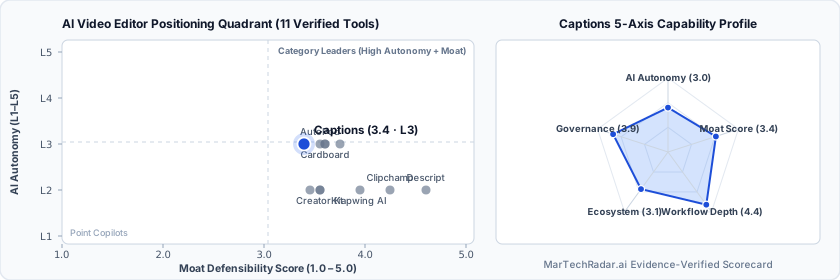
Captions is a Web SaaS tool for AI Video Editor (AI Video Repurposing & Shorts Editing) in Visual & Creative Media. Pricing: Free plan · From $24.99/mo. Best suited to B2B SaaS and Growth Teams. Editor ratings: AI autonomy L3 (conditional automation); moat score 3.4/5.0 (Workflow-embedded (strong)). Fact-checked by Jagmeet Sine on Oct 16, 2026.
AI video editing and repurposing studio automating captions, scene cuts, B-roll insertion, digital twin avatars, and multilingual dubbing.
Captions buyer fit verdict: when to choose vs. when to walk away
Choose Captions if (Best Fit)
- Target ICP & Stack Fit: You operate as B2B SaaS and Growth Teams requiring a Web SaaS deployment for AI Video Editor.
- L3 Architecture & Defensibility: High creator adoption combined with an integrated multimodal pipeline spanning speech-to-text styling, eye-contact neural correction, and synthetic avatar generation drives strong workflow stickiness.
- Commercial Model Fit: Your procurement budget aligns with Free plan · From $24.99/mo and want a self-serve free tier for zero-cost initial validation.
Walk away from Captions if (Deal-Breakers)
- Walk away if your workflow requires uncapped enterprise volume on the Free plan · From $24.99/mo entry plan without upgrading tiers.
- Walk away if your workflow cannot tolerate generative credit depletion bottleneck: A primary operational trade-off is that rendering high-resolution synthetic avatars and multilingual lip-synced dubs consumes monthly credit pools rapidly, creating a cost bottleneck for high-volume ad testing.
- Walk away if timeline precision limitation is a deal-breaker for your team: Because the editor prioritizes automated prompt-driven assembly, it struggles with frame-accurate multi-track keyframing and color grading, presenting a workflow limitation for traditional commercial film editors.
Captions key facts & scorecard
| Pricing | Free plan · From $24.99/moVendor pricing page |
|---|---|
| Free plan | Yes |
| Delivery | Web SaaS |
| Audience | B2B SaaS, Growth Teams |
| AI autonomy level | L3 · Conditional automationEditor-verified |
| Moat tier & score | 3.4 / 5.0 · Workflow-embedded (strong)Editor-verified |
| Funding | Series C+ |
| Total funding | $175M |
| Governance & docs | API & Docs ↗ |
| Headquarters | New York, NY |
| Founded | 2021 |
| Last verified |
Captions pros & cons: strengths vs. operational limitations
Pros: core strengths & capabilities
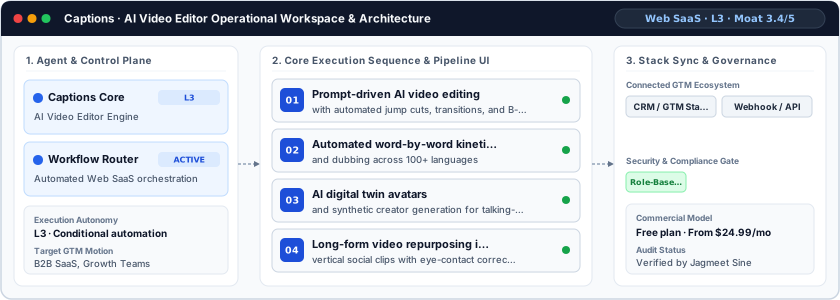
- Prompt-driven AI video editing: with automated jump cuts, transitions, and B-roll
- Automated word-by-word kinetic captioning: and dubbing across 100+ languages
- AI digital twin avatars: and synthetic creator generation for talking-head ads
- Long-form video repurposing into: vertical social clips with eye-contact correction
Cons: operational limitations & risks
- Generative Credit Depletion Bottleneck: A primary operational trade-off is that rendering high-resolution synthetic avatars and multilingual lip-synced dubs consumes monthly credit pools rapidly, creating a cost bottleneck for high-volume ad testing.
- Timeline Precision Limitation: Because the editor prioritizes automated prompt-driven assembly, it struggles with frame-accurate multi-track keyframing and color grading, presenting a workflow limitation for traditional commercial film editors.
- Synthetic Lip-Sync Latency and Artifacts: Complex rapid-speech translations and expressive head movements can introduce rendering latency or subtle lip-sync artifacts that require human quality review before paid media deployment.
Captions TCO & deal-breaker stress test
Simulate 12-month stepped TCO, hidden cost multipliers, contract lock-in exposure, and stack failure modes using only facts verified by Jagmeet Sine on · Capture SHA bc0a39ec.
Captions aligns with your 5-seat / $800/mo profile. Review the walk-away triggers and contract levers below before deployment.
| Plan / Tier | Verified Rate | Scale Fit | Scope & Quota Notes |
|---|---|---|---|
| Free / Sandbox | $0 | 1–2 seats (Evaluation) | Entry free tier with capped usage or feature quotas for initial workflow testing. |
| Entry / Starter | $24.99/mo | 1–2 seats | Access our library of curated AI Edit styles |
| Growth / Professional | $69.99/mo | 5 seats | Verified $69.99/mo tier from vendor pricing schedule. |
- Moat Score
- 3.4 / 5.0
- AI Autonomy
- L3
- Free Tier / Trial
- Free plan
Triggered audit signals & failure modes
- Published Self-Serve Entry FloorVerified Pricing Ledger
Captions publishes a transparent entry point (Free plan · From $24.99/mo) with a free tier for initial validation before committing.
- Tier Fit for 5-Seat Scale: Growth / Professional ($69.99/mo)Verified Tier Schedule
Verified $69.99/mo tier from vendor pricing schedule.
- Primary Operational Bottleneck: Generative Credit Depletion BottleneckAudit by Jagmeet Sine
A primary operational trade-off is that rendering high-resolution synthetic avatars and multilingual lip-synced dubs consumes monthly credit pools rapidly, creating a cost bottleneck for high-volume ad testing.
Hidden TCO Multipliers & Quota Gates
- Credit & Usage Burn Multiplier: Automated workflows consume metered credits/usage quotas; multi-step enrichment, voice minutes, or high-frequency agent runs can trigger mid-cycle top-up packs.
- Generative Credit Depletion Bottleneck: A primary operational trade-off is that rendering high-resolution synthetic avatars and multilingual lip-synced dubs consumes monthly credit pools rapidly, creating a cost bottleneck for high-volume ad testing.
- Timeline Precision Limitation: Because the editor prioritizes automated prompt-driven assembly, it struggles with frame-accurate multi-track keyframing and color grading, presenting a workflow limitation for traditional commercial film editors.
When to Walk Away & Negotiation Levers
- Walk away if your workflow requires uncapped enterprise volume on the Free plan · From $24.99/mo entry plan without upgrading tiers.
- Walk away if your workflow cannot tolerate generative credit depletion bottleneck: A primary operational trade-off is that rendering high-resolution synthetic avatars and multilingual lip-synced dubs consumes monthly credit pools rapidly, creating a cost bottleneck for high-volume ad testing.
- Walk away if timeline precision limitation is a deal-breaker for your team: Because the editor prioritizes automated prompt-driven assembly, it struggles with frame-accurate multi-track keyframing and color grading, presenting a workflow limitation for traditional commercial film editors.
- Validate exact quota thresholds (seats, credits, or API calls) included in Captions's Free plan · From $24.99/mo tier before converting from monthly to annual billing.
- Require a sandbox proof-of-concept testing generative credit depletion bottleneck against your live CRM/data schema before annual sign-off.
Ask a custom procurement or TCO stress-test question about Captions
Lower 5-seat floor (~$29/mo vs. $70 / mo)
Lower 5-seat floor (~$15/mo vs. $70 / mo)
Captions moat & subtrack positioning
High creator adoption combined with an integrated multimodal pipeline spanning speech-to-text styling, eye-contact neural correction, and synthetic avatar generation drives strong workflow stickiness.
Editorial review
Fact-checked by Jagmeet Sine (Senior MarTech Infrastructure & Agentic Workflow Architect) on .
Background
Founded in 2021 by Gaurav Misra and Dwight Churchill and headquartered in New York, NY, Captions (operating corporately alongside its generative research identity Mirage at trymirage) is an AI-powered video production and repurposing studio built for performance marketers, social media teams, and short-form creators. Backed by $175M in total funding across Series C and debt financing rounds from Andreessen Horowitz, Sequoia Capital, General Catalyst, Index Ventures, and SV Angel, the 101-to-250-employee company compresses the post-production lifecycle of talking-head videos and UGC ads. Instead of manually scrubbing timelines in desktop non-linear editors, marketers upload raw footage or scripts to produce captioned, localized vertical video assets for TikTok, Instagram Reels, and YouTube Shorts.
How Captions works
Captions operates at Level 3 autonomy by chaining automatic speech recognition, computer vision, and generative video diffusion models inside a unified cloud studio. When a user uploads a recording, the engine transcribes spoken audio, excises filler pauses, applies word-by-word kinetic typography, and inserts contextually matched B-roll, background scores, and sound effects. Its neural vision models perform real-time eye-contact correction and voice denoising, while its synthetic avatar and Mirage generative modules allow brands to mint digital twins or cast AI actors to deliver localized ad scripts across more than 100 languages.
Limitations
Operational limitations and technical trade-offs include:
- Generative Credit Depletion Bottleneck: A primary operational trade-off is that rendering high-resolution synthetic avatars and multilingual lip-synced dubs consumes monthly credit pools rapidly, creating a cost bottleneck for high-volume ad testing.
- Timeline Precision Limitation: Because the editor prioritizes automated prompt-driven assembly, it struggles with frame-accurate multi-track keyframing and color grading, presenting a workflow limitation for traditional commercial film editors.
- Synthetic Lip-Sync Latency and Artifacts: Complex rapid-speech translations and expressive head movements can introduce rendering latency or subtle lip-sync artifacts that require human quality review before paid media deployment.
Captions pricing
Captions offers a freemium subscription structure paired with credit-tiered paid plans. Alongside its Free plan for basic experimentation, the Max plan starts at $24.99/mo with 500 monthly credits, while the Scale / Frontier self-serve tier starts at $69.99/mo for 1,400 monthly credits. Custom Enterprise contracts provide tailored credit pools, dedicated concurrency, custom invoicing, and formal opt-outs from customer data model training.
How Captions compares
Within the AI Video Editor and AI Video Repurposing & Shorts Editing category, Captions competes against transcript-driven and multimodal editors including Descript, Kapwing AI, and Kite. Whereas Descript focuses heavily on document-style podcast and screencast editing and Kapwing AI emphasizes collaborative browser templates, Captions differentiates itself through mobile-first kinetic styling, neural eye-contact correction, and foundational synthetic actor models. Direct-to-consumer performance acquisition teams rely on Captions to scale high-frequency UGC ad variants, while long-form documentary and corporate video teams often pair it with traditional NLE suites.
Frequently asked questions about Captions
How much does Captions cost and what pricing tiers are available?
Published pricing summary for Captions: Free plan · From $24.99/mo. Captions includes a free tier or sandbox entry point. Verified tier schedule: Free / Sandbox ($0 for 1–2 seats (Evaluation)); Entry / Starter ($24.99/mo for 1–2 seats); Growth / Professional ($69.99/mo for 5 seats). Captions offers a freemium subscription structure paired with credit-tiered paid plans. Alongside its Free plan for basic experimentation, the Max plan starts at $24.99/mo with 500 monthly credits, while the Scale / Frontier self-serve tier starts at $69.99/mo for 1,400 monthly credits.
How does Captions work and how autonomous is its AI architecture?
AI video editing and repurposing studio automating captions, scene cuts, B-roll insertion, digital twin avatars, and multilingual dubbing. Within AI Video Editor (AI Video Repurposing & Shorts Editing), MarTechRadar rates its execution architecture at L3 · Conditional automation with a verified Moat Score of 3.4 / 5.0 (Workflow-embedded (strong)). High creator adoption combined with an integrated multimodal pipeline spanning speech-to-text styling, eye-contact neural correction, and synthetic avatar generation drives strong workflow stickiness.
What are the main limitations of Captions and when should buyers walk away?
Based on our editorial technical audit, key operational considerations and boundaries for Captions include: (1) Generative Credit Depletion Bottleneck: A primary operational trade-off is that rendering high-resolution synthetic avatars and multilingual lip-synced dubs consumes monthly credit pools rapidly, creating a cost bottleneck for high-volume ad testing. (2) Timeline Precision Limitation: Because the editor prioritizes automated prompt-driven assembly, it struggles with frame-accurate multi-track keyframing and color grading, presenting a workflow limitation for traditional commercial film editors. (3) Synthetic Lip-Sync Latency and Artifacts: Complex rapid-speech translations and expressive head movements can introduce rendering latency or subtle lip-sync artifacts that require human quality review before paid media deployment. Primary procurement walk-away rule: Walk away if your workflow requires uncapped enterprise volume on the Free plan · From $24.99/mo entry plan without upgrading tiers.
What integrations, compliance certifications, and contract terms apply to Captions?
First-party governance and developer endpoints verified on domain include: API Docs (https://captions.ai/help/docs/ai-usage). Key TCO multiplier to watch: Credit & Usage Burn Multiplier (Automated workflows consume metered credits/usage quotas; multi-step enrichment, voice minutes, or high-frequency agent runs can trigger mid-cycle top-up packs.) Before signing a contract, procurement teams should validate exact quota thresholds (seats, credits, or API calls) included in Captions's Free plan · From $24.99/mo tier before converting from monthly to annual billing.
What are the best Captions alternatives and head-to-head competitors in 2026?
Top fact-checked alternatives to Captions in AI Video Editor (AI Video Repurposing & Shorts Editing) include CreatorKit (Free plan · $0/mo · Enterprise plan), Clipchamp (Custom / enterprise pricing), AutoPod (From $29/mo), Opus Clip (Free plan · $15–$29/mo). Within the AI Video Editor and AI Video Repurposing & Shorts Editing category, Captions competes against transcript-driven and multimodal editors including Descript, Kapwing AI, and Kite.
Verified sources & evidence trail
- Official product domain: https://captions.ai
- Commercial pricing verification: https://captions.ai/pricing
- Verified corporate entity profiles (
sameAs): LinkedIn Company Profile · Crunchbase Entity Record - First-party governance & documentation links: API & Docs
- Editorial audit sign-off: Fact-checked by Jagmeet Sine on under the MarTechRadar Evidence-Ledger Protocol.