Munch Review (2026): AI Video Editor Pricing, Pros & Cons
Bottom line
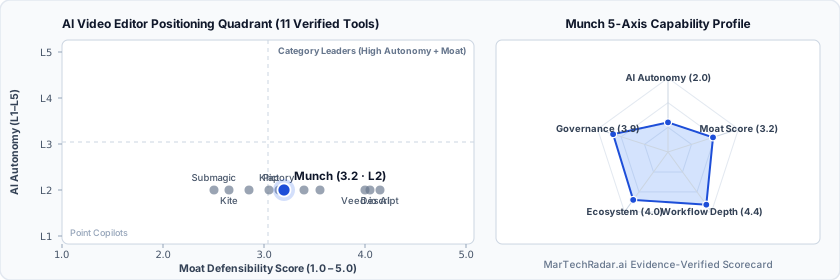
Munch is a Web SaaS tool for AI Video Editor (AI Video Repurposing & Shorts Editing) in Visual & Creative Media. Pricing: $38–$398/mo. Best suited to Enterprise Brands. Editor ratings: AI autonomy L2 (workflow copilot); moat score 3.2/5.0 (Workflow-embedded (strong)). Fact-checked by MarTechRadar Research Desk on Oct 7, 2026.
AI-powered video repurposing platform that extracts high-engagement vertical short clips from long-form videos using multimodal speech and visual analysis.
Is Munch worth it in 2026? Buyer fit & when to walk away
Choose Munch if (Best Fit)
- Target ICP & Stack Fit: You operate as Enterprise Brands requiring a Web SaaS deployment for AI Video Editor, with verified ecosystem connectivity for Twilio Segment, Intercom.
- L2 Architecture & Defensibility: Proprietary clip scoring models that combine speech diarization, semantic context extraction, and dynamic active-speaker visual tracking, reducing the human editing loop required for multi-channel video distribution.
- Commercial Model Fit: Your procurement budget aligns with $38–$398/mo.
Walk away from Munch if (Deal-Breakers)
- Walk away if your workflow cannot tolerate audio track separation: Acoustic cross-talk and overlapping dialogue degrade transcription accuracy and speaker diarization, requiring manual text corrections.
- Walk away if multi-subject framing is a deal-breaker for your team: Rapid multi-speaker exchanges can confuse dynamic re-centering algorithms, causing jerky reframing cuts that require manual keyframe adjustments.
Munch pricing, free plan & scorecard at a glance
| Pricing | $38–$398/moVendor pricing page |
|---|---|
| Free plan | No / not disclosed |
| Delivery | Web SaaS |
| Audience | Enterprise Brands |
| AI autonomy level | L2 · Workflow copilotEditor-verified |
| Moat tier & score | 3.2 / 5.0 · Workflow-embedded (strong)Editor-verified |
| Funding | Seed |
| Total funding | $7.2MBacked by A* Capital, Cardumen Capital |
| Founders | Oren Kandel, Peter Naftaliev |
| Company size | 11-50 employees |
| Ecosystem integrations | Twilio Segment, Intercom |
| Governance & docs | Terms ↗ · Privacy ↗ |
| Headquarters | Tel Aviv, IL |
| Founded | 2021 |
| Last verified | Oct 20, 2026 |
Munch pros & cons: strengths vs. operational limitations
Pros: core strengths & capabilities
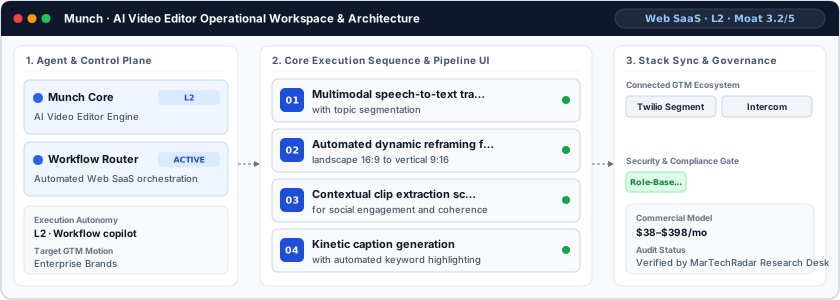
- Multimodal speech-to-text transcript processing: with topic segmentation
- Automated dynamic reframing from landscape 16:9 to vertical 9:16
- Contextual clip extraction scored: for social engagement and coherence
- Kinetic caption generation: with automated keyword highlighting
Cons: operational limitations & risks
- Audio Track Separation: Acoustic cross-talk and overlapping dialogue degrade transcription accuracy and speaker diarization, requiring manual text corrections.
- Multi-Subject Framing: Rapid multi-speaker exchanges can confuse dynamic re-centering algorithms, causing jerky reframing cuts that require manual keyframe adjustments.
- Contextual Coherence Boundaries: Heuristic virality scoring often extracts segments without critical setup context, requiring editorial oversight to ensure conceptual completeness.
Munch TCO & deal-breaker stress test
Simulate 12-month stepped TCO, hidden cost multipliers, contract lock-in exposure, and stack failure modes using only facts verified by MarTechRadar Research Desk on 2026-10-07 · Capture SHA 1773c692.
Munch aligns with your 5-seat / $800/mo profile. Review the walk-away triggers and contract levers below before deployment.
- Moat Score
- 3.2 / 5.0
- AI Autonomy
- L2
- Free Tier / Trial
- None disclosed
Triggered audit signals & failure modes
- Published Self-Serve Entry FloorVerified Pricing Ledger
Munch publishes a transparent entry point ($38–$398/mo) for initial validation before committing.
- Primary Operational Bottleneck: Audio Track SeparationAudit by MarTechRadar Research Desk
Acoustic cross-talk and overlapping dialogue degrade transcription accuracy and speaker diarization, requiring manual text corrections.
Test a custom Munch budget or stack constraint
Lower 5-seat floor (~$16/mo vs. From $38 / mo)
Lower 5-seat floor (~$25/mo vs. From $38 / mo)
Munch integrations, API, security & compliance stack
Munch AI moat & AI Video Editor positioning
Proprietary clip scoring models that combine speech diarization, semantic context extraction, and dynamic active-speaker visual tracking, reducing the human editing loop required for multi-channel video distribution.
Munch in-depth review, pricing & architecture analysis
Editor sign-off: Oct 7, 2026. How profiles are made.
What is Munch? Overview & background
Munch, established in 2021 in Tel Aviv, IL, provides an automated content pipeline designed to address the operational bottleneck of extracting short-form video from long-form media. Backed by $7.2M in funding, the platform targets performance marketing teams, agency editors, and brand social media managers seeking to convert webinars, podcasts, and video presentations into cross-platform social assets. By shifting video editing from manual timeline cutting to automated segmentation, Munch streamlines post-production workflows for multi-channel digital distribution.
How Munch works: architecture & workflow
At an architectural level, Munch executes a multimodal processing pipeline to transform raw footage into structured derivative clips. When long-form video enters the system, natural language processing models transcribe the audio track and segment speech into thematic clusters based on semantic coherence. Concurrently, computer vision models track active speakers and visual points of interest to dynamically reframe horizontal 16:9 footage into vertical 9:16 ratios. The engine scores potential segments for topical focus, generates synchronized kinetic captions, and exports platform-ready clips with minimal manual operator intervention, alongside native workflow integrations for Intercom.
Munch limitations, drawbacks & risks
Operational considerations and platform boundaries include:
- Audio Track Separation: Acoustic cross-talk and overlapping dialogue degrade transcription accuracy and speaker diarization, requiring manual text corrections.
- Multi-Subject Framing: Rapid multi-speaker exchanges can confuse dynamic re-centering algorithms, causing jerky reframing cuts that require manual keyframe adjustments.
- Contextual Coherence Boundaries: Heuristic virality scoring often extracts segments without critical setup context, requiring editorial oversight to ensure conceptual completeness.
Munch pricing, plans & cost breakdown
Munch monetizes via a tiered subscription model structured around processing volume and feature tiers. Entry pricing begins at $38 per month on annualized commitments, granting baseline minute ingestion and automated clip outputs. Upper-tier packages extend processing capacities and multi-brand configurations up to $398 per month, scaling storage allotments, export quotas, and agency workflow controls.
| Plan / Tier | Verified Price & Billing | Included Scope & Contract Terms |
|---|---|---|
| Essential | $38/mo | Billed annually · $456 per year |
How Munch compares vs. competitors & alternatives
Within the video repurposing sector, Munch differentiates itself against Descript, Kapwing AI, and Kite through focused multimodal clip extraction rather than open-ended timeline manipulation within the AI Video Editor segment. While Descript emphasizes full-scale audio-first document editing and Kapwing AI serves as a browser-based collaborative canvas, Munch automates vertical reframing and topic extraction. It functions effectively for mid-market content teams that prioritize automated volume generation over granular timeline editing.
Direct competitors & market radar
Top algorithmic competitors based on category positioning, capability overlap, and ICP alignment.
Frequently asked questions about Munch
How much does Munch cost in 2026?
Munch pricing: $38–$398/mo. No free plan is publicly disclosed. Munch monetizes via a tiered subscription model structured around processing volume and feature tiers. Entry pricing begins at $38 per month on annualized commitments, granting baseline minute ingestion and automated clip outputs.
What are the top Munch alternatives in AI Video Editor?
Verified AI Video Editor alternatives include Kite (From $40/mo), Descript (Free plan · $16–$65/mo · Enterprise plan), Kapwing AI (Free plan · $16–$50/mo), Vidyo.ai ($7–$49/mo). Within the video repurposing sector, Munch differentiates itself against Descript, Kapwing AI, and Kite through focused multimodal clip extraction rather than open-ended timeline manipulation within the AI Video Editor segment.
What are the main limitations and trade-offs of Munch?
Operational considerations and platform boundaries include: Audio Track Separation: Acoustic cross-talk and overlapping dialogue degrade transcription accuracy and speaker diarization, requiring manual text corrections. Walk away if your workflow cannot tolerate audio track separation: Acoustic cross-talk and overlapping dialogue degrade transcription accuracy and speaker diarization, requiring manual text corrections.
Verified sources & evidence trail
- Official product domain: https://getmunch.com
- Commercial pricing verification: https://www.munchstudio.com/pricing
- Verified corporate entity profiles (
sameAs): LinkedIn Company Profile · Crunchbase Entity Record - First-party governance & documentation links: Terms · Privacy
- Editor sign-off: Oct 7, 2026 (how profiles are made).
