Kite Review (2026): AI Video Editor Pricing, Limits & Alternatives
Bottom line
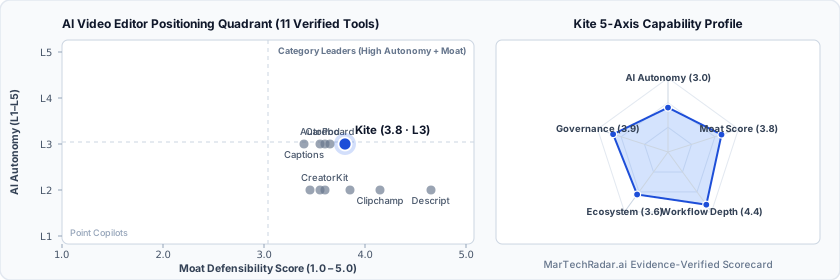
Kite is a Web SaaS tool for AI Video Editor (AI Video Repurposing & Shorts Editing) in Visual & Creative Media. Pricing: From $40/mo. Best suited to Growth Marketing Teams and Digital Marketing Leaders. Editor ratings: AI autonomy L3 (conditional automation); moat score 3.8/5.0 (Proprietary moat). Fact-checked by Tim Fenolz on Oct 11, 2026.
Kite is an AI-assisted screen recording and video styling application that converts desktop and mobile software captures into studio-grade product demo.
Kite buyer fit verdict: when to choose vs. when to walk away
Choose Kite if (Best Fit)
- Target ICP & Stack Fit: You operate as Growth Marketing Teams and Digital Marketing Leaders requiring a Web SaaS deployment for AI Video Editor, with verified ecosystem connectivity for Zoom.
- L3 Architecture & Defensibility: Kite builds defensibility around automated cursor-tracking mechanics, dynamic 3D camera transforms, and integrated synthetic narration, packaging high-end motion graphics into an accessible desktop workflow for product demonstration content.
- Commercial Model Fit: Your procurement budget aligns with From $40/mo.
Walk away from Kite if (Deal-Breakers)
- Walk away if your workflow requires uncapped enterprise volume on the From $40/mo entry plan without upgrading tiers.
- Walk away if your workflow cannot tolerate native os ingestion boundaries: The capture pipeline relies heavily on macOS-centric display frameworks, limiting native dynamic viewport automation for non-Apple developer environments and pure Linux workstations.
- Walk away if algorithmic focal misalignment is a deal-breaker for your team: Heuristic cursor tracking can trigger unintended camera zooms during rapid, erratic mouse gestures, requiring operators to manually override keyframe targets within dense software interfaces.
Kite key facts & scorecard
| Pricing | From $40/moVendor pricing page |
|---|---|
| Free plan | No / not disclosed |
| Delivery | Web SaaS |
| Audience | Growth Marketing Teams, Digital Marketing Leaders |
| AI autonomy level | L3 · Conditional automationEditor-verified |
| Moat tier & score | 3.8 / 5.0 · Proprietary moatEditor-verified |
| Funding | Pre-seed |
| Total funding | $500KBacked by StartEngine |
| Founders | Derek Feehrer, Todd Ashley |
| Company size | 2-10 employees |
| Ecosystem integrations | Zoom |
| Governance & docs | Trust & Security ↗ · Terms ↗ · Privacy ↗ |
| Headquarters | San Francisco, California, United States |
| Founded | 2023 |
| Last verified |
Kite pros & cons: strengths vs. operational limitations
Pros: core strengths & capabilities
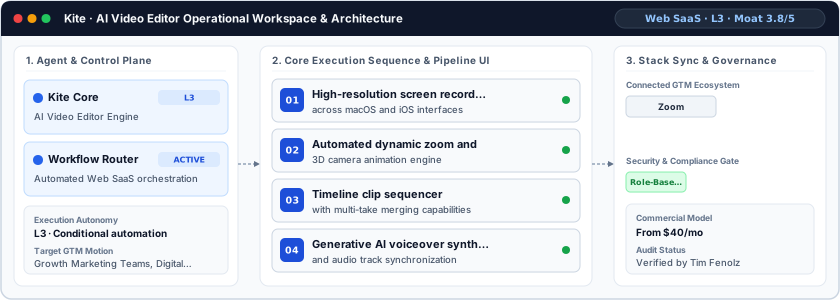
- High-resolution screen recording: across macOS and iOS interfaces
- Automated dynamic zoom and: 3D camera animation engine
- Timeline clip sequencer: with multi-take merging capabilities
- Generative AI voiceover synthesis: and audio track synchronization
Cons: operational limitations & risks
- Native OS Ingestion Boundaries: The capture pipeline relies heavily on macOS-centric display frameworks, limiting native dynamic viewport automation for non-Apple developer environments and pure Linux workstations.
- Algorithmic Focal Misalignment: Heuristic cursor tracking can trigger unintended camera zooms during rapid, erratic mouse gestures, requiring operators to manually override keyframe targets within dense software interfaces.
- Render Latency on Complex Projects: Applying multi-layer 3D perspective transforms alongside synthetic audio rendering creates significant client-side hardware compute overhead on entry-level host machines.
Kite TCO & deal-breaker stress test
Simulate 12-month stepped TCO, hidden cost multipliers, contract lock-in exposure, and stack failure modes using only facts verified by Tim Fenolz on · Capture SHA ce57f9c6.
Kite aligns with your 5-seat / $800/mo profile. Review the walk-away triggers and contract levers below before deployment.
| Plan / Tier | Verified Rate | Scale Fit | Scope & Quota Notes |
|---|---|---|---|
| Pro | $40/mo | 1–2 seats | per month, billed yearly |
| Team | $55/mo | 5 seats | per seat, billed yearly |
| Scale / Advanced | $165/mo | 15 seats | Cloud project sharing |
- Moat Score
- 3.8 / 5.0
- AI Autonomy
- L3
- Free Tier / Trial
- None disclosed
Triggered audit signals & failure modes
- Published Self-Serve Entry FloorVerified Pricing Ledger
Kite publishes a transparent entry point (From $40/mo) for initial validation before committing.
- Tier Fit for 5-Seat Scale: Team ($55/mo)Verified Tier Schedule
per seat, billed yearly
- Primary Operational Bottleneck: Native OS Ingestion BoundariesAudit by Tim Fenolz
The capture pipeline relies heavily on macOS-centric display frameworks, limiting native dynamic viewport automation for non-Apple developer environments and pure Linux workstations.
Hidden TCO Multipliers & Quota Gates
- Per-Seat Linear Scaling: Kite prices licenses on a per-user/seat basis (From $40/mo); expanding from 2 to 15+ operators multiplies base recurring spend linearly.
- Annual Billing Headline vs. Monthly Premium: Headline entry rates reflect annual billing commitments (Save 30%); month-to-month flexibility carries a higher effective monthly rate or requires annual prepayment.
- Enterprise Governance & Add-On Gating: Advanced capabilities such as Single Sign-On (SSO), custom role permissions, or specialized analytics modules are gated behind upper tiers or paid add-ons.
When to Walk Away & Negotiation Levers
- Walk away if your workflow requires uncapped enterprise volume on the From $40/mo entry plan without upgrading tiers.
- Walk away if your workflow cannot tolerate native os ingestion boundaries: The capture pipeline relies heavily on macOS-centric display frameworks, limiting native dynamic viewport automation for non-Apple developer environments and pure Linux workstations.
- Walk away if algorithmic focal misalignment is a deal-breaker for your team: Heuristic cursor tracking can trigger unintended camera zooms during rapid, erratic mouse gestures, requiring operators to manually override keyframe targets within dense software interfaces.
- Validate exact quota thresholds (seats, credits, or API calls) included in Kite's From $40/mo tier before converting from monthly to annual billing.
- Require a sandbox proof-of-concept testing native os ingestion boundaries against your live CRM/data schema before annual sign-off.
Ask a custom procurement or TCO stress-test question about Kite
Lower 5-seat floor (~$16/mo vs. $55 / mo)
Lower 5-seat floor (~$10/mo vs. $55 / mo)
Kite key entities, modules & ecosystem stack
Kite moat & subtrack positioning
Kite builds defensibility around automated cursor-tracking mechanics, dynamic 3D camera transforms, and integrated synthetic narration, packaging high-end motion graphics into an accessible desktop workflow for product demonstration content.
Editorial review
Fact-checked by Tim Fenolz (Lead AdTech, Programmatic & Attribution Analyst) on .
Background
Architected to bridge the structural gap between raw desktop screencasting and motion graphics production, Kite operates as a specialized screen recording engine for product marketers and technical sales teams. Established in 2023 and headquartered in San Francisco, California, United States, the company secured $500K in early venture backing to build its automated presentation pipeline. The software automates visual post-production by translating raw operating system inputs into polished, high-fidelity software walk-throughs and commercial assets.
How Kite works
At an architectural level, Kite processes raw display capture streams through a desktop recording engine targeting macOS and connected iOS devices. The underlying rendering engine tracks cursor vectors, active click states, and viewport coordinates to automatically calculate focal points. Kite applies smoothed bezier camera paths, 3D perspective tilts, and procedural zooms onto recorded interactions. An integrated generative audio layer synthesizes script-based AI voiceovers, aligning spoken cues directly with cursor movements, kinetic typography overlays, and automated timeline clip splices without manual keyframing.
Limitations
Operational considerations and platform boundaries include:
- Native OS Ingestion Boundaries: The capture pipeline relies heavily on macOS-centric display frameworks, limiting native dynamic viewport automation for non-Apple developer environments and pure Linux workstations.
- Algorithmic Focal Misalignment: Heuristic cursor tracking can trigger unintended camera zooms during rapid, erratic mouse gestures, requiring operators to manually override keyframe targets within dense software interfaces.
- Render Latency on Complex Projects: Applying multi-layer 3D perspective transforms alongside synthetic audio rendering creates significant client-side hardware compute overhead on entry-level host machines.
Kite pricing
Kite delivers its software capabilities through a direct subscription licensing framework. Access to the commercial tier begins at $40/month, unlocking the core screen recording suite, automated 3D zooming, and generative voiceover generation. Scaled usage tiers step up to $55 or $165 for teams requiring higher export volumes, multi-seat project management, and extended video asset libraries.
How Kite compares
Within the video repurposing ecosystem, Kite distinguishes itself from multi-track editing suites like Descript, Kapwing AI, and Munch by focusing squarely on procedural UI motion graphics rather than transcript-based clipping or social distribution. While Descript and Kapwing AI prioritize timeline-based podcast and dialog editing, Kite excels at turning silent, raw interface interactions into cinematic product commercials. The solution is ideal for high-growth software teams seeking scalable product marketing videos without dedicating dedicated motion design resources.
Direct competitors & market radar
Top algorithmic competitors based on category positioning, capability overlap, and ICP alignment.
Frequently asked questions about Kite
How much does Kite cost and what pricing tiers are available?
Published pricing summary for Kite: From $40/mo. A permanent free plan is not disclosed for Kite. Verified tier schedule: Pro ($40/mo for 1–2 seats); Team ($55/mo for 5 seats); Scale / Advanced ($165/mo for 15 seats). Kite delivers its software capabilities through a direct subscription licensing framework. Access to the commercial tier begins at $40/month, unlocking the core screen recording suite, automated 3D zooming, and generative voiceover generation.
How does Kite work and how autonomous is its AI architecture?
Kite is an AI-assisted screen recording and video styling application that converts desktop and mobile software captures into studio-grade product demo. Within AI Video Editor (AI Video Repurposing & Shorts Editing), MarTechRadar rates its execution architecture at L3 · Conditional automation with a verified Moat Score of 3.8 / 5.0 (Proprietary moat). Kite builds defensibility around automated cursor-tracking mechanics, dynamic 3D camera transforms, and integrated synthetic narration, packaging high-end motion graphics into an accessible desktop workflow for product demonstration content. Corporate profile: Founded by Derek Feehrer, Todd Ashley, operating at 2-10 employees scale.
What are the main limitations of Kite and when should buyers walk away?
Based on our editorial technical audit, key operational considerations and boundaries for Kite include: (1) Native OS Ingestion Boundaries: The capture pipeline relies heavily on macOS-centric display frameworks, limiting native dynamic viewport automation for non-Apple developer environments and pure Linux workstations. (2) Algorithmic Focal Misalignment: Heuristic cursor tracking can trigger unintended camera zooms during rapid, erratic mouse gestures, requiring operators to manually override keyframe targets within dense software interfaces. (3) Render Latency on Complex Projects: Applying multi-layer 3D perspective transforms alongside synthetic audio rendering creates significant client-side hardware compute overhead on entry-level host machines. Primary procurement walk-away rule: Walk away if your workflow requires uncapped enterprise volume on the From $40/mo entry plan without upgrading tiers.
What integrations, compliance certifications, and contract terms apply to Kite?
Verified ecosystem and stack integrations include Zoom. First-party governance and developer endpoints verified on domain include: Trust/Security (https://trust.kite.video). Key TCO multiplier to watch: Per-Seat Linear Scaling (Kite prices licenses on a per-user/seat basis (From $40/mo); expanding from 2 to 15+ operators multiplies base recurring spend linearly.) Before signing a contract, procurement teams should validate exact quota thresholds (seats, credits, or API calls) included in Kite's From $40/mo tier before converting from monthly to annual billing.
What are the best Kite alternatives and head-to-head competitors in 2026?
Top fact-checked alternatives to Kite in AI Video Editor (AI Video Repurposing & Shorts Editing) include Munch ($38–$398/mo), Descript (Free plan · $16–$65/mo · Enterprise plan), Veed.io AI (From $10/mo), Kapwing AI (Free plan · $16–$50/mo). Within the video repurposing ecosystem, Kite distinguishes itself from multi-track editing suites like Descript, Kapwing AI, and Munch by focusing squarely on procedural UI motion graphics rather than transcript-based clipping or social distribution.
Verified sources & evidence trail
- Official product domain: https://kite.video/
- Commercial pricing verification: https://kite.video/pricing
- Verified corporate entity profiles (
sameAs): LinkedIn Company Profile · Crunchbase Entity Record - First-party governance & documentation links: Trust & Security · Terms · Privacy
- Editorial audit sign-off: Fact-checked by Tim Fenolz on under the MarTechRadar Evidence-Ledger Protocol.