AutoPod Review (2026): AI Video Editor Pricing, Pros & Cons
Bottom line
AutoPod is a Web SaaS tool for AI Video Editor (AI Video Repurposing & Shorts Editing) in Visual & Creative Media. Pricing: From $29/mo. Best suited to Creators / Solo. Editor ratings: AI autonomy L2 (workflow copilot); moat score 2.1/5.0 (Workflow-embedded). Fact-checked by MarTechRadar Research Desk on Oct 16, 2026.
Adobe Premiere Pro automation plugin suite that algorithmically executes multi-camera switching, social clip creation, and jump cuts from audio waveforms.
Is AutoPod worth it in 2026? Buyer fit & when to walk away
Choose AutoPod if (Best Fit)
- Target ICP & Stack Fit: You operate as Creators / Solo requiring a Web SaaS deployment for AI Video Editor.
- L2 Architecture & Defensibility: Deep host-application lock-in via Adobe Premiere Pro panel APIs and local multi-track waveform heuristic algorithms, delivering immediate NLE execution without offloading footage to external cloud infrastructure.
- Commercial Model Fit: Your procurement budget aligns with From $29/mo.
Walk away from AutoPod if (Deal-Breakers)
- Walk away if your workflow cannot tolerate crosstalk sensitivity: High ambient noise floor or heavy acoustic bleed between studio microphones disrupts decibel threshold gating, triggering false-positive angle switches during active cross-talk.
- Walk away if nle dependency is a deal-breaker for your team: Architectural coupling exclusively to Adobe Premiere Pro prevents deployment in DaVinci Resolve or Final Cut Pro environments, creating vendor lock-in for editorial pipelines.
AutoPod pricing, free plan & scorecard at a glance
| Pricing | From $29/moVendor pricing page |
|---|---|
| Free plan | No / not disclosed |
| Delivery | Web SaaS |
| Audience | Creators / Solo |
| AI autonomy level | L2 · Workflow copilotEditor-verified |
| Moat tier & score | 2.1 / 5.0 · Workflow-embeddedEditor-verified |
| Funding | Undisclosed |
| Governance & docs | Privacy ↗ |
| Headquarters | United States |
| Last verified | Oct 16, 2026 |
AutoPod pros & cons: strengths vs. operational limitations
Pros: core strengths & capabilities
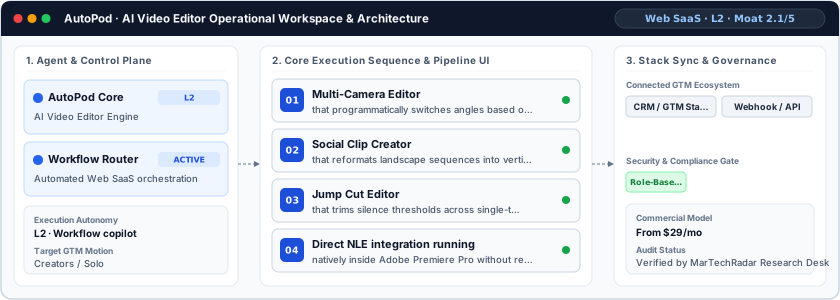
- Multi-Camera Editor: that programmatically switches angles based on individual audio channel decibel spikes and active speakers
- Social Clip Creator: that reformats landscape sequences into vertical social video with automated speaker reframing
- Jump Cut Editor: that trims silence thresholds across single-track and multi-track dialogue clips
- Direct NLE integration running: natively inside Adobe Premiere Pro without requiring external timeline exports
Cons: operational limitations & risks
- Crosstalk Sensitivity: High ambient noise floor or heavy acoustic bleed between studio microphones disrupts decibel threshold gating, triggering false-positive angle switches during active cross-talk.
- NLE Dependency: Architectural coupling exclusively to Adobe Premiere Pro prevents deployment in DaVinci Resolve or Final Cut Pro environments, creating vendor lock-in for editorial pipelines.
- Machine Node Licensing: Node-locked machine activation creates administrative friction when scaling render farms or rotating editors across distributed multi-seat post-production studios.
AutoPod TCO & deal-breaker stress test
Simulate 12-month stepped TCO, hidden cost multipliers, contract lock-in exposure, and stack failure modes using only facts verified by MarTechRadar Research Desk on 2026-10-16 · Capture SHA 8d8428cd.
AutoPod aligns with your 5-seat / $800/mo profile. Review the walk-away triggers and contract levers below before deployment.
- Moat Score
- 2.1 / 5.0
- AI Autonomy
- L2
- Free Tier / Trial
- None disclosed
Triggered audit signals & failure modes
- Published Self-Serve Entry FloorVerified Pricing Ledger
AutoPod publishes a transparent entry point (From $29/mo) for initial validation before committing.
- Primary Operational Bottleneck: NLE DependencyAudit by MarTechRadar Research Desk
Architectural coupling exclusively to Adobe Premiere Pro prevents deployment in DaVinci Resolve or Final Cut Pro environments, creating vendor lock-in for editorial pipelines.
Test a custom AutoPod budget or stack constraint
Lower 5-seat floor (~$15/mo vs. From $29 / mo)
Lower 5-seat floor (~$14/mo vs. From $29 / mo)
AutoPod AI moat & AI Video Editor positioning
Deep host-application lock-in via Adobe Premiere Pro panel APIs and local multi-track waveform heuristic algorithms, delivering immediate NLE execution without offloading footage to external cloud infrastructure.
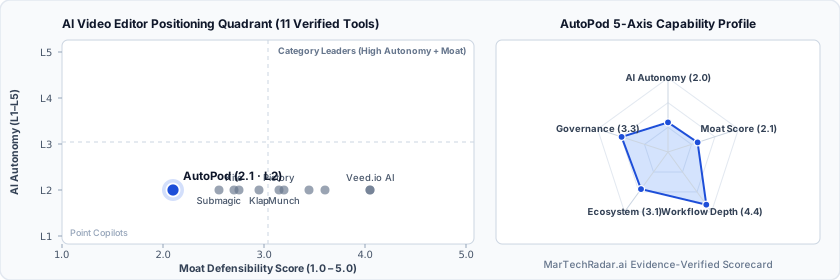
AutoPod in-depth review, pricing & architecture analysis
Editor sign-off: Oct 16, 2026. How profiles are made.
What is AutoPod? Overview & background
For post-production houses and podcast networks managing multi-track studio recordings, timeline assembly often bottlenecks delivery schedules. Based in the United States, AutoPod operates as a specialized sequence automation suite built directly into the non-linear editing workspace. Targeting professional video editors and post-production supervisors, the platform eliminates manual cutting across multi-camera setups by transforming raw timeline tracks into finished rough cuts. Rather than forcing editors to move footage out of primary editing applications, AutoPod executes algorithmic timeline cutting directly within the production timeline.
How AutoPod works: architecture & workflow
AutoPod operates as an Adobe Premiere Pro extension panel utilizing native non-linear editing APIs to automate cut generation. At an L2 workflow-copilot autonomy tier, the system ingests multi-track audio feeds directly from timeline sequences. Its Multi-Camera Editor applies digital signal processing to calculate speaker audio peaks, gate thresholds, and voice activity across distinct tracks. Based on user-configured rules—such as speaker priority, shot frequency, and wide-shot intervals—the engine executes frame-accurate razor cuts and camera angle switches. Complementary modules handle silent gap truncation and vertical sequence reframing without offloading media assets to cloud endpoints.
AutoPod limitations, drawbacks & risks
Operational considerations and platform boundaries include:
- Crosstalk Sensitivity: High ambient noise floor or heavy acoustic bleed between studio microphones disrupts decibel threshold gating, triggering false-positive angle switches during active cross-talk.
- NLE Dependency: Architectural coupling exclusively to Adobe Premiere Pro prevents deployment in DaVinci Resolve or Final Cut Pro environments, creating vendor lock-in for editorial pipelines.
- Machine Node Licensing: Node-locked machine activation creates administrative friction when scaling render farms or rotating editors across distributed multi-seat post-production studios.
AutoPod pricing, plans & cost breakdown
Commercial access to the plugin suite is structured as an individual seat license priced from $29/month. This deployment includes access to the Multi-Camera Editor, Social Clip Creator, and Jump Cut Editor modules. Commercial billing operates on a per-seat, single-workstation activation framework, allowing editors to license single workstations with license-transfer mechanisms for hardware upgrades.
How AutoPod compares vs. competitors & alternatives
Within the video repurposing domain, AutoPod differs substantially from web-based transcription-first platforms like Descript, Kapwing AI, and Kite. While cloud alternatives ingest compressed source media into hosted ecosystems to generate short clips via automated transcripts, AutoPod maintains all high-bitrate media locally inside the native Adobe NLE. This architecture eliminates multi-gigabyte cloud upload latency and preserves raw codec fidelity. AutoPod suits enterprise post-production studios and high-throughput podcast agencies requiring direct timeline manipulation without altering established non-linear editorial pipelines.
Frequently asked questions about AutoPod
How much does AutoPod cost in 2026?
AutoPod pricing: From $29/mo. No free plan is publicly disclosed. Commercial access to the plugin suite is structured as an individual seat license priced from $29/month. This deployment includes access to the Multi-Camera Editor, Social Clip Creator, and Jump Cut Editor modules.
What are the top AutoPod alternatives in AI Video Editor?
Verified AI Video Editor alternatives include Klap (From $14/mo), Opus Clip (Free plan · $15–$29/mo), CreatorKit (Custom / enterprise pricing), Raw Shorts (Custom / enterprise pricing). Within the video repurposing domain, AutoPod differs substantially from web-based transcription-first platforms like Descript, Kapwing AI, and Kite.
What are the main limitations and trade-offs of AutoPod?
Operational considerations and platform boundaries include: Crosstalk Sensitivity: High ambient noise floor or heavy acoustic bleed between studio microphones disrupts decibel threshold gating, triggering false-positive angle switches during active cross-talk. Walk away if your workflow cannot tolerate crosstalk sensitivity: High ambient noise floor or heavy acoustic bleed between studio microphones disrupts decibel threshold gating, triggering false-positive angle switches during active cross-talk.
Verified sources & evidence trail
- Official product domain: https://autopod.fm
- Commercial pricing verification: https://www.autopod.fm/pricing
- Verified corporate entity profiles (
sameAs): Crunchbase Entity Record - First-party governance & documentation links: Privacy
- Editor sign-off: Oct 16, 2026 (how profiles are made).
