Opus Clip Review (2026): AI Video Editor Pricing, Pros & Cons
Bottom line
Opus Clip is a Web SaaS tool for AI Video Editor (AI Video Repurposing & Shorts Editing) in Visual & Creative Media. Pricing: Free plan · $15–$29/mo. Best suited to Enterprise Brands. Editor ratings: AI autonomy L2 (workflow copilot); moat score 3.2/5.0 (Workflow-embedded (strong)). Fact-checked by MarTechRadar Research Desk on Oct 7, 2026.
Multimodal generative AI platform that parses long-form video recordings to extract, reframe, and subtitle short-form vertical video clips.
Is Opus Clip worth it in 2026? Buyer fit & when to walk away
Choose Opus Clip if (Best Fit)
- Target ICP & Stack Fit: You operate as Enterprise Brands requiring a Web SaaS deployment for AI Video Editor, with verified ecosystem connectivity for Slack, Twilio Segment, Intercom, Zapier.
- L2 Architecture & Defensibility: Proprietary virality scoring model coupled with automated multi-speaker facial tracking and automated transcription alignment, purpose-built for high-throughput social video repurposing.
- Commercial Model Fit: Your procurement budget aligns with Free plan · $15–$29/mo and want a self-serve free tier for zero-cost initial validation.
Walk away from Opus Clip if (Deal-Breakers)
- Walk away if your workflow cannot tolerate algorithmic narrative coherence: The heuristic scoring model occasionally extracts sentence fragments when source audio exhibits rapid conversational overlap, requiring manual boundary re-trimming.
- Walk away if dynamic framing occlusion is a deal-breaker for your team: Multi-subject panning scenes can confuse computer vision face detection, resulting in erratic viewport shifting between adjacent speakers during quick exchanges.
Opus Clip pricing, free plan & scorecard at a glance
| Pricing | Free plan · $15–$29/moVendor pricing page |
|---|---|
| Free plan | Yes |
| Delivery | Web SaaS |
| Audience | Enterprise Brands |
| AI autonomy level | L2 · Workflow copilotEditor-verified |
| Moat tier & score | 3.2 / 5.0 · Workflow-embedded (strong)Editor-verified |
| Funding | Series A |
| Total funding | Series ABacked by Millennium New Horizons, SoftBank Vision Fund 2, DCM Ventures |
| Company size | 51-200 employees |
| Ecosystem integrations | Slack, Twilio Segment, Intercom, Zapier |
| Governance & docs | Trust & Security ↗ · API & Docs ↗ · Terms ↗ · Privacy ↗ |
| Headquarters | Mountain View, California, United States |
| Founded | 2022 |
| Last verified | Oct 7, 2026 |
Opus Clip pros & cons: strengths vs. operational limitations
Pros: core strengths & capabilities
- Multimodal AI clipping engine: with automated virality scoring
- Active speaker facial tracking and dynamic 9:16 re-framing
- Automated animated caption generation: across 20+ languages
- Automated silence and filler: word excision
Cons: operational limitations & risks
- Algorithmic narrative coherence: The heuristic scoring model occasionally extracts sentence fragments when source audio exhibits rapid conversational overlap, requiring manual boundary re-trimming.
- Dynamic framing occlusion: Multi-subject panning scenes can confuse computer vision face detection, resulting in erratic viewport shifting between adjacent speakers during quick exchanges.
- Rendering credit exhaustion: Processing long-form source footage consumes finite processing minutes quickly, restricting continuous batch rendering on baseline credit allocations.
Opus Clip TCO & deal-breaker stress test
Simulate 12-month stepped TCO, hidden cost multipliers, contract lock-in exposure, and stack failure modes using only facts verified by MarTechRadar Research Desk on 2026-10-07 · Capture SHA f3534623.
Opus Clip aligns with your 5-seat / $800/mo profile. Review the walk-away triggers and contract levers below before deployment.
- Moat Score
- 3.2 / 5.0
- AI Autonomy
- L2
- Free Tier / Trial
- Free plan
Triggered audit signals & failure modes
- Published Self-Serve Entry FloorVerified Pricing Ledger
Opus Clip publishes a transparent entry point (Free plan · $15–$29/mo) with a free tier for initial validation before committing.
- Tier Fit for 5-Seat Scale: Pro ($17.4/mo)Verified Tier Schedule
For professional creators, marketers, & teams
- Primary Operational Bottleneck: Rendering credit exhaustionAudit by MarTechRadar Research Desk
Processing long-form source footage consumes finite processing minutes quickly, restricting continuous batch rendering on baseline credit allocations.
Test a custom Opus Clip budget or stack constraint
Lower 5-seat floor (~$16/mo vs. $17 / mo)
Lower 5-seat floor (~$16/mo vs. $17 / mo)
Opus Clip integrations, API, security & compliance stack
Opus Clip AI moat & AI Video Editor positioning
Proprietary virality scoring model coupled with automated multi-speaker facial tracking and automated transcription alignment, purpose-built for high-throughput social video repurposing.
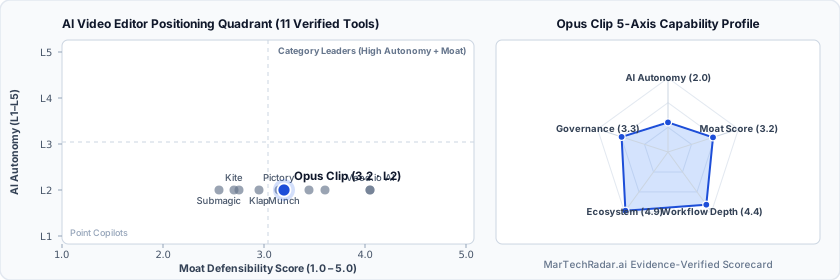
Opus Clip in-depth review, pricing & architecture analysis
Editor sign-off: Oct 7, 2026. How profiles are made.
What is Opus Clip? Overview & background
Opus Clip was founded in 2022 in Mountain View, California, to eliminate the manual editing overhead required to transform long-form recordings into short-form assets. Built for video marketing teams, media brands, and growth operators, the platform replaces manual multi-track timeline editing with automated content extraction. Within video repurposing pipelines, the software isolates high-engagement segments from webinars, podcasts, and interviews to generate vertical clips formatted for cross-platform distribution.
How Opus Clip works: architecture & workflow
The platform processes video via an automated multimodal pipeline that pairs automated speech recognition with facial detection models. Upon ingesting raw video streams via direct upload or external URLs, speech-to-text models transcribe dialogue while computer vision algorithms track speaker presence across individual frames. A semantic parsing layer evaluates narrative coherence and hook density to calculate a proprietary Virality Score. The rendering engine then executes dynamic 9:16 cropping, excises conversational pauses, and overlays synchronized kinetic captions, alongside native workflow integrations for Slack, Zapier, and Intercom.
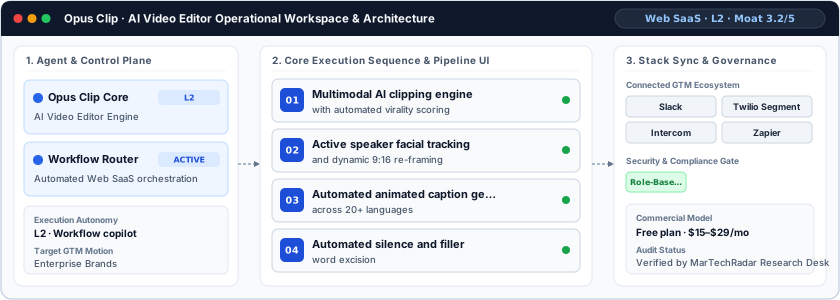
Opus Clip limitations, drawbacks & risks
Operational considerations and platform boundaries include:
- Algorithmic narrative coherence: The heuristic scoring model occasionally extracts sentence fragments when source audio exhibits rapid conversational overlap, requiring manual boundary re-trimming.
- Dynamic framing occlusion: Multi-subject panning scenes can confuse computer vision face detection, resulting in erratic viewport shifting between adjacent speakers during quick exchanges.
- Rendering credit exhaustion: Processing long-form source footage consumes finite processing minutes quickly, restricting continuous batch rendering on baseline credit allocations.
Opus Clip pricing, plans & cost breakdown
Opus Clip provides access through a tiered software-as-a-service structure beginning with a Free plan for basic evaluation. Paid tiers commence at the Starter plan priced at $15 per month for 150 processing credits. The Pro plan costs $29 per month on standard monthly billing, with annual commitments reducing the effective rate to $17.4 per month. Licensing tiers govern monthly processing credit caps, brand preset limits, and multi-user workspace seats.
| Plan / Tier | Verified Price & Billing | Included Scope & Contract Terms | |
|---|---|---|---|
| Free / Sandbox | $0 | Free plan or free tier offered by the vendor. | |
| Starter | $15/mo | For individual creators | |
| Pro | $17.4/mo | For professional creators, marketers, & teams | |
| Contract Watchout: Annual Billing Headline vs. Monthly Premium | The vendor pricing page advertises an annual-billing discount (Save up to 60%); month-to-month billing carries a higher effective monthly rate. | ||
How Opus Clip compares vs. competitors & alternatives
In contrast to timeline-centric editor Descript, which centers on text-driven document workflows, Opus Clip automates selection logic through predictive scoring within the AI Video Editor segment. While Kapwing AI and Kite supply broader canvas suites, Opus Clip prioritizes zero-touch 9:16 vertical formatting. Consequently, it fits media production units needing high-velocity social syndication from existing episodic video catalogs rather than full post-production suites.
Direct competitors & market radar
Top algorithmic competitors based on category positioning, capability overlap, and ICP alignment.
Frequently asked questions about Opus Clip
How much does Opus Clip cost in 2026?
Opus Clip pricing: Free plan · $15–$29/mo. A permanent free plan is available. Published tiers: Free / Sandbox ($0); Starter ($15/mo); Pro ($17.4/mo). Opus Clip provides access through a tiered software-as-a-service structure beginning with a Free plan for basic evaluation. Paid tiers commence at the Starter plan priced at $15 per month for 150 processing credits.
What are the top Opus Clip alternatives in AI Video Editor?
Verified AI Video Editor alternatives include Descript (Free plan · $16–$65/mo · Enterprise plan), Kapwing AI (Free plan · $16–$50/mo), HeyGen (Free plan · $24–$149/mo), Klap (From $14/mo). In contrast to timeline-centric editor Descript, which centers on text-driven document workflows, Opus Clip automates selection logic through predictive scoring within the AI Video Editor segment.
What are the main limitations and trade-offs of Opus Clip?
Operational considerations and platform boundaries include: Algorithmic narrative coherence: The heuristic scoring model occasionally extracts sentence fragments when source audio exhibits rapid conversational overlap, requiring manual boundary re-trimming. Walk away if your workflow cannot tolerate algorithmic narrative coherence: The heuristic scoring model occasionally extracts sentence fragments when source audio exhibits rapid conversational overlap, requiring manual boundary re-trimming.
Verified sources & evidence trail
- Official product domain: https://opus.pro
- Commercial pricing verification: https://www.opus.pro/pricing
- Verified corporate entity profiles (
sameAs): LinkedIn Company Profile - First-party governance & documentation links: Trust & Security · API & Docs · Terms · Privacy
- Editor sign-off: Oct 7, 2026 (how profiles are made).
