Acrely Review (2026): AI Calling Pricing, Limits & Alternatives
Bottom line
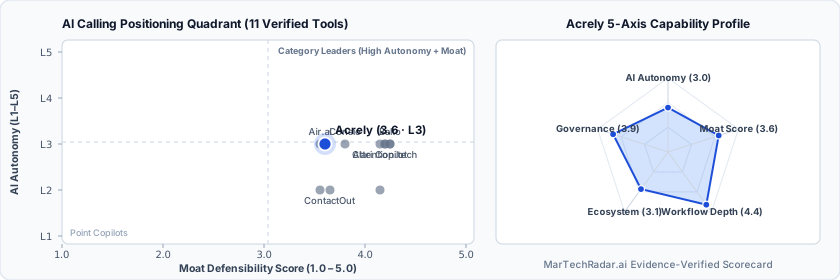
Acrely is a Web SaaS tool for AI Calling (Conversational Voice Calling Agents) in AI SDR & Outbound. Pricing: Pricing not disclosed. Best suited to B2B SaaS and Marketing & Growth Teams. Editor ratings: AI autonomy L3 (conditional automation); moat score 3.6/5.0 (Proprietary moat). Fact-checked by Sarah Per on Oct 16, 2026.
Controllable enterprise AI voice agents deployable in cloud or on-prem for sales and customer operations.
Acrely buyer fit verdict: when to choose vs. when to walk away
Choose Acrely if (Best Fit)
- Target ICP & Stack Fit: You operate as B2B SaaS and Marketing & Growth Teams requiring a Web SaaS deployment for AI Calling.
- L3 Architecture & Defensibility: Acrely (Lupitor) differentiates through deterministic conversation control, low-latency telephony orchestration, and flexible cloud or on-premises deployment for regulated enterprise voice workflows.
- Commercial Model Fit: Your procurement budget aligns with Pricing not disclosed.
Walk away from Acrely if (Deal-Breakers)
- Walk away if you require transparent self-serve monthly billing or your budget ceiling is under $1,000/mo (Acrely requires sales-gated custom quoting).
- Walk away if your workflow cannot tolerate on-premises telephony integration complexity: Deploying self-hosted voice models and wiring custom enterprise SIP trunks and internal APIs introduces a higher IT implementation learning curve than plug-and-play SMB web dialers.
- Walk away if deterministic script design overhead is a deal-breaker for your team: Enforcing strict state-machine conversation guardrails prevents hallucinations but requires revenue operations teams to map out explicit branching logic for edge-case buyer questions upfront.
Acrely key facts & scorecard
| Pricing | Pricing not disclosed |
|---|---|
| Free plan | No / not disclosed |
| Delivery | Web SaaS |
| Audience | B2B SaaS, Marketing & Growth Teams |
| AI autonomy level | L3 · Conditional automationEditor-verified |
| Moat tier & score | 3.6 / 5.0 · Proprietary moatEditor-verified |
| Funding | Pre-seed |
| Total funding | $500K |
| Founders | Alexander Stefanov, Derek Armfield |
| Company size | 2-10 employees |
| Headquarters | San Francisco, California |
| Founded | 2025 |
| Last verified |
Acrely pros & cons: strengths vs. operational limitations
Pros: core strengths & capabilities
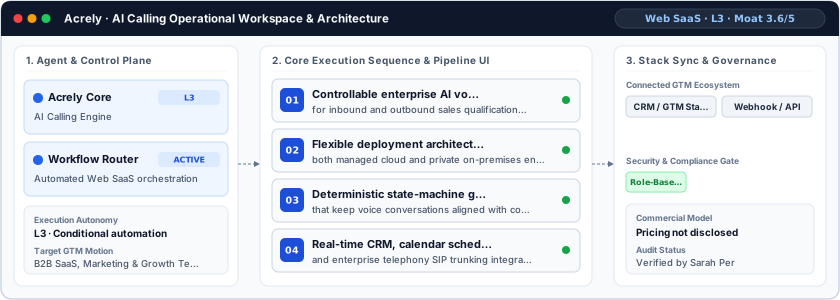
- Controllable enterprise AI voice agents: for inbound and outbound sales qualification and customer service
- Flexible deployment architecture supporting: both managed cloud and private on-premises enterprise environments
- Deterministic state-machine guardrails: that keep voice conversations aligned with compliance scripts
- Real-time CRM, calendar scheduling,: and enterprise telephony SIP trunking integrations
Cons: operational limitations & risks
- On-Premises Telephony Integration Complexity: Deploying self-hosted voice models and wiring custom enterprise SIP trunks and internal APIs introduces a higher IT implementation learning curve than plug-and-play SMB web dialers.
- Deterministic Script Design Overhead: Enforcing strict state-machine conversation guardrails prevents hallucinations but requires revenue operations teams to map out explicit branching logic for edge-case buyer questions upfront.
- Corporate-to-Product Brand Transition: Buyers cross-referencing Y Combinator and Crunchbase records under the legal entity name Acrely must account for the transition to the Lupitor product brand on the official domain.
Acrely TCO & deal-breaker stress test
Simulate 12-month stepped TCO, hidden cost multipliers, contract lock-in exposure, and stack failure modes using only facts verified by Sarah Per on · Capture SHA a387fda8.
Acrely triggers high-severity friction under your 5-seat / $800/mo constraints. Benchmark the verified subtrack alternatives below before committing.
| Plan / Tier | Verified Rate | Scale Fit | Scope & Quota Notes |
|---|---|---|---|
| Entry / Starter | $4/mo | 1–2 seats | Trusted by 40+ leading enterprises |
| Enterprise / Custom | Custom quote | 15–50+ seats (Enterprise SLA) | Sales-negotiated annual contract for custom volume, SSO/RBAC governance, and dedicated SLA. |
- Moat Score
- 3.6 / 5.0
- AI Autonomy
- L3
- Free Tier / Trial
- None disclosed
Triggered audit signals & failure modes
- Opaque Enterprise Quoting vs. SMB/Mid-Market BudgetVerified Pricing Ledger
Acrely does not disclose a public self-serve floor (Pricing not disclosed). Buyers with a $800/mo cap face high sales-qualification friction.
- Sales-Gated Contract TermsFact-checked by Sarah Per
Pricing is available on request through enterprise sales quotes, with customized tiers based on deployment model (managed cloud vs. on-premises license), concurrent telephony channels, and monthly conversation minutes.
- Primary Operational Bottleneck: On-Premises Telephony Integration ComplexityAudit by Sarah Per
Deploying self-hosted voice models and wiring custom enterprise SIP trunks and internal APIs introduces a higher IT implementation learning curve than plug-and-play SMB web dialers.
Hidden TCO Multipliers & Quota Gates
- On-Premises Telephony Integration Complexity: Deploying self-hosted voice models and wiring custom enterprise SIP trunks and internal APIs introduces a higher IT implementation learning curve than plug-and-play SMB web dialers.
- Deterministic Script Design Overhead: Enforcing strict state-machine conversation guardrails prevents hallucinations but requires revenue operations teams to map out explicit branching logic for edge-case buyer questions upfront.
When to Walk Away & Negotiation Levers
- Walk away if you require transparent self-serve monthly billing or your budget ceiling is under $1,000/mo (Acrely requires sales-gated custom quoting).
- Walk away if your workflow cannot tolerate on-premises telephony integration complexity: Deploying self-hosted voice models and wiring custom enterprise SIP trunks and internal APIs introduces a higher IT implementation learning curve than plug-and-play SMB web dialers.
- Walk away if deterministic script design overhead is a deal-breaker for your team: Enforcing strict state-machine conversation guardrails prevents hallucinations but requires revenue operations teams to map out explicit branching logic for edge-case buyer questions upfront.
- Demand a 30- to 60-day paid pilot opt-out clause in the Acrely order form before signing a 12-month enterprise commitment.
- Require a sandbox proof-of-concept testing on-premises telephony integration complexity against your live CRM/data schema before annual sign-off.
Ask a custom procurement or TCO stress-test question about Acrely
Offers a free tier (Free plan · $0/mo · Enterprise plan) · Transparent self-serve entry without mandatory annual lock-in
Verified AI Calling peer (Pricing not disclosed · Moat 3.9/5.0)
Acrely moat & subtrack positioning
Acrely (Lupitor) differentiates through deterministic conversation control, low-latency telephony orchestration, and flexible cloud or on-premises deployment for regulated enterprise voice workflows.
Editorial review
Fact-checked by Sarah Per (Principal Content Systems & Generative Media Editor) on .
Background
Founded in 2025 by Alexander Stefanov and Derek Armfield and headquartered in San Francisco, California, Acrely (acrely.ai, now operating under the product brand Lupitor) is an enterprise AI voice agent platform built for sales qualification, customer service, and regulated field operations. Operating with a team of 2 to 10 employees and backed by $500K in Pre-Seed funding from Y Combinator (S25), the company evolved from high-conversion outbound sales voice agents into a full-stack enterprise voice infrastructure platform engineered around controllable, compliant phone automation.
How Acrely works
Acrely operates at Level 3 autonomy through a deterministic state-machine conversation runtime, low-latency speech-to-speech telephony bridge, and hybrid cloud or on-premises deployment engine. Standard LLM voice wrappers frequently drift off-script or hallucinate unauthorized commercial promises during live phone calls; Acrely's Lupitor runtime enforces structured conversation graphs and policy guardrails so voice agents follow required disclosures, qualification checklists, and escalation rules on every call. Crucially, regulated financial, healthcare, and telecom enterprises can deploy the entire voice stack either in Acrely's managed cloud or inside their own private on-premises infrastructure.
Limitations
Operational limitations and technical trade-offs include:
- On-Premises Telephony Integration Complexity: Deploying self-hosted voice models and wiring custom enterprise SIP trunks and internal APIs introduces a higher IT implementation learning curve than plug-and-play SMB web dialers.
- Deterministic Script Design Overhead: Enforcing strict state-machine conversation guardrails prevents hallucinations but requires revenue operations teams to map out explicit branching logic for edge-case buyer questions upfront.
- Corporate-to-Product Brand Transition: Buyers cross-referencing Y Combinator and Crunchbase records under the legal entity name Acrely must account for the transition to the Lupitor product brand on the official domain.
Acrely pricing
Pricing is available on request through enterprise sales quotes, with customized tiers based on deployment model (managed cloud vs. on-premises license), concurrent telephony channels, and monthly conversation minutes. Enterprise teams can test the interactive voice demo on acrely.ai and request a custom commercial proposal.
How Acrely compares
Within the Autonomous B2B Sales Agents & AI BDRs and Enterprise Voice AI category, Acrely competes against conversational voice alternatives such as Retell AI, Bland AI, and PolyAI. Versus developer-only voice APIs like Retell AI or cloud-only providers that cannot meet strict data-residency mandates, Acrely (Lupitor) differentiates itself by offering full on-premises deployment alongside deterministic compliance guardrails. Regulated enterprises and high-volume inside sales teams choose Acrely to automate phone workflows without sacrificing data control.
Frequently asked questions about Acrely
How much does Acrely cost and does it require a custom enterprise quote?
Published pricing summary for Acrely: Pricing not disclosed. A permanent free plan is not disclosed for Acrely. Verified tier schedule: Entry / Starter ($4/mo for 1–2 seats); Enterprise / Custom (Custom quote for 15–50+ seats (Enterprise SLA)). Pricing is available on request through enterprise sales quotes, with customized tiers based on deployment model (managed cloud vs. on-premises license), concurrent telephony channels, and monthly conversation minutes.
How does Acrely work and how autonomous is its AI architecture?
Controllable enterprise AI voice agents deployable in cloud or on-prem for sales and customer operations. Within AI Calling (Conversational Voice Calling Agents), MarTechRadar rates its execution architecture at L3 · Conditional automation with a verified Moat Score of 3.6 / 5.0 (Proprietary moat). Acrely (Lupitor) differentiates through deterministic conversation control, low-latency telephony orchestration, and flexible cloud or on-premises deployment for regulated enterprise voice workflows. Corporate profile: Founded by Alexander Stefanov, Derek Armfield, operating at 2-10 employees scale.
What are the main limitations of Acrely and when should buyers walk away?
Based on our editorial technical audit, key operational considerations and boundaries for Acrely include: (1) On-Premises Telephony Integration Complexity: Deploying self-hosted voice models and wiring custom enterprise SIP trunks and internal APIs introduces a higher IT implementation learning curve than plug-and-play SMB web dialers. (2) Deterministic Script Design Overhead: Enforcing strict state-machine conversation guardrails prevents hallucinations but requires revenue operations teams to map out explicit branching logic for edge-case buyer questions upfront. (3) Corporate-to-Product Brand Transition: Buyers cross-referencing Y Combinator and Crunchbase records under the legal entity name Acrely must account for the transition to the Lupitor product brand on the official domain. Primary procurement walk-away rule: Walk away if you require transparent self-serve monthly billing or your budget ceiling is under $1,000/mo (Acrely requires sales-gated custom quoting).
What integrations, compliance certifications, and contract terms apply to Acrely?
Key TCO multiplier to watch: On-Premises Telephony Integration Complexity (Deploying self-hosted voice models and wiring custom enterprise SIP trunks and internal APIs introduces a higher IT implementation learning curve than plug-and-play SMB web dialers.) Before signing a contract, procurement teams should demand a 30- to 60-day paid pilot opt-out clause in the Acrely order form before signing a 12-month enterprise commitment.
What are the best Acrely alternatives and head-to-head competitors in 2026?
Top fact-checked alternatives to Acrely in AI Calling (Conversational Voice Calling Agents) include PolyAI (Pricing not disclosed), Simple AI (Pricing not disclosed), Leaping AI (Pricing not disclosed), Swordfish AI (Custom / enterprise pricing). Within the Autonomous B2B Sales Agents & AI BDRs and Enterprise Voice AI category, Acrely competes against conversational voice alternatives such as Retell AI, Bland AI, and PolyAI.
Verified sources & evidence trail
- Official product domain: https://www.acrely.ai
- Commercial pricing verification: Verified against official vendor pricing policy (Pricing not disclosed)
- Verified corporate entity profiles (
sameAs): LinkedIn Company Profile · Crunchbase Entity Record - Editorial audit sign-off: Fact-checked by Sarah Per on under the MarTechRadar Evidence-Ledger Protocol.