WINN.AI Review (2026): AI Calling Pricing, Limits & Alternatives
Bottom line
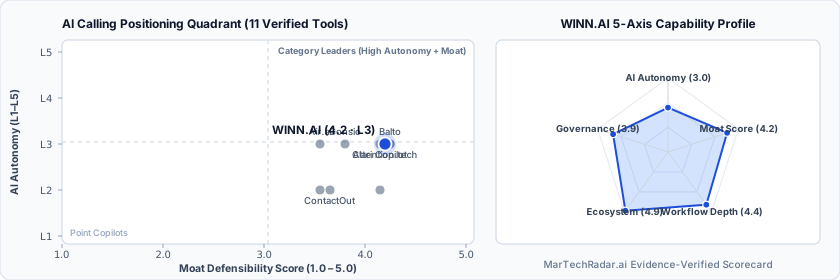
WINN.AI is a Web SaaS tool for AI Calling (Conversational Voice Calling Agents) in AI SDR & Outbound. Pricing: Custom / enterprise pricing. Best suited to B2B Sales Leaders, SDR/BDR Teams and Revenue Operations (RevOps). Editor ratings: AI autonomy L3 (conditional automation); moat score 4.2/5.0 (Proprietary moat). Fact-checked by Jiacky Lee on Oct 11, 2026.
Real-time AI sales copilot providing live in-call playbook tracking, dynamic objection handling battle cards, and automated post-call CRM data.
WINN.AI buyer fit verdict: when to choose vs. when to walk away
Choose WINN.AI if (Best Fit)
- Target ICP & Stack Fit: You operate as B2B Sales Leaders, SDR/BDR Teams and Revenue Operations (RevOps) requiring a Web SaaS deployment for AI Calling, with verified ecosystem connectivity for Salesforce, HubSpot, Slack, Zoom.
- L3 Architecture & Defensibility: Proprietary low-latency context engine coupling real-time acoustic transcription with structured sales methodology tracking (MEDDPICC, BANT, SPICED) and automated bidirectional CRM field attribution.
- Commercial Model Fit: Your procurement budget aligns with Custom / enterprise pricing.
Walk away from WINN.AI if (Deal-Breakers)
- Walk away if you require transparent self-serve monthly billing or your budget ceiling is under $1,000/mo (WINN.AI requires sales-gated custom quoting).
- Walk away if your workflow cannot tolerate CRM schema drift: Automated field population relies on rigid object schemas; unexpected API modifications or customized validation rules inside Salesforce or HubSpot can trigger extraction pipeline failures and unmapped properties.
- Walk away if audio packet degradation is a deal-breaker for your team: Acoustic transcription latency increases under suboptimal network conditions, leading to delayed battle card suggestions that arrive after conversation topics have already shifted.
WINN.AI key facts & scorecard
| Pricing | Custom / enterprise pricing |
|---|---|
| Free plan | No / not disclosed |
| Delivery | Web SaaS |
| Audience | B2B Sales Leaders, SDR/BDR Teams, Revenue Operations (RevOps) |
| AI autonomy level | L3 · Conditional automationEditor-verified |
| Moat tier & score | 4.2 / 5.0 · Proprietary moatEditor-verified |
| Funding | Series A |
| Total funding | $35MBacked by Insight Partners, Alumni Ventures, OurCrowd |
| Founders | Bar Haleva, Eldad Postan |
| Company size | 51-200 employees |
| Ecosystem integrations | Salesforce, HubSpot, Slack, Zoom |
| Governance & docs | Trust & Security ↗ · Privacy ↗ |
| Headquarters | Tel Aviv |
| Founded | 2021 |
| Last verified |
WINN.AI pros & cons: strengths vs. operational limitations
Pros: core strengths & capabilities
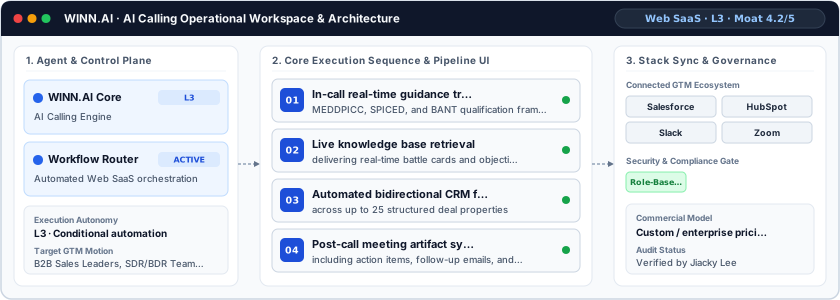
- In-call real-time guidance tracking: MEDDPICC, SPICED, and BANT qualification frameworks
- Live knowledge base retrieval: delivering real-time battle cards and objection handling
- Automated bidirectional CRM field population: across up to 25 structured deal properties
- Post-call meeting artifact synthesis: including action items, follow-up emails, and Slack updates
Cons: operational limitations & risks
- CRM Schema Drift: Automated field population relies on rigid object schemas; unexpected API modifications or customized validation rules inside Salesforce or HubSpot can trigger extraction pipeline failures and unmapped properties.
- Audio Packet Degradation: Acoustic transcription latency increases under suboptimal network conditions, leading to delayed battle card suggestions that arrive after conversation topics have already shifted.
- Context Window Boundary: Real-time inference engines struggle to disambiguate overlapping speakers or informal colloquial dialogue, resulting in occasional false positives against strict methodology qualification gates.
WINN.AI TCO & deal-breaker stress test
Simulate 12-month stepped TCO, hidden cost multipliers, contract lock-in exposure, and stack failure modes using only facts verified by Jiacky Lee on · Capture SHA 55e5f60a.
WINN.AI triggers high-severity friction under your 5-seat / $800/mo constraints. Benchmark the verified subtrack alternatives below before committing.
| Plan / Tier | Verified Rate | Scale Fit | Scope & Quota Notes |
|---|---|---|---|
| Enterprise / Custom | Custom quote | 15–50+ seats (Enterprise SLA) | Sales-negotiated annual contract for custom volume, SSO/RBAC governance, and dedicated SLA. |
- Moat Score
- 4.2 / 5.0
- AI Autonomy
- L3
- Free Tier / Trial
- None disclosed
Triggered audit signals & failure modes
- Opaque Enterprise Quoting vs. SMB/Mid-Market BudgetVerified Pricing Ledger
WINN.AI does not disclose a public self-serve floor (Custom / enterprise pricing). Buyers with a $800/mo cap face high sales-qualification friction.
- Sales-Gated Contract TermsFact-checked by Jiacky Lee
Commercial procurement operates entirely through custom enterprise pricing available upon request via direct sales engagement.
- Primary Operational Bottleneck: CRM Schema DriftAudit by Jiacky Lee
Automated field population relies on rigid object schemas; unexpected API modifications or customized validation rules inside Salesforce or HubSpot can trigger extraction pipeline failures and unmapped properties.
Hidden TCO Multipliers & Quota Gates
- Enterprise Governance & Add-On Gating: Advanced capabilities such as Single Sign-On (SSO), custom role permissions, or specialized analytics modules are gated behind upper tiers or paid add-ons.
- CRM Schema Drift: Automated field population relies on rigid object schemas; unexpected API modifications or customized validation rules inside Salesforce or HubSpot can trigger extraction pipeline failures and unmapped properties.
- Audio Packet Degradation: Acoustic transcription latency increases under suboptimal network conditions, leading to delayed battle card suggestions that arrive after conversation topics have already shifted.
When to Walk Away & Negotiation Levers
- Walk away if you require transparent self-serve monthly billing or your budget ceiling is under $1,000/mo (WINN.AI requires sales-gated custom quoting).
- Walk away if your workflow cannot tolerate CRM schema drift: Automated field population relies on rigid object schemas; unexpected API modifications or customized validation rules inside Salesforce or HubSpot can trigger extraction pipeline failures and unmapped properties.
- Walk away if audio packet degradation is a deal-breaker for your team: Acoustic transcription latency increases under suboptimal network conditions, leading to delayed battle card suggestions that arrive after conversation topics have already shifted.
- Demand a 30- to 60-day paid pilot opt-out clause in the WINN.AI order form before signing a 12-month enterprise commitment.
- Require a sandbox proof-of-concept testing CRM schema drift against your live CRM/data schema before annual sign-off.
Ask a custom procurement or TCO stress-test question about WINN.AI
Offers a free tier (Free plan · $0/mo · Enterprise plan) · Transparent self-serve entry without mandatory annual lock-in
Offers a free tier (Free plan · $0/mo · Enterprise plan) · Transparent self-serve entry without mandatory annual lock-in
WINN.AI key entities, modules & ecosystem stack
WINN.AI moat & subtrack positioning
Proprietary low-latency context engine coupling real-time acoustic transcription with structured sales methodology tracking (MEDDPICC, BANT, SPICED) and automated bidirectional CRM field attribution.
Editorial review
Fact-checked by Jiacky Lee (Managing Editor, AI Autonomy & Moat Methodology) on .
Background
Architected as a synchronous sales execution runtime, WINN.AI delivers live in-call assistance and automated administrative synchronization for B2B revenue teams. Headquartered in Tel Aviv and founded in 2021, the venture-backed organization has secured $35M in aggregate institutional financing to address the operational friction of manual sales hygiene. By positioning an active algorithmic copilot directly inside live web conferencing streams, the company targets enterprise sales leaders, revenue operations managers, and account executives seeking to enforce systematic qualification frameworks during customer interactions.
How WINN.AI works
WINN.AI captures real-time audio streams across conferencing infrastructure like Zoom and Google Meet, processing bidirectional speech via low-latency transcription models. Its core context engine continuously extracts conversation entities against predefined qualification methodologies, including MEDDPICC, BANT, and SPICED. Operating at Level 3 conditional autonomy, the platform programmatically projects dynamic battle cards, factual answers from internal documentation, and prompt suggestions to the rep during active dialogue. Concurrently, the pipeline parses qualitative interaction data to populate up to twenty-five structured CRM fields and generate follow-up communications upon call termination.
Limitations
Operational considerations and platform boundaries include:
- CRM Schema Drift: Automated field population relies on rigid object schemas; unexpected API modifications or customized validation rules inside Salesforce or HubSpot can trigger extraction pipeline failures and unmapped properties.
- Audio Packet Degradation: Acoustic transcription latency increases under suboptimal network conditions, leading to delayed battle card suggestions that arrive after conversation topics have already shifted.
- Context Window Boundary: Real-time inference engines struggle to disambiguate overlapping speakers or informal colloquial dialogue, resulting in occasional false positives against strict methodology qualification gates.
WINN.AI pricing
Commercial procurement operates entirely through custom enterprise pricing available upon request via direct sales engagement. Subscription agreements follow an annual software-as-a-service licensing structure evaluated against user seat counts, technical connector requirements, and organizational scale. Licensing tiers unlock elevated capabilities including expanded CRM field mappings, custom battle card ingestion, and dedicated integration support across enterprise communication stacks without public transactional tiers.
How WINN.AI compares
Within the voice calling and conversation intelligence landscape, WINN.AI differentiates through live, synchronous rep enablement rather than post-call asynchronous auditing. Unlike Dialpad Ai, which functions as a unified telephony carrier, WINN.AI overlays existing conferencing software to drive methodology compliance. Compared to autonomous voice agents like Bland.ai or Consio, which replace human callers entirely with synthetic interactive voice agents, WINN.AI optimizes human-led discovery for complex enterprise deals requiring high-touch negotiations.
Direct competitors & market radar
Top algorithmic competitors based on category positioning, capability overlap, and ICP alignment.
Frequently asked questions about WINN.AI
How much does WINN.AI cost and does it require a custom enterprise quote?
Published pricing summary for WINN.AI: Custom / enterprise pricing. A permanent free plan is not disclosed for WINN.AI. Commercial procurement operates entirely through custom enterprise pricing available upon request via direct sales engagement. Subscription agreements follow an annual software-as-a-service licensing structure evaluated against user seat counts, technical connector requirements, and organizational scale.
How does WINN.AI work and how autonomous is its AI architecture?
Real-time AI sales copilot providing live in-call playbook tracking, dynamic objection handling battle cards, and automated post-call CRM data. Within AI Calling (Conversational Voice Calling Agents), MarTechRadar rates its execution architecture at L3 · Conditional automation with a verified Moat Score of 4.2 / 5.0 (Proprietary moat). Proprietary low-latency context engine coupling real-time acoustic transcription with structured sales methodology tracking (MEDDPICC, BANT, SPICED) and automated bidirectional CRM field attribution. Corporate profile: Founded by Bar Haleva, Eldad Postan, operating at 51-200 employees scale.
What are the main limitations of WINN.AI and when should buyers walk away?
Based on our editorial technical audit, key operational considerations and boundaries for WINN.AI include: (1) CRM Schema Drift: Automated field population relies on rigid object schemas; unexpected API modifications or customized validation rules inside Salesforce or HubSpot can trigger extraction pipeline failures and unmapped properties. (2) Audio Packet Degradation: Acoustic transcription latency increases under suboptimal network conditions, leading to delayed battle card suggestions that arrive after conversation topics have already shifted. (3) Context Window Boundary: Real-time inference engines struggle to disambiguate overlapping speakers or informal colloquial dialogue, resulting in occasional false positives against strict methodology qualification gates. Primary procurement walk-away rule: Walk away if you require transparent self-serve monthly billing or your budget ceiling is under $1,000/mo (WINN.AI requires sales-gated custom quoting).
What integrations, compliance certifications, and contract terms apply to WINN.AI?
Verified ecosystem and stack integrations include Salesforce, HubSpot, Slack, Zoom. First-party governance and developer endpoints verified on domain include: Trust/Security (https://trust.winn.ai). Key TCO multiplier to watch: Enterprise Governance & Add-On Gating (Advanced capabilities such as Single Sign-On (SSO), custom role permissions, or specialized analytics modules are gated behind upper tiers or paid add-ons.) Before signing a contract, procurement teams should demand a 30- to 60-day paid pilot opt-out clause in the WINN.AI order form before signing a 12-month enterprise commitment.
What are the best WINN.AI alternatives and head-to-head competitors in 2026?
Top fact-checked alternatives to WINN.AI in AI Calling (Conversational Voice Calling Agents) include Overpath (Custom / enterprise pricing), Sybill AI (Free plan · $0/mo · Enterprise plan), Vapi.ai (From $0.05 usage-based), Kaspr (Free plan · $0/mo · Enterprise plan). Within the voice calling and conversation intelligence landscape, WINN.AI differentiates through live, synchronous rep enablement rather than post-call asynchronous auditing.
Verified sources & evidence trail
- Official product domain: https://winn.ai
- Commercial pricing verification: Verified against official vendor pricing policy (Custom / enterprise pricing)
- Verified corporate entity profiles (
sameAs): LinkedIn Company Profile · Crunchbase Entity Record - First-party governance & documentation links: Trust & Security · Privacy
- Editorial audit sign-off: Fact-checked by Jiacky Lee on under the MarTechRadar Evidence-Ledger Protocol.