Transifex Review (2026): AI Translation Pricing, Pros & Cons
Bottom line
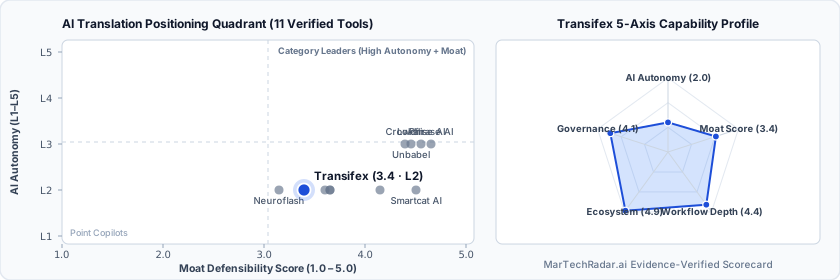
Transifex is a Web SaaS tool for AI Translation (Multilingual & Global Localization) in Copy & Content. Pricing: Custom / enterprise pricing. Best suited to B2B SaaS, DTC / eCommerce and Enterprise Brands. Editor ratings: AI autonomy L2 (workflow copilot); moat score 3.4/5.0 (Workflow-embedded (strong)). Fact-checked by MarTechRadar Research Desk on Oct 7, 2026.
Continuous localization and translation management platform that automates digital content and software internationalization via developer APIs and AI.
Is Transifex worth it in 2026? Buyer fit & when to walk away
Choose Transifex if (Best Fit)
- Target ICP & Stack Fit: You operate as B2B SaaS, DTC / eCommerce and Enterprise Brands requiring a Web SaaS deployment for AI Translation, with verified ecosystem connectivity for HubSpot, Slack, Shopify, Zapier.
- L2 Architecture & Defensibility: Deep ecosystem integrations with developer codebases, extensive translation memory repositories, and automated continuous delivery pipelines for multilingual software strings.
- Commercial Model Fit: Your procurement budget aligns with Custom / enterprise pricing.
Walk away from Transifex if (Deal-Breakers)
- Walk away if you need published self-serve pricing: Transifex is sold by custom quote.
- Walk away if your workflow cannot tolerate contextual ui string truncation: Automated string translation frequently causes visual layout breaking in target languages with longer text expansion factors, requiring manual UI validation outside the platform interface.
- Walk away if API rate limiting on high-frequency pushes is a deal-breaker for your team: Continuous deployment setups with high-frequency commits can trigger ingestion rate limits during large bulk string updates, delaying automated branch merges.
Transifex pricing, free plan & scorecard at a glance
| Pricing | Custom / enterprise pricing |
|---|---|
| Free plan | No / not disclosed |
| Delivery | Web SaaS |
| Audience | B2B SaaS, DTC / eCommerce, Enterprise Brands |
| AI autonomy level | L2 · Workflow copilotEditor-verified |
| Moat tier & score | 3.4 / 5.0 · Workflow-embedded (strong)Editor-verified |
| Funding | Undisclosed |
| Total funding | UndisclosedBacked by New Enterprise Associates (NEA), Toba Capital, Espresso Capital |
| Company size | 201-500 employees |
| Ecosystem integrations | HubSpot, Slack, Shopify, Zapier |
| Compliance & governance | GDPR |
| Governance & docs | Trust & Security ↗ · API & Docs ↗ · Terms ↗ · Privacy ↗ |
| Headquarters | Covina, California |
| Founded | 2009 |
| Last verified | Oct 7, 2026 |
Transifex pros & cons: strengths vs. operational limitations
Pros: core strengths & capabilities
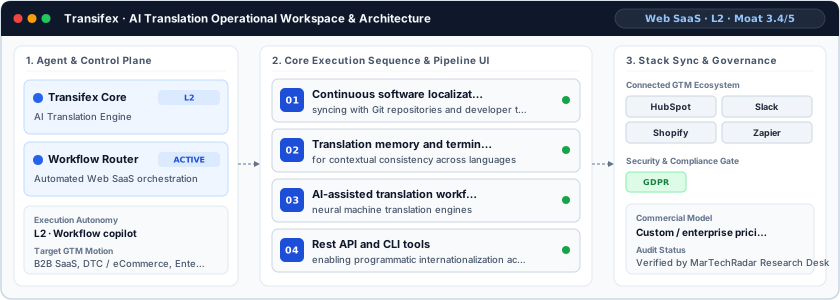
- Continuous software localization pipelines: syncing with Git repositories and developer toolchains
- Translation memory and terminology glossaries: for contextual consistency across languages
- AI-assisted translation workflows integrating: neural machine translation engines
- Rest API and CLI tools: enabling programmatic internationalization across web and mobile platforms
Cons: operational limitations & risks
- Contextual UI String Truncation: Automated string translation frequently causes visual layout breaking in target languages with longer text expansion factors, requiring manual UI validation outside the platform interface.
- API Rate Limiting on High-Frequency Pushes: Continuous deployment setups with high-frequency commits can trigger ingestion rate limits during large bulk string updates, delaying automated branch merges.
- Branch Merging Conflicts: Complex multi-branch Git workflows require strict key-naming discipline; divergent developer branches occasionally produce collision errors within centralized translation memories.
Transifex TCO & deal-breaker stress test
Simulate 12-month stepped TCO, hidden cost multipliers, contract lock-in exposure, and stack failure modes using only facts verified by MarTechRadar Research Desk on 2026-10-07.
Transifex triggers high-severity friction under your 5-seat / $800/mo constraints. Benchmark the verified subtrack alternatives below before committing.
- Moat Score
- 3.4 / 5.0
- AI Autonomy
- L2
- Free Tier / Trial
- None disclosed
Triggered audit signals & failure modes
- Opaque Enterprise Quoting vs. SMB/Mid-Market BudgetVerified Pricing Ledger
Transifex does not disclose a public self-serve floor (Custom / enterprise pricing). Buyers with a $800/mo cap face high sales-qualification friction.
- Sales-Gated Contract TermsFact-checked by MarTechRadar Research Desk
Transifex distributes its platform through tiered software-as-a-service subscriptions. Commercial pricing is available on request through tailored enterprise sales quotes based on organizational scale and seats.
- Primary Operational Bottleneck: Contextual UI String TruncationAudit by MarTechRadar Research Desk
Automated string translation frequently causes visual layout breaking in target languages with longer text expansion factors, requiring manual UI validation outside the platform interface.
Test a custom Transifex budget or stack constraint
Lower 5-seat floor (~$100/mo vs. Custom Quote) · Transparent self-serve entry without mandatory annual lock-in
Lower 5-seat floor (~$100/mo vs. Custom Quote)
Transifex integrations, API, security & compliance stack
Transifex AI moat & AI Translation positioning
Deep ecosystem integrations with developer codebases, extensive translation memory repositories, and automated continuous delivery pipelines for multilingual software strings.
Transifex in-depth review, pricing & architecture analysis
Editor sign-off: Oct 7, 2026. How profiles are made.
What is Transifex? Overview & background
To synchronize continuous software delivery cycles with multi-market release cadences, global software organizations require automated translation pipelines rather than disconnected file exchanges. Headquartered in Covina, California, and founded in 2009, Transifex provides a centralized localization management hub engineered for product teams, engineering leads, and international marketing managers. The platform converts static, human-dependent translation handoffs into continuous integration workflows across internationalized web and mobile applications.
How Transifex works: architecture & workflow
Transifex functions through a bidirectional synchronization pipeline that executes automated localization tasks with conditional human oversight. The platform extracts source strings programmatically via developer APIs, CLI tooling, and Git repository integrations. Ingested strings pass through centralized translation memory databases, glossary validation checks, and neural machine translation layers before reaching human linguists or automated post-editing workflows. Real-time webhooks dispatch translated assets back to codebases and staging environments upon validation, minimizing engineering touchpoints during software sprints, alongside native workflow integrations for HubSpot, Slack, Zapier, and Shopify under verified GDPR governance controls.
Transifex limitations, drawbacks & risks
Operational considerations and platform boundaries include:
- Contextual UI String Truncation: Automated string translation frequently causes visual layout breaking in target languages with longer text expansion factors, requiring manual UI validation outside the platform interface.
- API Rate Limiting on High-Frequency Pushes: Continuous deployment setups with high-frequency commits can trigger ingestion rate limits during large bulk string updates, delaying automated branch merges.
- Branch Merging Conflicts: Complex multi-branch Git workflows require strict key-naming discipline; divergent developer branches occasionally produce collision errors within centralized translation memories.
Transifex pricing, plans & cost breakdown
Transifex distributes its platform through tiered software-as-a-service subscriptions. Commercial pricing is available on request through tailored enterprise sales quotes based on organizational scale and seats. Contracts scale based on hosted word volumes, managed target languages, workflow automation features, and platform seats across translators, reviewers, and developer administrators.
| Plan / Tier | Verified Price & Billing | Included Scope & Contract Terms |
|---|---|---|
| Enterprise / Custom | Custom quote | Custom-quoted plan; terms come from the vendor's sales team. |
How Transifex compares vs. competitors & alternatives
Transifex targets full-stack software localization, distinguishing itself architecturally from standalone copy polishers like DeepL Write, which lack repository synchronization and string extraction tools within the AI Translation segment. While translation engines like DeepL deliver raw machine translation, Transifex serves as the orchestration layer that organizes translation memories and linguist assignments. Unlike generative tools such as Neuroflash focused on standalone content drafting, Transifex is optimized for technical product teams maintaining continuous, localized codebases.
Direct competitors & market radar
Top algorithmic competitors based on category positioning, capability overlap, and ICP alignment.
Frequently asked questions about Transifex
Does Transifex publish pricing or require an enterprise quote?
Transifex pricing: Custom / enterprise pricing. No free plan is publicly disclosed. Transifex distributes its platform through tiered software-as-a-service subscriptions. Commercial pricing is available on request through tailored enterprise sales quotes based on organizational scale and seats.
What are the top Transifex alternatives in AI Translation?
Verified AI Translation alternatives include Neuroflash (€42–€84/mo), Lokalise AI (From $100/mo), Smartcat AI (From $1,200/yr), Crowdin (Custom / enterprise pricing). Transifex targets full-stack software localization, distinguishing itself architecturally from standalone copy polishers like DeepL Write, which lack repository synchronization and string extraction tools within the AI Translation segment.
What are the main limitations and trade-offs of Transifex?
Operational considerations and platform boundaries include: Contextual UI String Truncation: Automated string translation frequently causes visual layout breaking in target languages with longer text expansion factors, requiring manual UI validation outside the platform interface. Walk away if you need published self-serve pricing: Transifex is sold by custom quote.
Verified sources & evidence trail
- Official product domain: https://transifex.com
- Commercial pricing verification: Verified against official vendor pricing policy (Custom / enterprise pricing)
- Verified corporate entity profiles (
sameAs): LinkedIn Company Profile - First-party governance & documentation links: Trust & Security · API & Docs · Terms · Privacy
- Editor sign-off: Oct 7, 2026 (how profiles are made).
