Neuroflash Review (2026): AI Translation Pricing, Pros & Cons
Bottom line
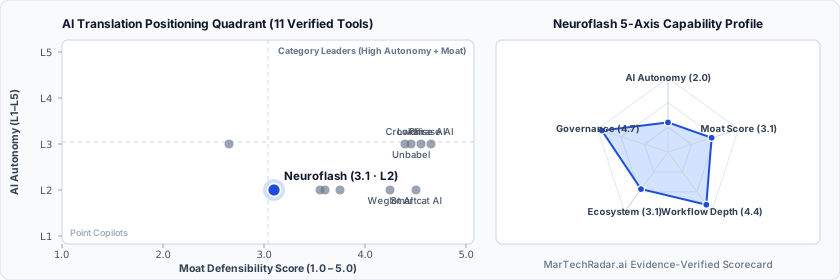
Neuroflash is a Web SaaS tool for AI Translation (Multilingual & Global Localization) in Copy & Content. Pricing: €42–€84/mo. Best suited to DTC / eCommerce and Enterprise Brands. Editor ratings: AI autonomy L2 (workflow copilot); moat score 3.1/5.0 (Workflow-embedded (strong)). Fact-checked by MarTechRadar Research Desk on Oct 6, 2026.
Audience intelligence and content generation platform pairing generative models with synthetic persona digital twins for predictive performance validation.
Is Neuroflash worth it in 2026? Buyer fit & when to walk away
Choose Neuroflash if (Best Fit)
- Target ICP & Stack Fit: You operate as DTC / eCommerce and Enterprise Brands requiring a Web SaaS deployment for AI Translation.
- L2 Architecture & Defensibility: Proprietary predictive audience intelligence built on synthetic persona simulations, paired with strictly European-hosted, GDPR-compliant infrastructure tailored for DACH and EU enterprise markets.
- Commercial Model Fit: Your procurement budget aligns with €42–€84/mo.
Walk away from Neuroflash if (Deal-Breakers)
- Walk away if your workflow cannot tolerate simulation fidelity boundaries: Predictive scores rely on synthetic digital twin distributions that can drift from actual real-world buyer behavior in hyper-niche vertical markets.
- Walk away if daily token throttling is a deal-breaker for your team: Tiered credit quotas restrict daily batch evaluations, forcing high-volume production teams to throttle automated variant generation across large catalog inventories.
Neuroflash pricing, free plan & scorecard at a glance
| Pricing | €42–€84/moVendor pricing page |
|---|---|
| Free plan | No / not disclosed |
| Delivery | Web SaaS |
| Audience | DTC / eCommerce, Enterprise Brands |
| AI autonomy level | L2 · Workflow copilotEditor-verified |
| Moat tier & score | 3.1 / 5.0 · Workflow-embedded (strong)Editor-verified |
| Funding | Seed |
| Total funding | $800K |
| Founders | Henrik Büning, Henrik Roth, Jens Windel, Jonathan Mall |
| Company size | 11-50 employees |
| Compliance & governance | GDPR |
| Governance & docs | API & Docs ↗ · Changelog ↗ · Terms ↗ |
| Headquarters | Hamburg |
| Founded | 2022 |
| Last verified | Oct 6, 2026 |
Neuroflash pros & cons: strengths vs. operational limitations
Pros: core strengths & capabilities
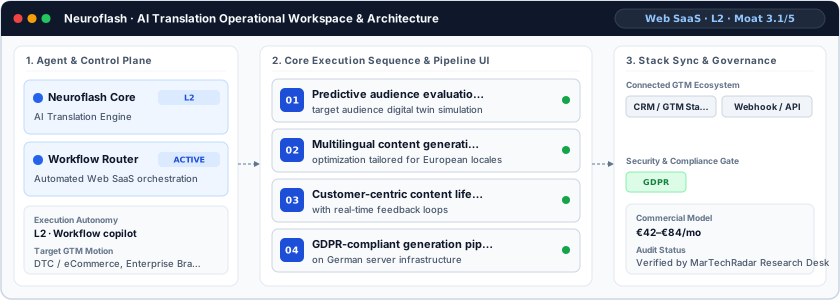
- Predictive audience evaluation utilizing: target audience digital twin simulation
- Multilingual content generation and optimization tailored for European locales
- Customer-centric content lifecycle scoring: with real-time feedback loops
- GDPR-compliant generation pipeline hosted: on German server infrastructure
Cons: operational limitations & risks
- Simulation fidelity boundaries: Predictive scores rely on synthetic digital twin distributions that can drift from actual real-world buyer behavior in hyper-niche vertical markets.
- Daily token throttling: Tiered credit quotas restrict daily batch evaluations, forcing high-volume production teams to throttle automated variant generation across large catalog inventories.
- Codebase translation constraints: The system targets marketing copy and customer feedback rather than developer-centric string localization formats like XLIFF or JSON key-value repositories.
Neuroflash TCO & deal-breaker stress test
Simulate 12-month stepped TCO, hidden cost multipliers, contract lock-in exposure, and stack failure modes using only facts verified by MarTechRadar Research Desk on 2026-10-06 · Capture SHA efbf115f.
Neuroflash is viable for 5 seats, but requires commercial or technical verification on the flagged items below.
- Moat Score
- 3.1 / 5.0
- AI Autonomy
- L2
- Free Tier / Trial
- None disclosed
Triggered audit signals & failure modes
- Opaque Enterprise Quoting vs. SMB/Mid-Market BudgetVerified Pricing Ledger
Neuroflash does not disclose a public self-serve floor (€42–€84/mo). Buyers with a $800/mo cap face high sales-qualification friction.
- Published Self-Serve Entry FloorVerified Pricing Ledger
Neuroflash publishes a transparent entry point (€42–€84/mo) for initial validation before committing.
- Primary Operational Bottleneck: Daily token throttlingAudit by MarTechRadar Research Desk
Tiered credit quotas restrict daily batch evaluations, forcing high-volume production teams to throttle automated variant generation across large catalog inventories.
Test a custom Neuroflash budget or stack constraint
Lower 5-seat floor (~$100/mo vs. ~€42/mo)
Lower 5-seat floor (~$100/mo vs. ~€42/mo)
Neuroflash integrations, API, security & compliance stack
Neuroflash AI moat & AI Translation positioning
Proprietary predictive audience intelligence built on synthetic persona simulations, paired with strictly European-hosted, GDPR-compliant infrastructure tailored for DACH and EU enterprise markets.
Neuroflash in-depth review, pricing & architecture analysis
Editor sign-off: Oct 6, 2026. How profiles are made.
What is Neuroflash? Overview & background
Backed by $800K in seed capital and established in 2022 in Hamburg, Neuroflash provides an audience intelligence and generative copy platform designed for European marketing teams, brand strategists, and localization managers. The company addresses the uncertainty of multi-market campaign deployment by pairing automated text generation with predictive performance scoring. Rather than treating content production as an isolated drafting exercise, Neuroflash targets organizations needing deterministic validation before deploying creative assets across international regions.
How Neuroflash works: architecture & workflow
Operating at an L2 autonomy rating, the architecture combines generative language models with a synthetic panel framework termed Digital Twins. The ingestion pipeline models audience response profiles against a database of consumer archetypes. When generating copy, the system evaluates linguistic variations against these personas, scoring relevance and engagement potential before distribution. All compute runs on German cloud infrastructure under strict GDPR protocols, enforcing localized data tenancy across the modeling lifecycle.
Neuroflash limitations, drawbacks & risks
Operational considerations and platform boundaries include:
- Simulation fidelity boundaries: Predictive scores rely on synthetic digital twin distributions that can drift from actual real-world buyer behavior in hyper-niche vertical markets.
- Daily token throttling: Tiered credit quotas restrict daily batch evaluations, forcing high-volume production teams to throttle automated variant generation across large catalog inventories.
- Codebase translation constraints: The system targets marketing copy and customer feedback rather than developer-centric string localization formats like XLIFF or JSON key-value repositories.
Neuroflash pricing, plans & cost breakdown
Commercial access is packaged as a tiered software-as-a-service model ranging between €42 - €84/month billed annually. The Essential tier begins at €42 per month and provides 25,000 daily credits for entry-level workloads. The Pro tier costs €84 per month per user, expanding daily allocations to 250,000 credits to support scaled publishing cadences. Enterprise engagements require negotiated licensing for custom credit allocations and governance.
| Plan / Tier | Verified Price & Billing | Included Scope & Contract Terms |
|---|---|---|
| Essential | €42/mo | Verified €42/mo Essential tier from vendor pricing schedule. |
How Neuroflash compares vs. competitors & alternatives
Within multilingual content operations, Neuroflash competes against DeepL, DeepL Write, and Transifex within the AI Translation segment. While DeepL and DeepL Write deliver superior raw neural machine translation and stylistic phrasing accuracy, and Transifex governs complex software localization strings via developer pipelines, Neuroflash differentiates through audience simulation. It suits DACH and EU brand marketing organizations that require compliant European infrastructure alongside pre-publication resonance testing rather than straightforward file localization.
Direct competitors & market radar
Top algorithmic competitors based on category positioning, capability overlap, and ICP alignment.
Frequently asked questions about Neuroflash
How much does Neuroflash cost in 2026?
Neuroflash pricing: €42–€84/mo. No free plan is publicly disclosed. Commercial access is packaged as a tiered software-as-a-service model ranging between €42 - €84/month billed annually. The Essential tier begins at €42 per month and provides 25,000 daily credits for entry-level workloads.
What are the top Neuroflash alternatives in AI Translation?
Verified AI Translation alternatives include Transifex (Custom / enterprise pricing), Lokalise AI (From $100/mo), Smartcat AI (From $1,200/yr), Unbabel (Custom / enterprise pricing). Within multilingual content operations, Neuroflash competes against DeepL, DeepL Write, and Transifex within the AI Translation segment.
What are the main limitations and trade-offs of Neuroflash?
Operational considerations and platform boundaries include: Simulation fidelity boundaries: Predictive scores rely on synthetic digital twin distributions that can drift from actual real-world buyer behavior in hyper-niche vertical markets. Walk away if your workflow cannot tolerate simulation fidelity boundaries: Predictive scores rely on synthetic digital twin distributions that can drift from actual real-world buyer behavior in hyper-niche vertical markets.
Verified sources & evidence trail
- Official product domain: https://neuroflash.com
- Commercial pricing verification: https://neuroflash.com/pricing/
- Verified corporate entity profiles (
sameAs): LinkedIn Company Profile · Crunchbase Entity Record - First-party governance & documentation links: API & Docs · Changelog · Terms
- Editor sign-off: Oct 6, 2026 (how profiles are made).
