Writesonic Review (2026): AI Content Marketing Pricing, Pros & Cons
Bottom line
Writesonic is a Web SaaS tool for AI Content Marketing (Enterprise & Long-Form Brand Content) in Copy & Content. Pricing: From $50/mo. Best suited to B2B SaaS and Marketing Agencies. Editor ratings: AI autonomy L2 (workflow copilot); moat score 4.0/5.0 (Proprietary moat). Fact-checked by MarTechRadar Research Desk on Oct 15, 2026.
AI search growth engine and content workspace combining prompt-monitoring analytics, generative engine optimization, and long-form authoring.
Is Writesonic worth it in 2026? Buyer fit & when to walk away
Choose Writesonic if (Best Fit)
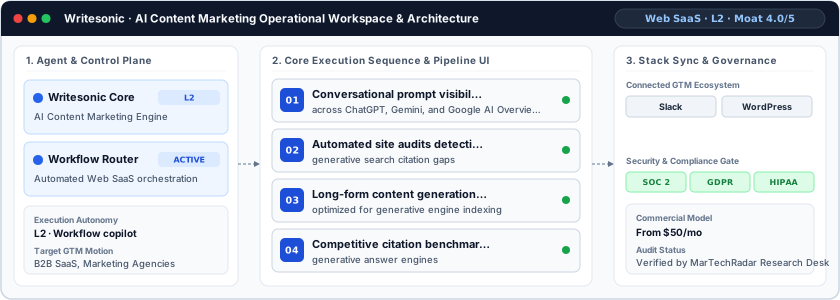
- Target ICP & Stack Fit: You operate as B2B SaaS and Marketing Agencies requiring a Web SaaS deployment for AI Content Marketing, with verified ecosystem connectivity for Slack, WordPress.
- L2 Architecture & Defensibility: Moderate moat focused on synthetic prompt-tracking telemetry across conversational engines like ChatGPT and Gemini, paired with domain-specific content generation workflows.
- Commercial Model Fit: Your procurement budget aligns with From $50/mo.
Walk away from Writesonic if (Deal-Breakers)
- Walk away if your workflow cannot tolerate conversational telemetry volatility: Because foundational model providers frequently adjust weighting and retrieval pipelines without documentation, external prompt ranking telemetry exhibits sudden variance, producing temporal citation instability.
- Walk away if domain authority coupling is a deal-breaker for your team: Generated long-form assets cannot overcome severe underlying domain authority deficits, meaning content will fail to influence conversational citations without external backlink acquisition.
Writesonic pricing, free plan & scorecard at a glance
| Pricing | From $50/moVendor pricing page |
|---|---|
| Free plan | No / not disclosed |
| Delivery | Web SaaS |
| Audience | B2B SaaS, Marketing Agencies |
| AI autonomy level | L2 · Workflow copilotEditor-verified |
| Moat tier & score | 4.0 / 5.0 · Proprietary moatEditor-verified |
| Funding | Venture-backed |
| Total funding | $2.6M |
| Founders | Samanyou Garg |
| Company size | 51-200 employees |
| Ecosystem integrations | Slack, WordPress |
| Compliance & governance | SOC 2, GDPR, HIPAA |
| Governance & docs | System Status ↗ · API & Docs ↗ · DPA ↗ · Terms ↗ · Privacy ↗ |
| Headquarters | Delaware, USA, US |
| Founded | 2021 |
| Last verified | Oct 15, 2026 |
Writesonic pros & cons: strengths vs. operational limitations
Pros: core strengths & capabilities
- Conversational prompt visibility tracking: across ChatGPT, Gemini, and Google AI Overviews
- Automated site audits detecting: generative search citation gaps
- Long-form content generation pipelines: optimized for generative engine indexing
- Competitive citation benchmarking against: generative answer engines
Cons: operational limitations & risks
- Conversational Telemetry Volatility: Because foundational model providers frequently adjust weighting and retrieval pipelines without documentation, external prompt ranking telemetry exhibits sudden variance, producing temporal citation instability.
- Domain Authority Coupling: Generated long-form assets cannot overcome severe underlying domain authority deficits, meaning content will fail to influence conversational citations without external backlink acquisition.
- Enterprise Knowledge Integration: The platform lacks deep bidirectional connectors into internal enterprise data warehouses, requiring manual exports to reconcile tracking metrics with closed-loop pipeline conversion data.
Writesonic TCO & deal-breaker stress test
Simulate 12-month stepped TCO, hidden cost multipliers, contract lock-in exposure, and stack failure modes using only facts verified by MarTechRadar Research Desk on 2026-10-15 · Capture SHA 7e0442f8.
Writesonic aligns with your 5-seat / $800/mo profile. Review the walk-away triggers and contract levers below before deployment.
- Moat Score
- 4.0 / 5.0
- AI Autonomy
- L2
- Free Tier / Trial
- None disclosed
Triggered audit signals & failure modes
- Published Self-Serve Entry FloorVerified Pricing Ledger
Writesonic publishes a transparent entry point (From $50/mo) for initial validation before committing.
- Tier Fit for 5-Seat Scale: Custom ($50/mo)Verified Tier Schedule
Additional Users
- Primary Operational Bottleneck: Conversational Telemetry VolatilityAudit by MarTechRadar Research Desk
Because foundational model providers frequently adjust weighting and retrieval pipelines without documentation, external prompt ranking telemetry exhibits sudden variance, producing temporal citation instability.
Test a custom Writesonic budget or stack constraint
Fits within $800/mo budget ($59–$69/seat/mo · Enterprise plan)
Lower 5-seat floor (~$49/mo vs. $50 / mo)
Writesonic integrations, API, security & compliance stack
Writesonic AI moat & AI Content Marketing positioning
Moderate moat focused on synthetic prompt-tracking telemetry across conversational engines like ChatGPT and Gemini, paired with domain-specific content generation workflows.
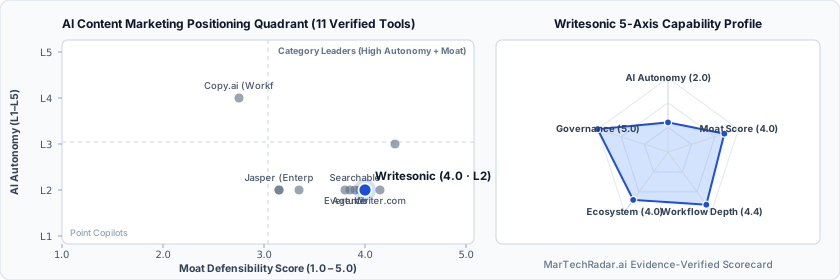
Writesonic in-depth review, pricing & architecture analysis
Editor sign-off: Oct 15, 2026. How profiles are made.
What is Writesonic? Overview & background
To capture organic reach across conversational engines and standard search indexes, marketing teams require automated tracking of AI-generated answers alongside content production. Writesonic, established in 2021 and headquartered in Delaware, USA, US, has secured $2.6M in funding. The platform targets search marketing leads and agency operators tasked with tracking brand citations in conversational answer engines, transitioning from a basic copywriting utility into an AI search visibility engine.
How Writesonic works: architecture & workflow
The platform functions as an automated content and observability system operating at L2 autonomy. Writesonic issues synthetic queries across external conversational models—including ChatGPT, Gemini, and Google AI Overviews—to analyze share of model voice. Its ingestion pipeline parses output responses for brand mentions, identifying gaps where competitors surface instead. Remediation workflows utilize structured retrieval-augmented generation pipelines, allowing editorial teams to generate long-form, source-cited copy aligned with target prompt surfaces, alongside native workflow integrations for Slack and WordPress under verified SOC 2 Type II, GDPR, and HIPAA governance controls.
Writesonic limitations, drawbacks & risks
Operational considerations and platform boundaries include:
- Conversational Telemetry Volatility: Because foundational model providers frequently adjust weighting and retrieval pipelines without documentation, external prompt ranking telemetry exhibits sudden variance, producing temporal citation instability.
- Domain Authority Coupling: Generated long-form assets cannot overcome severe underlying domain authority deficits, meaning content will fail to influence conversational citations without external backlink acquisition.
- Enterprise Knowledge Integration: The platform lacks deep bidirectional connectors into internal enterprise data warehouses, requiring manual exports to reconcile tracking metrics with closed-loop pipeline conversion data.
Writesonic pricing, plans & cost breakdown
Writesonic operates a self-serve subscription model. Commercial plans start from $50/month for baseline content creation and tracking capabilities. Higher tiers scale based on monitored query prompts, recurring site audit volume, and multi-model generation usage limits. Enterprise agreements add custom prompt tracking volume and administrative controls.
| Plan / Tier | Verified Price & Billing | Included Scope & Contract Terms | |
|---|---|---|---|
| Custom | $50/mo | Additional Users | |
| Starter | $79/mo | per month, billed annually | |
| Contract Watchout: Annual Billing Headline vs. Monthly Premium | The vendor pricing page advertises an annual-billing discount (Save 20%); month-to-month billing carries a higher effective monthly rate. | ||
How Writesonic compares vs. competitors & alternatives
Within enterprise content generation, Writesonic competes against Writer, Jasper, and Typeface within the AI Content Marketing segment, alongside verified subtrack peers such as AndromedAI and Artificial Societies. While Writer emphasizes proprietary corporate models with enterprise governance and Typeface delivers structured brand-asset generation, Writesonic differentiates through its embedded Answer Engine Optimization telemetry. However, enterprises requiring deep compliance frameworks and zero-retention infrastructure will find enterprise-focused platforms more compliant for high-security environments. Teams evaluating verified options alongside Typeface and Amdahl should weigh its workflow integration depth and contract structure against daily volume requirements.
Direct competitors & market radar
Top algorithmic competitors based on category positioning, capability overlap, and ICP alignment.
Frequently asked questions about Writesonic
How much does Writesonic cost in 2026?
Writesonic pricing: From $50/mo. No free plan is publicly disclosed. Published tiers: Custom ($50/mo); Starter ($79/mo). Writesonic operates a self-serve subscription model. Commercial plans start from $50/month for baseline content creation and tracking capabilities.
What are the top Writesonic alternatives in AI Content Marketing?
Verified AI Content Marketing alternatives include Jasper (Enterprise) ($59–$69/seat/mo · Enterprise plan), Skribra (Custom / enterprise pricing), Typeface (Custom / enterprise pricing), AndromedAI (Custom / enterprise pricing). Within enterprise content generation, Writesonic competes against Writer, Jasper, and Typeface within the AI Content Marketing segment, alongside verified subtrack peers such as AndromedAI and Artificial Societies.
What are the main limitations and trade-offs of Writesonic?
Operational considerations and platform boundaries include: Conversational Telemetry Volatility: Because foundational model providers frequently adjust weighting and retrieval pipelines without documentation, external prompt ranking telemetry exhibits sudden variance, producing temporal citation instability. Walk away if your workflow cannot tolerate conversational telemetry volatility: Because foundational model providers frequently adjust weighting and retrieval pipelines without documentation, external prompt ranking telemetry exhibits sudden variance, producing temporal citation instability.
Verified sources & evidence trail
- Official product domain: https://writesonic.com
- Commercial pricing verification: https://writesonic.com/pricing
- Verified corporate entity profiles (
sameAs): LinkedIn Company Profile · Crunchbase Entity Record - First-party governance & documentation links: System Status · API & Docs · DPA · Terms · Privacy
- Editor sign-off: Oct 15, 2026 (how profiles are made).
