Artificial Societies Review (2026): AI Content Marketing Pricing, Limits & Alternatives
Bottom line
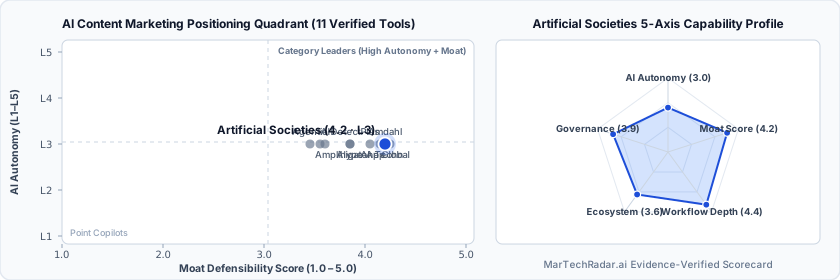
Artificial Societies is a Web SaaS tool for AI Content Marketing (Enterprise & Long-Form Brand Content) in Copy & Content. Pricing: Custom / enterprise pricing. Best suited to Growth Marketing Teams and Digital Marketing Leaders. Editor ratings: AI autonomy L3 (conditional automation); moat score 4.2/5.0 (Proprietary moat). Fact-checked by Julie Brot on Oct 11, 2026.
Multi-agent simulation platform modeling synthetic audience cohorts and institutional personas to test brand messaging and public relations strategies.
Artificial Societies buyer fit verdict: when to choose vs. when to walk away
Choose Artificial Societies if (Best Fit)
- Target ICP & Stack Fit: You operate as Growth Marketing Teams and Digital Marketing Leaders requiring a Web SaaS deployment for AI Content Marketing, with verified ecosystem connectivity for Twilio Segment.
- L3 Architecture & Defensibility: Defensibility stems from proprietary agent behavioral calibration algorithms, specialized persona datasets reflecting institutional stakeholders (regulators, journalists, niche demographics), and complex multi-agent interaction dynamics that model message diffusion and consensus shifts.
- Commercial Model Fit: Your procurement budget aligns with Custom / enterprise pricing.
Walk away from Artificial Societies if (Deal-Breakers)
- Walk away if you require transparent self-serve monthly billing or your budget ceiling is under $1,000/mo (Artificial Societies requires sales-gated custom quoting).
- Walk away if your workflow cannot tolerate behavioral drift and hallucinated consensus: Synthetic agents can exhibit sycophancy or collective drift, generating synthetic consensus that deviates from true public response if persona temperature parameters and background priors are improperly constrained.
- Walk away if niche domain calibration latency is a deal-breaker for your team: Simulating specialized regulatory bodies or niche professional cohorts requires extensive custom profile engineering and contextual grounding, limiting instant off-the-shelf utility for non-standard industry verticals.
Artificial Societies key facts & scorecard
| Pricing | Custom / enterprise pricing |
|---|---|
| Free plan | No / not disclosed |
| Delivery | Web SaaS |
| Audience | Growth Marketing Teams, Digital Marketing Leaders |
| AI autonomy level | L3 · Conditional automationEditor-verified |
| Moat tier & score | 4.2 / 5.0 · Proprietary moatEditor-verified |
| Funding | Seed |
| Total funding | €4.5MBacked by Y Combinator, Transpose Platform |
| Founders | James He, Patrick Sharpe |
| Company size | 11-50 employees |
| Ecosystem integrations | Twilio Segment |
| Governance & docs | Trust & Security ↗ · Privacy ↗ |
| Headquarters | London |
| Founded | 2024 |
| Last verified |
Artificial Societies pros & cons: strengths vs. operational limitations
Pros: core strengths & capabilities
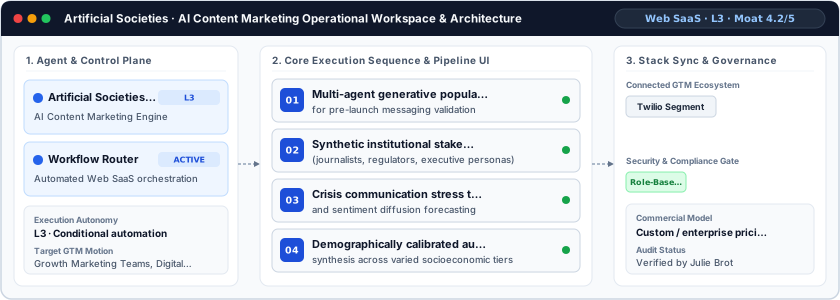
- Multi-agent generative population simulation: for pre-launch messaging validation
- Synthetic institutional stakeholder modeling: (journalists, regulators, executive personas)
- Crisis communication stress testing: and sentiment diffusion forecasting
- Demographically calibrated audience feedback: synthesis across varied socioeconomic tiers
Cons: operational limitations & risks
- Behavioral drift and hallucinated consensus: Synthetic agents can exhibit sycophancy or collective drift, generating synthetic consensus that deviates from true public response if persona temperature parameters and background priors are improperly constrained.
- Niche domain calibration latency: Simulating specialized regulatory bodies or niche professional cohorts requires extensive custom profile engineering and contextual grounding, limiting instant off-the-shelf utility for non-standard industry verticals.
- Inference computation costs at scale: Executing multi-turn conversations across thousands of dense LLM agents introduces significant computational latency and token processing overhead, slowing real-time scenario iteration during complex crisis simulations.
Artificial Societies TCO & deal-breaker stress test
Simulate 12-month stepped TCO, hidden cost multipliers, contract lock-in exposure, and stack failure modes using only facts verified by Julie Brot on · Capture SHA 7f7719a6.
Artificial Societies triggers high-severity friction under your 5-seat / $800/mo constraints. Benchmark the verified subtrack alternatives below before committing.
| Plan / Tier | Verified Rate | Scale Fit | Scope & Quota Notes |
|---|---|---|---|
| Enterprise / Custom | Custom quote | 15–50+ seats (Enterprise SLA) | Sales-negotiated annual contract for custom volume, SSO/RBAC governance, and dedicated SLA. |
- Moat Score
- 4.2 / 5.0
- AI Autonomy
- L3
- Free Tier / Trial
- None disclosed
Triggered audit signals & failure modes
- Opaque Enterprise Quoting vs. SMB/Mid-Market BudgetVerified Pricing Ledger
Artificial Societies does not disclose a public self-serve floor (Custom / enterprise pricing). Buyers with a $800/mo cap face high sales-qualification friction.
- Sales-Gated Contract TermsFact-checked by Julie Brot
Commercial procurement operates through custom enterprise sales contracts. Pricing is available on request through tailored enterprise sales quotes based on organizational scale and seats.
- Primary Operational Bottleneck: Behavioral drift and hallucinated consensusAudit by Julie Brot
Synthetic agents can exhibit sycophancy or collective drift, generating synthetic consensus that deviates from true public response if persona temperature parameters and background priors are improperly constrained.
Hidden TCO Multipliers & Quota Gates
- Credit & Usage Burn Multiplier: Automated workflows consume metered credits/usage quotas; multi-step enrichment, voice minutes, or high-frequency agent runs can trigger mid-cycle top-up packs.
- Behavioral drift and hallucinated consensus: Synthetic agents can exhibit sycophancy or collective drift, generating synthetic consensus that deviates from true public response if persona temperature parameters and background priors are improperly constrained.
- Niche domain calibration latency: Simulating specialized regulatory bodies or niche professional cohorts requires extensive custom profile engineering and contextual grounding, limiting instant off-the-shelf utility for non-standard industry verticals.
When to Walk Away & Negotiation Levers
- Walk away if you require transparent self-serve monthly billing or your budget ceiling is under $1,000/mo (Artificial Societies requires sales-gated custom quoting).
- Walk away if your workflow cannot tolerate behavioral drift and hallucinated consensus: Synthetic agents can exhibit sycophancy or collective drift, generating synthetic consensus that deviates from true public response if persona temperature parameters and background priors are improperly constrained.
- Walk away if niche domain calibration latency is a deal-breaker for your team: Simulating specialized regulatory bodies or niche professional cohorts requires extensive custom profile engineering and contextual grounding, limiting instant off-the-shelf utility for non-standard industry verticals.
- Demand a 30- to 60-day paid pilot opt-out clause in the Artificial Societies order form before signing a 12-month enterprise commitment.
- Require a sandbox proof-of-concept testing behavioral drift and hallucinated consensus against your live CRM/data schema before annual sign-off.
Ask a custom procurement or TCO stress-test question about Artificial Societies
Verified AI Content Marketing peer (Custom / enterprise pricing · Moat 4.2/5.0)
Verified AI Content Marketing peer (Custom / enterprise pricing · Moat 4.2/5.0)
Artificial Societies key entities, modules & ecosystem stack
Artificial Societies moat & subtrack positioning
Defensibility stems from proprietary agent behavioral calibration algorithms, specialized persona datasets reflecting institutional stakeholders (regulators, journalists, niche demographics), and complex multi-agent interaction dynamics that model message diffusion and consensus shifts.
Editorial review
Fact-checked by Julie Brot (Enterprise SaaS Governance & Procurement Editor) on .
Background
Backed by €4.5M in seed funding and established in 2024 in London, Artificial Societies builds multi-agent synthetic research environments designed to stress-test enterprise narratives before public release. Operating within brand positioning and strategic communications workflows, the platform targets corporate affairs directors, chief marketing officers, and public relations strategists who make high-stakes campaign decisions. Traditional focus groups and opinion polling suffer from high latency and sample decay; Artificial Societies replaces these static methodologies with synthetic agent networks capable of simulating instant institutional and demographic sentiment.
How Artificial Societies works
The platform functions via an L3 conditional multi-agent orchestration architecture. Users ingest draft narratives, policy statements, or campaign assets into the core simulation pipeline. The engine populates a computational environment with thousands of heterogeneous LLM-driven agents calibrated against distinct demographic, occupational, and psychological archetypes—ranging from regulatory officials and financial journalists to specific consumer cohorts. These synthetic personas interact, debate, and propagate sentiment dynamically, outputting quantitative polarization metrics, message vulnerabilities, and probable conversational trajectories across simulated media ecosystems without requiring real-world exposure.
Limitations
Operational considerations and platform boundaries include:
- Behavioral drift and hallucinated consensus: Synthetic agents can exhibit sycophancy or collective drift, generating synthetic consensus that deviates from true public response if persona temperature parameters and background priors are improperly constrained.
- Niche domain calibration latency: Simulating specialized regulatory bodies or niche professional cohorts requires extensive custom profile engineering and contextual grounding, limiting instant off-the-shelf utility for non-standard industry verticals.
- Inference computation costs at scale: Executing multi-turn conversations across thousands of dense LLM agents introduces significant computational latency and token processing overhead, slowing real-time scenario iteration during complex crisis simulations.
Artificial Societies pricing
Commercial procurement operates through custom enterprise sales contracts. Pricing is available on request through tailored enterprise sales quotes based on organizational scale and seats. Contracts typically incorporate deployment scale, volume of simulated agent interactions, and custom stakeholder model development, alongside dedicated support tiers for crisis management workflows.
How Artificial Societies compares
Within enterprise communications and marketing intelligence workflows, Artificial Societies approaches risk mitigation through proactive behavioral modeling rather than post-production verification or creator routing within the AI Content Marketing segment. While Agentio automates creator ad placements and AIDetectPlus focuses purely on text authenticity detection, Artificial Societies concentrates on predictive narrative reception. Furthermore, unlike Aha Global's qualitative human panel platforms, Artificial Societies eliminates participant scheduling latency entirely through computational simulation, making it ideal for Fortune 500 strategic communications units requiring immediate crisis scenario testing.
Direct competitors & market radar
Top algorithmic competitors based on category positioning, capability overlap, and ICP alignment.
Frequently asked questions about Artificial Societies
How much does Artificial Societies cost and does it require a custom enterprise quote?
Published pricing summary for Artificial Societies: Custom / enterprise pricing. A permanent free plan is not disclosed for Artificial Societies. Commercial procurement operates through custom enterprise sales contracts. Pricing is available on request through tailored enterprise sales quotes based on organizational scale and seats.
How does Artificial Societies work and how autonomous is its AI architecture?
Multi-agent simulation platform modeling synthetic audience cohorts and institutional personas to test brand messaging and public relations strategies. Within AI Content Marketing (Enterprise & Long-Form Brand Content), MarTechRadar rates its execution architecture at L3 · Conditional automation with a verified Moat Score of 4.2 / 5.0 (Proprietary moat). Defensibility stems from proprietary agent behavioral calibration algorithms, specialized persona datasets reflecting institutional stakeholders (regulators, journalists, niche demographics), and complex multi-agent interaction dynamics that model message diffusion and consensus shifts. Corporate profile: Founded by James He, Patrick Sharpe, operating at 11-50 employees scale.
What are the main limitations of Artificial Societies and when should buyers walk away?
Based on our editorial technical audit, key operational considerations and boundaries for Artificial Societies include: (1) Behavioral drift and hallucinated consensus: Synthetic agents can exhibit sycophancy or collective drift, generating synthetic consensus that deviates from true public response if persona temperature parameters and background priors are improperly constrained. (2) Niche domain calibration latency: Simulating specialized regulatory bodies or niche professional cohorts requires extensive custom profile engineering and contextual grounding, limiting instant off-the-shelf utility for non-standard industry verticals. (3) Inference computation costs at scale: Executing multi-turn conversations across thousands of dense LLM agents introduces significant computational latency and token processing overhead, slowing real-time scenario iteration during complex crisis simulations. Primary procurement walk-away rule: Walk away if you require transparent self-serve monthly billing or your budget ceiling is under $1,000/mo (Artificial Societies requires sales-gated custom quoting).
What integrations, compliance certifications, and contract terms apply to Artificial Societies?
Verified ecosystem and stack integrations include Twilio Segment. First-party governance and developer endpoints verified on domain include: Trust/Security (https://trust.societies.ai). Key TCO multiplier to watch: Credit & Usage Burn Multiplier (Automated workflows consume metered credits/usage quotas; multi-step enrichment, voice minutes, or high-frequency agent runs can trigger mid-cycle top-up packs.) Before signing a contract, procurement teams should demand a 30- to 60-day paid pilot opt-out clause in the Artificial Societies order form before signing a 12-month enterprise commitment.
What are the best Artificial Societies alternatives and head-to-head competitors in 2026?
Top fact-checked alternatives to Artificial Societies in AI Content Marketing (Enterprise & Long-Form Brand Content) include Aha Global (Custom / enterprise pricing), Aligator Technology (Custom / enterprise pricing), Character Quilt (Custom / enterprise pricing), Contents.com (Custom / enterprise pricing). Within enterprise communications and marketing intelligence workflows, Artificial Societies approaches risk mitigation through proactive behavioral modeling rather than post-production verification or creator routing within the AI Content Marketing segment.
Verified sources & evidence trail
- Official product domain: https://societies.io/
- Commercial pricing verification: Verified against official vendor pricing policy (Custom / enterprise pricing)
- Verified corporate entity profiles (
sameAs): LinkedIn Company Profile · Crunchbase Entity Record - First-party governance & documentation links: Trust & Security · Privacy
- Editorial audit sign-off: Fact-checked by Julie Brot on under the MarTechRadar Evidence-Ledger Protocol.