Skribra Review (2026): GEO Pricing, Limits & Alternatives
Bottom line
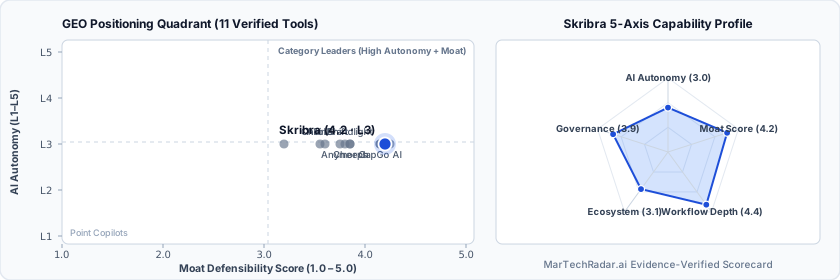
Skribra is a Web SaaS tool for GEO (GEO Brand Tracking & LLM Rank Tracking) in GEO & AI SEO. Pricing: Custom / enterprise pricing. Best suited to SEO Directors, Brand Strategy Leaders and Growth Marketers. Editor ratings: AI autonomy L3 (conditional automation); moat score 4.2/5.0 (Proprietary moat). Fact-checked by Tim Fenolz on Oct 14, 2026.
Autonomous search intelligence and generative engine optimization agent tracking brand visibility and ranking citations across search and answer engines.
Skribra buyer fit verdict: when to choose vs. when to walk away
Choose Skribra if (Best Fit)
- Target ICP & Stack Fit: You operate as SEO Directors, Brand Strategy Leaders and Growth Marketers requiring a Web SaaS deployment for GEO.
- L3 Architecture & Defensibility: Defensibility centers on its multi-platform query probing harness, tracking citations across ChatGPT, Perplexity, Claude, Gemini, and Grok alongside automated markdown indexing pipelines.
- Commercial Model Fit: Your procurement budget aligns with Custom / enterprise pricing.
Walk away from Skribra if (Deal-Breakers)
- Walk away if you require transparent self-serve monthly billing or your budget ceiling is under $1,000/mo (Skribra requires sales-gated custom quoting).
- Walk away if your workflow cannot tolerate probabilistic variance in LLM citations: Generative model responses fluctuate based on stochastic sampling, causing citation monitoring to experience semantic drift and temporal instability across identical prompt evaluations.
- Walk away if synthetic crawl rate limiting is a deal-breaker for your team: Automated probing against external commercial conversational interfaces faces aggressive endpoint rate throttling and anti-bot mitigation, risking occasional gaps in time-series ranking telemetry.
Skribra key facts & scorecard
| Pricing | Custom / enterprise pricing |
|---|---|
| Free plan | No / not disclosed |
| Delivery | Web SaaS |
| Audience | SEO Directors, Brand Strategy Leaders, Growth Marketers |
| AI autonomy level | L3 · Conditional automationEditor-verified |
| Moat tier & score | 4.2 / 5.0 · Proprietary moatEditor-verified |
| Funding | Seed |
| Total funding | $1M |
| Founders | Sev Leo |
| Company size | 0-1 employees |
| Governance & docs | API & Docs ↗ · Changelog ↗ · Terms ↗ · Privacy ↗ |
| Headquarters | Sheridan, Wyoming, United States |
| Founded | 2024 |
| Last verified |
Skribra pros & cons: strengths vs. operational limitations
Pros: core strengths & capabilities
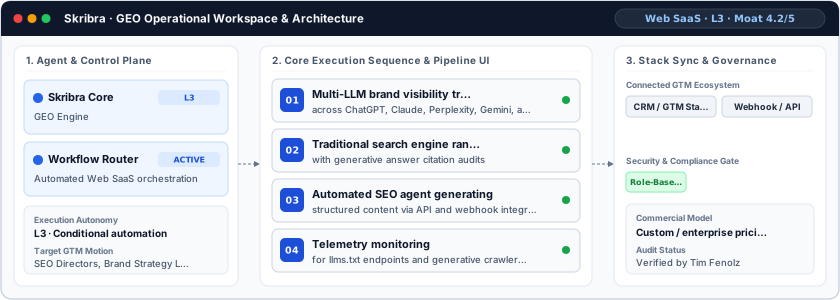
- Multi-LLM brand visibility tracking: across ChatGPT, Claude, Perplexity, Gemini, and Grok
- Traditional search engine rank tracking paired: with generative answer citation audits
- Automated SEO agent generating: structured content via API and webhook integrations
- Telemetry monitoring: for llms.txt endpoints and generative crawler accessibility
Cons: operational limitations & risks
- Probabilistic Variance in LLM Citations: Generative model responses fluctuate based on stochastic sampling, causing citation monitoring to experience semantic drift and temporal instability across identical prompt evaluations.
- Synthetic Crawl Rate Limiting: Automated probing against external commercial conversational interfaces faces aggressive endpoint rate throttling and anti-bot mitigation, risking occasional gaps in time-series ranking telemetry.
- Automated Content Maintenance Debt: Autonomous publication agents require human editorial oversight to reconcile hallucinated technical terminology and maintain strict adherence to internal domain schema standards.
Skribra TCO & deal-breaker stress test
Simulate 12-month stepped TCO, hidden cost multipliers, contract lock-in exposure, and stack failure modes using only facts verified by Tim Fenolz on · Capture SHA 60ae27bc.
Skribra triggers high-severity friction under your 5-seat / $800/mo constraints. Benchmark the verified subtrack alternatives below before committing.
| Plan / Tier | Verified Rate | Scale Fit | Scope & Quota Notes |
|---|---|---|---|
| Enterprise / Custom | Custom quote | 15–50+ seats (Enterprise SLA) | Sales-negotiated annual contract for custom volume, SSO/RBAC governance, and dedicated SLA. |
- Moat Score
- 4.2 / 5.0
- AI Autonomy
- L3
- Free Tier / Trial
- None disclosed
Triggered audit signals & failure modes
- Opaque Enterprise Quoting vs. SMB/Mid-Market BudgetVerified Pricing Ledger
Skribra does not disclose a public self-serve floor (Custom / enterprise pricing). Buyers with a $800/mo cap face high sales-qualification friction.
- Sales-Gated Contract TermsFact-checked by Tim Fenolz
Commercial pricing for Skribra is available on request through tailored enterprise sales quotes based on organizational scale, monitored query volumes, and seat allotments.
- Primary Operational Bottleneck: Probabilistic Variance in LLM CitationsAudit by Tim Fenolz
Generative model responses fluctuate based on stochastic sampling, causing citation monitoring to experience semantic drift and temporal instability across identical prompt evaluations.
Hidden TCO Multipliers & Quota Gates
- Probabilistic Variance in LLM Citations: Generative model responses fluctuate based on stochastic sampling, causing citation monitoring to experience semantic drift and temporal instability across identical prompt evaluations.
- Synthetic Crawl Rate Limiting: Automated probing against external commercial conversational interfaces faces aggressive endpoint rate throttling and anti-bot mitigation, risking occasional gaps in time-series ranking telemetry.
When to Walk Away & Negotiation Levers
- Walk away if you require transparent self-serve monthly billing or your budget ceiling is under $1,000/mo (Skribra requires sales-gated custom quoting).
- Walk away if your workflow cannot tolerate probabilistic variance in LLM citations: Generative model responses fluctuate based on stochastic sampling, causing citation monitoring to experience semantic drift and temporal instability across identical prompt evaluations.
- Walk away if synthetic crawl rate limiting is a deal-breaker for your team: Automated probing against external commercial conversational interfaces faces aggressive endpoint rate throttling and anti-bot mitigation, risking occasional gaps in time-series ranking telemetry.
- Demand a 30- to 60-day paid pilot opt-out clause in the Skribra order form before signing a 12-month enterprise commitment.
- Require a sandbox proof-of-concept testing probabilistic variance in LLM citations against your live CRM/data schema before annual sign-off.
Ask a custom procurement or TCO stress-test question about Skribra
Lower 5-seat floor (~$24/mo vs. Custom Quote) · Transparent self-serve entry without mandatory annual lock-in
Lower 5-seat floor (~$50/mo vs. Custom Quote) · Transparent self-serve entry without mandatory annual lock-in
Skribra moat & subtrack positioning
Defensibility centers on its multi-platform query probing harness, tracking citations across ChatGPT, Perplexity, Claude, Gemini, and Grok alongside automated markdown indexing pipelines.
Editorial review
Fact-checked by Tim Fenolz (Lead AdTech, Programmatic & Attribution Analyst) on .
Background
Established in 2024 in Sheridan, Wyoming, United States, Skribra addresses the visibility void left by traditional indexers as enterprise discovery moves into generative search. Backed by $1M in venture financing, the platform serves enterprise search strategists, content operations directors, and digital marketing leaders who require continuous tracking across traditional search result pages and generative answer engines. Rather than treating rank tracking as static keyword positions, Skribra automates multi-engine brand presence audits.
How Skribra works
Skribra functions as an autonomous rank intelligence system (Autonomy Level L3) operating across classical web crawlers and modern generative engines including ChatGPT, Perplexity, Claude, Gemini, and Grok. Its ingestion pipeline deploys structured probe queries against conversational interfaces, extracting brand entity references, source citations, and topical context. The platform synchronizes search position data with entity graphs, exposing ingestion webhooks, automated publishing agents, and llms.txt protocol formatting to continuously steer generative retrieval algorithms.
Limitations
Operational considerations and platform boundaries include:
- Probabilistic Variance in LLM Citations: Generative model responses fluctuate based on stochastic sampling, causing citation monitoring to experience semantic drift and temporal instability across identical prompt evaluations.
- Synthetic Crawl Rate Limiting: Automated probing against external commercial conversational interfaces faces aggressive endpoint rate throttling and anti-bot mitigation, risking occasional gaps in time-series ranking telemetry.
- Automated Content Maintenance Debt: Autonomous publication agents require human editorial oversight to reconcile hallucinated technical terminology and maintain strict adherence to internal domain schema standards.
Skribra pricing
Commercial pricing for Skribra is available on request through tailored enterprise sales quotes based on organizational scale, monitored query volumes, and seat allotments. Prospective teams can test core functionality through a short trial period, while enterprise procurement tiers bundle custom indexing quotas, high-frequency probing cadences, and dedicated Content API integration support.
How Skribra compares
Within generative answer monitoring, Skribra competes against platforms like Anymorph, AthenaHQ, and Brandlight. While AthenaHQ and Brandlight focus primarily on post-hoc sentiment analysis and brand mention monitoring across synthetic answers, Skribra couples synthetic query auditing with autonomous content generation agents and crawler endpoints. This architecture serves mid-market and enterprise inbound marketing teams seeking programmatic content adjustments directly mapped to generative engine visibility deficits.
Direct competitors & market radar
Top algorithmic competitors based on category positioning, capability overlap, and ICP alignment.
Frequently asked questions about Skribra
How much does Skribra cost and does it require a custom enterprise quote?
Published pricing summary for Skribra: Custom / enterprise pricing. A permanent free plan is not disclosed for Skribra. Commercial pricing for Skribra is available on request through tailored enterprise sales quotes based on organizational scale, monitored query volumes, and seat allotments.
How does Skribra work and how autonomous is its AI architecture?
Autonomous search intelligence and generative engine optimization agent tracking brand visibility and ranking citations across search and answer engines. Within GEO (GEO Brand Tracking & LLM Rank Tracking), MarTechRadar rates its execution architecture at L3 · Conditional automation with a verified Moat Score of 4.2 / 5.0 (Proprietary moat). Defensibility centers on its multi-platform query probing harness, tracking citations across ChatGPT, Perplexity, Claude, Gemini, and Grok alongside automated markdown indexing pipelines. Corporate profile: Founded by Sev Leo, operating at 0-1 employees scale.
What are the main limitations of Skribra and when should buyers walk away?
Based on our editorial technical audit, key operational considerations and boundaries for Skribra include: (1) Probabilistic Variance in LLM Citations: Generative model responses fluctuate based on stochastic sampling, causing citation monitoring to experience semantic drift and temporal instability across identical prompt evaluations. (2) Synthetic Crawl Rate Limiting: Automated probing against external commercial conversational interfaces faces aggressive endpoint rate throttling and anti-bot mitigation, risking occasional gaps in time-series ranking telemetry. (3) Automated Content Maintenance Debt: Autonomous publication agents require human editorial oversight to reconcile hallucinated technical terminology and maintain strict adherence to internal domain schema standards. Primary procurement walk-away rule: Walk away if you require transparent self-serve monthly billing or your budget ceiling is under $1,000/mo (Skribra requires sales-gated custom quoting).
What integrations, compliance certifications, and contract terms apply to Skribra?
First-party governance and developer endpoints verified on domain include: API Docs (https://skribra.com/docs). Key TCO multiplier to watch: Probabilistic Variance in LLM Citations (Generative model responses fluctuate based on stochastic sampling, causing citation monitoring to experience semantic drift and temporal instability across identical prompt evaluations.) Before signing a contract, procurement teams should demand a 30- to 60-day paid pilot opt-out clause in the Skribra order form before signing a 12-month enterprise commitment.
What are the best Skribra alternatives and head-to-head competitors in 2026?
Top fact-checked alternatives to Skribra in GEO (GEO Brand Tracking & LLM Rank Tracking) include Writesonic (From $50/mo), Scalenut (From $24/mo), Parsnipp ($39.99–$99.99/mo), emberos (Custom / enterprise pricing). Within generative answer monitoring, Skribra competes against platforms like Anymorph, AthenaHQ, and Brandlight.
Verified sources & evidence trail
- Official product domain: https://skribra.com/
- Commercial pricing verification: Verified against official vendor pricing policy (Custom / enterprise pricing)
- Verified corporate entity profiles (
sameAs): LinkedIn Company Profile · Crunchbase Entity Record - First-party governance & documentation links: API & Docs · Changelog · Terms · Privacy
- Editorial audit sign-off: Fact-checked by Tim Fenolz on under the MarTechRadar Evidence-Ledger Protocol.