Scalenut Review (2026): Content Optimization Pricing, Pros & Cons
Bottom line
Scalenut is a Web SaaS tool for Content Optimization (Content Optimization & SERP Intelligence) in GEO & AI SEO. Pricing: $21–$199/mo. Best suited to B2B SaaS and Creators / Solo. Editor ratings: AI autonomy L2 (workflow copilot); moat score 3.1/5.0 (Workflow-embedded (strong)). Fact-checked by MarTechRadar Research Desk on Oct 14, 2026.
AI-powered SEO and content intelligence platform unifying search intent analysis, automated long-form generation, and generative engine optimization (GEO).
Is Scalenut worth it in 2026? Buyer fit & when to walk away
Choose Scalenut if (Best Fit)
- Target ICP & Stack Fit: You operate as B2B SaaS and Creators / Solo requiring a Web SaaS deployment for Content Optimization, with verified ecosystem connectivity for Shopify, WordPress, Twilio Segment.
- L2 Architecture & Defensibility: End-to-end integration of automated SERP competitive research with generative engine optimization (GEO) scoring and AI search visibility tracking across models like ChatGPT and Google AI Overviews.
- Commercial Model Fit: Your procurement budget aligns with $21–$199/mo.
Walk away from Scalenut if (Deal-Breakers)
- Walk away if your workflow cannot tolerate algorithmic drift in AI search auditing: AI visibility metrics depend on external LLM response stability; continuous token updates and stochastic answer variation in third-party engines cause fluctuating citation telemetry across refresh intervals.
- Walk away if entity over-optimization overhead is a deal-breaker for your team: Algorithmic density recommendations can produce repetitive semantic phrase insertions, requiring rigorous editorial intervention to avoid unnatural syntactical phrasing.
Scalenut pricing, free plan & scorecard at a glance
| Pricing | $21–$199/moVendor pricing page |
|---|---|
| Free plan | No / not disclosed |
| Delivery | Web SaaS |
| Audience | B2B SaaS, Creators / Solo |
| AI autonomy level | L2 · Workflow copilotEditor-verified |
| Moat tier & score | 3.1 / 5.0 · Workflow-embedded (strong)Editor-verified |
| Funding | Venture-backed |
| Total funding | $3.5M |
| Founders | Gaurav Goyal, Mayank Jain, Saurabh Wadhawan |
| Company size | 11-50 employees |
| Ecosystem integrations | Shopify, WordPress, Twilio Segment |
| Governance & docs | Changelog ↗ · Privacy ↗ |
| Headquarters | Altadena, California |
| Founded | 2020 |
| Last verified | Oct 24, 2026 |
Scalenut pros & cons: strengths vs. operational limitations
Pros: core strengths & capabilities
- AI Visibility module tracking domain citations: across ChatGPT and Google AI Overviews
- Cruise Mode automated long-form: article generation engine based on competitive SERP extraction
- Generative Engine Optimization (GEO): content auditor for LLM citation readiness
- Programmatic keyword clustering and NLP topic modeling workspace
Cons: operational limitations & risks
- Algorithmic Drift in AI Search Auditing: AI visibility metrics depend on external LLM response stability; continuous token updates and stochastic answer variation in third-party engines cause fluctuating citation telemetry across refresh intervals.
- Entity Over-Optimization Overhead: Algorithmic density recommendations can produce repetitive semantic phrase insertions, requiring rigorous editorial intervention to avoid unnatural syntactical phrasing.
- Catalog Scaling Latency: Large-scale batch production of multi-thousand-page programmatic sites stresses workspace token ceilings and requires manual review to prevent duplicate structural outlines.
Scalenut TCO & deal-breaker stress test
Simulate 12-month stepped TCO, hidden cost multipliers, contract lock-in exposure, and stack failure modes using only facts verified by MarTechRadar Research Desk on 2026-10-14 · Capture SHA 0b98ca3b.
Scalenut aligns with your 5-seat / $800/mo profile. Review the walk-away triggers and contract levers below before deployment.
- Moat Score
- 3.1 / 5.0
- AI Autonomy
- L2
- Free Tier / Trial
- None disclosed
Triggered audit signals & failure modes
- Published Self-Serve Entry FloorVerified Pricing Ledger
Scalenut publishes a transparent entry point ($21–$199/mo) for initial validation before committing.
- Tier Fit for 5-Seat Scale: Pro ($70/mo)Verified Tier Schedule
Verified $70/mo Pro tier from vendor pricing schedule.
- Primary Operational Bottleneck: Algorithmic Drift in AI Search AuditingAudit by MarTechRadar Research Desk
AI visibility metrics depend on external LLM response stability; continuous token updates and stochastic answer variation in third-party engines cause fluctuating citation telemetry across refresh intervals.
Test a custom Scalenut budget or stack constraint
Lower 5-seat floor (~$8/mo vs. $70 / mo)
Scalenut integrations, API, security & compliance stack
Scalenut AI moat & Content Optimization positioning
End-to-end integration of automated SERP competitive research with generative engine optimization (GEO) scoring and AI search visibility tracking across models like ChatGPT and Google AI Overviews.
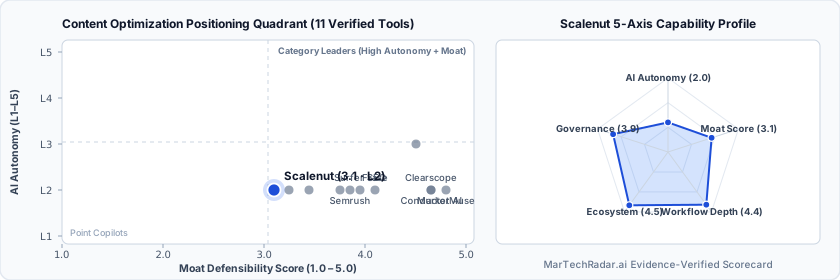
Scalenut in-depth review, pricing & architecture analysis
Editor sign-off: Oct 14, 2026. How profiles are made.
What is Scalenut? Overview & background
Architected as a dedicated organic growth engine combining generative engine optimization with editorial automation, Scalenut replaces disjointed SEO toolchains with closed-loop content production. Established in 2020 and headquartered in Altadena, California, the company has raised $3.5M in venture funding to bridge the operational gap between keyword intelligence and programmatic execution. Directed at technical content strategists, SEO directors, and demand generation teams managing scaled organic footprints, the platform structures organic discoverability around algorithmic generative answer engines alongside standard indexation crawlers.
How Scalenut works: architecture & workflow
At its technical core, Scalenut functions at Level 2 autonomy by pairing natural language processing extractors with multi-stage LLM generation pipelines. Ingestion workflows scrape top-ranking search results to construct contextual vector representations, extracting entity density, heading structures, and semantic co-occurrences. The engine parses these parameters through proprietary prompt chains to draft long-form editorial drafts, evaluate citation readiness for models like ChatGPT and Google AI Overviews, and flag topical coverage gaps before human-in-the-loop review, alongside native workflow integrations for Shopify, WordPress, and Semrush.
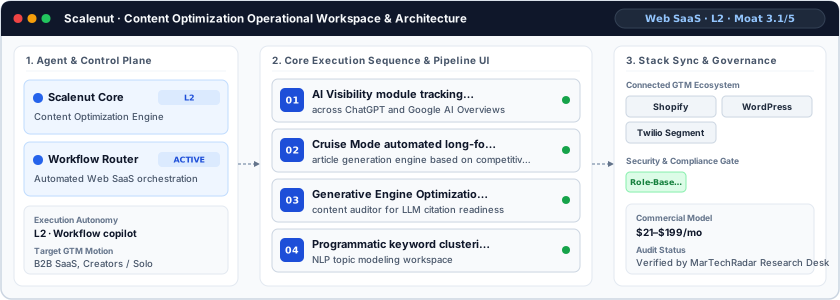
Scalenut limitations, drawbacks & risks
Operational considerations and platform boundaries include:
- Algorithmic Drift in AI Search Auditing: AI visibility metrics depend on external LLM response stability; continuous token updates and stochastic answer variation in third-party engines cause fluctuating citation telemetry across refresh intervals.
- Entity Over-Optimization Overhead: Algorithmic density recommendations can produce repetitive semantic phrase insertions, requiring rigorous editorial intervention to avoid unnatural syntactical phrasing.
- Catalog Scaling Latency: Large-scale batch production of multi-thousand-page programmatic sites stresses workspace token ceilings and requires manual review to prevent duplicate structural outlines.
Scalenut pricing, plans & cost breakdown
Commercial access operates under a tiered software-as-a-service model indexed to prompt tracking allowances, workspace caps, and generation volumes. Entry licensing begins on the Starter plan at $21 per month on annual billing ($59 per month billed monthly) for 10 tracked prompts and one workspace, scaling to Plus at $31 per month billed annually ($89 per month billed monthly, 25 tracked prompts, two workspaces) and Pro at $70 per month billed annually ($199 per month billed monthly). Higher enterprise tiers expand seat licenses, increase monitored generative engine prompts, and unlock managed VIP workflow services.
| Plan / Tier | Verified Price & Billing | Included Scope & Contract Terms | |
|---|---|---|---|
| Starter | $21/mo | Verified $21/mo Starter tier from vendor pricing schedule. | |
| Plus | $31/mo | Verified $31/mo Plus tier from vendor pricing schedule. | |
| Pro | $70/mo | Verified $70/mo Pro tier from vendor pricing schedule. | |
| Contract Watchout: Annual Billing Headline vs. Monthly Premium | The vendor pricing page advertises an annual-billing discount (Save 65%); month-to-month billing carries a higher effective monthly rate. | ||
How Scalenut compares vs. competitors & alternatives
Within organic content and discovery infrastructure, Scalenut occupies a dedicated execution layer within the AI Content Marketing segment. While Typeface structures programmatic influencer monetization networks, AndromedAI handles bespoke localization pipelines, and Amdahl restricts its scope to token classification and AI text detection, Scalenut targets full-funnel content production. It provides superior unified GEO attribution compared to isolated detectors, though enterprise organizations requiring complex compliance governance will still require internal editorial oversight layers.
Direct competitors & market radar
Top algorithmic competitors based on category positioning, capability overlap, and ICP alignment.
Frequently asked questions about Scalenut
How much does Scalenut cost in 2026?
Scalenut pricing: $21–$199/mo. No free plan is publicly disclosed. Published tiers: Starter ($21/mo); Plus ($31/mo); Pro ($70/mo). Commercial access operates under a tiered software-as-a-service model indexed to prompt tracking allowances, workspace caps, and generation volumes.
What are the top Scalenut alternatives in Content Optimization?
Verified Content Optimization alternatives include Skribra (Custom / enterprise pricing), MarketMuse (Custom / enterprise pricing), Hall (Custom / enterprise pricing), Conversion (Custom / enterprise pricing). Within organic content and discovery infrastructure, Scalenut occupies a dedicated execution layer within the AI Content Marketing segment.
What are the main limitations and trade-offs of Scalenut?
Operational considerations and platform boundaries include: Algorithmic Drift in AI Search Auditing: AI visibility metrics depend on external LLM response stability; continuous token updates and stochastic answer variation in third-party engines cause fluctuating citation telemetry across refresh intervals. Walk away if your workflow cannot tolerate algorithmic drift in AI search auditing: AI visibility metrics depend on external LLM response stability; continuous token updates and stochastic answer variation in third-party engines cause fluctuating citation telemetry across refresh intervals.
Verified sources & evidence trail
- Official product domain: https://scalenut.com
- Commercial pricing verification: https://www.scalenut.com/pricing
- Verified corporate entity profiles (
sameAs): LinkedIn Company Profile · Crunchbase Entity Record - First-party governance & documentation links: Changelog · Privacy
- Editor sign-off: Oct 14, 2026 (how profiles are made).
