Conversion Review (2026): Content Optimization Pricing, Limits & Alternatives
Bottom line
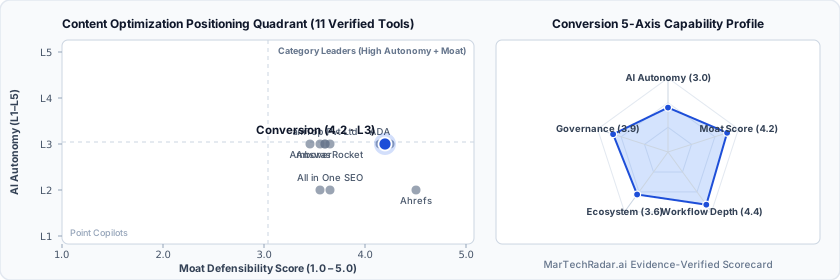
Conversion is a Web SaaS tool for Content Optimization (Content Optimization & SERP Intelligence) in GEO & AI SEO. Pricing: Custom / enterprise pricing. Best suited to SEO Directors, Brand Strategy Leaders and Growth Marketers. Editor ratings: AI autonomy L3 (conditional automation); moat score 4.2/5.0 (Proprietary moat). Fact-checked by Julie Brot on Oct 11, 2026.
Conversion is an AI-native B2B marketing automation platform unifying campaign orchestration, native attribution, and bi-directional CRM synchronization.
Conversion buyer fit verdict: when to choose vs. when to walk away
Choose Conversion if (Best Fit)
- Target ICP & Stack Fit: You operate as SEO Directors, Brand Strategy Leaders and Growth Marketers requiring a Web SaaS deployment for Content Optimization, with verified ecosystem connectivity for Salesforce.
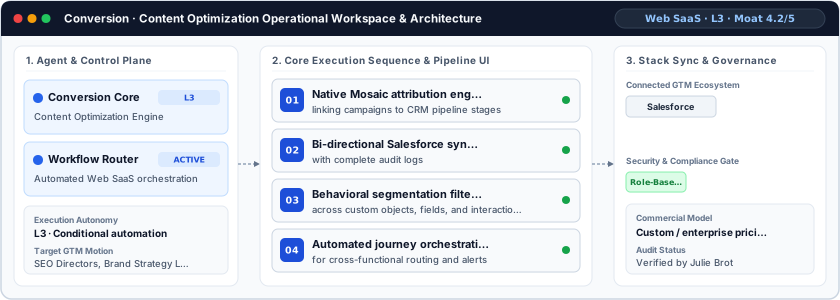
- L3 Architecture & Defensibility: Deep bi-directional Salesforce synchronization with full audit logging paired with natively embedded attribution (Mosaic) eliminates multi-vendor data drift across campaign lifecycles.
- Commercial Model Fit: Your procurement budget aligns with Custom / enterprise pricing.
Walk away from Conversion if (Deal-Breakers)
- Walk away if you require transparent self-serve monthly billing or your budget ceiling is under $1,000/mo (Conversion requires sales-gated custom quoting).
- Walk away if your workflow cannot tolerate CRM schema coupling: The system depends heavily on rigid Salesforce object mappings, causing workflow stalls or sync throttles if upstream CRM validation rules and permissions change abruptly.
- Walk away if attribution cold starts is a deal-breaker for your team: The native Mosaic attribution module requires high historical deal volume to establish statistically valid multi-touch weightings, limiting effectiveness for early-stage B2B cohorts.
Conversion key facts & scorecard
| Pricing | Custom / enterprise pricing |
|---|---|
| Free plan | No / not disclosed |
| Delivery | Web SaaS |
| Audience | SEO Directors, Brand Strategy Leaders, Growth Marketers |
| AI autonomy level | L3 · Conditional automationEditor-verified |
| Moat tier & score | 4.2 / 5.0 · Proprietary moatEditor-verified |
| Funding | Series A |
| Total funding | $30.5MBacked by Antler, Abstract |
| Founders | James Jiao, Neil Tewari |
| Company size | 51-200 employees |
| Ecosystem integrations | Salesforce |
| Governance & docs | Trust & Security ↗ · API & Docs ↗ · Changelog ↗ · DPA ↗ · Terms ↗ · Privacy ↗ |
| Headquarters | San Francisco, California |
| Founded | 2020 |
| Last verified |
Conversion pros & cons: strengths vs. operational limitations
Pros: core strengths & capabilities
- Native Mosaic attribution engine: linking campaigns to CRM pipeline stages
- Bi-directional Salesforce synchronization: with complete audit logs
- Behavioral segmentation filtering: across custom objects, fields, and interactions
- Automated journey orchestration: for cross-functional routing and alerts
Cons: operational limitations & risks
- CRM Schema Coupling: The system depends heavily on rigid Salesforce object mappings, causing workflow stalls or sync throttles if upstream CRM validation rules and permissions change abruptly.
- Attribution Cold Starts: The native Mosaic attribution module requires high historical deal volume to establish statistically valid multi-touch weightings, limiting effectiveness for early-stage B2B cohorts.
- Event Ingestion Bottlenecks: Processing non-standard web events outside standard landing page components demands custom webhook configuration, creating maintenance overhead for non-standard data pipelines.
Conversion TCO & deal-breaker stress test
Simulate 12-month stepped TCO, hidden cost multipliers, contract lock-in exposure, and stack failure modes using only facts verified by Julie Brot on · Capture SHA e0bb68e7.
Conversion triggers high-severity friction under your 5-seat / $800/mo constraints. Benchmark the verified subtrack alternatives below before committing.
| Plan / Tier | Verified Rate | Scale Fit | Scope & Quota Notes |
|---|---|---|---|
| Enterprise / Custom | Custom quote | 15–50+ seats (Enterprise SLA) | Sales-negotiated annual contract for custom volume, SSO/RBAC governance, and dedicated SLA. |
- Moat Score
- 4.2 / 5.0
- AI Autonomy
- L3
- Free Tier / Trial
- None disclosed
Triggered audit signals & failure modes
- Opaque Enterprise Quoting vs. SMB/Mid-Market BudgetVerified Pricing Ledger
Conversion does not disclose a public self-serve floor (Custom / enterprise pricing). Buyers with a $800/mo cap face high sales-qualification friction.
- Sales-Gated Contract TermsFact-checked by Julie Brot
Conversion distributes its software through custom enterprise pricing available on request via sales engagements.
- Primary Operational Bottleneck: CRM Schema CouplingAudit by Julie Brot
The system depends heavily on rigid Salesforce object mappings, causing workflow stalls or sync throttles if upstream CRM validation rules and permissions change abruptly.
Hidden TCO Multipliers & Quota Gates
- Enterprise Governance & Add-On Gating: Advanced capabilities such as Single Sign-On (SSO), custom role permissions, or specialized analytics modules are gated behind upper tiers or paid add-ons.
- CRM Schema Coupling: The system depends heavily on rigid Salesforce object mappings, causing workflow stalls or sync throttles if upstream CRM validation rules and permissions change abruptly.
- Attribution Cold Starts: The native Mosaic attribution module requires high historical deal volume to establish statistically valid multi-touch weightings, limiting effectiveness for early-stage B2B cohorts.
When to Walk Away & Negotiation Levers
- Walk away if you require transparent self-serve monthly billing or your budget ceiling is under $1,000/mo (Conversion requires sales-gated custom quoting).
- Walk away if your workflow cannot tolerate CRM schema coupling: The system depends heavily on rigid Salesforce object mappings, causing workflow stalls or sync throttles if upstream CRM validation rules and permissions change abruptly.
- Walk away if attribution cold starts is a deal-breaker for your team: The native Mosaic attribution module requires high historical deal volume to establish statistically valid multi-touch weightings, limiting effectiveness for early-stage B2B cohorts.
- Demand a 30- to 60-day paid pilot opt-out clause in the Conversion order form before signing a 12-month enterprise commitment.
- Require a sandbox proof-of-concept testing CRM schema coupling against your live CRM/data schema before annual sign-off.
Ask a custom procurement or TCO stress-test question about Conversion
Lower 5-seat floor (~$599/mo vs. Custom Quote) · Transparent self-serve entry without mandatory annual lock-in
Lower 5-seat floor (~$16/mo vs. Custom Quote) · Transparent self-serve entry without mandatory annual lock-in
Conversion key entities, modules & ecosystem stack
Conversion moat & subtrack positioning
Deep bi-directional Salesforce synchronization with full audit logging paired with natively embedded attribution (Mosaic) eliminates multi-vendor data drift across campaign lifecycles.
Editorial review
Fact-checked by Julie Brot (Enterprise SaaS Governance & Procurement Editor) on .
Background
Architected to replace legacy marketing cloud stacks with unified execution logic, Conversion is an AI-native marketing automation engine built for enterprise demand generation teams and revenue operations leaders. Headquartered in San Francisco, California, and founded in 2020, the platform has secured $30.5M in venture funding. Conversion consolidates campaign orchestration, progressive profiling, dynamic lead scoring, and native attribution into a single system of record, targeting B2B organizations seeking direct synchronization with enterprise CRM architectures.
How Conversion works
At the architectural level, the system functions through a continuous, bi-directional Salesforce sync pipeline that mirrors field schemas, custom objects, and behavioral events in real time with comprehensive audit logging. The core engine coordinates journeys using an event-driven automation framework, routing records via AI-tuned propensity scoring models and programmatic round-robin queues. In parallel, its native attribution layer, Mosaic, maps touchpoints directly to opportunity stages without third-party tracking scripts, feeding algorithmic optimization routines that adjust content delivery and engagement cadences based on prospect interactions.
Limitations
Operational considerations and platform boundaries include:
- CRM Schema Coupling: The system depends heavily on rigid Salesforce object mappings, causing workflow stalls or sync throttles if upstream CRM validation rules and permissions change abruptly.
- Attribution Cold Starts: The native Mosaic attribution module requires high historical deal volume to establish statistically valid multi-touch weightings, limiting effectiveness for early-stage B2B cohorts.
- Event Ingestion Bottlenecks: Processing non-standard web events outside standard landing page components demands custom webhook configuration, creating maintenance overhead for non-standard data pipelines.
Conversion pricing
Conversion distributes its software through custom enterprise pricing available on request via sales engagements. Procurement contracts are structured around customized annual software licenses that scale according to database volume, active user seats, and tenant integration complexity. Production deployment tiers include technical onboarding, dedicated CRM sync management, and enterprise support access without public self-serve tiers.
How Conversion compares
Within enterprise workflows, Conversion competes against distinct architectures. Traditional SEO and content intelligence tools like Ahrefs deliver deep organic SERP telemetry and keyword indexes, yet lack native CRM campaign routing and attribution capabilities. Meanwhile, vertical platforms such as Amboras or specialized tools like Clearscope provide standalone editorial scoring but lack scalable marketing automation frameworks. Conversion fits mid-market and enterprise B2B sales organizations prioritizing consolidated CRM orchestration over disconnected SEO research utilities.
Direct competitors & market radar
Top algorithmic competitors based on category positioning, capability overlap, and ICP alignment.
Frequently asked questions about Conversion
How much does Conversion cost and does it require a custom enterprise quote?
Published pricing summary for Conversion: Custom / enterprise pricing. A permanent free plan is not disclosed for Conversion. Conversion distributes its software through custom enterprise pricing available on request via sales engagements. Procurement contracts are structured around customized annual software licenses that scale according to database volume, active user seats, and tenant integration complexity.
How does Conversion work and how autonomous is its AI architecture?
Conversion is an AI-native B2B marketing automation platform unifying campaign orchestration, native attribution, and bi-directional CRM synchronization. Within Content Optimization (Content Optimization & SERP Intelligence), MarTechRadar rates its execution architecture at L3 · Conditional automation with a verified Moat Score of 4.2 / 5.0 (Proprietary moat). Deep bi-directional Salesforce synchronization with full audit logging paired with natively embedded attribution (Mosaic) eliminates multi-vendor data drift across campaign lifecycles. Corporate profile: Founded by James Jiao, Neil Tewari, operating at 51-200 employees scale.
What are the main limitations of Conversion and when should buyers walk away?
Based on our editorial technical audit, key operational considerations and boundaries for Conversion include: (1) CRM Schema Coupling: The system depends heavily on rigid Salesforce object mappings, causing workflow stalls or sync throttles if upstream CRM validation rules and permissions change abruptly. (2) Attribution Cold Starts: The native Mosaic attribution module requires high historical deal volume to establish statistically valid multi-touch weightings, limiting effectiveness for early-stage B2B cohorts. (3) Event Ingestion Bottlenecks: Processing non-standard web events outside standard landing page components demands custom webhook configuration, creating maintenance overhead for non-standard data pipelines. Primary procurement walk-away rule: Walk away if you require transparent self-serve monthly billing or your budget ceiling is under $1,000/mo (Conversion requires sales-gated custom quoting).
What integrations, compliance certifications, and contract terms apply to Conversion?
Verified ecosystem and stack integrations include Salesforce. First-party governance and developer endpoints verified on domain include: Trust/Security (https://conversion.ai/security), API Docs (https://docs.conversion.ai), DPA (https://conversion.ai/dpa). Key TCO multiplier to watch: Enterprise Governance & Add-On Gating (Advanced capabilities such as Single Sign-On (SSO), custom role permissions, or specialized analytics modules are gated behind upper tiers or paid add-ons.) Before signing a contract, procurement teams should demand a 30- to 60-day paid pilot opt-out clause in the Conversion order form before signing a 12-month enterprise commitment.
What are the best Conversion alternatives and head-to-head competitors in 2026?
Top fact-checked alternatives to Conversion in Content Optimization (Content Optimization & SERP Intelligence) include Optmyzr (Custom / enterprise pricing), Gauge (From $599/mo), Citera (From $99/mo), Taja AI (From $15.99/mo). Within enterprise workflows, Conversion competes against distinct architectures. Traditional SEO and content intelligence tools like Ahrefs deliver deep organic SERP telemetry and keyword indexes, yet lack native CRM campaign routing and attribution capabilities.
Verified sources & evidence trail
- Official product domain: https://conversion.ai
- Commercial pricing verification: Verified against official vendor pricing policy (Custom / enterprise pricing)
- Verified corporate entity profiles (
sameAs): LinkedIn Company Profile · Crunchbase Entity Record - First-party governance & documentation links: Trust & Security · API & Docs · Changelog · DPA · Terms · Privacy
- Editorial audit sign-off: Fact-checked by Julie Brot on under the MarTechRadar Evidence-Ledger Protocol.