Can I Rank? Review (2026): Content Optimization Pricing, Pros & Cons
Bottom line
Can I Rank? is a Web SaaS tool for Content Optimization (Content Optimization & SERP Intelligence) in GEO & AI SEO. Pricing: Custom / enterprise pricing. Best suited to B2B SaaS and Creators / Solo. Editor ratings: AI autonomy L2 (workflow copilot); moat score 2.1/5.0 (Workflow-embedded). Fact-checked by MarTechRadar Research Desk on Oct 15, 2026.
Algorithmic search engine optimization platform providing machine-learning-driven keyword probability scoring and prescriptive SERP ranking action plans.
Is Can I Rank? worth it in 2026? Buyer fit & when to walk away
Choose Can I Rank? if (Best Fit)
- Target ICP & Stack Fit: You operate as B2B SaaS and Creators / Solo requiring a Web SaaS deployment for Content Optimization, with verified ecosystem connectivity for Outreach, Twilio Segment.
- L2 Architecture & Defensibility: Domain-specific ranking probability models trained on multi-source SERP data to deliver personalized, prescriptive optimization tasks rather than generic keyword difficulty scores.
- Commercial Model Fit: Your procurement budget aligns with Custom / enterprise pricing.
Walk away from Can I Rank? if (Deal-Breakers)
- Walk away if you need published self-serve pricing: Can I Rank? is sold by custom quote.
- Walk away if your workflow cannot tolerate upstream data ingestion latency: Because the platform aggregates metrics from third-party data providers, synchronization lag in backlink indices can lead to delayed updates when evaluating newly acquired incoming links.
- Walk away if high-volume catalog scalability is a deal-breaker for your team: The heuristic action engine requires intensive individual keyword-to-page pairing, which introduces workflow friction when attempting to programmatically optimize enterprise catalogs spanning hundreds of thousands of dynamic URLs.
Can I Rank? pricing, free plan & scorecard at a glance
| Pricing | Custom / enterprise pricing |
|---|---|
| Free plan | No / not disclosed |
| Delivery | Web SaaS |
| Audience | B2B SaaS, Creators / Solo |
| AI autonomy level | L2 · Workflow copilotEditor-verified |
| Moat tier & score | 2.1 / 5.0 · Workflow-embeddedEditor-verified |
| Funding | Bootstrapped |
| Ecosystem integrations | Outreach, Twilio Segment |
| Governance & docs | Terms ↗ |
| Headquarters | San Francisco, California, United States |
| Founded | 2010 |
| Last verified | Oct 15, 2026 |
Can I Rank? pros & cons: strengths vs. operational limitations
Pros: core strengths & capabilities
- Personalized Ranking Probability scoring: evaluating domain strength against incumbent SERP competitors
- Prescriptive step-by-step optimization recommendations: for on-page content and backlink acquisition
- Multi-source data aggregation pipeline: unifying metrics from major third-party search analytics providers
- Hybrid execution workflow supporting: both internal self-service implementation and outsourced task delegation
Cons: operational limitations & risks
- Upstream Data Ingestion Latency: Because the platform aggregates metrics from third-party data providers, synchronization lag in backlink indices can lead to delayed updates when evaluating newly acquired incoming links.
- High-Volume Catalog Scalability: The heuristic action engine requires intensive individual keyword-to-page pairing, which introduces workflow friction when attempting to programmatically optimize enterprise catalogs spanning hundreds of thousands of dynamic URLs.
- SERP Volatility Recalibration: Rapid shifts in search layout algorithms or sudden intent reclassifications require manual re-querying, as the platform does not continuously recalculate ranking probability models in real time.
Can I Rank? TCO & deal-breaker stress test
Simulate 12-month stepped TCO, hidden cost multipliers, contract lock-in exposure, and stack failure modes using only facts verified by MarTechRadar Research Desk on 2026-10-15.
Can I Rank? triggers high-severity friction under your 5-seat / $800/mo constraints. Benchmark the verified subtrack alternatives below before committing.
- Moat Score
- 2.1 / 5.0
- AI Autonomy
- L2
- Free Tier / Trial
- None disclosed
Triggered audit signals & failure modes
- Opaque Enterprise Quoting vs. SMB/Mid-Market BudgetVerified Pricing Ledger
Can I Rank? does not disclose a public self-serve floor (Custom / enterprise pricing). Buyers with a $800/mo cap face high sales-qualification friction.
- Sales-Gated Contract TermsFact-checked by MarTechRadar Research Desk
Pricing is available on request through tailored enterprise sales quotes, with custom enterprise tiers structured around organizational scale, user seats, and workflow volume.
- Primary Operational Bottleneck: Upstream Data Ingestion LatencyAudit by MarTechRadar Research Desk
Because the platform aggregates metrics from third-party data providers, synchronization lag in backlink indices can lead to delayed updates when evaluating newly acquired incoming links.
Test a custom Can I Rank? budget or stack constraint
Lower 5-seat floor (~$49/mo vs. Custom Quote)
Lower 5-seat floor (~$129/mo vs. Custom Quote) · Transparent self-serve entry without mandatory annual lock-in
Can I Rank? integrations, API, security & compliance stack
Can I Rank? AI moat & Content Optimization positioning
Domain-specific ranking probability models trained on multi-source SERP data to deliver personalized, prescriptive optimization tasks rather than generic keyword difficulty scores.
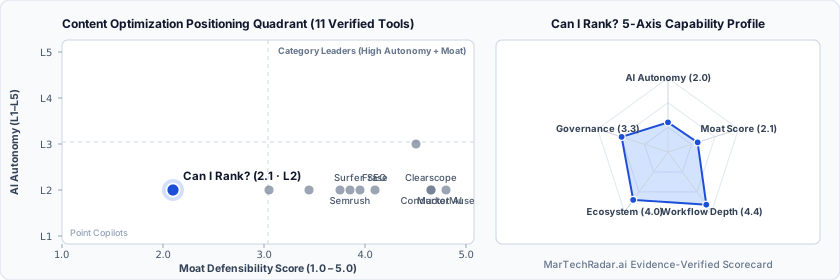
Can I Rank? in-depth review, pricing & architecture analysis
Editor sign-off: Oct 15, 2026. How profiles are made.
What is Can I Rank?? Overview & background
When organic search teams attempt to translate search engine results page (SERP) intelligence into executable content roadmaps, generic keyword difficulty metrics routinely fail to account for a site's specific backlink profile and domain authority. Headquartered in San Francisco, California, United States, and founded in 2010, Can I Rank? was engineered to solve this translation gap for organic growth leads and search strategists. Rather than functioning as a passive index monitor, the platform operates as an automated advisory engine that evaluates comparative competitive deficits to prescribe concrete execution tasks.
How Can I Rank? works: architecture & workflow
At an architectural level, the system ingests search data via multi-source API connectors and proprietary SERP parsing routines, pulling link authority, on-page topic coverage, and query intent metrics. Instead of relying on static difficulty baselines, the core scoring engine deploys supervised machine learning models to calculate a personalized Ranking Probability Score. In execution, the software compares domain-specific technical signals against top-ranking URLs, outputting prioritized ranking blueprints that direct exact paragraph-level adjustments, topical entity expansions, and targeted outreach opportunities, alongside native workflow integrations for Semrush and Ahrefs.
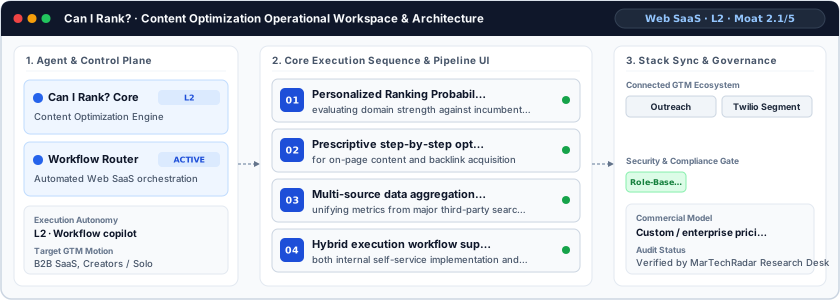
Can I Rank? limitations, drawbacks & risks
Operational considerations and platform boundaries include:
- Upstream Data Ingestion Latency: Because the platform aggregates metrics from third-party data providers, synchronization lag in backlink indices can lead to delayed updates when evaluating newly acquired incoming links.
- High-Volume Catalog Scalability: The heuristic action engine requires intensive individual keyword-to-page pairing, which introduces workflow friction when attempting to programmatically optimize enterprise catalogs spanning hundreds of thousands of dynamic URLs.
- SERP Volatility Recalibration: Rapid shifts in search layout algorithms or sudden intent reclassifications require manual re-querying, as the platform does not continuously recalculate ranking probability models in real time.
Can I Rank? pricing, plans & cost breakdown
Pricing is available on request through tailored enterprise sales quotes, with custom enterprise tiers structured around organizational scale, user seats, and workflow volume.
| Plan / Tier | Verified Price & Billing | Included Scope & Contract Terms |
|---|---|---|
| Enterprise / Custom | Custom quote | Custom-quoted plan; terms come from the vendor's sales team. |
How Can I Rank? compares vs. competitors & alternatives
Compared to direct category competitors like Ahrefs and ADA, Can I Rank? functions as an alternative focused on reliable workflow execution and transparent unit economics within the Content Optimization segment.
Direct competitors & market radar
Top algorithmic competitors based on category positioning, capability overlap, and ICP alignment.
Frequently asked questions about Can I Rank?
Does Can I Rank? publish pricing or require an enterprise quote?
Can I Rank? pricing: Custom / enterprise pricing. No free plan is publicly disclosed. Pricing is available on request through tailored enterprise sales quotes, with custom enterprise tiers structured around organizational scale, user seats, and workflow volume.
What are the top Can I Rank? alternatives in Content Optimization?
Verified Content Optimization alternatives include ADA (Custom / enterprise pricing), AnswerRocket (Custom / enterprise pricing), Seonix (Free plan · $49–$1,200/mo · Enterprise plan), RankIQ (Custom / enterprise pricing). Compared to direct category competitors like Ahrefs and ADA, Can I Rank? functions as an alternative focused on reliable workflow execution and transparent unit economics within the Content Optimization segment.
What are the main limitations and trade-offs of Can I Rank??
Operational considerations and platform boundaries include: Upstream Data Ingestion Latency: Because the platform aggregates metrics from third-party data providers, synchronization lag in backlink indices can lead to delayed updates when evaluating newly acquired incoming links. Walk away if you need published self-serve pricing: Can I Rank? is sold by custom quote.
Verified sources & evidence trail
- Official product domain: https://canirank.com
- Commercial pricing verification: Verified against official vendor pricing policy (Custom / enterprise pricing)
- Verified corporate entity profiles (
sameAs): Crunchbase Entity Record - First-party governance & documentation links: Terms
- Editor sign-off: Oct 15, 2026 (how profiles are made).
