Seonix Review (2026): Content Optimization Pricing, Pros & Cons
Bottom line
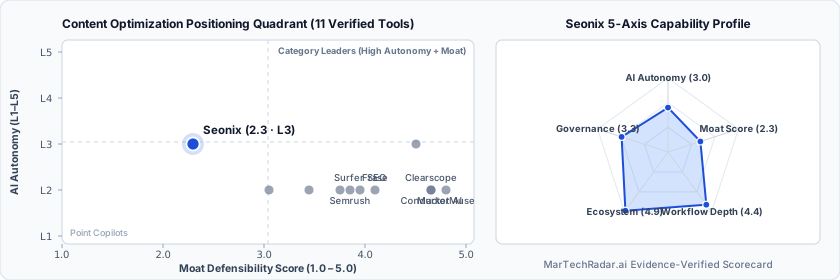
Seonix is a Web SaaS tool for Content Optimization (Content Optimization & SERP Intelligence) in GEO & AI SEO. Pricing: Free plan · $49–$1,200/mo · Enterprise plan. Editor ratings: AI autonomy L3 (conditional automation); moat score 2.3/5.0 (Workflow-embedded). Fact-checked by MarTechRadar Research Desk on Nov 14, 2026.
Automated SEO and GEO platform running 14 autopilot modules to research keywords, generate multilingual articles, and publish across 5 CMSs.
Is Seonix worth it in 2026? Buyer fit & when to walk away
Choose Seonix if (Best Fit)
- Target ICP & Stack Fit: You operate as Content Optimization teams requiring a Web SaaS deployment for Content Optimization, with verified ecosystem connectivity for Shopify, WordPress, Webflow, Model Context Protocol (MCP).
- L3 Architecture & Defensibility: Seonix combines an 8-module traditional SEO engine and a 6-module AI search (GEO) suite with a multi-model LLM gateway (Gemini, Claude, GPT) and direct scheduled auto-publishing across WordPress, Ghost, Webflow, Shopify, and Wix.
- Commercial Model Fit: Your procurement budget aligns with Free plan · $49–$1,200/mo · Enterprise plan and want a self-serve free tier for zero-cost initial validation.
Walk away from Seonix if (Deal-Breakers)
- Walk away if your workflow cannot tolerate no monthly article rollover: On the Starter tier, the allowance of 30 published AI articles per month (along with daily caps of 50 AI edits and 5 AI cover images) resets at the end of each billing cycle without rollover.
- Walk away if on-site content focus vs. off-page authority is a deal-breaker for your team: While Seonix automates technical hygiene, structured content production, and `/llms.txt` readiness, it does not execute external backlink outreach or digital PR campaigns required to lift domain authority in highly competitive SERPs.
Seonix pricing, free plan & scorecard at a glance
| Pricing | Free plan · $49–$1,200/mo · Enterprise planVendor pricing page |
|---|---|
| Free plan | Yes |
| Delivery | Web SaaS |
| Audience | — |
| AI autonomy level | L3 · Conditional automationEditor-verified |
| Moat tier & score | 2.3 / 5.0 · Workflow-embeddedEditor-verified |
| Funding | Undisclosed |
| Company size | 2-10 employees |
| Ecosystem integrations | Shopify, WordPress, Webflow, Model Context Protocol (MCP) |
| Headquarters | Kyiv, UA |
| Founded | 2026 |
| Last verified | Nov 14, 2026 |
Seonix pros & cons: strengths vs. operational limitations
Pros: core strengths & capabilities
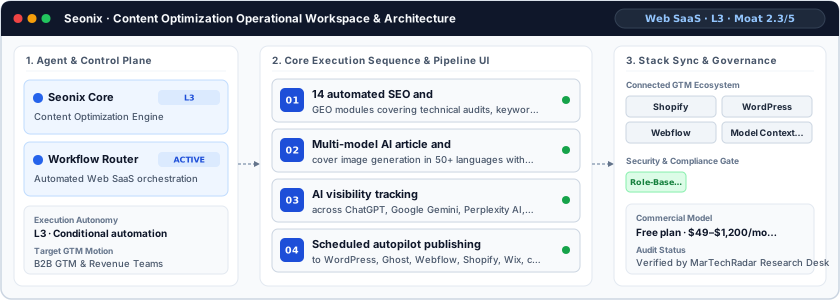
- 14 automated SEO and GEO modules covering technical audits, keyword clustering, schema markup, and llms.txt generation
- Multi-model AI article and cover image generation in 50+ languages with real-time on-page SEO and citation scoring
- AI visibility tracking: across ChatGPT, Google Gemini, Perplexity AI, and Microsoft Copilot answers
- Scheduled autopilot publishing: to WordPress, Ghost, Webflow, Shopify, Wix, custom APIs, and MCP agents
Cons: operational limitations & risks
- No Monthly Article Rollover: On the Starter tier, the allowance of 30 published AI articles per month (along with daily caps of 50 AI edits and 5 AI cover images) resets at the end of each billing cycle without rollover.
- On-Site Content Focus vs. Off-Page Authority: While Seonix automates technical hygiene, structured content production, and `/llms.txt` readiness, it does not execute external backlink outreach or digital PR campaigns required to lift domain authority in highly competitive SERPs.
- Strict Refund Eligibility Window: First-time subscribers can request a refund within 14 days only if zero articles, keyword lookups, or site scans have been triggered on the account.
Seonix TCO & deal-breaker stress test
Simulate 12-month stepped TCO, hidden cost multipliers, contract lock-in exposure, and stack failure modes using only facts verified by MarTechRadar Research Desk on 2026-11-14 · Capture SHA 4715eeaa.
Seonix is viable for 5 seats, but requires commercial or technical verification on the flagged items below.
- Moat Score
- 2.3 / 5.0
- AI Autonomy
- L3
- Free Tier / Trial
- Free plan
Triggered audit signals & failure modes
- Annual Contract Lock-in Risk DetectedFact-checked by MarTechRadar Research Desk
Seonix follows a freemium and tiered subscription structure with no long-term contracts: Free ($0): Includes a full website technical SEO audit, site health and page speed monitoring, AI business profile setup, broken link and missing meta detection, AI-search readiness checks, and Google Search Console plus GA4 analytics integration.
- Primary Operational Bottleneck: No Monthly Article RolloverAudit by MarTechRadar Research Desk
On the Starter tier, the allowance of 30 published AI articles per month (along with daily caps of 50 AI edits and 5 AI cover images) resets at the end of each billing cycle without rollover.
Test a custom Seonix budget or stack constraint
Fits within $800/mo budget (From $299/mo) · Transparent self-serve entry without mandatory annual lock-in
Seonix integrations, API, security & compliance stack
Seonix AI moat & Content Optimization positioning
Seonix combines an 8-module traditional SEO engine and a 6-module AI search (GEO) suite with a multi-model LLM gateway (Gemini, Claude, GPT) and direct scheduled auto-publishing across WordPress, Ghost, Webflow, Shopify, and Wix.
Seonix in-depth review, pricing & architecture analysis
Editor sign-off: Nov 14, 2026. How profiles are made.
What is Seonix? Overview & background
Founded in 2026 and headquartered in Kyiv, UA, Seonix (seonix.ai) is an automated SEO and Generative Engine Optimization (GEO) platform designed for founders, small businesses, and SaaS teams that want organic search and AI answer visibility without managing an agency retainer. Instead of offering isolated keyword tables or raw text generators, Seonix runs an end-to-end publishing workflow that audits a domain, identifies winnable search and AI queries, generates optimized articles with visuals, and publishes them on a recurring schedule.
How Seonix works: architecture & workflow
Operating at Level 3 conditional autopilot autonomy, Seonix orchestrates 14 automated modules split between Traditional SEO (8 modules) and AI Search / GEO (6 modules). On the traditional search side, the platform performs technical site crawls (checking sitemaps, robots.txt, broken links, duplicate titles, and missing metadata), clusters keywords with Google search volume and intent data, drafts articles through a multi-model gateway across Gemini, Claude, and GPT, enforces real-time on-page SEO scoring, injects JSON-LD schema and social covers, syncs Google Search Console and GA4 analytics, and optimizes WordPress Core Web Vitals. On the AI search side, Seonix tracks brand mentions in ChatGPT answers, formats articles with direct-answer and FAQ structures for LLM citation, maintains an /llms.txt crawler map and Brand Knowledge Profile, monitors competitor query gaps, and automatically refreshes decaying pages. Content is generated natively across 50+ languages and auto-published to WordPress, Ghost, Webflow, Shopify, Wix, custom REST APIs, or via MCP for AI agents.
Seonix limitations, drawbacks & risks
Operational limitations and technical trade-offs include:
- No Monthly Article Rollover: On the Starter tier, the allowance of 30 published AI articles per month (along with daily caps of 50 AI edits and 5 AI cover images) resets at the end of each billing cycle without rollover.
- On-Site Content Focus vs. Off-Page Authority: While Seonix automates technical hygiene, structured content production, and
/llms.txtreadiness, it does not execute external backlink outreach or digital PR campaigns required to lift domain authority in highly competitive SERPs. - Strict Refund Eligibility Window: First-time subscribers can request a refund within 14 days only if zero articles, keyword lookups, or site scans have been triggered on the account.
Seonix pricing, plans & cost breakdown
Seonix follows a freemium and tiered subscription structure with no long-term contracts:
- Free ($0): Includes a full website technical SEO audit, site health and page speed monitoring, AI business profile setup, broken link and missing meta detection, AI-search readiness checks, and Google Search Console plus GA4 analytics integration.
- Starter ($49/month, discounted from the $100/month regular price, or $470/year instead of $1,200/year): Supports 1 website project, 30 published AI articles per month, 50 AI edits per day, 5 AI cover images per day, keyword research, site SEO audits, and scheduled auto-publishing.
- Enterprise (Custom pricing): Adds unlimited website projects, unlimited content generation, custom AI cost limits, custom integrations, and a dedicated account manager.
| Plan / Tier | Verified Price & Billing | Included Scope & Contract Terms | |
|---|---|---|---|
| Free / Sandbox | $0 | Free plan or free tier offered by the vendor. | |
| Starter | $49/mo | Verified $49/mo Starter tier from vendor pricing schedule. | |
| Enterprise / Custom | Custom quote | Custom-quoted plan; terms come from the vendor's sales team. | |
| Contract Watchout: Annual Billing Headline vs. Monthly Premium | The vendor pricing page advertises an annual-billing discount (Save 20%); month-to-month billing carries a higher effective monthly rate. | ||
How Seonix compares vs. competitors & alternatives
In the Technical, Programmatic SEO & GEO subtrack, Seonix competes with automated SEO content and GEO platforms such as Outrank, Machined, Byword, and RankPill. Compared with batch programmatic generators like Byword or Machined, Seonix differentiates through its lower $49/month entry point, permanent $0 technical audit and GSC/GA4 monitoring tier, built-in /llms.txt and AI visibility modules, and native 5-CMS auto-publishing.
Frequently asked questions about Seonix
How much does Seonix cost in 2026?
Seonix pricing: Free plan · $49–$1,200/mo · Enterprise plan. A permanent free plan is available. Published tiers: Free / Sandbox ($0); Starter ($49/mo); Enterprise / Custom (Custom quote). Seonix follows a freemium and tiered subscription structure with no long-term contracts: Free ($0): Includes a full website technical SEO audit, site health and page speed monitoring, AI business profile setup, broken link and missing meta detection, AI-search readiness checks, and Google Search Console plus GA4 analytics integration.
What are the top Seonix alternatives in Content Optimization?
Verified Content Optimization alternatives include RankIQ (Custom / enterprise pricing), Service Stories (From $299/mo), amTop Pvt Ltd (Custom / enterprise pricing), Can I Rank? (Custom / enterprise pricing). In the Technical, Programmatic SEO & GEO subtrack, Seonix competes with automated SEO content and GEO platforms such as Outrank, Machined, Byword, and RankPill.
What are the main limitations and trade-offs of Seonix?
Operational limitations and technical trade-offs include: No Monthly Article Rollover: On the Starter tier, the allowance of 30 published AI articles per month (along with daily caps of 50 AI edits and 5 AI cover images) resets at the end of each billing cycle without rollover. Walk away if your workflow cannot tolerate no monthly article rollover: On the Starter tier, the allowance of 30 published AI articles per month (along with daily caps of 50 AI edits and 5 AI cover images) resets at the end of each billing cycle without rollover.
Verified sources & evidence trail
- Official product domain: https://seonix.ai
- Commercial pricing verification: https://seonix.ai/pricing
- Verified corporate entity profiles (
sameAs): LinkedIn Company Profile - Editor sign-off: Nov 14, 2026 (how profiles are made).
