MarketMuse Review (2026): Content Optimization Pricing, Pros & Cons
Bottom line
MarketMuse is a Web SaaS tool for Content Optimization (Content Optimization & SERP Intelligence) in GEO & AI SEO. Pricing: Custom / enterprise pricing. Best suited to B2B SaaS, DTC / eCommerce and Enterprise Brands. Editor ratings: AI autonomy L2 (workflow copilot); moat score 4.8/5.0 (Proprietary moat (category leader)). Fact-checked by MarTechRadar Research Desk on Oct 15, 2026.
AI content intelligence platform that automates topic modeling, competitive content auditing, and personalized search difficulty scoring for organic.
Is MarketMuse worth it in 2026? Buyer fit & when to walk away
Choose MarketMuse if (Best Fit)
- Target ICP & Stack Fit: You operate as B2B SaaS, DTC / eCommerce and Enterprise Brands requiring a Web SaaS deployment for Content Optimization.
- L2 Architecture & Defensibility: Patented semantic topic modeling algorithms combined with personalized domain authority scoring that calculates content ranking probability relative to existing domain depth rather than generic third-party metrics.
- Commercial Model Fit: Your procurement budget aligns with Custom / enterprise pricing.
Walk away from MarketMuse if (Deal-Breakers)
- Walk away if you need published self-serve pricing: MarketMuse is sold by custom quote.
- Walk away if your workflow cannot tolerate crawl processing latency: Full-site inventory ingestion and comprehensive topic graph generation experience notable latency bottlenecks across multi-thousand-page domains, delaying real-time audit cycles.
- Walk away if editorial variance is a deal-breaker for your team: Automated content briefs heavily prioritize informational intent and term frequency density, requiring manual intervention to adapt suggestions for highly creative or narrative-driven editorial formats.
MarketMuse pricing, free plan & scorecard at a glance
| Pricing | Custom / enterprise pricing |
|---|---|
| Free plan | No / not disclosed |
| Delivery | Web SaaS |
| Audience | B2B SaaS, DTC / eCommerce, Enterprise Brands |
| AI autonomy level | L2 · Workflow copilotEditor-verified |
| Moat tier & score | 4.8 / 5.0 · Proprietary moat (category leader)Editor-verified |
| Funding | AcquiredAcquired by Siteimprove |
| Total funding | $9.2M |
| Founders | Aki Balogh, Jeff Coyle, Richard Mallah |
| Company size | 11-50 employees |
| Governance & docs | Terms ↗ · Privacy ↗ |
| Headquarters | Boston, Massachusetts, United States |
| Founded | 2013 |
| Last verified | Oct 15, 2026 |
MarketMuse pros & cons: strengths vs. operational limitations
Pros: core strengths & capabilities
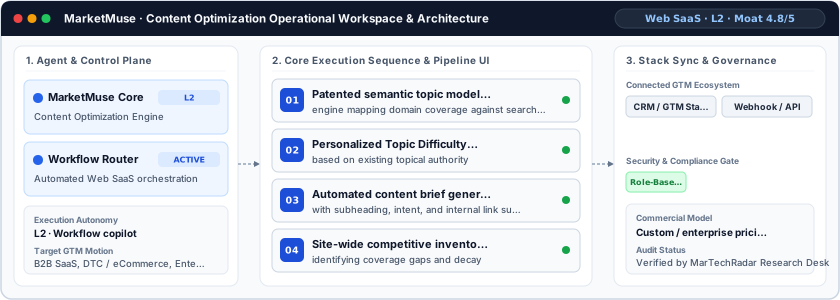
- Patented semantic topic modeling: engine mapping domain coverage against search intent
- Personalized Topic Difficulty scoring: based on existing topical authority
- Automated content brief generator: with subheading, intent, and internal link suggestions
- Site-wide competitive inventory auditing: identifying coverage gaps and decay
Cons: operational limitations & risks
- Crawl Processing Latency: Full-site inventory ingestion and comprehensive topic graph generation experience notable latency bottlenecks across multi-thousand-page domains, delaying real-time audit cycles.
- Editorial Variance: Automated content briefs heavily prioritize informational intent and term frequency density, requiring manual intervention to adapt suggestions for highly creative or narrative-driven editorial formats.
- Technical Execution Scope: The platform focuses strictly on semantic gap analysis and topical coverage, providing minimal diagnostic utility for technical web architecture, rendering bottlenecks, or indexation errors.
MarketMuse TCO & deal-breaker stress test
Simulate 12-month stepped TCO, hidden cost multipliers, contract lock-in exposure, and stack failure modes using only facts verified by MarTechRadar Research Desk on 2026-10-15.
MarketMuse triggers high-severity friction under your 5-seat / $800/mo constraints. Benchmark the verified subtrack alternatives below before committing.
- Moat Score
- 4.8 / 5.0
- AI Autonomy
- L2
- Free Tier / Trial
- None disclosed
Triggered audit signals & failure modes
- Opaque Enterprise Quoting vs. SMB/Mid-Market BudgetVerified Pricing Ledger
MarketMuse does not disclose a public self-serve floor (Custom / enterprise pricing). Buyers with a $800/mo cap face high sales-qualification friction.
- Sales-Gated Contract TermsFact-checked by MarTechRadar Research Desk
MarketMuse provisions commercial licensing across multi-tiered software packages based on organizational seat counts, query allocations, tracked topic volume, and monthly content brief generation limits.
- Primary Operational Bottleneck: Crawl Processing LatencyAudit by MarTechRadar Research Desk
Full-site inventory ingestion and comprehensive topic graph generation experience notable latency bottlenecks across multi-thousand-page domains, delaying real-time audit cycles.
Test a custom MarketMuse budget or stack constraint
Lower 5-seat floor (~$129/mo vs. Custom Quote) · Transparent self-serve entry without mandatory annual lock-in
Lower 5-seat floor (~$145/mo vs. Custom Quote) · Transparent self-serve entry without mandatory annual lock-in
MarketMuse AI moat & Content Optimization positioning
Patented semantic topic modeling algorithms combined with personalized domain authority scoring that calculates content ranking probability relative to existing domain depth rather than generic third-party metrics.
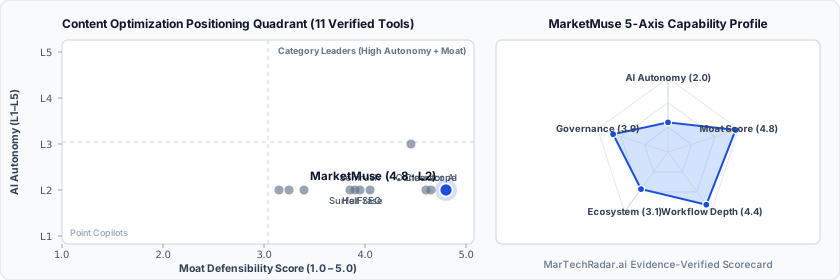
MarketMuse in-depth review, pricing & architecture analysis
Editor sign-off: Oct 15, 2026. How profiles are made.
What is MarketMuse? Overview & background
Architected to replace intuitive editorial planning with semantic data science, MarketMuse operates as an algorithmic content intelligence platform. Established in 2013 in Boston, Massachusetts, United States, the company secured $9.2M in venture funding before being acquired by Siteimprove. Designed primarily for enterprise content strategists, SEO directors, and digital publishing teams, the system replaces manual search engine results page scraping with automated topic modeling and inventory gap analysis.
How MarketMuse works: architecture & workflow
Operating at an L2 autonomy tier, MarketMuse automates content research and briefing by parsing domain content inventories against web-scale knowledge structures. The platform ingests client URLs alongside live search engine results page corpora, running semantic natural language processing models to establish conceptual hierarchies and term distributions. Instead of relying solely on public link-based metrics, the system calculates a proprietary personalized difficulty score that benchmarks an organization's existing topical authority against target subject clusters to guide production priorities.
MarketMuse limitations, drawbacks & risks
Operational considerations and platform boundaries include:
- Crawl Processing Latency: Full-site inventory ingestion and comprehensive topic graph generation experience notable latency bottlenecks across multi-thousand-page domains, delaying real-time audit cycles.
- Editorial Variance: Automated content briefs heavily prioritize informational intent and term frequency density, requiring manual intervention to adapt suggestions for highly creative or narrative-driven editorial formats.
- Technical Execution Scope: The platform focuses strictly on semantic gap analysis and topical coverage, providing minimal diagnostic utility for technical web architecture, rendering bottlenecks, or indexation errors.
MarketMuse pricing, plans & cost breakdown
MarketMuse provisions commercial licensing across multi-tiered software packages based on organizational seat counts, query allocations, tracked topic volume, and monthly content brief generation limits. Enterprise access requires structured contracts where commercial pricing is available on request through tailored enterprise sales quotes based on organizational scale and seats. Integrations and enterprise-tier inventory tracking are managed via customized agreements rather than open self-service tiers.
| Plan / Tier | Verified Price & Billing | Included Scope & Contract Terms |
|---|---|---|
| Enterprise / Custom | Custom quote | Custom-quoted plan; terms come from the vendor's sales team. |
How MarketMuse compares vs. competitors & alternatives
Compared to direct category competitors like Profound and Peec AI, MarketMuse functions as an alternative focused on specialized workflow execution within the Content Optimization segment. While Ahrefs emphasizes raw backlink intelligence, technical crawl diagnostics, and general search volume, MarketMuse differentiates through semantic vector analysis and site-specific topical authority scoring. Point solutions like Surfer SEO provide boutique workflow capabilities, and point graders like Clearscope focus on single-document lexical scoring rather than site-wide inventory discovery. MarketMuse delivers the highest operational utility to large digital editorial operations and enterprise content marketing teams requiring predictive topical gap analysis at scale. Teams evaluating verified options alongside Ahrefs and ADA should weigh its workflow integration depth and contract structure against daily volume requirements.
Direct competitors & market radar
Top algorithmic competitors based on category positioning, capability overlap, and ICP alignment.
Frequently asked questions about MarketMuse
Does MarketMuse publish pricing or require an enterprise quote?
MarketMuse pricing: Custom / enterprise pricing. No free plan is publicly disclosed. MarketMuse provisions commercial licensing across multi-tiered software packages based on organizational seat counts, query allocations, tracked topic volume, and monthly content brief generation limits.
What are the top MarketMuse alternatives in Content Optimization?
Verified Content Optimization alternatives include Clearscope ($129–$399/mo · Enterprise plan), Surfer SEO ($49–$299/mo), Taboola (Custom / enterprise pricing), Ahrefs (Free plan · $29–$1,499/mo). Compared to direct category competitors like Profound and Peec AI, MarketMuse functions as an alternative focused on specialized workflow execution within the Content Optimization segment.
What are the main limitations and trade-offs of MarketMuse?
Operational considerations and platform boundaries include: Crawl Processing Latency: Full-site inventory ingestion and comprehensive topic graph generation experience notable latency bottlenecks across multi-thousand-page domains, delaying real-time audit cycles. Walk away if you need published self-serve pricing: MarketMuse is sold by custom quote.
Verified sources & evidence trail
- Official product domain: https://marketmuse.com
- Commercial pricing verification: Verified against official vendor pricing policy (Custom / enterprise pricing)
- Verified corporate entity profiles (
sameAs): Crunchbase Entity Record - First-party governance & documentation links: Terms · Privacy
- Editor sign-off: Oct 15, 2026 (how profiles are made).
