Anyword Review (2026): AI Copywriting Pricing, Pros & Cons
Bottom line
Anyword is a Web SaaS tool for AI Copywriting (Direct-Response & eCommerce Copy) in Copy & Content. Pricing: $49–$99/mo. Best suited to B2B SaaS and Marketing Agencies. Editor ratings: AI autonomy L2 (workflow copilot); moat score 3.7/5.0 (Proprietary moat). Fact-checked by MarTechRadar Research Desk on Oct 7, 2026.
Performance-focused AI copywriting and predictive analytics platform that evaluates direct-response messaging against historical conversion data.
Is Anyword worth it in 2026? Buyer fit & when to walk away
Choose Anyword if (Best Fit)
- Target ICP & Stack Fit: You operate as B2B SaaS and Marketing Agencies requiring a Web SaaS deployment for AI Copywriting.
- L2 Architecture & Defensibility: Proprietary predictive performance scoring engine trained on historical ad spend and engagement datasets, coupled with enterprise brand guideline token enforcement.
- Commercial Model Fit: Your procurement budget aligns with $49–$99/mo.
Walk away from Anyword if (Deal-Breakers)
- Walk away if your workflow cannot tolerate predictive drift in niche verticals: The predictive performance model relies heavily on historical consumer engagement patterns, yielding less reliable predictive scores when applied to highly specialized B2B categories or emerging technical niches.
- Walk away if brand voice context constraints is a deal-breaker for your team: Entry tiers impose stringent limits on active brand voice configurations, creating operational friction for growth agencies managing multiple client personas simultaneously.
Anyword pricing, free plan & scorecard at a glance
| Pricing | $49–$99/moVendor pricing page |
|---|---|
| Free plan | No / not disclosed |
| Delivery | Web SaaS |
| Audience | B2B SaaS, Marketing Agencies |
| AI autonomy level | L2 · Workflow copilotEditor-verified |
| Moat tier & score | 3.7 / 5.0 · Proprietary moatEditor-verified |
| Funding | Series B |
| Total funding | $30.1MBacked by Innovation Endeavors, The New York Times, UpWest, Marker |
| Founders | Arnon Joseph, Yaniv Makover |
| Company size | 11-50 employees |
| Compliance & governance | GDPR, HIPAA |
| Governance & docs | Trust & Security ↗ · Privacy ↗ |
| Headquarters | New York, NY |
| Founded | 2013 |
| Last verified | Oct 7, 2026 |
Anyword pros & cons: strengths vs. operational limitations
Pros: core strengths & capabilities
- Predictive Performance Score evaluating: conversion probability before campaign launch
- Brand voice calibration enforcing: enterprise tone across generated variations
- Multi-channel copy generator tailored: for paid search, social ads, and product descriptions
- Gen-AI Content Performance API: integrating predictive scoring directly into production pipelines
Cons: operational limitations & risks
- Predictive Drift in Niche Verticals: The predictive performance model relies heavily on historical consumer engagement patterns, yielding less reliable predictive scores when applied to highly specialized B2B categories or emerging technical niches.
- Brand Voice Context Constraints: Entry tiers impose stringent limits on active brand voice configurations, creating operational friction for growth agencies managing multiple client personas simultaneously.
- Prediction Credit Exhaustion: Algorithmic score computations consume finite predictive quota allocations, forcing high-velocity teams to meter variant testing during extensive multivariate campaign setups.
Anyword TCO & deal-breaker stress test
Simulate 12-month stepped TCO, hidden cost multipliers, contract lock-in exposure, and stack failure modes using only facts verified by MarTechRadar Research Desk on 2026-10-07 · Capture SHA 4d658086.
Anyword aligns with your 5-seat / $800/mo profile. Review the walk-away triggers and contract levers below before deployment.
- Moat Score
- 3.7 / 5.0
- AI Autonomy
- L2
- Free Tier / Trial
- None disclosed
Triggered audit signals & failure modes
- Published Self-Serve Entry FloorVerified Pricing Ledger
Anyword publishes a transparent entry point ($49–$99/mo) for initial validation before committing.
- Tier Fit for 5-Seat Scale: Starter ($49/mo)Verified Tier Schedule
For solo marketers & freelancers who want on-brand content backed by Anyword’s performance data
- Primary Operational Bottleneck: Prediction Credit ExhaustionAudit by MarTechRadar Research Desk
Algorithmic score computations consume finite predictive quota allocations, forcing high-velocity teams to meter variant testing during extensive multivariate campaign setups.
Test a custom Anyword budget or stack constraint
Lower 5-seat floor (~$10/mo vs. $49 / mo)
Fits within $800/mo budget ($59–$69/seat/mo · Enterprise plan)
Anyword integrations, API, security & compliance stack
Anyword AI moat & AI Copywriting positioning
Proprietary predictive performance scoring engine trained on historical ad spend and engagement datasets, coupled with enterprise brand guideline token enforcement.
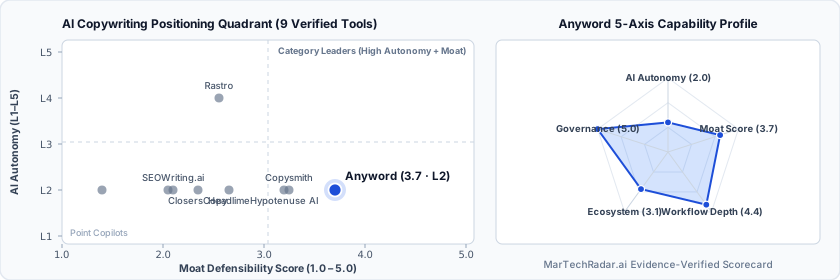
Anyword in-depth review, pricing & architecture analysis
Editor sign-off: Oct 7, 2026. How profiles are made.
What is Anyword? Overview & background
Backed by institutional capital, Anyword was founded in 2013 in New York, NY, securing $30.1M in total funding to eliminate speculative drafting in conversion-focused digital marketing. Built primarily for performance marketers, growth acquisition leads, and direct-to-consumer eCommerce copywriters, the platform reframes text generation around measurable click-through and conversion metrics rather than generic stylistic prose.
How Anyword works: architecture & workflow
Operating at an L2 autonomy rating, the platform couples large language model generation with a proprietary predictive scoring engine trained on billions of commercial ad engagements. During inference, inputs flow through brand voice guardrails before candidate variants are processed by predictive regression layers that assign a numerical performance index. Marketing teams leverage these predictive distributions to evaluate copy efficacy across ad variants prior to budget deployment under verified GDPR and HIPAA governance controls.
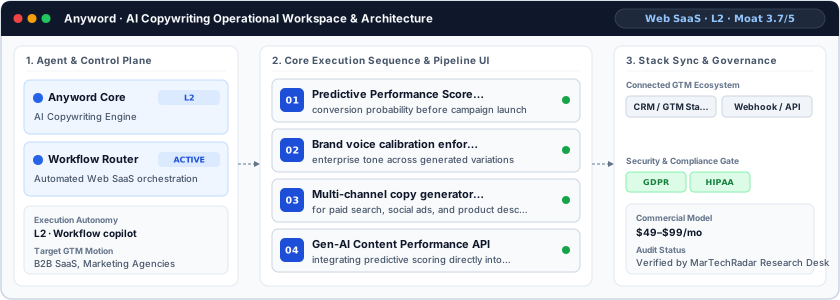
Anyword limitations, drawbacks & risks
Operational considerations and platform boundaries include:
- Predictive Drift in Niche Verticals: The predictive performance model relies heavily on historical consumer engagement patterns, yielding less reliable predictive scores when applied to highly specialized B2B categories or emerging technical niches.
- Brand Voice Context Constraints: Entry tiers impose stringent limits on active brand voice configurations, creating operational friction for growth agencies managing multiple client personas simultaneously.
- Prediction Credit Exhaustion: Algorithmic score computations consume finite predictive quota allocations, forcing high-velocity teams to meter variant testing during extensive multivariate campaign setups.
Anyword pricing, plans & cost breakdown
Commercial access follows a tiered SaaS subscription structure indexed to predictive calculation quotas and administrative seats. The entry Starter plan begins at $49 per month for individual operators requiring core generation and limited scoring checks. Multi-seat marketing teams scale into higher operational tiers priced at $99 per month, which unlock expanded prediction volumes, advanced performance data integrations, and collaborative workflow capabilities.
| Plan / Tier | Verified Price & Billing | Target Seat / Scale Fit | Included Scope & Contract Terms |
|---|---|---|---|
| Starter | $49/mo | Unlimited seats | For solo marketers & freelancers who want on-brand content backed by Anyword’s performance data |
| Custom | $59/mo | Unlimited seats | Price per additional seat |
How Anyword compares vs. competitors & alternatives
Within the performance copywriting segment, Anyword competes against alternatives like Copysmith, ClosersCopy, and Headlime. While Copysmith emphasizes bulk catalog generation and ClosersCopy focuses on long-form sales frameworks, Anyword differentiates through empirical performance forecasting prior to publication. It remains optimal for metrics-focused growth teams allocating recurring media spend that require algorithmic validation before launching ad variants.
Direct competitors & market radar
Top algorithmic competitors based on category positioning, capability overlap, and ICP alignment.
Frequently asked questions about Anyword
How much does Anyword cost in 2026?
Anyword pricing: $49–$99/mo. No free plan is publicly disclosed. Published tiers: Starter ($49/mo); Custom ($59/mo). Commercial access follows a tiered SaaS subscription structure indexed to predictive calculation quotas and administrative seats.
What are the top Anyword alternatives in AI Copywriting?
Verified AI Copywriting alternatives include Jasper (Enterprise) ($59–$69/seat/mo · Enterprise plan), Copy.ai (Workflows) ($49–$249/mo), Copysmith (Custom / enterprise pricing), Persado (Custom / enterprise pricing). Within the performance copywriting segment, Anyword competes against alternatives like Copysmith, ClosersCopy, and Headlime.
What are the main limitations and trade-offs of Anyword?
Operational considerations and platform boundaries include: Predictive Drift in Niche Verticals: The predictive performance model relies heavily on historical consumer engagement patterns, yielding less reliable predictive scores when applied to highly specialized B2B categories or emerging technical niches. Walk away if your workflow cannot tolerate predictive drift in niche verticals: The predictive performance model relies heavily on historical consumer engagement patterns, yielding less reliable predictive scores when applied to highly specialized B2B categories or emerging technical niches.
Verified sources & evidence trail
- Official product domain: https://anyword.com
- Commercial pricing verification: https://www.anyword.com/pricing
- Verified corporate entity profiles (
sameAs): LinkedIn Company Profile · Crunchbase Entity Record - First-party governance & documentation links: Trust & Security · Privacy
- Editor sign-off: Oct 7, 2026 (how profiles are made).
