Rastro Review (2026): AI Copywriting Pricing, Pros & Cons
Bottom line
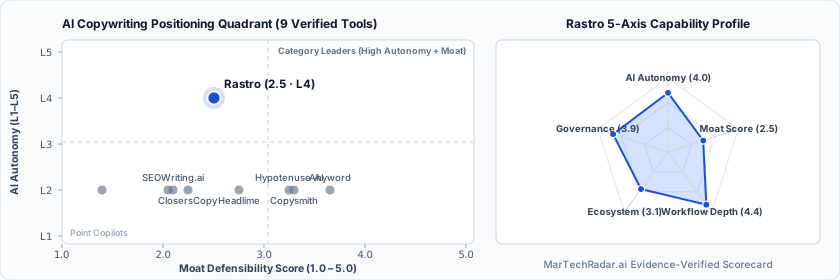
Rastro is a Web SaaS tool for AI Copywriting (Direct-Response & eCommerce Copy) in Copy & Content. Pricing: From $1,000/mo · Enterprise plan. Best suited to B2B Marketers, Revenue Operations and Growth Teams. Editor ratings: AI autonomy L4 (autonomous agent); moat score 2.5/5.0 (Workflow-embedded). Fact-checked by MarTechRadar Research Desk on Oct 27, 2026.
Industrial-grade AI catalog operations platform automating supplier onboarding, SKU attribute enrichment, and PIM exports for manufacturers and distributors.
Is Rastro worth it in 2026? Buyer fit & when to walk away
Choose Rastro if (Best Fit)
- Target ICP & Stack Fit: You operate as B2B Marketers, Revenue Operations and Growth Teams requiring a Web SaaS deployment for AI Copywriting.
- L4 Architecture & Defensibility: Rastro builds a strong B2B and retail catalog automation moat by turning raw supplier PDFs, feeds, and manufacturer websites into cited, PIM-ready product catalogs with Y Combinator Pre-Seed backing ($500K).
- Commercial Model Fit: Your procurement budget aligns with From $1,000/mo · Enterprise plan and want trial evaluation before contract sign-off.
Walk away from Rastro if (Deal-Breakers)
- Walk away if your team is at early validation stage with a <$250/mo tool budget (Rastro starts at From $1,000/mo · Enterprise plan before seat or usage expansion).
- Walk away if your workflow cannot tolerate primary operational trade-off: In practical enterprise deployments, the primary trade-off is that Rastro starts at $1,000/month for up to 1,000 SKUs (scaling with total catalog size), making it purpose-built for B2B distributors, manufacturers, and mid-to-large retailers rather than hobbyist dropshippers with a dozen products.
- Walk away if functional scope boundary is a deal-breaker for your team: Rastro is not built for outbound cold calling, social media influencer discovery, or programmatic display ad bidding.
Rastro pricing, free plan & scorecard at a glance
| Pricing | From $1,000/mo · Enterprise planVendor pricing page |
|---|---|
| Free plan | No / not disclosed |
| Delivery | Web SaaS |
| Audience | B2B Marketers, Revenue Operations, Growth Teams |
| AI autonomy level | L4 · Autonomous agentEditor-verified |
| Moat tier & score | 2.5 / 5.0 · Workflow-embeddedEditor-verified |
| Funding | Pre-seed |
| Total funding | $500KBacked by Y Combinator |
| Founders | Augustin Baudoin, Baptiste Cumin, Papa Sougou Wele |
| Company size | 2-10 employees |
| Headquarters | San Francisco, California, United States |
| Founded | 2024 |
| Last verified | Oct 27, 2026 |
Rastro pros & cons: strengths vs. operational limitations
Pros: core strengths & capabilities
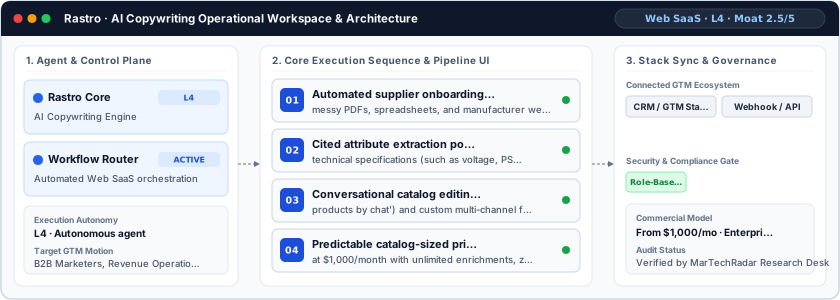
- Automated supplier onboarding ingesting: messy PDFs, spreadsheets, and manufacturer websites from just a supplier reference and price
- Cited attribute extraction populating: technical specifications (such as voltage, PSI, weight, and material composition) across every SKU
- Conversational catalog editing ('Update: products by chat') and custom multi-channel feed exports with direct PIM synchronization
- Predictable catalog-sized pricing starting: at $1,000/month with unlimited enrichments, zero per-seat fees, and a 1-month guided working trial
Cons: operational limitations & risks
- Primary Operational Trade-Off: In practical enterprise deployments, the primary trade-off is that Rastro starts at $1,000/month for up to 1,000 SKUs (scaling with total catalog size), making it purpose-built for B2B distributors, manufacturers, and mid-to-large retailers rather than hobbyist dropshippers with a dozen products.
- Functional Scope Boundary: Rastro is not built for outbound cold calling, social media influencer discovery, or programmatic display ad bidding.
- Deployment & Governance Considerations: Additionally, onboarding begins with a structured one-month working trial where Rastro's dedicated implementation team loads the customer's supplier files, resolves taxonomy rules, and configures custom channel exports.
Rastro TCO & deal-breaker stress test
Simulate 12-month stepped TCO, hidden cost multipliers, contract lock-in exposure, and stack failure modes using only facts verified by MarTechRadar Research Desk on 2026-10-27 · Capture SHA b70a9bfd.
Rastro triggers high-severity friction under your 5-seat / $800/mo constraints. Benchmark the verified subtrack alternatives below before committing.
- Moat Score
- 2.5 / 5.0
- AI Autonomy
- L4
- Free Tier / Trial
- Free trial
Triggered audit signals & failure modes
- Budget Ceiling Breached ($1,000/mo vs. $800/mo cap)Verified Pricing Ledger
At 5 seats, Rastro's verified entry floor (From $1,000/mo · Enterprise plan) exceeds your $800/mo budget before add-ons or overages.
- Published Self-Serve Entry FloorVerified Pricing Ledger
Rastro publishes a transparent entry point (From $1,000/mo · Enterprise plan) with a free trial for initial validation before committing.
- Primary Operational Bottleneck: Primary Operational Trade-OffAudit by MarTechRadar Research Desk
In practical enterprise deployments, the primary trade-off is that Rastro starts at $1,000/month for up to 1,000 SKUs (scaling with total catalog size), making it purpose-built for B2B distributors, manufacturers, and mid-to-large retailers rather than hobbyist dropshippers with a dozen products.
Test a custom Rastro budget or stack constraint
Lower 5-seat floor (~$10/mo vs. From $1,000 / mo)
Lower 5-seat floor (~$14/mo vs. From $1,000 / mo)
Rastro AI moat & AI Copywriting positioning
Rastro builds a strong B2B and retail catalog automation moat by turning raw supplier PDFs, feeds, and manufacturer websites into cited, PIM-ready product catalogs with Y Combinator Pre-Seed backing ($500K).
Rastro in-depth review, pricing & architecture analysis
Audited by MarTechRadar Research Desk (Evidence-Ledger Verified) on Oct 27, 2026.
What is Rastro? Overview & background
Rastro is an AI-native catalog operations and product information enrichment platform built for manufacturers, industrial distributors, and multi-brand e-commerce retailers. Founded in 2024 by Augustin Baudoin, Baptiste Cumin, and Papa Sougou Wele and headquartered in San Francisco, California, the Y Combinator (Summer 2024) company operates with 2 to 10 employees and has raised $500K in Pre-Seed funding from Y Combinator. Engineered to replace manual spreadsheet data entry and slow supplier onboarding, Rastro turns sparse supplier references into complete, channel-ready product catalogs, capturing buyer searches for ai product catalog enrichment, rastro ai pricing, and industrial pim automation agents.
How Rastro works: architecture & workflow
At the technical core of Rastro is a system of industrial-grade catalog AI agents designed to handle complex technical and retail SKUs. A merchandising team can upload minimal input—often just a supplier part number and a price—alongside raw supplier PDFs, CSV feeds, or manufacturer URLs. Rastro's agents automatically crawl manufacturer sites, extract digital assets, fill missing technical attributes (such as pressure ratings, dimensions, voltage, or material composition) with source citations for human review, and map the normalized records into the customer's taxonomy. Merchandisers can then refine product lines via natural-language chat and sync clean exports directly into their Product Information Management (PIM) or e-commerce storefront.
Rastro limitations, drawbacks & risks
Operational considerations and platform boundaries include:
- Primary Operational Trade-Off: In practical enterprise deployments, the primary trade-off is that Rastro starts at $1,000/month for up to 1,000 SKUs (scaling with total catalog size), making it purpose-built for B2B distributors, manufacturers, and mid-to-large retailers rather than hobbyist dropshippers with a dozen products.
- Functional Scope Boundary: Rastro is not built for outbound cold calling, social media influencer discovery, or programmatic display ad bidding.
- Deployment & Governance Considerations: Additionally, onboarding begins with a structured one-month working trial where Rastro's dedicated implementation team loads the customer's supplier files, resolves taxonomy rules, and configures custom channel exports.
Rastro pricing, plans & cost breakdown
Manufacturer & Distributor PIM plans starting at $1,000/month (includes 1-month working trial with dedicated implementation team, up to 1,000 SKUs, unlimited enrichments, custom channel exports, and no per-seat fees). On its official pricing page (rastro.ai/pricing), Rastro publishes transparent catalog-based pricing starting at $1,000 per month—which includes a one-month working trial with a dedicated implementation team, up to 1,000 SKUs, unlimited attribute and content enrichments, custom exports for every sales channel, priority support, and zero per-seat user fees.
| Plan / Tier | Verified Price & Billing | Target Seat / Scale Fit | Included Scope & Contract Terms |
|---|---|---|---|
| Enterprise / Custom | Custom quote | 15–50+ seats (Enterprise SLA) | Sales-negotiated annual contract for custom volume, SSO/RBAC governance, and dedicated SLA. |
| Contract Watchout: Primary Operational Trade-Off | In practical enterprise deployments, the primary trade-off is that Rastro starts at $1,000/month for up to 1,000 SKUs (scaling with total catalog size), making it purpose-built for B2B distributors, manufacturers, and mid-to-large retailers rather than hobbyist dropshippers with a dozen products. | ||
How Rastro compares vs. competitors & alternatives
In the e-commerce product copy and catalog AI subtrack (CAT-01-03), Rastro competes with Anglera, Hypotenuse AI, and Describely, as well as legacy PIM suites like Akeneo and Salsify. Compared to generic e-commerce copywriters that hallucinate technical specifications on industrial or B2B hardware SKUs, Rastro differentiates itself through cited manufacturer PDF/web extraction, unlimited enrichments per SKU, and hands-on catalog implementation. Manufacturers and distributors modernizing catalog operations should evaluate Rastro.
Frequently asked questions about Rastro
How much does Rastro cost in 2026?
Rastro pricing: From $1,000/mo · Enterprise plan. No permanent free tier is listed; trial evaluation is offered. Manufacturer & Distributor PIM plans starting at $1,000/month (includes 1-month working trial with dedicated implementation team, up to 1,000 SKUs, unlimited enrichments, custom channel exports, and no per-seat fees).
What are the top Rastro alternatives in AI Copywriting?
Verified AI Copywriting alternatives include SEOWriting.ai ($14–$59/mo), Headlime (From $10/mo), Koala.sh (From $25/mo), Nichesss (From $19/mo). In the e-commerce product copy and catalog AI subtrack (`CAT-01-03`), Rastro competes with Anglera, Hypotenuse AI, and Describely, as well as legacy PIM suites like Akeneo and Salsify.
Verified sources & evidence trail
- Official product domain: https://www.rastro.ai
- Commercial pricing verification: https://www.rastro.ai/pricing
- Verified corporate entity profiles (
sameAs): LinkedIn Company Profile · Crunchbase Entity Record - Editorial audit sign-off: Audited by MarTechRadar Research Desk (Evidence-Ledger Verified) on Oct 27, 2026.
