Hypotenuse AI Review (2026): AI Copywriting Pricing, Pros & Cons
Bottom line
Hypotenuse AI is a Web SaaS tool for AI Copywriting (Direct-Response & eCommerce Copy) in Copy & Content. Pricing: Custom / enterprise pricing. Best suited to DTC / eCommerce and Enterprise Brands. Editor ratings: AI autonomy L2 (workflow copilot); moat score 3.2/5.0 (Workflow-embedded (strong)). Fact-checked by MarTechRadar Research Desk on Oct 14, 2026.
AI-first product experience management platform that automates catalog data enrichment, brand-aligned product descriptions, and studio image.
Is Hypotenuse AI worth it in 2026? Buyer fit & when to walk away
Choose Hypotenuse AI if (Best Fit)
- Target ICP & Stack Fit: You operate as DTC / eCommerce and Enterprise Brands requiring a Web SaaS deployment for AI Copywriting, with verified ecosystem connectivity for Salesforce, Shopify, Google Ads, Stripe.
- L2 Architecture & Defensibility: Hypotenuse AI couples catalog-scale multi-modal enrichment with structured PIM data hygiene, bridging generative copywriting and automated digital asset cleanup directly inside enterprise merchandise syndication workflows.
- Commercial Model Fit: Your procurement budget aligns with Custom / enterprise pricing.
Walk away from Hypotenuse AI if (Deal-Breakers)
- Walk away if you need published self-serve pricing: Hypotenuse AI is sold by custom quote.
- Walk away if your workflow cannot tolerate taxonomy ingestion volatility: Unstructured source data with severe attribute fragmentation frequently requires manual mapping intervention before generative runs produce uniform copy outputs.
- Walk away if multimodal semantic drift is a deal-breaker for your team: Automated background replacement and image standardization can occasionally introduce visual artifacts or distort fine product textures on complex apparel items.
Hypotenuse AI pricing, free plan & scorecard at a glance
| Pricing | Custom / enterprise pricing |
|---|---|
| Free plan | No / not disclosed |
| Delivery | Web SaaS |
| Audience | DTC / eCommerce, Enterprise Brands |
| AI autonomy level | L2 · Workflow copilotEditor-verified |
| Moat tier & score | 3.2 / 5.0 · Workflow-embedded (strong)Editor-verified |
| Funding | Seed |
| Total funding | $125K |
| Founders | Joshua Wong |
| Company size | 11-50 employees |
| Ecosystem integrations | Salesforce, Shopify, Google Ads, Stripe |
| Compliance & governance | SOC 2 |
| Governance & docs | Terms ↗ · Privacy ↗ |
| Headquarters | Mountain View, California, United States |
| Founded | 2020 |
| Last verified | Oct 14, 2026 |
Hypotenuse AI pros & cons: strengths vs. operational limitations
Pros: core strengths & capabilities
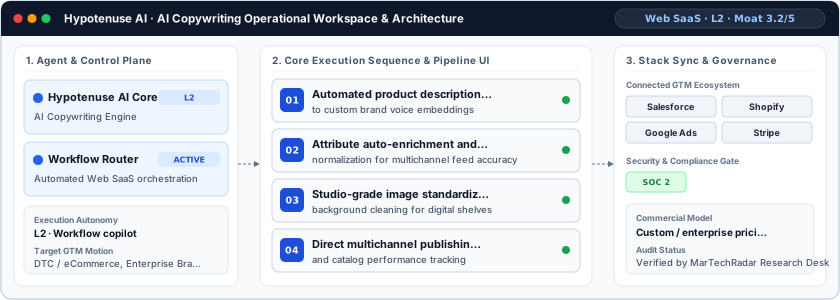
- Automated product description generation tuned: to custom brand voice embeddings
- Attribute auto-enrichment and catalog: normalization for multichannel feed accuracy
- Studio-grade image standardization and background cleaning for digital shelves
- Direct multichannel publishing integrations and catalog performance tracking
Cons: operational limitations & risks
- Taxonomy Ingestion Volatility: Unstructured source data with severe attribute fragmentation frequently requires manual mapping intervention before generative runs produce uniform copy outputs.
- Multimodal Semantic Drift: Automated background replacement and image standardization can occasionally introduce visual artifacts or distort fine product textures on complex apparel items.
- API Feed Throughput Latency: Concurrent catalog refreshes exceeding tens of thousands of SKUs encounter rate throttling when writing back to external eCommerce platforms and marketplaces.
Hypotenuse AI TCO & deal-breaker stress test
Simulate 12-month stepped TCO, hidden cost multipliers, contract lock-in exposure, and stack failure modes using only facts verified by MarTechRadar Research Desk on 2026-10-14.
Hypotenuse AI triggers high-severity friction under your 5-seat / $800/mo constraints. Benchmark the verified subtrack alternatives below before committing.
- Moat Score
- 3.2 / 5.0
- AI Autonomy
- L2
- Free Tier / Trial
- None disclosed
Triggered audit signals & failure modes
- Opaque Enterprise Quoting vs. SMB/Mid-Market BudgetVerified Pricing Ledger
Hypotenuse AI does not disclose a public self-serve floor (Custom / enterprise pricing). Buyers with a $800/mo cap face high sales-qualification friction.
- Sales-Gated Contract TermsFact-checked by MarTechRadar Research Desk
Commercial pricing for Hypotenuse AI is available on request through tailored enterprise sales quotes based on organizational scale and seats. The vendor packages its software tiers around catalog volume parameters, team seat counts, and content generation limits.
- Primary Operational Bottleneck: Taxonomy Ingestion VolatilityAudit by MarTechRadar Research Desk
Unstructured source data with severe attribute fragmentation frequently requires manual mapping intervention before generative runs produce uniform copy outputs.
Test a custom Hypotenuse AI budget or stack constraint
Lower 5-seat floor (~$49/mo vs. Custom Quote) · Transparent self-serve entry without mandatory annual lock-in
Lower 5-seat floor (~$299/mo vs. Custom Quote) · Transparent self-serve entry without mandatory annual lock-in
Hypotenuse AI integrations, API, security & compliance stack
Hypotenuse AI AI moat & AI Copywriting positioning
Hypotenuse AI couples catalog-scale multi-modal enrichment with structured PIM data hygiene, bridging generative copywriting and automated digital asset cleanup directly inside enterprise merchandise syndication workflows.
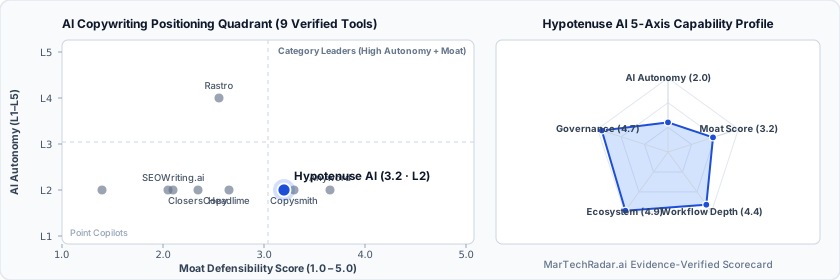
Hypotenuse AI in-depth review, pricing & architecture analysis
Editor sign-off: Oct 14, 2026. How profiles are made.
What is Hypotenuse AI? Overview & background
Architectured as a specialized product experience management and catalog generation layer, Hypotenuse AI targets enterprise merchandising directors and eCommerce catalog managers. Established in 2020 and headquartered in Mountain View, California, United States, the company secured $125K in initial venture backing to address high-volume product content production bottlenecks. The platform repositions copy generation from ad-hoc drafting into an automated pipeline, unifying attribute normalization, visual asset standardization, and SKU-level copy generation.
How Hypotenuse AI works: architecture & workflow
Hypotenuse AI functions at Level 2 autonomy by pairing natural language processing models with structured product information management pipelines. The engine ingests unstandardized catalog attributes via CSV, API, or direct eCommerce store feeds, applying semantic parsing to extract missing technical specifications. These normalized attributes feed deterministic prompt chains anchored to brand voice guidelines and target SEO parameters. Concurrently, the platform processes source imagery through visual enhancement models to enforce digital shelf standards before distributing finalized assets to connected storefronts, alongside native workflow integrations for Salesforce, Shopify, Google Ads, and Stripe under verified SOC 2 Type II governance controls.
Hypotenuse AI limitations, drawbacks & risks
Operational considerations and platform boundaries include:
- Taxonomy Ingestion Volatility: Unstructured source data with severe attribute fragmentation frequently requires manual mapping intervention before generative runs produce uniform copy outputs.
- Multimodal Semantic Drift: Automated background replacement and image standardization can occasionally introduce visual artifacts or distort fine product textures on complex apparel items.
- API Feed Throughput Latency: Concurrent catalog refreshes exceeding tens of thousands of SKUs encounter rate throttling when writing back to external eCommerce platforms and marketplaces.
Hypotenuse AI pricing, plans & cost breakdown
Commercial pricing for Hypotenuse AI is available on request through tailored enterprise sales quotes based on organizational scale and seats. The vendor packages its software tiers around catalog volume parameters, team seat counts, and content generation limits. While an entry-level tier caters to smaller digital catalogs requiring core content types across multilingual markets, high-volume merchants must negotiate enterprise contracts that provide custom workflow routing, governance controls, and dedicated API capacity.
| Plan / Tier | Verified Price & Billing | Included Scope & Contract Terms |
|---|---|---|
| Enterprise / Custom | Custom quote | Custom-quoted plan; terms come from the vendor's sales team. |
How Hypotenuse AI compares vs. competitors & alternatives
Within the eCommerce copywriting space, Hypotenuse AI competes against platforms like Anyword, Copysmith, and ClosersCopy within the AI Copywriting segment. While Anyword concentrates on predictive performance scoring for short-form conversion ads and ClosersCopy targets direct-response long-form sales copy, Hypotenuse AI distinguishes itself through deep catalog PIM capabilities and integrated visual asset optimization. Copysmith offers competitive bulk eCommerce generation, yet Hypotenuse AI provides tighter governance for enterprise digital shelf syndication, making it best suited for multi-brand retail operations managing complex product databases.
Direct competitors & market radar
Top algorithmic competitors based on category positioning, capability overlap, and ICP alignment.
Frequently asked questions about Hypotenuse AI
Does Hypotenuse AI publish pricing or require an enterprise quote?
Hypotenuse AI pricing: Custom / enterprise pricing. No free plan is publicly disclosed. Commercial pricing for Hypotenuse AI is available on request through tailored enterprise sales quotes based on organizational scale and seats.
What are the top Hypotenuse AI alternatives in AI Copywriting?
Verified AI Copywriting alternatives include Astral ($299–$1,199/mo), DaisySocial (Custom / enterprise pricing), Anyword ($49–$99/mo), Copysmith (Custom / enterprise pricing). Within the eCommerce copywriting space, Hypotenuse AI competes against platforms like Anyword, Copysmith, and ClosersCopy within the AI Copywriting segment.
What are the main limitations and trade-offs of Hypotenuse AI?
Operational considerations and platform boundaries include: Taxonomy Ingestion Volatility: Unstructured source data with severe attribute fragmentation frequently requires manual mapping intervention before generative runs produce uniform copy outputs. Walk away if you need published self-serve pricing: Hypotenuse AI is sold by custom quote.
Verified sources & evidence trail
- Official product domain: https://hypotenuse.ai
- Commercial pricing verification: Verified against official vendor pricing policy (Custom / enterprise pricing)
- Verified corporate entity profiles (
sameAs): LinkedIn Company Profile · Crunchbase Entity Record - First-party governance & documentation links: Terms · Privacy
- Editor sign-off: Oct 14, 2026 (how profiles are made).
