Unbabel Review (2026): AI Translation Pricing, Pros & Cons
Bottom line
Unbabel is a Web SaaS tool for AI Translation (Multilingual & Global Localization) in Copy & Content. Pricing: Custom / enterprise pricing. Best suited to DTC / eCommerce and Enterprise Brands. Editor ratings: AI autonomy L3 (conditional automation); moat score 4.5/5.0 (Proprietary moat (category leader)). Fact-checked by MarTechRadar Research Desk on Oct 14, 2026.
Enterprise language operations platform pairing neural machine translation with automated quality estimation and dynamic human review for cross-border.
Is Unbabel worth it in 2026? Buyer fit & when to walk away
Choose Unbabel if (Best Fit)
- Target ICP & Stack Fit: You operate as DTC / eCommerce and Enterprise Brands requiring a Web SaaS deployment for AI Translation, with verified ecosystem connectivity for Salesforce, Zendesk, Intercom.
- L3 Architecture & Defensibility: Proprietary automated quality estimation (QE) engines combined with a managed global post-editing crowd, backed by corporate integration scale following its acquisition by TransPerfect.
- Commercial Model Fit: Your procurement budget aligns with Custom / enterprise pricing.
Walk away from Unbabel if (Deal-Breakers)
- Walk away if you need published self-serve pricing: Unbabel is sold by custom quote.
- Walk away if your workflow cannot tolerate human-in-the-loop latency spikes: Workflows requiring human post-editing introduce variable queue latencies, creating processing bottlenecks during off-peak timezone coverage or localized translator shortages.
- Walk away if integration schema drift is a deal-breaker for your team: Deep coupling with third-party ticketing and content management schemas demands continuous maintenance when upstream platforms modify API structures or webhook payloads.
Unbabel pricing, free plan & scorecard at a glance
| Pricing | Custom / enterprise pricing |
|---|---|
| Free plan | No / not disclosed |
| Delivery | Web SaaS |
| Audience | DTC / eCommerce, Enterprise Brands |
| AI autonomy level | L3 · Conditional automationEditor-verified |
| Moat tier & score | 4.5 / 5.0 · Proprietary moat (category leader)Editor-verified |
| Funding | AcquiredAcquired by TransPerfect |
| Total funding | $112.2M |
| Founders | Bruno Prezado, Hugo Silva, João Graça, Sofia Pessanha |
| Company size | 201-500 employees |
| Ecosystem integrations | Salesforce, Zendesk, Intercom |
| Governance & docs | Trust & Security ↗ · System Status ↗ · Terms ↗ · Privacy ↗ |
| Headquarters | San Francisco, California |
| Founded | 2013 |
| Last verified | Oct 14, 2026 |
Unbabel pros & cons: strengths vs. operational limitations
Pros: core strengths & capabilities
- AI-powered Language Operations platform: with dynamic workflow orchestration
- Automated Quality Estimation (QE): scoring to trigger selective human post-editing
- Deep CRM and helpdesk integrations: for real-time customer support translation
- Custom translation memory and brand terminology enforcement pipelines
Cons: operational limitations & risks
- Human-in-the-loop latency spikes: Workflows requiring human post-editing introduce variable queue latencies, creating processing bottlenecks during off-peak timezone coverage or localized translator shortages.
- Integration schema drift: Deep coupling with third-party ticketing and content management schemas demands continuous maintenance when upstream platforms modify API structures or webhook payloads.
- Terminology governance drift: Dynamic adaptation struggles with high-velocity marketing taxonomies where newly minted product terminology lacks sufficient parallel corpus data for accurate quality scoring.
Unbabel TCO & deal-breaker stress test
Simulate 12-month stepped TCO, hidden cost multipliers, contract lock-in exposure, and stack failure modes using only facts verified by MarTechRadar Research Desk on 2026-10-14.
Unbabel triggers high-severity friction under your 5-seat / $800/mo constraints. Benchmark the verified subtrack alternatives below before committing.
- Moat Score
- 4.5 / 5.0
- AI Autonomy
- L3
- Free Tier / Trial
- None disclosed
Triggered audit signals & failure modes
- Opaque Enterprise Quoting vs. SMB/Mid-Market BudgetVerified Pricing Ledger
Unbabel does not disclose a public self-serve floor (Custom / enterprise pricing). Buyers with a $800/mo cap face high sales-qualification friction.
- Sales-Gated Contract TermsFact-checked by MarTechRadar Research Desk
Unbabel structures its commercial model through custom enterprise contracts negotiated via direct sales consultation.
- Primary Operational Bottleneck: Human-in-the-loop latency spikesAudit by MarTechRadar Research Desk
Workflows requiring human post-editing introduce variable queue latencies, creating processing bottlenecks during off-peak timezone coverage or localized translator shortages.
Test a custom Unbabel budget or stack constraint
Lower 5-seat floor (~$100/mo vs. Custom Quote) · Transparent self-serve entry without mandatory annual lock-in
Unbabel integrations, API, security & compliance stack
Automated Quality Estimation scoring to trigger selective human post-editing
Unbabel AI moat & AI Translation positioning
Proprietary automated quality estimation (QE) engines combined with a managed global post-editing crowd, backed by corporate integration scale following its acquisition by TransPerfect.
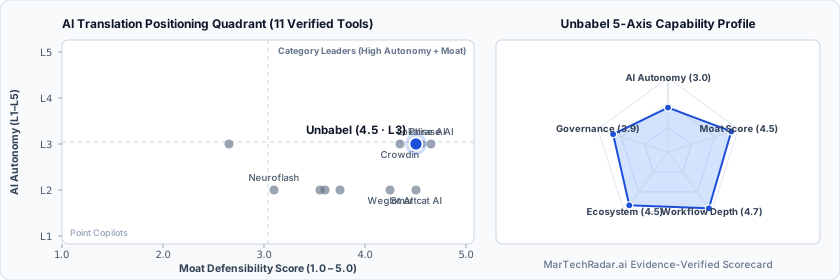
Unbabel in-depth review, pricing & architecture analysis
Editor sign-off: Oct 14, 2026. How profiles are made.
What is Unbabel? Overview & background
Capitalized with $112.2M in cumulative funding before its acquisition by TransPerfect, Unbabel was founded in 2013 in San Francisco, California to establish dedicated Language Operations across distributed digital enterprises. The vendor positions its platform directly toward enterprise localization directors, global customer experience executives, and international marketing leads who require auditable translation workflows rather than unverified raw machine translation. Operating within the multilingual and global localization track, Unbabel shifts translation from an ad-hoc agency service into a continuously monitored programmatic operational layer.
How Unbabel works: architecture & workflow
Under the hood, Unbabel operates at an L3 conditional autonomy level by coupling proprietary neural machine translation engines with algorithmic Quality Estimation models. The ingestion layer receives source text through bi-directional connectors linked to content repositories and support ticket systems. The Quality Estimation pipeline evaluates synthetic outputs against semantic accuracy and brand terminology parameters in flight. When predicted quality falls below established thresholds, the platform automatically routes segments to a distributed network of vetted bilingual post-editors who correct anomalies before downstream delivery, programmatically retraining domain-specific translation memories, alongside native workflow integrations for Salesforce, Intercom, and Zendesk.
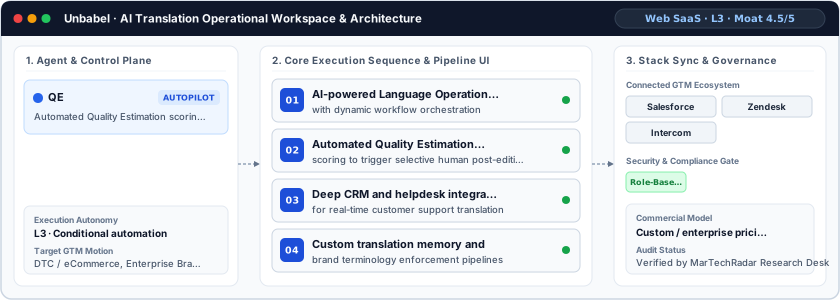
Unbabel limitations, drawbacks & risks
Operational considerations and platform boundaries include:
- Human-in-the-loop latency spikes: Workflows requiring human post-editing introduce variable queue latencies, creating processing bottlenecks during off-peak timezone coverage or localized translator shortages.
- Integration schema drift: Deep coupling with third-party ticketing and content management schemas demands continuous maintenance when upstream platforms modify API structures or webhook payloads.
- Terminology governance drift: Dynamic adaptation struggles with high-velocity marketing taxonomies where newly minted product terminology lacks sufficient parallel corpus data for accurate quality scoring.
Unbabel pricing, plans & cost breakdown
Unbabel structures its commercial model through custom enterprise contracts negotiated via direct sales consultation. Licensing is packaged based on annual translated word volume, specific target language pairings, platform seat counts, and agreed human-in-the-loop quality review tiers. Commercial pricing is available on request through tailored enterprise sales quotes based on organizational scale and seats, with custom implementation, governance engineering, and dedicated account management provided under standard master services agreements.
| Plan / Tier | Verified Price & Billing | Included Scope & Contract Terms |
|---|---|---|
| Enterprise / Custom | Custom quote | Custom-quoted plan; terms come from the vendor's sales team. |
How Unbabel compares vs. competitors & alternatives
Within the localization landscape, Unbabel differentiates itself from pure-play neural translation engines like DeepL Write, which prioritize individual desktop rewriting without managed human verification frameworks within the AI Translation segment. Unlike Neuroflash, which centers on generative AI copywriting rather than cross-lingual translation workflows, Unbabel isolates enterprise translation accuracy. Compared to developer-centric continuous localization systems like Transifex that manage raw code strings and static translation files, Unbabel excels in high-volume, dynamic communications. It remains best suited for enterprise brands running scaled multilingual customer support and continuous international marketing operations.
Direct competitors & market radar
Top algorithmic competitors based on category positioning, capability overlap, and ICP alignment.
Frequently asked questions about Unbabel
Does Unbabel publish pricing or require an enterprise quote?
Unbabel pricing: Custom / enterprise pricing. No free plan is publicly disclosed. Unbabel structures its commercial model through custom enterprise contracts negotiated via direct sales consultation.
What are the top Unbabel alternatives in AI Translation?
Verified AI Translation alternatives include Neuroflash (€42–€84/mo), Phrase AI (Custom / enterprise pricing), Weglot AI (Custom / enterprise pricing), Bureau Works ($980–$3,300/mo · Enterprise plan). Within the localization landscape, Unbabel differentiates itself from pure-play neural translation engines like DeepL Write, which prioritize individual desktop rewriting without managed human verification frameworks within the AI Translation segment.
What are the main limitations and trade-offs of Unbabel?
Operational considerations and platform boundaries include: Human-in-the-loop latency spikes: Workflows requiring human post-editing introduce variable queue latencies, creating processing bottlenecks during off-peak timezone coverage or localized translator shortages. Walk away if you need published self-serve pricing: Unbabel is sold by custom quote.
Verified sources & evidence trail
- Official product domain: https://unbabel.com
- Commercial pricing verification: Verified against official vendor pricing policy (Custom / enterprise pricing)
- Verified corporate entity profiles (
sameAs): LinkedIn Company Profile · Crunchbase Entity Record - First-party governance & documentation links: Trust & Security · System Status · Terms · Privacy
- Editor sign-off: Oct 14, 2026 (how profiles are made).
