Smartcat AI Review (2026): AI Translation Pricing, Pros & Cons
Bottom line
Smartcat AI is a Web SaaS tool for AI Translation (Multilingual & Global Localization) in Copy & Content. Pricing: From $1,200/yr. Best suited to DTC / eCommerce and Enterprise Brands. Editor ratings: AI autonomy L2 (workflow copilot); moat score 4.5/5.0 (Proprietary moat (category leader)). Fact-checked by MarTechRadar Research Desk on Oct 14, 2026.
Autonomous multilingual translation and content orchestration platform combining neural machine translation, generative AI coworkers, and collaborative.
Is Smartcat AI worth it in 2026? Buyer fit & when to walk away
Choose Smartcat AI if (Best Fit)
- Target ICP & Stack Fit: You operate as DTC / eCommerce and Enterprise Brands requiring a Web SaaS deployment for AI Translation, with verified ecosystem connectivity for Salesforce, Slack, WordPress, Twilio Segment.
- L2 Architecture & Defensibility: Proprietary adaptive translation memories integrated with autonomous multi-agent linguistic orchestration ('AI Coworkers') and a native two-sided marketplace for human-in-the-loop validation.
- Commercial Model Fit: Your procurement budget aligns with From $1,200/yr.
Walk away from Smartcat AI if (Deal-Breakers)
- Walk away if your workflow cannot tolerate high-context ui string truncation: Automated translation runs frequently disregard strict frontend character boundaries, requiring manual CSS re-engineering or post-generation human intervention on complex software interfaces.
- Walk away if terminology drift in complex schemas is a deal-breaker for your team: When ingesting multi-branch software strings without rich contextual metadata, generative translation agents can inject semantic variations that degrade translation memory reuse rates.
Smartcat AI pricing, free plan & scorecard at a glance
| Pricing | From $1,200/yrVendor pricing page |
|---|---|
| Free plan | No / not disclosed |
| Delivery | Web SaaS |
| Audience | DTC / eCommerce, Enterprise Brands |
| AI autonomy level | L2 · Workflow copilotEditor-verified |
| Moat tier & score | 4.5 / 5.0 · Proprietary moat (category leader)Editor-verified |
| Funding | Venture-backed |
| Total funding | $71.9M |
| Founders | Ivan Smolnikov |
| Company size | 201-500 employees |
| Ecosystem integrations | Salesforce, Slack, WordPress, Twilio Segment, Zendesk |
| Governance & docs | Trust & Security ↗ · System Status ↗ · API & Docs ↗ · Changelog ↗ · Terms ↗ · Privacy ↗ |
| Headquarters | Wilmington, DE |
| Founded | 2016 |
| Last verified | Oct 14, 2026 |
Smartcat AI pros & cons: strengths vs. operational limitations
Pros: core strengths & capabilities
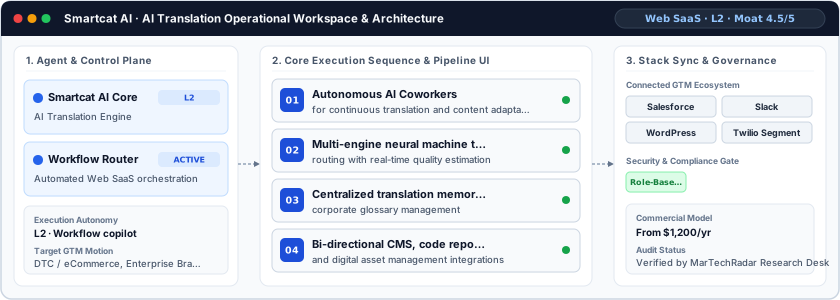
- Autonomous AI Coworkers: for continuous translation and content adaptation
- Multi-engine neural machine translation: routing with real-time quality estimation
- Centralized translation memory and corporate glossary management
- Bi-directional CMS, code repository, and digital asset management integrations
Cons: operational limitations & risks
- High-Context UI String Truncation: Automated translation runs frequently disregard strict frontend character boundaries, requiring manual CSS re-engineering or post-generation human intervention on complex software interfaces.
- Terminology Drift in Complex Schemas: When ingesting multi-branch software strings without rich contextual metadata, generative translation agents can inject semantic variations that degrade translation memory reuse rates.
- API Rate Limits During Batch Syncs: High-volume synchronous documentation exports through upstream CMS connectors encounter throttling under sustained concurrency, introducing delivery pipeline latency.
Smartcat AI TCO & deal-breaker stress test
Simulate 12-month stepped TCO, hidden cost multipliers, contract lock-in exposure, and stack failure modes using only facts verified by MarTechRadar Research Desk on 2026-10-14 · Capture SHA 93cae66f.
Smartcat AI is viable for 5 seats, but requires commercial or technical verification on the flagged items below.
- Moat Score
- 4.5 / 5.0
- AI Autonomy
- L2
- Free Tier / Trial
- None disclosed
Triggered audit signals & failure modes
- Annual Contract Lock-in Risk DetectedFact-checked by MarTechRadar Research Desk
Smartcat AI operates on an annual subscription model tied to platform capabilities, workflow governance, and agent allocation. Entry tiers begin at $1200 per year for standard linear translation workflows, chief of staff orchestration, and unlimited seat access.
- Primary Operational Bottleneck: High-Context UI String TruncationAudit by MarTechRadar Research Desk
Automated translation runs frequently disregard strict frontend character boundaries, requiring manual CSS re-engineering or post-generation human intervention on complex software interfaces.
Test a custom Smartcat AI budget or stack constraint
Lower 5-seat floor (~$99/mo vs. $1,200 / yr upfront) · Transparent self-serve entry without mandatory annual lock-in
Smartcat AI integrations, API, security & compliance stack
Smartcat AI AI moat & AI Translation positioning
Proprietary adaptive translation memories integrated with autonomous multi-agent linguistic orchestration ('AI Coworkers') and a native two-sided marketplace for human-in-the-loop validation.
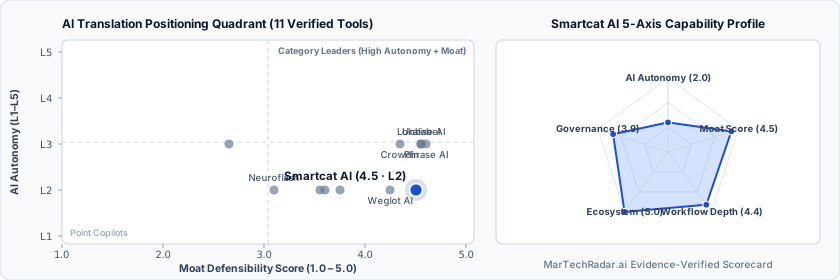
Smartcat AI in-depth review, pricing & architecture analysis
Editor sign-off: Oct 14, 2026. How profiles are made.
What is Smartcat AI? Overview & background
Architected as a centralized translation operating system, Smartcat AI unifies multi-engine neural machine translation with autonomous generative workflows to address enterprise localization debt. Headquartered in Wilmington, DE, and founded in 2016, the company has secured $71.9M in venture funding to displace fragmented desktop computer-assisted translation (CAT) utilities. The platform targets enterprise localization managers, global content operations leads, and product internationalization teams seeking to operationalize continuous multi-market adaptation across digital touchpoints.
How Smartcat AI works: architecture & workflow
At its technical core, Smartcat AI operates as an L3 autonomous localization orchestration pipeline. Inbound assets from connected code repositories, document stores, and enterprise CMS platforms are ingested into a unified parsing engine that segments copy while isolating structural markup. The execution engine routes segments through an ensemble of neural translation providers paired with specialized LLM agents dubbed AI Coworkers. These agents query dynamic translation memories and client-specific terminology glossaries, applying programmatic quality estimation scoring to decide whether a segment can be published automatically or requires human review, alongside native workflow integrations for Salesforce, Slack, WordPress, and Zendesk.
Smartcat AI limitations, drawbacks & risks
Operational considerations and platform boundaries include:
- High-Context UI String Truncation: Automated translation runs frequently disregard strict frontend character boundaries, requiring manual CSS re-engineering or post-generation human intervention on complex software interfaces.
- Terminology Drift in Complex Schemas: When ingesting multi-branch software strings without rich contextual metadata, generative translation agents can inject semantic variations that degrade translation memory reuse rates.
- API Rate Limits During Batch Syncs: High-volume synchronous documentation exports through upstream CMS connectors encounter throttling under sustained concurrency, introducing delivery pipeline latency.
Smartcat AI pricing, plans & cost breakdown
Smartcat AI operates on an annual subscription model tied to platform capabilities, workflow governance, and agent allocation. Entry tiers begin at $1200 per year for standard linear translation workflows, chief of staff orchestration, and unlimited seat access. Mid-market packages scale upward from $24000 per year to unlock advanced automation throughput, multi-agent capacity, accelerated service level agreements, and complex governance controls for global enterprise deployments.
How Smartcat AI compares vs. competitors & alternatives
Smartcat AI diverges from single-purpose linguistic refinement tools like DeepL Write by managing full localization lifecycles rather than isolated copy polish within the AI Translation segment. Compared to marketing copy generators such as Neuroflash, Smartcat AI anchors its models to rigid translation memory databases and enterprise terminology vaults. Against developer-centric continuous localization engines like Transifex, Smartcat AI provides broader multi-department asset coverage across collateral, multimedia, and enterprise documentation, appealing to global enterprises managing distributed content ecosystems.
Direct competitors & market radar
Top algorithmic competitors based on category positioning, capability overlap, and ICP alignment.
Frequently asked questions about Smartcat AI
How much does Smartcat AI cost in 2026?
Smartcat AI pricing: From $1,200/yr. No free plan is publicly disclosed. Smartcat AI operates on an annual subscription model tied to platform capabilities, workflow governance, and agent allocation.
What are the top Smartcat AI alternatives in AI Translation?
Verified AI Translation alternatives include Neuroflash (€42–€84/mo), Transifex (Custom / enterprise pricing), Crowdin (Custom / enterprise pricing), Lingo.dev (Free plan · $99/mo · Enterprise plan). Smartcat AI diverges from single-purpose linguistic refinement tools like DeepL Write by managing full localization lifecycles rather than isolated copy polish within the AI Translation segment.
What are the main limitations and trade-offs of Smartcat AI?
Operational considerations and platform boundaries include: High-Context UI String Truncation: Automated translation runs frequently disregard strict frontend character boundaries, requiring manual CSS re-engineering or post-generation human intervention on complex software interfaces. Walk away if your workflow cannot tolerate high-context ui string truncation: Automated translation runs frequently disregard strict frontend character boundaries, requiring manual CSS re-engineering or post-generation human intervention on complex software interfaces.
Verified sources & evidence trail
- Official product domain: https://smartcat.com
- Commercial pricing verification: https://www.smartcat.com/pricing/
- Verified corporate entity profiles (
sameAs): LinkedIn Company Profile · Crunchbase Entity Record - First-party governance & documentation links: Trust & Security · System Status · API & Docs · Changelog · Terms · Privacy
- Editor sign-off: Oct 14, 2026 (how profiles are made).
