Lingo.dev Review (2026): AI Translation Pricing, Pros & Cons
Bottom line
Lingo.dev is a Cloud SaaS Platform tool for AI Translation (Multilingual & Global Localization) in Copy & Content. Pricing: Free plan · $99/mo · Enterprise plan. Best suited to B2B Marketing and Growth & Revenue Teams. Editor ratings: AI autonomy L3 (conditional automation); moat score 2.7/5.0 (Workflow-embedded). Fact-checked by MarTechRadar Research Desk on Oct 26, 2026.
AI localization engineering platform automating multilingual website, marketing copy, and software UI translation in CI/CD with LLMs at cost.
Is Lingo.dev worth it in 2026? Buyer fit & when to walk away
Choose Lingo.dev if (Best Fit)
- Target ICP & Stack Fit: You operate as B2B Marketing and Growth & Revenue Teams requiring a Cloud SaaS Platform deployment for AI Translation, with verified ecosystem connectivity for Zendesk, Atlassian Jira, Model Context Protocol (MCP).
- L3 Architecture & Defensibility: Lingo.dev (formerly Replexica) commands a strong localization engineering moat through its Git/CI/CD-native translation compiler, zero-markup pass-through LLM pricing, unlimited seats and glossaries, native MCP server, and $4.7M in Seed funding led by Initialized Capital and Y Combinator.
- Commercial Model Fit: Your procurement budget aligns with Free plan · $99/mo · Enterprise plan and want a self-serve free tier for zero-cost initial validation.
Walk away from Lingo.dev if (Deal-Breakers)
- Walk away if your workflow requires uncapped enterprise volume on the Free plan · $99/mo · Enterprise plan entry plan without upgrading tiers.
- Walk away if your workflow cannot tolerate primary operational trade-off: In practical enterprise deployments, the primary trade-off is that Lingo.dev is architected around developer- and CMS-friendly pipelines (Git, API, MCP), meaning non-technical marketers accustomed to uploading Word documents via email will need initial engineering setup to connect their CMS or repository.
- Walk away if functional scope boundary is a deal-breaker for your team: Lingo.dev is not built for video lip-sync dubbing, paid social media ad buying, or outbound B2B sales calling.
Lingo.dev pricing, free plan & scorecard at a glance
| Pricing | Free plan · $99/mo · Enterprise planVendor pricing page |
|---|---|
| Free plan | Yes |
| Delivery | Cloud SaaS Platform |
| Audience | B2B Marketing, Growth & Revenue Teams |
| AI autonomy level | L3 · Conditional automationEditor-verified |
| Moat tier & score | 2.7 / 5.0 · Workflow-embeddedEditor-verified |
| Funding | Seed |
| Total funding | $4.7MBacked by Transpose Platform Management, Y Combinator, Initialized Capital |
| Founders | Max Prilutskiy, Veronica Prilutskaya |
| Company size | 11-50 employees |
| Ecosystem integrations | Zendesk, Atlassian Jira, Model Context Protocol (MCP) |
| Headquarters | San Francisco, California, United States |
| Founded | 2024 |
| Last verified | Oct 26, 2026 |
Lingo.dev pros & cons: strengths vs. operational limitations
Pros: core strengths & capabilities
- Automated CI/CD localization: via GitHub App, GitLab, Bitbucket, Payload CMS, and Zendesk Help Center integrations
- Context-aware Localization Engines enforcing: unlimited glossaries, brand voice rules, and automated $0.01 quality AI review runs
- Zero-markup pass-through LLM pricing paired: with synchronous/asynchronous REST APIs, webhooks, and a Management API / MCP server
- Unlimited user seats: across all tiers, eliminating legacy per-translator and per-word localization agency markups
Cons: operational limitations & risks
- Primary Operational Trade-Off: In practical enterprise deployments, the primary trade-off is that Lingo.dev is architected around developer- and CMS-friendly pipelines (Git, API, MCP), meaning non-technical marketers accustomed to uploading Word documents via email will need initial engineering setup to connect their CMS or repository.
- Functional Scope Boundary: Lingo.dev is not built for video lip-sync dubbing, paid social media ad buying, or outbound B2B sales calling.
- Deployment & Governance Considerations: Additionally, advanced governance capabilities—including configurable async pipelines, pre-localization AI source editing, human-in-the-loop review workflows, and Jira/Zendesk/Payload CMS connectors—require upgrading from the $99/month Production plan to a Custom Enterprise contract.
Lingo.dev TCO & deal-breaker stress test
Simulate 12-month stepped TCO, hidden cost multipliers, contract lock-in exposure, and stack failure modes using only facts verified by MarTechRadar Research Desk on 2026-10-26 · Capture SHA 9b6f3b8a.
Lingo.dev aligns with your 5-seat / $800/mo profile. Review the walk-away triggers and contract levers below before deployment.
- Moat Score
- 2.7 / 5.0
- AI Autonomy
- L3
- Free Tier / Trial
- Free plan
Triggered audit signals & failure modes
- Published Self-Serve Entry FloorVerified Pricing Ledger
Lingo.dev publishes a transparent entry point (Free plan · $99/mo · Enterprise plan) with a free tier for initial validation before committing.
- Primary Operational Bottleneck: Deployment & Governance ConsiderationsAudit by MarTechRadar Research Desk
Additionally, advanced governance capabilities—including configurable async pipelines, pre-localization AI source editing, human-in-the-loop review workflows, and Jira/Zendesk/Payload CMS connectors—require upgrading from the $99/month Production plan to a Custom Enterprise contract.
Test a custom Lingo.dev budget or stack constraint
Lower 5-seat floor (~$5/mo vs. From $99 / mo)
Fits within $800/mo budget (From $100/mo)
Lingo.dev integrations, API, security & compliance stack
Lingo.dev AI moat & AI Translation positioning
Lingo.dev (formerly Replexica) commands a strong localization engineering moat through its Git/CI/CD-native translation compiler, zero-markup pass-through LLM pricing, unlimited seats and glossaries, native MCP server, and $4.7M in Seed funding led by Initialized Capital and Y Combinator.
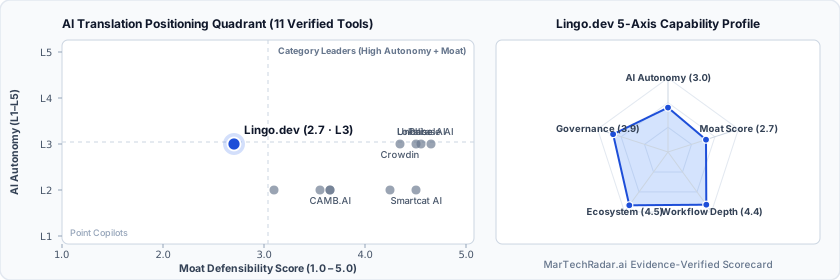
Lingo.dev in-depth review, pricing & architecture analysis
Audited by MarTechRadar Research Desk (Evidence-Ledger Verified) on Oct 26, 2026.
What is Lingo.dev? Overview & background
Lingo.dev (formerly known as Replexica, operating at lingo.dev) is an AI localization engineering platform built for global growth teams, international SEO/marketing engineers, and software product organizations. Founded in 2024 by Max Prilutskiy and Veronica Prilutskaya and headquartered in San Francisco, California, the Y Combinator (Fall 2024) company employs 11 to 50 people and has raised $4.7M in Seed funding backed by Initialized Capital, Y Combinator, and Transpose Platform Management. Designed to replace slow human translation queues and legacy TMS seat licenses, Lingo.dev automates website, marketing landing page, and application localization directly inside engineering and CMS workflows, capturing search demand for ai website localization platform, lingo dev pricing, and a smartling vs lokalise alternative.
How Lingo.dev works: architecture & workflow
At the technical core of Lingo.dev is a programmable Localization Engine architecture integrated directly into Git repositories (GitHub, GitLab, Bitbucket), headless CMS platforms (such as Payload CMS), and customer support hubs (Zendesk Help Center). Whenever a marketer or developer pushes updated English copy, Markdown articles, or JSON/i18n strings, Lingo.dev's pipeline detects the delta, applies custom Brand Voice instructions and domain Glossaries, routes the translation through frontier LLMs at zero markup, and executes automated Quality AI Review runs to verify cultural nuance and formatting integrity before committing localized files back. The platform also exposes synchronous/asynchronous APIs and a native Model Context Protocol (MCP) server for agent-driven localization.
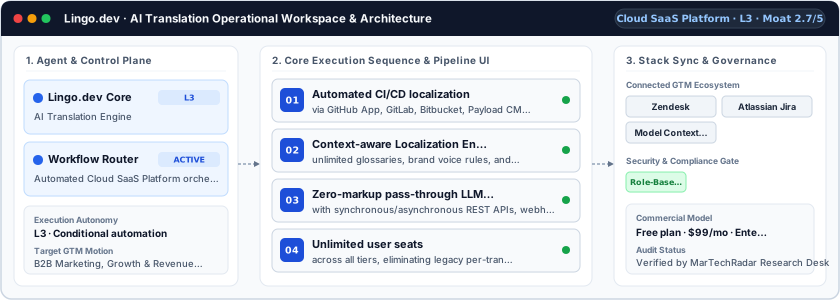
Lingo.dev limitations, drawbacks & risks
Operational considerations and platform boundaries include:
- Primary Operational Trade-Off: In practical enterprise deployments, the primary trade-off is that Lingo.dev is architected around developer- and CMS-friendly pipelines (Git, API, MCP), meaning non-technical marketers accustomed to uploading Word documents via email will need initial engineering setup to connect their CMS or repository.
- Functional Scope Boundary: Lingo.dev is not built for video lip-sync dubbing, paid social media ad buying, or outbound B2B sales calling.
- Deployment & Governance Considerations: Additionally, advanced governance capabilities—including configurable async pipelines, pre-localization AI source editing, human-in-the-loop review workflows, and Jira/Zendesk/Payload CMS connectors—require upgrading from the $99/month Production plan to a Custom Enterprise contract.
Lingo.dev pricing, plans & cost breakdown
Sandbox at $0/mo base, Production at $99/mo base (+$0.50/engine/mo, $2/MTok infra, $0.01/AI review run, and 0% markup pass-through LLM cost), Custom Enterprise. On its official pricing page (lingo.dev/en/pricing), Lingo.dev includes unlimited seats, unlimited glossaries, unlimited brand voices, and Management API/MCP access on every plan, passing underlying LLM token costs through at 0% markup: Sandbox has a $0/month base price (100K tokens/day throughput and 7-day data retention), Production has a $99/month base price (5M tokens/day throughput and 30-day retention), and both bill usage at $0.50 per engine/month, $2 per million tokens of Lingo.dev infrastructure, and $0.01 per Quality AI review run, while Enterprise offers custom annual contracts.
| Plan / Tier | Verified Price & Billing | Target Seat / Scale Fit | Included Scope & Contract Terms |
|---|---|---|---|
| Free / Sandbox | $0 | Unlimited seats (capped credits) | Entry free tier with capped usage or feature quotas for initial workflow testing. |
| Enterprise / Custom | Custom quote | Unlimited seats (Enterprise SLA) | Sales-negotiated annual contract for custom volume, SSO/RBAC governance, and dedicated SLA. |
| Contract Watchout: Credit & Usage Burn Multiplier | Workflows on Lingo.dev consume metered credits or usage quotas; voice/media minutes, multi-step synthesis, or high-frequency runs can exhaust base allocations and trigger mid-cycle top-up packs. | ||
How Lingo.dev compares vs. competitors & alternatives
In the multilingual and global localization category, Lingo.dev competes with Smartling, Lokalise AI, Weglot AI, Phrase AI, and Smartcat AI, alongside verified subtrack peers including Bureau Works, Rask AI, and CAMB.AI. Compared to legacy Translation Management Systems that charge steep per-seat fees and opaque per-word markups on top of machine translation APIs, Lingo.dev differentiates itself through 0% pass-through LLM billing, unlimited seats, and native CI/CD and MCP automation. SaaS companies and global marketing teams scaling international web presence should evaluate Lingo.dev.
Frequently asked questions about Lingo.dev
How much does Lingo.dev cost in 2026?
Lingo.dev pricing: Free plan · $99/mo · Enterprise plan. A permanent free plan is available. Published tiers: Free / Sandbox ($0); Enterprise / Custom (Custom quote). Sandbox at $0/mo base, Production at $99/mo base (+$0.50/engine/mo, $2/MTok infra, $0.01/AI review run, and 0% markup pass-through LLM cost), Custom Enterprise.
What are the top Lingo.dev alternatives in AI Translation?
Verified AI Translation alternatives include Lokalise AI (From $100/mo), Smartcat AI (From $1,200/yr), Phrase AI (Custom / enterprise pricing), CAMB.AI (Free plan · $5–$900/mo). In the multilingual and global localization category, Lingo.dev competes with Smartling, Lokalise AI, Weglot AI, Phrase AI, and Smartcat AI, alongside verified subtrack peers including Bureau Works, Rask AI, and CAMB.AI.
Verified sources & evidence trail
- Official product domain: https://lingo.dev
- Commercial pricing verification: https://lingo.dev/en/pricing
- Verified corporate entity profiles (
sameAs): LinkedIn Company Profile · Crunchbase Entity Record - Editorial audit sign-off: Audited by MarTechRadar Research Desk (Evidence-Ledger Verified) on Oct 26, 2026.
