Smartling Review (2026): AI Translation Pricing, Limits & Alternatives
Bottom line
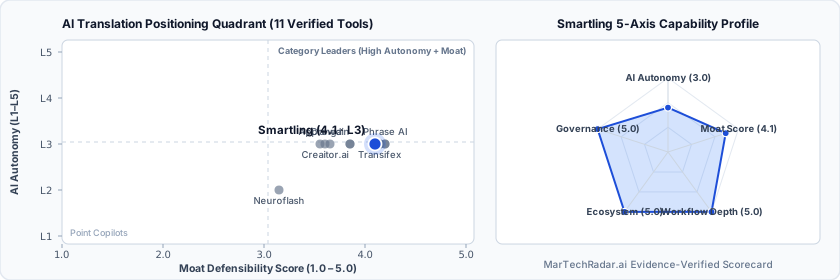
Smartling is a SaaS Platform tool for AI Translation (Multilingual & Global Localization) in Copy & Content. Pricing: Pricing not disclosed. Best suited to B2B Marketing & GTM Teams. Editor ratings: AI autonomy L3 (conditional automation); moat score 4.1/5.0 (Proprietary moat). Fact-checked by Sarah Per on Oct 23, 2026.
Enterprise AI translation management system orchestrating multi-LLM neural translation, automated LQA agents, and continuous localization.
Smartling buyer fit verdict: when to choose vs. when to walk away
Choose Smartling if (Best Fit)
- Target ICP & Stack Fit: You operate as B2B Marketing & GTM Teams requiring a SaaS Platform deployment for AI Translation, with verified ecosystem connectivity for Salesforce, HubSpot, Shopify, Webflow.
- L3 Architecture & Defensibility: Smartling commands an enterprise localization moat through its multi-LLM AI Hub routing across 20+ translation engines, visual context capture, and $223.3M in institutional backing (acquired by Vitruvian Partners).
- Commercial Model Fit: Your procurement budget aligns with Pricing not disclosed.
Walk away from Smartling if (Deal-Breakers)
- Walk away if you require transparent self-serve monthly billing or your budget ceiling is under $1,000/mo (Smartling requires sales-gated custom quoting).
- Walk away if your workflow cannot tolerate enterprise implementation & connector setup overhead: Configuring automated string extraction, visual context capture, and Global Delivery Network proxy rules across complex multi-region CMS and e-commerce architectures introduces an onboarding learning curve that requires engineering coordination.
- Walk away if not built for lightweight solo creators is a deal-breaker for your team: Smartling's enterprise governance workflows, translation memory architecture, and contract structure are over-engineered for solo bloggers or small businesses translating occasional social posts.
Smartling key facts & scorecard
| Pricing | Pricing not disclosed |
|---|---|
| Free plan | No / not disclosed |
| Delivery | SaaS Platform |
| Audience | B2B Marketing & GTM Teams |
| AI autonomy level | L3 · Conditional automationEditor-verified |
| Moat tier & score | 4.1 / 5.0 · Proprietary moatEditor-verified |
| Funding | AcquiredAcquired by Vitruvian Partners |
| Total funding | $223.3MBacked by Techstars, Venrock, First Round Capital, Felicis, Battery Ventures |
| Founders | Andrey Akselrod, Jack Welde |
| Company size | 51-200 employees |
| Ecosystem integrations | Salesforce, HubSpot, Shopify, Webflow, Braze, Zendesk |
| Compliance & governance | SOC 2, GDPR, HIPAA, ISO 27001 |
| Headquarters | New York, New York, United States |
| Founded | 2009 |
| Last verified |
Smartling pros & cons: strengths vs. operational limitations
Pros: core strengths & capabilities
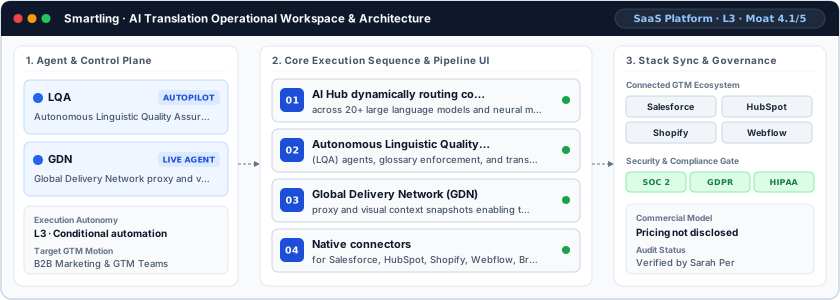
- AI Hub dynamically routing content: across 20+ large language models and neural machine translation engines per language pair
- Autonomous Linguistic Quality Assurance: (LQA) agents, glossary enforcement, and translation memory leverage
- Global Delivery Network (GDN): proxy and visual context snapshots enabling translators and AI models to see live layout constraints
- Native connectors: for Salesforce, HubSpot, Shopify, Webflow, Braze, Intercom, and Zendesk under SOC 2, ISO 27001, GDPR, and HIPAA compliance
Cons: operational limitations & risks
- Enterprise Implementation & Connector Setup Overhead: Configuring automated string extraction, visual context capture, and Global Delivery Network proxy rules across complex multi-region CMS and e-commerce architectures introduces an onboarding learning curve that requires engineering coordination.
- Not Built for Lightweight Solo Creators: Smartling's enterprise governance workflows, translation memory architecture, and contract structure are over-engineered for solo bloggers or small businesses translating occasional social posts.
- Human-in-the-Loop Cost Layer: When enterprises combine Smartling's software subscription with managed human translation and transcreation services for creative brand slogans, per-word linguistic fees add variable expenditure beyond base platform licensing.
Are you a founder, co-founder, or product/growth lead at Smartling? Verify your official @smartling.com email to publish a factual architectural response or 2026 roadmap update below these limitations.
Smartling TCO & deal-breaker stress test
Simulate 12-month stepped TCO, hidden cost multipliers, contract lock-in exposure, and stack failure modes using only facts verified by Sarah Per on · Capture SHA 690c8fa0.
Smartling triggers high-severity friction under your 5-seat / $800/mo constraints. Benchmark the verified subtrack alternatives below before committing.
| Plan / Tier | Verified Rate | Scale Fit | Scope & Quota Notes |
|---|---|---|---|
| Enterprise / Custom | Custom quote | 15–50+ seats (Enterprise SLA) | Sales-negotiated annual contract for custom volume, SSO/RBAC governance, and dedicated SLA. |
- Moat Score
- 4.1 / 5.0
- AI Autonomy
- L3
- Free Tier / Trial
- None disclosed
Triggered audit signals & failure modes
- Opaque Enterprise Quoting vs. SMB/Mid-Market BudgetVerified Pricing Ledger
Smartling does not disclose a public self-serve floor (Pricing not disclosed). Buyers with a $800/mo cap face high sales-qualification friction.
- Sales-Gated Contract TermsFact-checked by Sarah Per
Smartling operates on a custom enterprise SaaS subscription and per-word AI/language services model with pricing available on request.
- Primary Operational Bottleneck: Not Built for Lightweight Solo CreatorsAudit by Sarah Per
Smartling's enterprise governance workflows, translation memory architecture, and contract structure are over-engineered for solo bloggers or small businesses translating occasional social posts.
Hidden TCO Multipliers & Quota Gates
- Enterprise Implementation & Connector Setup Overhead: Configuring automated string extraction, visual context capture, and Global Delivery Network proxy rules across complex multi-region CMS and e-commerce architectures introduces an onboarding learning curve that requires engineering coordination.
- Not Built for Lightweight Solo Creators: Smartling's enterprise governance workflows, translation memory architecture, and contract structure are over-engineered for solo bloggers or small businesses translating occasional social posts.
When to Walk Away & Negotiation Levers
- Walk away if you require transparent self-serve monthly billing or your budget ceiling is under $1,000/mo (Smartling requires sales-gated custom quoting).
- Walk away if your workflow cannot tolerate enterprise implementation & connector setup overhead: Configuring automated string extraction, visual context capture, and Global Delivery Network proxy rules across complex multi-region CMS and e-commerce architectures introduces an onboarding learning curve that requires engineering coordination.
- Walk away if not built for lightweight solo creators is a deal-breaker for your team: Smartling's enterprise governance workflows, translation memory architecture, and contract structure are over-engineered for solo bloggers or small businesses translating occasional social posts.
- Demand a 30- to 60-day paid pilot opt-out clause in the Smartling order form before signing a 12-month enterprise commitment.
- Require a sandbox proof-of-concept testing enterprise implementation & connector setup overhead against your live CRM/data schema before annual sign-off.
Ask a custom procurement or TCO stress-test question about Smartling
Lower 5-seat floor (~$42/mo vs. Custom Quote)
Lower 5-seat floor (~$69/mo vs. Custom Quote) · Transparent self-serve entry without mandatory annual lock-in
Smartling key entities, modules & ecosystem stack
Autonomous Linguistic Quality Assurance agents, glossary enforcement, and translation memory leverage
Global Delivery Network proxy and visual context snapshots enabling translators and AI models to see live layout constraints
Smartling moat & subtrack positioning
Smartling commands an enterprise localization moat through its multi-LLM AI Hub routing across 20+ translation engines, visual context capture, and $223.3M in institutional backing (acquired by Vitruvian Partners).
Editorial review
Fact-checked by Sarah Per (Principal Content Systems & Generative Media Editor) on .
Background
Founded in 2009 by Andrey Akselrod and Jack Welde and headquartered in New York, New York, United States, Smartling (smartling.com) is an enterprise AI translation management system (TMS) and language services platform built for global digital brands across technology, e-commerce, travel, and financial services. Operating with a team of 51-200 employees after raising $223.3M across seven funding rounds from lead investors including Techstars, Venrock, First Round Capital, Felicis, and Battery Ventures—and backed by majority private equity owner Vitruvian Partners—the company automates continuous localization across websites, mobile apps, marketing campaigns, and customer support repositories. Rather than managing manual spreadsheet handoffs to regional translation agencies, global marketing teams use Smartling to localize digital experiences continuously.
How Smartling works
Smartling operates at Level 3 autonomy by combining its cloud Translation Management System and Global Delivery Network (GDN) proxy with its multi-engine AI Hub. When new marketing copy, web pages, or product strings are published in source systems such as HubSpot, Salesforce, Shopify, Webflow, Braze, Intercom, or Zendesk, Smartling automatically detects changes, captures visual layout context, and checks centralized Translation Memory and brand glossaries. Its AI Hub then dynamically selects the highest-performing combination of 20+ large language models and neural machine translation engines for each specific domain and language pair, applying automated prompt engineering, glossary injection, and AI Linguistic Quality Assurance (LQA) checks before routing high-visibility assets to optional human post-editors. The platform operates under SOC 2, ISO 27001, GDPR, and HIPAA security certifications.
Limitations
Operational limitations and technical trade-offs include:
- Enterprise Implementation & Connector Setup Overhead: Configuring automated string extraction, visual context capture, and Global Delivery Network proxy rules across complex multi-region CMS and e-commerce architectures introduces an onboarding learning curve that requires engineering coordination.
- Not Built for Lightweight Solo Creators: Smartling's enterprise governance workflows, translation memory architecture, and contract structure are over-engineered for solo bloggers or small businesses translating occasional social posts.
- Human-in-the-Loop Cost Layer: When enterprises combine Smartling's software subscription with managed human translation and transcreation services for creative brand slogans, per-word linguistic fees add variable expenditure beyond base platform licensing.
Smartling pricing
Smartling operates on a custom enterprise SaaS subscription and per-word AI/language services model with pricing available on request. Platform tiers (such as Core and Enterprise plans) are scoped around the number of connected content repositories, automated workflow rules, Global Delivery Network proxy traffic, and monthly AI translation volume. Prospective global marketing and localization leaders engage Smartling's sales team for a custom localization ROI audit and annual contract proposal.
How Smartling compares
Within the Multilingual & Global Localization category, Smartling competes against enterprise translation management and AI localization platforms such as Phrase, Lokalise, Transifex, and Bureau Works. Versus developer-only string tools like Lokalise or standalone neural translation APIs like DeepL, Smartling differentiates itself through its patented Global Delivery Network web proxy, visual context rendering, multi-LLM AI Hub routing across 20+ engines, and integrated enterprise language services.
Frequently asked questions about Smartling
How much does Smartling cost and does it require a custom enterprise quote?
Published pricing summary for Smartling: Pricing not disclosed. A permanent free plan is not disclosed for Smartling. Smartling operates on a custom enterprise SaaS subscription and per-word AI/language services model with pricing available on request.
How does Smartling work and how autonomous is its AI architecture?
Enterprise AI translation management system orchestrating multi-LLM neural translation, automated LQA agents, and continuous localization. Within AI Translation (Multilingual & Global Localization), MarTechRadar rates its execution architecture at L3 · Conditional automation with a verified Moat Score of 4.1 / 5.0 (Proprietary moat). Smartling commands an enterprise localization moat through its multi-LLM AI Hub routing across 20+ translation engines, visual context capture, and $223.3M in institutional backing (acquired by Vitruvian Partners). Corporate profile: Founded by Andrey Akselrod, Jack Welde, operating at 51-200 employees scale, acquired by Vitruvian Partners.
What are the main limitations of Smartling and when should buyers walk away?
Based on our editorial technical audit, key operational considerations and boundaries for Smartling include: (1) Enterprise Implementation & Connector Setup Overhead: Configuring automated string extraction, visual context capture, and Global Delivery Network proxy rules across complex multi-region CMS and e-commerce architectures introduces an onboarding learning curve that requires engineering coordination. (2) Not Built for Lightweight Solo Creators: Smartling's enterprise governance workflows, translation memory architecture, and contract structure are over-engineered for solo bloggers or small businesses translating occasional social posts. (3) Human-in-the-Loop Cost Layer: When enterprises combine Smartling's software subscription with managed human translation and transcreation services for creative brand slogans, per-word linguistic fees add variable expenditure beyond base platform licensing. Primary procurement walk-away rule: Walk away if you require transparent self-serve monthly billing or your budget ceiling is under $1,000/mo (Smartling requires sales-gated custom quoting).
What integrations, compliance certifications, and contract terms apply to Smartling?
Verified ecosystem and stack integrations include Salesforce, HubSpot, Shopify, Webflow, Braze, Zendesk, Intercom. Documented security and governance attestations include SOC 2, GDPR, HIPAA, ISO 27001. Key TCO multiplier to watch: Enterprise Implementation & Connector Setup Overhead (Configuring automated string extraction, visual context capture, and Global Delivery Network proxy rules across complex multi-region CMS and e-commerce architectures introduces an onboarding learning curve that requires engineering coordination.) Before signing a contract, procurement teams should demand a 30- to 60-day paid pilot opt-out clause in the Smartling order form before signing a 12-month enterprise commitment.
What are the best Smartling alternatives and head-to-head competitors in 2026?
Top fact-checked alternatives to Smartling in AI Translation (Multilingual & Global Localization) include Bureau Works ($980/mo · Enterprise plan), Applanga (From $500/yr), ModernMT (Custom / enterprise pricing), Transifex (Custom / enterprise pricing). Within the Multilingual & Global Localization category, Smartling competes against enterprise translation management and AI localization platforms such as Phrase, Lokalise, Transifex, and Bureau Works.
Verified sources & evidence trail
- Official product domain: https://smartling.com
- Commercial pricing verification: Verified against official vendor pricing policy (Pricing not disclosed)
- Verified corporate entity profiles (
sameAs): LinkedIn Company Profile · Crunchbase Entity Record - Editorial audit sign-off: Fact-checked by Sarah Per on under the MarTechRadar Evidence-Ledger Protocol.