Rask AI Review (2026): AI Translation Pricing, Limits & Alternatives
Bottom line
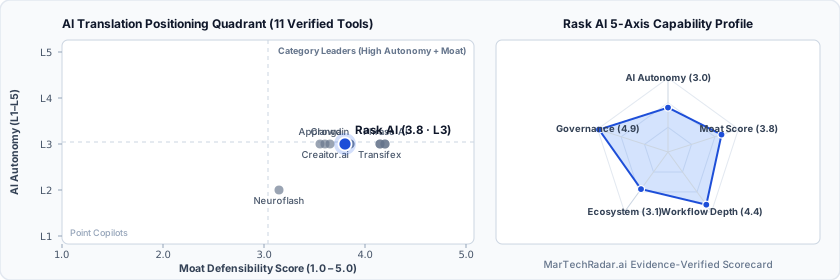
Rask AI is a SaaS Platform tool for AI Translation (Multilingual & Global Localization) in Copy & Content. Pricing: $39/mo · Enterprise plan. Best suited to B2B Marketing & GTM Teams. Editor ratings: AI autonomy L3 (conditional automation); moat score 3.8/5.0 (Proprietary moat). Fact-checked by Jagmeet Sine on Oct 23, 2026.
AI video localization and dubbing platform automating transcription, 135+ language translation, multi-speaker voice cloning, and lip-sync.
Rask AI buyer fit verdict: when to choose vs. when to walk away
Choose Rask AI if (Best Fit)
- Target ICP & Stack Fit: You operate as B2B Marketing & GTM Teams requiring a SaaS Platform deployment for AI Translation.
- L3 Architecture & Defensibility: Rask AI builds a scalable video localization moat through its multi-speaker voice cloning across 32+ languages, automated lip-sync adaptation, 135+ language translation pipeline, and SOC 2 Type II enterprise security.
- Commercial Model Fit: Your procurement budget aligns with $39/mo · Enterprise plan.
Walk away from Rask AI if (Deal-Breakers)
- Walk away if your workflow requires uncapped enterprise volume on the $39/mo · Enterprise plan entry plan without upgrading tiers.
- Walk away if your workflow cannot tolerate lip-sync visual artifacts on occluded faces: Automated Lip-Sync frame synthesis performs best on clear, front-facing speakers and can exhibit visual distortion or fidelity degradation when subjects turn sharply, wear microphones over their mouths, or move rapidly.
- Walk away if minute-based credit burn bottleneck is a deal-breaker for your team: Because voice cloning, translation, and Lip-Sync rendering consume metered monthly video minutes (with extra minutes billed at $3/minute on self-serve tiers), localizing multi-hour webinar archives across dozens of languages creates rapid cost overhead.
Rask AI key facts & scorecard
| Pricing | $39/mo · Enterprise planVendor pricing page |
|---|---|
| Free plan | No / not disclosed |
| Delivery | SaaS Platform |
| Audience | B2B Marketing & GTM Teams |
| AI autonomy level | L3 · Conditional automationEditor-verified |
| Moat tier & score | 3.8 / 5.0 · Proprietary moatEditor-verified |
| Funding | Bootstrapped |
| Founders | Maria Chmir |
| Company size | 11-50 employees |
| Compliance & governance | SOC 2, GDPR |
| Headquarters | Dover, Delaware, United States |
| Founded | 2023 |
| Last verified |
Rask AI pros & cons: strengths vs. operational limitations
Pros: core strengths & capabilities
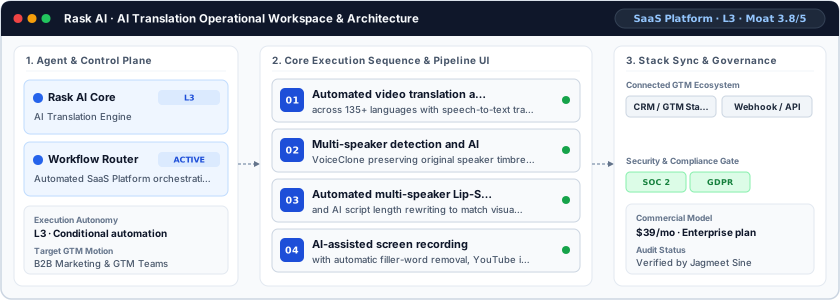
- Automated video translation and dubbing: across 135+ languages with speech-to-text transcription and SRT/VTT subtitle export
- Multi-speaker detection and AI: VoiceClone preserving original speaker timbre and cadence in 32+ languages
- Automated multi-speaker Lip-Sync adaptation: and AI script length rewriting to match visual mouth movements
- AI-assisted screen recording: with automatic filler-word removal, YouTube integration, REST API, and SOC 2 Type II compliance
Cons: operational limitations & risks
- Lip-Sync Visual Artifacts on Occluded Faces: Automated Lip-Sync frame synthesis performs best on clear, front-facing speakers and can exhibit visual distortion or fidelity degradation when subjects turn sharply, wear microphones over their mouths, or move rapidly.
- Minute-Based Credit Burn Bottleneck: Because voice cloning, translation, and Lip-Sync rendering consume metered monthly video minutes (with extra minutes billed at $3/minute on self-serve tiers), localizing multi-hour webinar archives across dozens of languages creates rapid cost overhead.
- Idiomatic & Technical Terminology Review: Highly technical B2B product demos or compliance-sensitive ads still require human linguists to configure custom glossaries and review AI-rewritten scripts before publishing.
Are you a founder, co-founder, or product/growth lead at Rask AI? Verify your official @rask.ai email to publish a factual architectural response or 2026 roadmap update below these limitations.
Rask AI TCO & deal-breaker stress test
Simulate 12-month stepped TCO, hidden cost multipliers, contract lock-in exposure, and stack failure modes using only facts verified by Jagmeet Sine on · Capture SHA f4d19de6.
Rask AI is viable for 5 seats, but requires commercial or technical verification on the flagged items below.
| Plan / Tier | Verified Rate | Scale Fit | Scope & Quota Notes |
|---|---|---|---|
| Entry / Starter | $39/mo | 1–2 seats | Verified $39/mo published rate on vendor pricing schedule. |
| Growth / Professional | $67/mo | 5 seats | Verified $67/mo published rate on vendor pricing schedule. |
| Scale / Advanced | $99/mo | 15 seats | Verified $99/mo published rate on vendor pricing schedule. |
| Enterprise / Custom | Custom quote | 15–50+ seats (Enterprise SLA) | Sales-negotiated annual contract for custom volume, SSO/RBAC governance, and dedicated SLA. |
- Moat Score
- 3.8 / 5.0
- AI Autonomy
- L3
- Free Tier / Trial
- None disclosed
Triggered audit signals & failure modes
- Published Self-Serve Entry FloorVerified Pricing Ledger
Rask AI publishes a transparent entry point ($39/mo · Enterprise plan) for initial validation before committing.
- Usage / Credit Burn VolatilityCommercial Model Audit
Rask AI uses credit or usage-metered billing ($39/mo · Enterprise plan). High-volume automated workflows across 5 seats can trigger mid-cycle overage charges.
- Tier Fit for 5-Seat Scale: Growth / Professional ($67/mo)Verified Tier Schedule
Verified $67/mo published rate on vendor pricing schedule.
- Primary Operational Bottleneck: Minute-Based Credit Burn BottleneckAudit by Jagmeet Sine
Because voice cloning, translation, and Lip-Sync rendering consume metered monthly video minutes (with extra minutes billed at $3/minute on self-serve tiers), localizing multi-hour webinar archives across dozens of languages creates rapid cost overhead.
Hidden TCO Multipliers & Quota Gates
- Annual Billing Headline vs. Monthly Premium: Headline entry rates reflect annual billing commitments; month-to-month flexibility carries a higher effective monthly rate or requires annual prepayment.
- Credit & Usage Burn Multiplier: Automated workflows consume metered credits/usage quotas; multi-step enrichment, voice minutes, or high-frequency agent runs can trigger mid-cycle top-up packs.
- Enterprise Governance & Add-On Gating: Advanced capabilities such as Single Sign-On (SSO), custom role permissions, or specialized analytics modules are gated behind upper tiers or paid add-ons.
When to Walk Away & Negotiation Levers
- Walk away if your workflow requires uncapped enterprise volume on the $39/mo · Enterprise plan entry plan without upgrading tiers.
- Walk away if your workflow cannot tolerate lip-sync visual artifacts on occluded faces: Automated Lip-Sync frame synthesis performs best on clear, front-facing speakers and can exhibit visual distortion or fidelity degradation when subjects turn sharply, wear microphones over their mouths, or move rapidly.
- Walk away if minute-based credit burn bottleneck is a deal-breaker for your team: Because voice cloning, translation, and Lip-Sync rendering consume metered monthly video minutes (with extra minutes billed at $3/minute on self-serve tiers), localizing multi-hour webinar archives across dozens of languages creates rapid cost overhead.
- Validate exact quota thresholds (seats, credits, or API calls) included in Rask AI's $39/mo · Enterprise plan tier before converting from monthly to annual billing.
- Require a sandbox proof-of-concept testing lip-sync visual artifacts on occluded faces against your live CRM/data schema before annual sign-off.
Ask a custom procurement or TCO stress-test question about Rask AI
Lower 5-seat floor (~$42/mo vs. $67 / mo)
Fits within $800/mo budget (From $69/mo)
Rask AI key entities, modules & ecosystem stack
Rask AI moat & subtrack positioning
Rask AI builds a scalable video localization moat through its multi-speaker voice cloning across 32+ languages, automated lip-sync adaptation, 135+ language translation pipeline, and SOC 2 Type II enterprise security.
Editorial review
Fact-checked by Jagmeet Sine (Senior MarTech Infrastructure & Agentic Workflow Architect) on .
Background
Founded in 2023 by Maria Chmir and headquartered in Dover, Delaware, United States, Rask AI (rask.ai) is an AI-powered video localization, dubbing, and voice cloning platform built for global marketing teams, EdTech providers, media creators, and corporate training departments. Operating with a team of 11-50 employees, the company enables organizations to adapt video campaigns, product walkthroughs, webinars, and social shorts into more than 135 languages without booking external recording studios or human voice actors. Rather than managing fragmented workflows across transcription contractors, subtitle translators, and audio editors, marketing teams use Rask AI to centralize multilingual video production in a browser-based studio and developer API.
How Rask AI works
Rask AI operates at Level 3 autonomy by chaining automated speech recognition (ASR), neural machine translation, generative voice cloning, and visual lip-sync synthesis into a unified pipeline. When a user uploads a video or connects a YouTube source, Rask AI diarizes individual speakers, transcribes spoken dialogue, and translates the script into 135+ target languages while using AI script rewriting to match target syllable counts to the original video timing. Its VoiceClone engine synthesizes localized speech that preserves each speaker's vocal identity across 32+ languages, while multi-speaker Lip-Sync technology modifies facial mouth movements in the video frames to align with the dubbed audio track. The platform also includes AI screen recording with automated filler-word removal, custom translation dictionaries, SRT subtitle exports, and REST API endpoints governed by SOC 2 Type II and GDPR compliance.
Limitations
Operational limitations and technical trade-offs include:
- Lip-Sync Visual Artifacts on Occluded Faces: Automated Lip-Sync frame synthesis performs best on clear, front-facing speakers and can exhibit visual distortion or fidelity degradation when subjects turn sharply, wear microphones over their mouths, or move rapidly.
- Minute-Based Credit Burn Bottleneck: Because voice cloning, translation, and Lip-Sync rendering consume metered monthly video minutes (with extra minutes billed at $3/minute on self-serve tiers), localizing multi-hour webinar archives across dozens of languages creates rapid cost overhead.
- Idiomatic & Technical Terminology Review: Highly technical B2B product demos or compliance-sensitive ads still require human linguists to configure custom glossaries and review AI-rewritten scripts before publishing.
Rask AI pricing
Rask AI operates on a minute-metered SaaS subscription model with monthly and annual billing tiers (offering up to 35% savings on annual plans) plus a free trial ($0 entry test). On annual billing, the Creator plan starts at $39/month (or $67/month billed monthly, with promotional tiers at $28/month) and includes 25 minutes per month of dubbing, VoiceClone, and AI editing. The Creator Pro plan costs $99/month billed annually ($139–$167/month on flexible tiers, scaling to $249–$329/month for higher minute bundles) and adds multi-speaker Lip-Sync, SRT uploads, and translation dictionary controls. The Business plan is priced at $389/month billed annually ($799–$989/month for expanded team minute allocations) for 5 seats and 250 monthly minutes, while custom Enterprise contracts add API access, SSO/SAML, custom voices, and dedicated SLA support.
How Rask AI compares
Within the Multilingual & Global Localization category, Rask AI competes against AI video dubbing and voice localization platforms such as ElevenLabs, CAMB.AI, HeyGen, and Papercup. Versus audio-first speech synthesis platforms like ElevenLabs or live broadcast dubbing engines like CAMB.AI, Rask AI differentiates itself as an all-in-one visual localization studio that combines 135+ language dubbing with automated multi-speaker Lip-Sync adaptation, AI screen recording, and subtitle synchronization for marketing and educational video teams.
Frequently asked questions about Rask AI
How much does Rask AI cost and what pricing tiers are available?
Published pricing summary for Rask AI: $39/mo · Enterprise plan. A permanent free plan is not disclosed for Rask AI. Verified tier schedule: Entry / Starter ($39/mo for 1–2 seats); Growth / Professional ($67/mo for 5 seats); Scale / Advanced ($99/mo for 15 seats); Enterprise / Custom (Custom quote for 15–50+ seats (Enterprise SLA)). Rask AI operates on a minute-metered SaaS subscription model with monthly and annual billing tiers (offering up to 35% savings on annual plans) plus a free trial ($0 entry test).
How does Rask AI work and how autonomous is its AI architecture?
AI video localization and dubbing platform automating transcription, 135+ language translation, multi-speaker voice cloning, and lip-sync. Within AI Translation (Multilingual & Global Localization), MarTechRadar rates its execution architecture at L3 · Conditional automation with a verified Moat Score of 3.8 / 5.0 (Proprietary moat). Rask AI builds a scalable video localization moat through its multi-speaker voice cloning across 32+ languages, automated lip-sync adaptation, 135+ language translation pipeline, and SOC 2 Type II enterprise security. Corporate profile: Founded by Maria Chmir, operating at 11-50 employees scale.
What are the main limitations of Rask AI and when should buyers walk away?
Based on our editorial technical audit, key operational considerations and boundaries for Rask AI include: (1) Lip-Sync Visual Artifacts on Occluded Faces: Automated Lip-Sync frame synthesis performs best on clear, front-facing speakers and can exhibit visual distortion or fidelity degradation when subjects turn sharply, wear microphones over their mouths, or move rapidly. (2) Minute-Based Credit Burn Bottleneck: Because voice cloning, translation, and Lip-Sync rendering consume metered monthly video minutes (with extra minutes billed at $3/minute on self-serve tiers), localizing multi-hour webinar archives across dozens of languages creates rapid cost overhead. (3) Idiomatic & Technical Terminology Review: Highly technical B2B product demos or compliance-sensitive ads still require human linguists to configure custom glossaries and review AI-rewritten scripts before publishing. Primary procurement walk-away rule: Walk away if your workflow requires uncapped enterprise volume on the $39/mo · Enterprise plan entry plan without upgrading tiers.
What integrations, compliance certifications, and contract terms apply to Rask AI?
Documented security and governance attestations include SOC 2, GDPR. Key TCO multiplier to watch: Annual Billing Headline vs. Monthly Premium (Headline entry rates reflect annual billing commitments; month-to-month flexibility carries a higher effective monthly rate or requires annual prepayment.) Before signing a contract, procurement teams should validate exact quota thresholds (seats, credits, or API calls) included in Rask AI's $39/mo · Enterprise plan tier before converting from monthly to annual billing.
What are the best Rask AI alternatives and head-to-head competitors in 2026?
Top fact-checked alternatives to Rask AI in AI Translation (Multilingual & Global Localization) include CAMB.AI (Free plan · $0/mo), Bureau Works ($980/mo · Enterprise plan), Creaitor.ai (From $69/mo), Applanga (From $500/yr). Within the Multilingual & Global Localization category, Rask AI competes against AI video dubbing and voice localization platforms such as ElevenLabs, CAMB.AI, HeyGen, and Papercup.
Verified sources & evidence trail
- Official product domain: https://rask.ai
- Commercial pricing verification: https://www.rask.ai/pricing
- Verified corporate entity profiles (
sameAs): LinkedIn Company Profile · Crunchbase Entity Record - Editorial audit sign-off: Fact-checked by Jagmeet Sine on under the MarTechRadar Evidence-Ledger Protocol.