Tenjin Review (2026): Marketing Attribution Pricing, Pros & Cons
Bottom line
Tenjin is a Web SaaS tool for Marketing Attribution (Multi-Touch Attribution & eCommerce Dashboards) in Analytics & Attribution. Pricing: Custom / enterprise pricing. Best suited to DTC / eCommerce. Editor ratings: AI autonomy L2 (workflow copilot); moat score 3.6/5.0 (Proprietary moat). Fact-checked by MarTechRadar Research Desk on Oct 15, 2026.
Mobile measurement partner and growth data pipeline unifying app attribution, ad network aggregation, and direct SQL access for performance marketing teams.
Is Tenjin worth it in 2026? Buyer fit & when to walk away
Choose Tenjin if (Best Fit)
- Target ICP & Stack Fit: You operate as DTC / eCommerce requiring a Web SaaS deployment for Marketing Attribution, with verified ecosystem connectivity for Slack, Snowflake.
- L2 Architecture & Defensibility: Consolidated direct data warehouse access via managed schemas, combined with native SKAdNetwork modeling and automated ad spend ETL pipes across fragmented mobile ad networks.
- Commercial Model Fit: Your procurement budget aligns with Custom / enterprise pricing.
Walk away from Tenjin if (Deal-Breakers)
- Walk away if you need published self-serve pricing: Tenjin is sold by custom quote.
- Walk away if your workflow cannot tolerate skadnetwork schema rigidity: Navigating Apple SKAdNetwork timer mechanics and tiered privacy thresholds requires continuous manual tuning of conversion value schemas to avoid aggregate data loss.
- Walk away if ad spend API latency is a deal-breaker for your team: Upstream ad partner reporting APIs introduce synchronization lags, requiring historical backfills that complicate intraday return-on-ad-spend (ROAS) evaluations.
Tenjin pricing, free plan & scorecard at a glance
| Pricing | Custom / enterprise pricing |
|---|---|
| Free plan | No / not disclosed |
| Delivery | Web SaaS |
| Audience | DTC / eCommerce |
| AI autonomy level | L2 · Workflow copilotEditor-verified |
| Moat tier & score | 3.6 / 5.0 · Proprietary moatEditor-verified |
| Funding | Series A |
| Company size | 11-50 employees |
| Ecosystem integrations | Slack, Snowflake |
| Compliance & governance | SOC 2, GDPR, ISO 27001 |
| Governance & docs | API & Docs ↗ · Terms ↗ · Privacy ↗ |
| Headquarters | United States |
| Last verified | Oct 15, 2026 |
Tenjin pros & cons: strengths vs. operational limitations
Pros: core strengths & capabilities
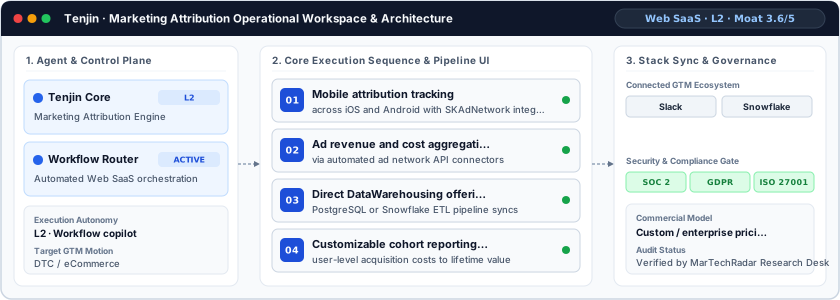
- Mobile attribution tracking: across iOS and Android with SKAdNetwork integration
- Ad revenue and cost aggregation: via automated ad network API connectors
- Direct DataWarehousing offering automated: PostgreSQL or Snowflake ETL pipeline syncs
- Customizable cohort reporting linking: user-level acquisition costs to lifetime value
Cons: operational limitations & risks
- SKAdNetwork Schema Rigidity: Navigating Apple SKAdNetwork timer mechanics and tiered privacy thresholds requires continuous manual tuning of conversion value schemas to avoid aggregate data loss.
- Ad Spend API Latency: Upstream ad partner reporting APIs introduce synchronization lags, requiring historical backfills that complicate intraday return-on-ad-spend (ROAS) evaluations.
- Data Warehouse Maintenance Overhead: Direct SQL access demands dedicated internal analytics resources to write, maintain, and optimize querying schemas as network reporting specifications evolve.
Tenjin TCO & deal-breaker stress test
Simulate 12-month stepped TCO, hidden cost multipliers, contract lock-in exposure, and stack failure modes using only facts verified by MarTechRadar Research Desk on 2026-10-15 · Capture SHA 819a41c7.
Tenjin triggers high-severity friction under your 5-seat / $800/mo constraints. Benchmark the verified subtrack alternatives below before committing.
- Moat Score
- 3.6 / 5.0
- AI Autonomy
- L2
- Free Tier / Trial
- None disclosed
Triggered audit signals & failure modes
- Opaque Enterprise Quoting vs. SMB/Mid-Market BudgetVerified Pricing Ledger
Tenjin does not disclose a public self-serve floor (Custom / enterprise pricing). Buyers with a $800/mo cap face high sales-qualification friction.
- Sales-Gated Contract TermsFact-checked by MarTechRadar Research Desk
Commercial pricing is available on request through tailored enterprise sales quotes based on organizational scale and seats.
- Primary Operational Bottleneck: SKAdNetwork Schema RigidityAudit by MarTechRadar Research Desk
Navigating Apple SKAdNetwork timer mechanics and tiered privacy thresholds requires continuous manual tuning of conversion value schemas to avoid aggregate data loss.
Test a custom Tenjin budget or stack constraint
Offers a free tier (Free plan · $2,500 · Enterprise plan) · Transparent self-serve entry without mandatory annual lock-in
Offers a free tier (Custom / enterprise pricing) · Transparent self-serve entry without mandatory annual lock-in
Tenjin integrations, API, security & compliance stack
Tenjin AI moat & Marketing Attribution positioning
Consolidated direct data warehouse access via managed schemas, combined with native SKAdNetwork modeling and automated ad spend ETL pipes across fragmented mobile ad networks.
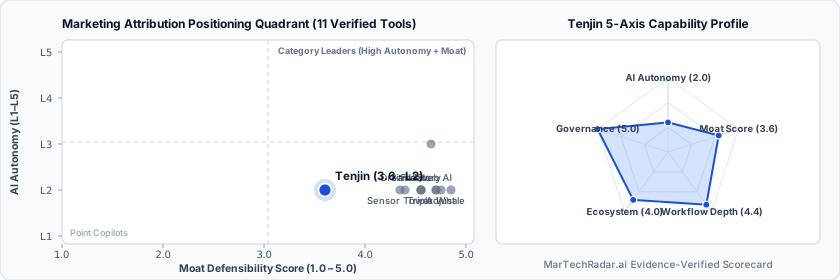
Tenjin in-depth review, pricing & architecture analysis
Editor sign-off: Oct 15, 2026. How profiles are made.
What is Tenjin? Overview & background
Architected around automated extract-transform-load (ETL) data flows rather than rigid proprietary dashboards, United States-based Tenjin targets mobile performance marketing teams and technical growth leads. Sitting within modern attribution and commerce reporting infrastructure, the platform structures fractured user acquisition telemetry into normalized datasets. Its framework shifts data ownership back to developers and analytics teams by pairing attribution tracking with programmatic warehouse synchronization.
How Tenjin works: architecture & workflow
The platform functions by pairing native software development kits (SDKs) on mobile clients with server-to-server ad network API connectors. As install events, in-app purchases, and ad impressions fire, the ingestion pipeline unifies cost and impression metrics with deterministic device identifiers and SKAdNetwork conversion signals. Rather than gating aggregated metrics behind black-box views, the system normalizes ad spend across ad networks and streams structured cohort tables directly into client-owned relational data warehouses using programmatic replication jobs, alongside native workflow integrations for Slack under verified SOC 2, GDPR, and ISO 27001 governance controls.
Tenjin limitations, drawbacks & risks
Operational considerations and platform boundaries include:
- SKAdNetwork Schema Rigidity: Navigating Apple SKAdNetwork timer mechanics and tiered privacy thresholds requires continuous manual tuning of conversion value schemas to avoid aggregate data loss.
- Ad Spend API Latency: Upstream ad partner reporting APIs introduce synchronization lags, requiring historical backfills that complicate intraday return-on-ad-spend (ROAS) evaluations.
- Data Warehouse Maintenance Overhead: Direct SQL access demands dedicated internal analytics resources to write, maintain, and optimize querying schemas as network reporting specifications evolve.
Tenjin pricing, plans & cost breakdown
Commercial pricing is available on request through tailored enterprise sales quotes based on organizational scale and seats. Contracts typically adjust based on tracked monthly active users, total ad spend aggregated, and data warehouse synchronization infrastructure requirements, with custom enterprise packages configured directly by sales representatives.
| Plan / Tier | Verified Price & Billing | Target Seat / Scale Fit | Included Scope & Contract Terms |
|---|---|---|---|
| Enterprise / Custom | Custom quote | Unlimited seats | Custom-quoted plan; terms come from the vendor's sales team. |
| Contract Watchout: Annual Billing Headline vs. Monthly Premium | The vendor pricing page advertises an annual-billing discount (save $400/year); month-to-month billing carries a higher effective monthly rate. | ||
How Tenjin compares vs. competitors & alternatives
While competitors like Adjust and AppsFlyer deliver packaged enterprise reporting suites focused on out-of-the-box attribution dashboards, Tenjin differentiates through unbundled direct SQL access and leaner engineering footprints within the Marketing Attribution segment. In contrast to marketing aggregation tools like Adverity, it serves as an accredited mobile measurement partner with native SDK instrumentation. Tenjin best fits mid-market app publishers and engineering-led growth organizations that prioritize direct database ownership over pre-packaged dashboard visualizations.
Frequently asked questions about Tenjin
Does Tenjin publish pricing or require an enterprise quote?
Tenjin pricing: Custom / enterprise pricing. No free plan is publicly disclosed. Commercial pricing is available on request through tailored enterprise sales quotes based on organizational scale and seats.
What are the top Tenjin alternatives in Marketing Attribution?
Verified Marketing Attribution alternatives include Kochava (Custom / enterprise pricing), RevenueCat (Free plan · $2,500 · Enterprise plan), Qonversion (Free plan · $7,000 · Enterprise plan), Adapty (Custom / enterprise pricing). While competitors like Adjust and AppsFlyer deliver packaged enterprise reporting suites focused on out-of-the-box attribution dashboards, Tenjin differentiates through unbundled direct SQL access and leaner engineering footprints within the Marketing Attribution segment.
What are the main limitations and trade-offs of Tenjin?
Operational considerations and platform boundaries include: SKAdNetwork Schema Rigidity: Navigating Apple SKAdNetwork timer mechanics and tiered privacy thresholds requires continuous manual tuning of conversion value schemas to avoid aggregate data loss. Walk away if you need published self-serve pricing: Tenjin is sold by custom quote.
Verified sources & evidence trail
- Official product domain: https://tenjin.com
- Commercial pricing verification: Verified against official vendor pricing policy (Custom / enterprise pricing)
- Verified corporate entity profiles (
sameAs): LinkedIn Company Profile · Crunchbase Entity Record - First-party governance & documentation links: API & Docs · Terms · Privacy
- Editor sign-off: Oct 15, 2026 (how profiles are made).
