Swordfish AI Review (2026): AI Calling Pricing, Pros & Cons
Bottom line
Swordfish AI is a Web SaaS tool for AI Calling (Conversational Voice Calling Agents) in AI SDR & Outbound. Pricing: Custom / enterprise pricing. Best suited to B2B SaaS, DTC / eCommerce and Enterprise Brands. Editor ratings: AI autonomy L3 (conditional automation); moat score 2.5/5.0 (Workflow-embedded). Fact-checked by MarTechRadar Research Desk on Oct 16, 2026.
Autonomous conversational calling and contact verification platform orchestrating outbound agent workflows for enterprise sales development pipelines.
Is Swordfish AI worth it in 2026? Buyer fit & when to walk away
Choose Swordfish AI if (Best Fit)
- Target ICP & Stack Fit: You operate as B2B SaaS, DTC / eCommerce and Enterprise Brands requiring a Web SaaS deployment for AI Calling, with verified ecosystem connectivity for Outreach.
- L3 Architecture & Defensibility: Deep identity resolution mechanisms combined with proprietary contact verification networks and telephony orchestration workflows.
- Commercial Model Fit: Your procurement budget aligns with Custom / enterprise pricing.
Walk away from Swordfish AI if (Deal-Breakers)
- Walk away if you need published self-serve pricing: Swordfish AI is sold by custom quote.
- Walk away if your workflow cannot tolerate carrier filtering overhead: High-volume automated outbound dialing runs the continuous risk of carrier-level spam tagging, necessitating intensive phone reputation management and frequent caller ID rotation.
- Walk away if telephony latency jitter is a deal-breaker for your team: Voice parsing across conversational transitions can experience round-trip audio latency spikes over public WebRTC connections, interrupting dialog cadence during live interactions.
Swordfish AI pricing, free plan & scorecard at a glance
| Pricing | Custom / enterprise pricing |
|---|---|
| Free plan | No / not disclosed |
| Delivery | Web SaaS |
| Audience | B2B SaaS, DTC / eCommerce, Enterprise Brands |
| AI autonomy level | L3 · Conditional automationEditor-verified |
| Moat tier & score | 2.5 / 5.0 · Workflow-embeddedEditor-verified |
| Funding | Bootstrapped |
| Founders | Ben Argeband |
| Company size | 11-50 employees |
| Ecosystem integrations | Outreach |
| Headquarters | New York, United States |
| Founded | 2019 |
| Last verified | Oct 16, 2026 |
Swordfish AI pros & cons: strengths vs. operational limitations
Pros: core strengths & capabilities
- Autonomous conversational telephony pipeline: for sales outreach orchestration
- Real-time waterfall phone and identity data verification engine
- Direct bi-directional synchronization: with enterprise CRM ecosystems
- Automated qualification scheduling and intent detection framework
Cons: operational limitations & risks
- Carrier Filtering Overhead: High-volume automated outbound dialing runs the continuous risk of carrier-level spam tagging, necessitating intensive phone reputation management and frequent caller ID rotation.
- Telephony Latency Jitter: Voice parsing across conversational transitions can experience round-trip audio latency spikes over public WebRTC connections, interrupting dialog cadence during live interactions.
- Waterfall Enrichment Latency: Real-time identity verification workflows introduce API wait times when cycling through external data providers, causing queuing bottlenecks during large batch runs.
Swordfish AI TCO & deal-breaker stress test
Simulate 12-month stepped TCO, hidden cost multipliers, contract lock-in exposure, and stack failure modes using only facts verified by MarTechRadar Research Desk on 2026-10-16.
Swordfish AI triggers high-severity friction under your 5-seat / $800/mo constraints. Benchmark the verified subtrack alternatives below before committing.
- Moat Score
- 2.5 / 5.0
- AI Autonomy
- L3
- Free Tier / Trial
- None disclosed
Triggered audit signals & failure modes
- Opaque Enterprise Quoting vs. SMB/Mid-Market BudgetVerified Pricing Ledger
Swordfish AI does not disclose a public self-serve floor (Custom / enterprise pricing). Buyers with a $800/mo cap face high sales-qualification friction.
- Sales-Gated Contract TermsFact-checked by MarTechRadar Research Desk
Pricing is available on request through tailored enterprise sales quotes, with custom enterprise tiers structured around organizational scale, user seats, and workflow volume.
- Primary Operational Bottleneck: Carrier Filtering OverheadAudit by MarTechRadar Research Desk
High-volume automated outbound dialing runs the continuous risk of carrier-level spam tagging, necessitating intensive phone reputation management and frequent caller ID rotation.
Test a custom Swordfish AI budget or stack constraint
Lower 5-seat floor (~$299/mo vs. Custom Quote) · Transparent self-serve entry without mandatory annual lock-in
Lower 5-seat floor (~$75/mo vs. Custom Quote) · Transparent self-serve entry without mandatory annual lock-in
Swordfish AI integrations, API, security & compliance stack
Swordfish AI AI moat & AI Calling positioning
Deep identity resolution mechanisms combined with proprietary contact verification networks and telephony orchestration workflows.
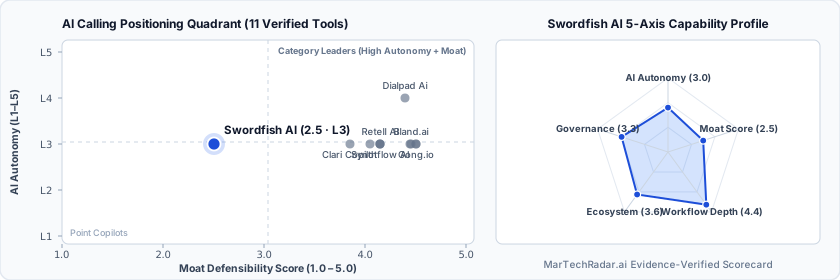
Swordfish AI in-depth review, pricing & architecture analysis
Editor sign-off: Oct 16, 2026. How profiles are made.
What is Swordfish AI? Overview & background
Within modern revenue operations, conversational automation relies on combining verified identity intelligence with low-latency communication networks. Established in 2019 and headquartered in New York, United States, Swordfish AI engineers outbound dialing and identity verification infrastructure designed for enterprise sales development teams and revenue operations directors. The platform focuses on resolving target profile data and orchestrating automated outbound calling workflows across mid-market and enterprise customer acquisition stacks.
How Swordfish AI works: architecture & workflow
Swordfish AI functions via an event-driven execution framework that coordinates data enrichment pipelines with telephony transport interfaces. Incoming CRM accounts or prospect lists trigger an asynchronous verification routine, executing multi-source waterfall queries across telecom data feeds to confirm phone carrier and connectivity statuses. Once verified, the platform dispatches outbound voice tasks through programmatic SIP endpoints, using automated speech parsing and natural language intent classification to steer dialog trees and log structured call outcomes directly back to systems of record.
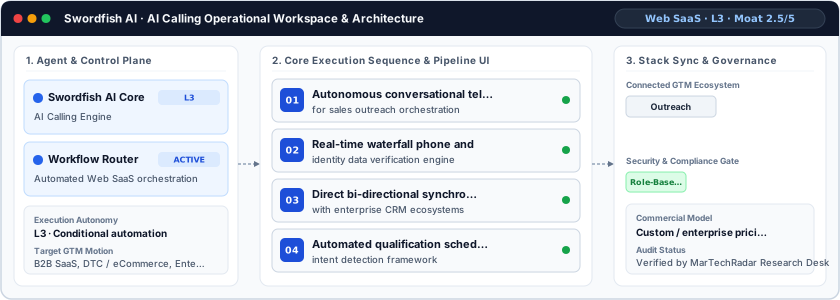
Swordfish AI limitations, drawbacks & risks
Operational considerations and platform boundaries include:
- Carrier Filtering Overhead: High-volume automated outbound dialing runs the continuous risk of carrier-level spam tagging, necessitating intensive phone reputation management and frequent caller ID rotation.
- Telephony Latency Jitter: Voice parsing across conversational transitions can experience round-trip audio latency spikes over public WebRTC connections, interrupting dialog cadence during live interactions.
- Waterfall Enrichment Latency: Real-time identity verification workflows introduce API wait times when cycling through external data providers, causing queuing bottlenecks during large batch runs.
Swordfish AI pricing, plans & cost breakdown
Pricing is available on request through tailored enterprise sales quotes, with custom enterprise tiers structured around organizational scale, user seats, and workflow volume.
| Plan / Tier | Verified Price & Billing | Included Scope & Contract Terms |
|---|---|---|
| Enterprise / Custom | Custom quote | Custom-quoted plan; terms come from the vendor's sales team. |
How Swordfish AI compares vs. competitors & alternatives
Compared to infrastructure-level conversational voice engines like Bland.ai, Swordfish AI places heavier architectural emphasis on integrated contact verification prior to dial execution. While Dialpad Ai focuses on human agent assistance and Consio concentrates on lightweight calling scripts, Swordfish AI targets full-lifecycle prospect qualification. It remains best suited for revenue teams requiring native data enrichment paired with programmatic outbound calling automation.
Frequently asked questions about Swordfish AI
Does Swordfish AI publish pricing or require an enterprise quote?
Swordfish AI pricing: Custom / enterprise pricing. No free plan is publicly disclosed. Pricing is available on request through tailored enterprise sales quotes, with custom enterprise tiers structured around organizational scale, user seats, and workflow volume.
What are the top Swordfish AI alternatives in AI Calling?
Verified AI Calling alternatives include Kaspr (Custom / enterprise pricing), Freya (Custom / enterprise pricing), ContactOut (Custom / enterprise pricing), Prospeo (Custom / enterprise pricing). Compared to infrastructure-level conversational voice engines like Bland.ai, Swordfish AI places heavier architectural emphasis on integrated contact verification prior to dial execution.
What are the main limitations and trade-offs of Swordfish AI?
Operational considerations and platform boundaries include: Carrier Filtering Overhead: High-volume automated outbound dialing runs the continuous risk of carrier-level spam tagging, necessitating intensive phone reputation management and frequent caller ID rotation. Walk away if you need published self-serve pricing: Swordfish AI is sold by custom quote.
Verified sources & evidence trail
- Official product domain: https://swordfish.ai
- Commercial pricing verification: Verified against official vendor pricing policy (Custom / enterprise pricing)
- Verified corporate entity profiles (
sameAs): LinkedIn Company Profile · Crunchbase Entity Record - Editor sign-off: Oct 16, 2026 (how profiles are made).
