LUMOS Review (2026): AI Programmatic Advertising Pricing, Pros & Cons
Bottom line
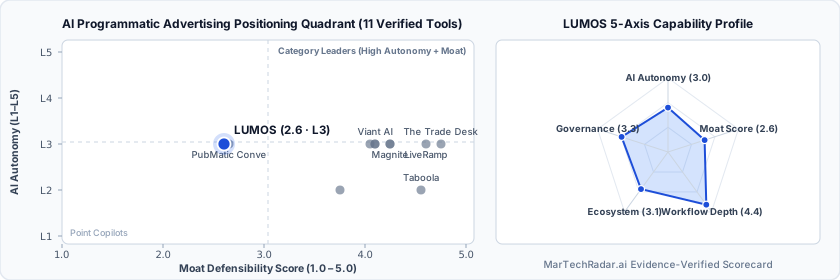
LUMOS is a Cloud SaaS Platform tool for AI Programmatic Advertising (Programmatic DSP/SSP & Contextual AdTech) in AdTech & Paid Media. Pricing: Custom / enterprise pricing. Best suited to B2B Marketing and Growth & Revenue Teams. Editor ratings: AI autonomy L3 (conditional automation); moat score 2.6/5.0 (Workflow-embedded). Fact-checked by MarTechRadar Research Desk on Oct 26, 2026.
Omnichannel audience intelligence, programmatic DOOH planning, and AI-driven campaign measurement and retargeting platform for brands and agencies.
Is LUMOS worth it in 2026? Buyer fit & when to walk away
Choose LUMOS if (Best Fit)
- Target ICP & Stack Fit: You operate as B2B Marketing and Growth & Revenue Teams requiring a Cloud SaaS Platform deployment for AI Programmatic Advertising.
- L3 Architecture & Defensibility: LUMOS builds a differentiated programmatic AdTech moat by uniting real-world physical location intelligence, Digital Out-of-Home (DOOH) inventory planning, cross-screen mobile retargeting, and Seed funding led by Claremont Capital.
- Commercial Model Fit: Your procurement budget aligns with Custom / enterprise pricing.
Walk away from LUMOS if (Deal-Breakers)
- Walk away if you require transparent self-serve monthly billing or your budget ceiling is under $1,000/mo (LUMOS requires sales-gated custom quoting).
- Walk away if your workflow cannot tolerate primary operational trade-off: In practical enterprise deployments, the primary trade-off is that geospatial audience modeling and cross-device offline-to-online retargeting depend on regional location-signal density and local privacy regulations, which can vary across international markets.
- Walk away if functional scope boundary is a deal-breaker for your team: LUMOS is not built for B2B cold email outbound sequencing, generative text blog writing, or inbound customer support ticket automation.
LUMOS pricing, free plan & scorecard at a glance
| Pricing | Custom / enterprise pricing |
|---|---|
| Free plan | No / not disclosed |
| Delivery | Cloud SaaS Platform |
| Audience | B2B Marketing, Growth & Revenue Teams |
| AI autonomy level | L3 · Conditional automationEditor-verified |
| Moat tier & score | 2.6 / 5.0 · Workflow-embeddedEditor-verified |
| Funding | Seed |
| Total funding | SeedBacked by Claremont Capital, Barry Winata, Hugo de Jong, Abraham Robertson, Curt Shi |
| Founders | Eric Fan |
| Company size | 11-50 employees |
| Headquarters | Sydney, New South Wales, Australia |
| Founded | 2020 |
| Last verified | Oct 26, 2026 |
LUMOS pros & cons: strengths vs. operational limitations
Pros: core strengths & capabilities
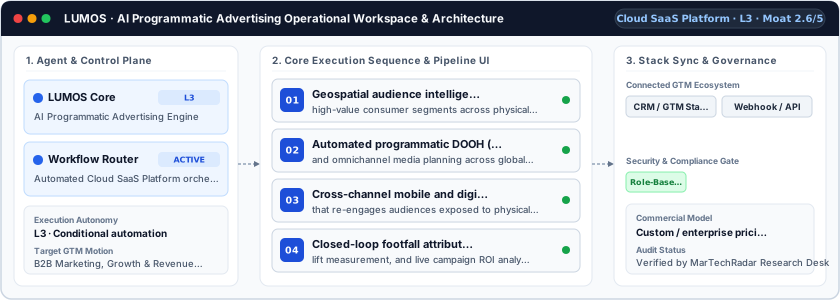
- Geospatial audience intelligence mapping: high-value consumer segments across physical locations and out-of-home environments
- Automated programmatic DOOH (pDOOH): and omnichannel media planning across global digital billboard and screen networks
- Cross-channel mobile and digital retargeting: that re-engages audiences exposed to physical out-of-home campaigns
- Closed-loop footfall attribution, brand: lift measurement, and live campaign ROI analytics for agencies and brand advertisers
Cons: operational limitations & risks
- Primary Operational Trade-Off: In practical enterprise deployments, the primary trade-off is that geospatial audience modeling and cross-device offline-to-online retargeting depend on regional location-signal density and local privacy regulations, which can vary across international markets.
- Functional Scope Boundary: LUMOS is not built for B2B cold email outbound sequencing, generative text blog writing, or inbound customer support ticket automation.
- Deployment & Governance Considerations: Additionally, because pricing is customized around media activation volume and enterprise platform access ("Book a Demo"), smaller advertisers without dedicated programmatic or out-of-home media budgets may find the platform over-engineered for simple social boosts.
LUMOS TCO & deal-breaker stress test
Simulate 12-month stepped TCO, hidden cost multipliers, contract lock-in exposure, and stack failure modes using only facts verified by MarTechRadar Research Desk on 2026-10-26.
LUMOS triggers high-severity friction under your 5-seat / $800/mo constraints. Benchmark the verified subtrack alternatives below before committing.
- Moat Score
- 2.6 / 5.0
- AI Autonomy
- L3
- Free Tier / Trial
- None disclosed
Triggered audit signals & failure modes
- Opaque Enterprise Quoting vs. SMB/Mid-Market BudgetVerified Pricing Ledger
LUMOS does not disclose a public self-serve floor (Custom / enterprise pricing). Buyers with a $800/mo cap face high sales-qualification friction.
- Sales-Gated Contract TermsFact-checked by MarTechRadar Research Desk
Pricing available on request.
- Primary Operational Bottleneck: Primary Operational Trade-OffAudit by MarTechRadar Research Desk
In practical enterprise deployments, the primary trade-off is that geospatial audience modeling and cross-device offline-to-online retargeting depend on regional location-signal density and local privacy regulations, which can vary across international markets.
Test a custom LUMOS budget or stack constraint
Verified AI Programmatic Advertising peer (Custom / enterprise pricing · Moat 4.8/5.0)
Verified AI Programmatic Advertising peer (Custom / enterprise pricing · Moat 4.2/5.0)
LUMOS AI moat & AI Programmatic Advertising positioning
LUMOS builds a differentiated programmatic AdTech moat by uniting real-world physical location intelligence, Digital Out-of-Home (DOOH) inventory planning, cross-screen mobile retargeting, and Seed funding led by Claremont Capital.
LUMOS in-depth review, pricing & architecture analysis
Audited by MarTechRadar Research Desk (Evidence-Ledger Verified) on Oct 26, 2026.
What is LUMOS? Overview & background
LUMOS (operating at spotlumos.com) is an omnichannel audience intelligence, programmatic Digital Out-of-Home (pDOOH) planning, and campaign attribution platform built for media agencies, brand advertisers, and performance growth marketers. Founded in 2020 by Eric Fan and headquartered in Sydney, New South Wales, Australia, the company operates with 11 to 50 employees and has raised Seed funding backed by Claremont Capital, Barry Winata, Hugo de Jong, Abraham Robertson, and Curt Shi. By bridging physical-world location intelligence with programmatic screen buying and digital retargeting, LUMOS enables marketers to plan, activate, and measure offline-to-online media campaigns in a single self-serve workspace, capturing demand around programmatic dooh audience intelligence, spotlumos pricing, and omnichannel ad attribution tools.
How LUMOS works: architecture & workflow
At the technical core of LUMOS is a geospatial data fusion and programmatic DSP/SSP integration architecture. The platform ingests privacy-compliant mobility signals, demographic datasets, and point-of-interest (POI) visitation patterns to identify where target buyer personas congregate in the physical world. Media planners use LUMOS's interactive planning engine to score and select optimal Out-of-Home (OOH) and pDOOH screens by audience affinity index and hourly impression density. Once a campaign is live, LUMOS captures anonymized device exposure windows around active screens to trigger synchronized mobile, social, and display retargeting sequences, closing the loop with verifiable footfall uplift and online conversion attribution.
LUMOS limitations, drawbacks & risks
Operational considerations and platform boundaries include:
- Primary Operational Trade-Off: In practical enterprise deployments, the primary trade-off is that geospatial audience modeling and cross-device offline-to-online retargeting depend on regional location-signal density and local privacy regulations, which can vary across international markets.
- Functional Scope Boundary: LUMOS is not built for B2B cold email outbound sequencing, generative text blog writing, or inbound customer support ticket automation.
- Deployment & Governance Considerations: Additionally, because pricing is customized around media activation volume and enterprise platform access ("Book a Demo"), smaller advertisers without dedicated programmatic or out-of-home media budgets may find the platform over-engineered for simple social boosts.
LUMOS pricing, plans & cost breakdown
Pricing available on request. On its official website (spotlumos.com), LUMOS provides custom onboarding and commercial quotes via its "Book a Demo" workflow, structuring fees around platform intelligence seats, programmatic media activation volume, and attribution reporting requirements.
| Plan / Tier | Verified Price & Billing | Target Seat / Scale Fit | Included Scope & Contract Terms |
|---|---|---|---|
| Enterprise / Custom | Custom quote | 15–50+ seats (Enterprise SLA) | Sales-negotiated annual contract for custom volume, SSO/RBAC governance, and dedicated SLA. |
| Contract Watchout: Primary Operational Trade-Off | In practical enterprise deployments, the primary trade-off is that geospatial audience modeling and cross-device offline-to-online retargeting depend on regional location-signal density and local privacy regulations, which can vary across international markets. | ||
How LUMOS compares vs. competitors & alternatives
In the programmatic AdTech, omnichannel DSP, and audience intelligence market, LUMOS competes with StackAdapt, The Trade Desk Kokai, and Viant AI within the Programmatic DSP/SSP & Contextual AdTech segment. Compared to digital-only DSPs that lack physical-world movement intelligence or legacy OOH buying agencies that rely on static spreadsheets without digital retargeting or footfall attribution, LUMOS differentiates itself by unifying geospatial audience planning, pDOOH activation, and cross-screen retargeting. Media agencies and multi-region consumer brands should evaluate LUMOS to turn out-of-home advertising into a measurable performance channel.
Frequently asked questions about LUMOS
Does LUMOS publish pricing or require an enterprise quote?
LUMOS pricing: Custom / enterprise pricing. No free plan is publicly disclosed. Pricing available on request.
What are the top LUMOS alternatives in AI Programmatic Advertising?
Verified AI Programmatic Advertising alternatives include The Trade Desk Kokai (Custom / enterprise pricing), StackAdapt (Pricing not disclosed), TripleLift (Custom / enterprise pricing), Sharethrough (Custom / enterprise pricing). In the programmatic AdTech, omnichannel DSP, and audience intelligence market, LUMOS competes with StackAdapt, The Trade Desk Kokai, and Viant AI within the Programmatic DSP/SSP & Contextual AdTech segment.
Verified sources & evidence trail
- Official product domain: https://spotlumos.com
- Commercial pricing verification: Verified against official vendor pricing policy (Custom / enterprise pricing)
- Verified corporate entity profiles (
sameAs): LinkedIn Company Profile · Crunchbase Entity Record - Editorial audit sign-off: Audited by MarTechRadar Research Desk (Evidence-Ledger Verified) on Oct 26, 2026.
