Viant AI Review (2026): AI Programmatic Advertising Pricing, Pros & Cons
Bottom line
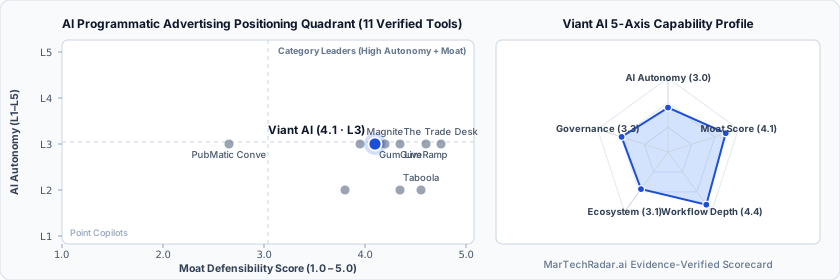
Viant AI is a Web SaaS tool for AI Programmatic Advertising (Programmatic DSP/SSP & Contextual AdTech) in AdTech & Paid Media. Pricing: Custom / enterprise pricing. Best suited to DTC / eCommerce and Enterprise Brands. Editor ratings: AI autonomy L3 (conditional automation); moat score 4.1/5.0 (Proprietary moat). Fact-checked by MarTechRadar Research Desk on Oct 14, 2026.
Autonomous programmatic demand-side platform leveraging conversational AI and household identity resolution for omnichannel media planning and real-time.
Is Viant AI worth it in 2026? Buyer fit & when to walk away
Choose Viant AI if (Best Fit)
- Target ICP & Stack Fit: You operate as DTC / eCommerce and Enterprise Brands requiring a Web SaaS deployment for AI Programmatic Advertising.
- L3 Architecture & Defensibility: Viant's moat stems from its deterministic Household ID resolution infrastructure coupled with a purpose-built autonomous DSP architecture that translates natural-language media briefs directly into live real-time bidding strategies across CTV, digital audio, and web environments.
- Commercial Model Fit: Your procurement budget aligns with Custom / enterprise pricing.
Walk away from Viant AI if (Deal-Breakers)
- Walk away if you need published self-serve pricing: Viant AI is sold by custom quote.
- Walk away if your workflow cannot tolerate walled garden exclusion: The autonomous bidding infrastructure cannot execute buys or resolve identities directly inside closed ecosystems like Meta, Google Search, or Amazon DSP, confining media optimization strictly to open programmatic inventory.
- Walk away if high media spend dependency is a deal-breaker for your team: Algorithmic decision loops and identity graph modeling require substantial impression volume and conversion event density to train properly, leading to cold-start underperformance on low-budget tactical campaigns.
Viant AI pricing, free plan & scorecard at a glance
| Pricing | Custom / enterprise pricing |
|---|---|
| Free plan | No / not disclosed |
| Delivery | Web SaaS |
| Audience | DTC / eCommerce, Enterprise Brands |
| AI autonomy level | L3 · Conditional automationEditor-verified |
| Moat tier & score | 4.1 / 5.0 · Proprietary moatEditor-verified |
| Funding | AcquiredAcquired by Time Inc. |
| Founders | Byron W. Smith, Chris Vanderhook, Eric Greenberg, Russell Vanderhook |
| Company size | 201-500 employees |
| Governance & docs | Trust & Security ↗ · Privacy ↗ |
| Headquarters | Irvine, California |
| Founded | 1996 |
| Last verified | Oct 14, 2026 |
Viant AI pros & cons: strengths vs. operational limitations
Pros: core strengths & capabilities
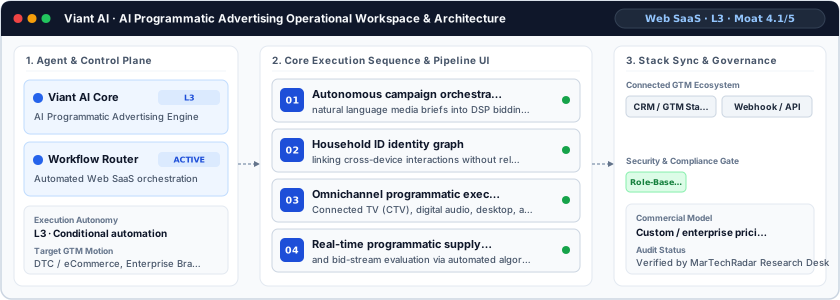
- Autonomous campaign orchestration converting: natural language media briefs into DSP bidding strategies
- Household ID identity graph: linking cross-device interactions without relying on third-party tracking cookies
- Omnichannel programmatic execution spanning: Connected TV (CTV), digital audio, desktop, and mobile channels
- Real-time programmatic supply optimization and bid-stream evaluation via automated algorithms
Cons: operational limitations & risks
- Walled garden exclusion: The autonomous bidding infrastructure cannot execute buys or resolve identities directly inside closed ecosystems like Meta, Google Search, or Amazon DSP, confining media optimization strictly to open programmatic inventory.
- High media spend dependency: Algorithmic decision loops and identity graph modeling require substantial impression volume and conversion event density to train properly, leading to cold-start underperformance on low-budget tactical campaigns.
- Household identity resolution edge cases: Attribution models map cross-device interactions to physical households rather than discrete personal devices, causing attribution skew and audience misallocation in high-occupancy or shared IP network environments.
Viant AI TCO & deal-breaker stress test
Simulate 12-month stepped TCO, hidden cost multipliers, contract lock-in exposure, and stack failure modes using only facts verified by MarTechRadar Research Desk on 2026-10-14.
Viant AI triggers high-severity friction under your 5-seat / $800/mo constraints. Benchmark the verified subtrack alternatives below before committing.
- Moat Score
- 4.1 / 5.0
- AI Autonomy
- L3
- Free Tier / Trial
- None disclosed
Triggered audit signals & failure modes
- Opaque Enterprise Quoting vs. SMB/Mid-Market BudgetVerified Pricing Ledger
Viant AI does not disclose a public self-serve floor (Custom / enterprise pricing). Buyers with a $800/mo cap face high sales-qualification friction.
- Sales-Gated Contract TermsFact-checked by MarTechRadar Research Desk
Viant AI operates under an enterprise engagement structure where commercial pricing is available on request through tailored enterprise sales quotes based on organizational scale and seats.
- Primary Operational Bottleneck: High media spend dependencyAudit by MarTechRadar Research Desk
Algorithmic decision loops and identity graph modeling require substantial impression volume and conversion event density to train properly, leading to cold-start underperformance on low-budget tactical campaigns.
Test a custom Viant AI budget or stack constraint
Lower 5-seat floor (~$36/mo vs. Custom Quote) · Transparent self-serve entry without mandatory annual lock-in
Lower 5-seat floor (~$25/mo vs. Custom Quote) · Transparent self-serve entry without mandatory annual lock-in
Viant AI AI moat & AI Programmatic Advertising positioning
Viant's moat stems from its deterministic Household ID resolution infrastructure coupled with a purpose-built autonomous DSP architecture that translates natural-language media briefs directly into live real-time bidding strategies across CTV, digital audio, and web environments.
Viant AI in-depth review, pricing & architecture analysis
Editor sign-off: Oct 14, 2026. How profiles are made.
What is Viant AI? Overview & background
Modern media planning teams face severe operational drag when translating complex campaign briefs into granular targeting parameters across fragmented ad exchanges. Established in 1996 in Irvine, California, and formerly acquired by Time Inc. before returning to public markets, Viant developed Viant AI to automate manual execution across programmatic workflows. Designed specifically for agency media directors and enterprise programmatic trading desks, the platform shifts media procurement away from manual seat operations toward autonomous execution. It targets enterprise organizations deploying multi-channel brand budgets across connected television, digital out-of-home, and open web environments.
How Viant AI works: architecture & workflow
Viant AI operates as a Level 3 autonomous media-buying layer layered directly onto Viant's core demand-side platform. Users ingest natural language campaign inputs, such as target demographics, budget constraints, flight dates, and core performance goals. The underlying inference engine parses these parameters, matches them against Viant's deterministic Household ID identity graph, and synthesizes complete media plans. The system automatically structures flighting budgets, selects supply paths, and sets dynamic bid parameters within the real-time bidding engine. Optimization algorithms continuously reallocate live media spend across Connected TV, digital audio, and display inventory based on verified conversions and reach velocity.
Viant AI limitations, drawbacks & risks
Operational considerations and platform boundaries include:
- Walled garden exclusion: The autonomous bidding infrastructure cannot execute buys or resolve identities directly inside closed ecosystems like Meta, Google Search, or Amazon DSP, confining media optimization strictly to open programmatic inventory.
- High media spend dependency: Algorithmic decision loops and identity graph modeling require substantial impression volume and conversion event density to train properly, leading to cold-start underperformance on low-budget tactical campaigns.
- Household identity resolution edge cases: Attribution models map cross-device interactions to physical households rather than discrete personal devices, causing attribution skew and audience misallocation in high-occupancy or shared IP network environments.
Viant AI pricing, plans & cost breakdown
Viant AI operates under an enterprise engagement structure where commercial pricing is available on request through tailored enterprise sales quotes based on organizational scale and seats. The model typically incorporates programmatic take rates calculated as a percentage of managed gross media spend, alongside committed volume tiers for demand-side software usage. Enterprise contracts can also encompass dedicated managed services, premium identity graph queries, and custom reporting integrations negotiated on multi-year agreements.
| Plan / Tier | Verified Price & Billing | Included Scope & Contract Terms |
|---|---|---|
| Enterprise / Custom | Custom quote | Custom-quoted plan; terms come from the vendor's sales team. |
How Viant AI compares vs. competitors & alternatives
Viant AI competes in the broader programmatic ecosystem against platforms like AdRoll, GumGum, and LiveRamp. While AdRoll targets mid-market direct-to-consumer advertisers with self-serve retargeting, Viant AI delivers automated Connected TV and enterprise household targeting. GumGum concentrates narrowly on contextual computer vision and natural language processing at the publisher edge, whereas Viant manages full-funnel bid valuation across broader identity networks. LiveRamp provides identity syndication and data clean rooms to third-party tools, but lacks Viant AI's native DSP execution layer.
Direct competitors & market radar
Top algorithmic competitors based on category positioning, capability overlap, and ICP alignment.
Frequently asked questions about Viant AI
Does Viant AI publish pricing or require an enterprise quote?
Viant AI pricing: Custom / enterprise pricing. No free plan is publicly disclosed. Viant AI operates under an enterprise engagement structure where commercial pricing is available on request through tailored enterprise sales quotes based on organizational scale and seats.
What are the top Viant AI alternatives in AI Programmatic Advertising?
Verified AI Programmatic Advertising alternatives include GoMarble (From $25/mo), The Trade Desk Kokai (Custom / enterprise pricing), AdRoll (Free plan · $36/mo), Veylan (Custom / enterprise pricing). Viant AI competes in the broader programmatic ecosystem against platforms like AdRoll, GumGum, and LiveRamp.
What are the main limitations and trade-offs of Viant AI?
Operational considerations and platform boundaries include: Walled garden exclusion: The autonomous bidding infrastructure cannot execute buys or resolve identities directly inside closed ecosystems like Meta, Google Search, or Amazon DSP, confining media optimization strictly to open programmatic inventory. Walk away if you need published self-serve pricing: Viant AI is sold by custom quote.
Verified sources & evidence trail
- Official product domain: https://viantinc.com
- Commercial pricing verification: Verified against official vendor pricing policy (Custom / enterprise pricing)
- Verified corporate entity profiles (
sameAs): LinkedIn Company Profile · Crunchbase Entity Record - First-party governance & documentation links: Trust & Security · Privacy
- Editor sign-off: Oct 14, 2026 (how profiles are made).
