GumGum Review (2026): AI Programmatic Advertising Pricing, Pros & Cons
Bottom line
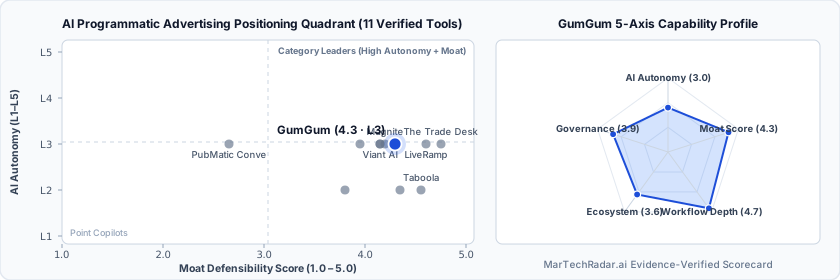
GumGum is a Web SaaS tool for AI Programmatic Advertising (Programmatic DSP/SSP & Contextual AdTech) in AdTech & Paid Media. Pricing: Custom / enterprise pricing. Best suited to DTC / eCommerce and Enterprise Brands. Editor ratings: AI autonomy L3 (conditional automation); moat score 4.3/5.0 (Proprietary moat (category leader)). Fact-checked by MarTechRadar Research Desk on Oct 12, 2026.
Contextual intelligence and programmatic ad platform applying multimodal computer vision and NLP to execute cookie-free brand safety and high-impact ad.
Is GumGum worth it in 2026? Buyer fit & when to walk away
Choose GumGum if (Best Fit)
- Target ICP & Stack Fit: You operate as DTC / eCommerce and Enterprise Brands requiring a Web SaaS deployment for AI Programmatic Advertising, with verified ecosystem connectivity for Twilio Segment.
- L3 Architecture & Defensibility: Proprietary Verity contextual intelligence engine with dual MRC accreditation for content analysis and brand safety across text, image, and video, combined with proprietary high-impact ad formats and direct publisher SSP integrations.
- Commercial Model Fit: Your procurement budget aligns with Custom / enterprise pricing.
Walk away from GumGum if (Deal-Breakers)
- Walk away if you need published self-serve pricing: GumGum is sold by custom quote.
- Walk away if your workflow cannot tolerate dynamic content and paywall ingestion lag: Real-time page extraction encounters latency spikes or incomplete classification on hard-paywalled publisher domains and single-page applications relying on asynchronous client-side DOM rendering.
- Walk away if cross-device attribution latency is a deal-breaker for your team: Without identity-based tracking graphs, deterministic multi-touch attribution and longitudinal frequency capping across disparate CTV and mobile display channels require probabilistic modeling approximations.
GumGum pricing, free plan & scorecard at a glance
| Pricing | Custom / enterprise pricing |
|---|---|
| Free plan | No / not disclosed |
| Delivery | Web SaaS |
| Audience | DTC / eCommerce, Enterprise Brands |
| AI autonomy level | L3 · Conditional automationEditor-verified |
| Moat tier & score | 4.3 / 5.0 · Proprietary moat (category leader)Editor-verified |
| Funding | Series C+ |
| Total funding | $133.8MBacked by Goldman Sachs Growth |
| Founders | Ari Mir, Ophir Tanz |
| Company size | 501-1,000 employees |
| Ecosystem integrations | Twilio Segment |
| Governance & docs | Privacy ↗ |
| Headquarters | Santa Monica, California |
| Founded | 2008 |
| Last verified | Oct 12, 2026 |
GumGum pros & cons: strengths vs. operational limitations
Pros: core strengths & capabilities
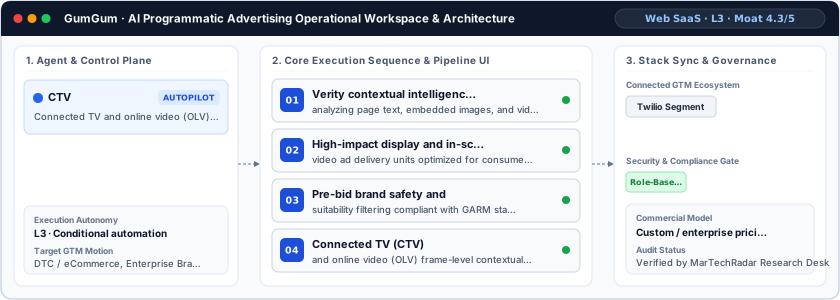
- Verity contextual intelligence engine: analyzing page text, embedded images, and video frames concurrently
- High-impact display and in-screen: video ad delivery units optimized for consumer attention
- Pre-bid brand safety and suitability filtering compliant with GARM standards
- Connected TV (CTV) and online video (OLV) frame-level contextual classification
Cons: operational limitations & risks
- Dynamic Content and Paywall Ingestion Lag: Real-time page extraction encounters latency spikes or incomplete classification on hard-paywalled publisher domains and single-page applications relying on asynchronous client-side DOM rendering.
- Cross-Device Attribution Latency: Without identity-based tracking graphs, deterministic multi-touch attribution and longitudinal frequency capping across disparate CTV and mobile display channels require probabilistic modeling approximations.
- Rich Media Inventory Fill Constraints: Proprietary high-impact dynamic creative formats depend heavily on bespoke publisher supply-side integrations, restricting scale in unvetted or low-tier programmatic ad exchanges.
GumGum TCO & deal-breaker stress test
Simulate 12-month stepped TCO, hidden cost multipliers, contract lock-in exposure, and stack failure modes using only facts verified by MarTechRadar Research Desk on 2026-10-12.
GumGum triggers high-severity friction under your 5-seat / $800/mo constraints. Benchmark the verified subtrack alternatives below before committing.
- Moat Score
- 4.3 / 5.0
- AI Autonomy
- L3
- Free Tier / Trial
- None disclosed
Triggered audit signals & failure modes
- Opaque Enterprise Quoting vs. SMB/Mid-Market BudgetVerified Pricing Ledger
GumGum does not disclose a public self-serve floor (Custom / enterprise pricing). Buyers with a $800/mo cap face high sales-qualification friction.
- Sales-Gated Contract TermsFact-checked by MarTechRadar Research Desk
Commercial access is structured through direct managed service contracts or programmatic programmatic guaranteed and private marketplace deals.
- Primary Operational Bottleneck: Rich Media Inventory Fill ConstraintsAudit by MarTechRadar Research Desk
Proprietary high-impact dynamic creative formats depend heavily on bespoke publisher supply-side integrations, restricting scale in unvetted or low-tier programmatic ad exchanges.
Test a custom GumGum budget or stack constraint
Lower 5-seat floor (~$36/mo vs. Custom Quote) · Transparent self-serve entry without mandatory annual lock-in
GumGum integrations, API, security & compliance stack
Connected TV and online video (OLV) frame-level contextual classification
GumGum AI moat & AI Programmatic Advertising positioning
Proprietary Verity contextual intelligence engine with dual MRC accreditation for content analysis and brand safety across text, image, and video, combined with proprietary high-impact ad formats and direct publisher SSP integrations.
GumGum in-depth review, pricing & architecture analysis
Editor sign-off: Oct 12, 2026. How profiles are made.
What is GumGum? Overview & background
Architected around multimodal contextual parsing rather than persistent user identifiers, GumGum was established in 2008 in Santa Monica, California, to deliver cookieless programmatic advertising across display, video, and CTV environments. Backed by $133.8M in venture capital funding, the enterprise platform targets media agency investment leads, programmatic traders, and enterprise brand marketers seeking addressability without relying on third-party tracking vectors. Operating as an intelligence layer across buy-side and sell-side transactions, GumGum aligns dynamic creative units with page-level audience attention.
How GumGum works: architecture & workflow
At its technical core, GumGum runs on Verity, a proprietary computer vision and natural language processing engine that analyzes web, video, and audio assets at runtime. Rather than scanning basic page metadata or isolated keywords, the system ingests raw DOM content, transcribes streaming audio, and decodes video keyframes to establish semantic relevance and brand suitability scores against IAB and GARM taxonomies. These signals feed real-time bidding pipelines via pre-bid programmatic integrations or custom marketplace private deals, triggering dynamic high-impact units when contextual thresholds are met.
GumGum limitations, drawbacks & risks
Operational considerations and platform boundaries include:
- Dynamic Content and Paywall Ingestion Lag: Real-time page extraction encounters latency spikes or incomplete classification on hard-paywalled publisher domains and single-page applications relying on asynchronous client-side DOM rendering.
- Cross-Device Attribution Latency: Without identity-based tracking graphs, deterministic multi-touch attribution and longitudinal frequency capping across disparate CTV and mobile display channels require probabilistic modeling approximations.
- Rich Media Inventory Fill Constraints: Proprietary high-impact dynamic creative formats depend heavily on bespoke publisher supply-side integrations, restricting scale in unvetted or low-tier programmatic ad exchanges.
GumGum pricing, plans & cost breakdown
Commercial access is structured through direct managed service contracts or programmatic programmatic guaranteed and private marketplace deals. Pricing is available on request through tailored enterprise sales quotes based on organizational scale, campaign flight parameters, and custom media spend allocations without static published tiers.
| Plan / Tier | Verified Price & Billing | Included Scope & Contract Terms |
|---|---|---|
| Enterprise / Custom | Custom quote | Custom-quoted plan; terms come from the vendor's sales team. |
How GumGum compares vs. competitors & alternatives
While LiveRamp anchors data activation around authenticated identity resolution graphs, GumGum relies strictly on real-time content understanding to bypass identity deprecation altogether within the AI Programmatic Advertising segment. In contrast to Outbrain Smartlogic's focus on algorithmic recommendation feeds and native ad grids, or AdRoll's retargeting orientation for middle-market direct-response brands, GumGum isolates high-impact awareness and contextual precision. The architecture best serves global consumer brands and media agencies executing large-scale brand safety and attention-driven campaigns across premium digital inventory.
Direct competitors & market radar
Top algorithmic competitors based on category positioning, capability overlap, and ICP alignment.
Frequently asked questions about GumGum
Does GumGum publish pricing or require an enterprise quote?
GumGum pricing: Custom / enterprise pricing. No free plan is publicly disclosed. Commercial access is structured through direct managed service contracts or programmatic programmatic guaranteed and private marketplace deals.
What are the top GumGum alternatives in AI Programmatic Advertising?
Verified AI Programmatic Advertising alternatives include LiveRamp (From $20,000/yr), AdRoll (Free plan · $36/mo), Taboola (Custom / enterprise pricing), Magnite (Custom / enterprise pricing). While LiveRamp anchors data activation around authenticated identity resolution graphs, GumGum relies strictly on real-time content understanding to bypass identity deprecation altogether within the AI Programmatic Advertising segment.
What are the main limitations and trade-offs of GumGum?
Operational considerations and platform boundaries include: Dynamic Content and Paywall Ingestion Lag: Real-time page extraction encounters latency spikes or incomplete classification on hard-paywalled publisher domains and single-page applications relying on asynchronous client-side DOM rendering. Walk away if you need published self-serve pricing: GumGum is sold by custom quote.
Verified sources & evidence trail
- Official product domain: https://gumgum.com
- Commercial pricing verification: Verified against official vendor pricing policy (Custom / enterprise pricing)
- Verified corporate entity profiles (
sameAs): LinkedIn Company Profile · Crunchbase Entity Record - First-party governance & documentation links: Privacy
- Editor sign-off: Oct 12, 2026 (how profiles are made).
