Brax Review (2026): AI Programmatic Advertising Pricing, Pros & Cons
Bottom line
Brax is a Web SaaS tool for AI Programmatic Advertising (Programmatic DSP/SSP & Contextual AdTech) in AdTech & Paid Media. Pricing: $199–$499/mo. Best suited to DTC / eCommerce. Editor ratings: AI autonomy L2 (workflow copilot); moat score 3.8/5.0 (Proprietary moat). Fact-checked by MarTechRadar Research Desk on Oct 14, 2026.
Multi-network native advertising management platform centralizing campaign creation, reporting, and automated rule execution across Taboola and Outbrain.
Is Brax worth it in 2026? Buyer fit & when to walk away
Choose Brax if (Best Fit)
- Target ICP & Stack Fit: You operate as DTC / eCommerce requiring a Web SaaS deployment for AI Programmatic Advertising, with verified ecosystem connectivity for Slack, Google Analytics 4 (GA4).
- L2 Architecture & Defensibility: Proprietary multi-channel ad exchange connectors, unified cross-network campaign rule engines, and deep operational integration within parent entity Wishpond's performance marketing suite.
- Commercial Model Fit: Your procurement budget aligns with $199–$499/mo.
Walk away from Brax if (Deal-Breakers)
- Walk away if your workflow cannot tolerate API sync latency: External native ad network APIs introduce telemetry polling delays, which can hinder sub-minute bid adjustments during sudden cost-per-click spikes.
- Walk away if creative ingestion constraints is a deal-breaker for your team: Creative validation relies on disparate partner specifications, causing occasional rejection cycles when pushing high-volume headline and image matrices simultaneously.
Brax pricing, free plan & scorecard at a glance
| Pricing | $199–$499/moVendor pricing page |
|---|---|
| Free plan | No / not disclosed |
| Delivery | Web SaaS |
| Audience | DTC / eCommerce |
| AI autonomy level | L2 · Workflow copilotEditor-verified |
| Moat tier & score | 3.8 / 5.0 · Proprietary moatEditor-verified |
| Funding | AcquiredAcquired by Wishpond |
| Founders | Joe Speiser, Justin Festa |
| Company size | 11-50 employees |
| Ecosystem integrations | Slack, Google Analytics 4 (GA4) |
| Governance & docs | Terms ↗ · Privacy ↗ |
| Headquarters | Vancouver, British Columbia |
| Founded | 2014 |
| Last verified | Oct 14, 2026 |
Brax pros & cons: strengths vs. operational limitations
Pros: core strengths & capabilities
- Cross-network native ad orchestration: spanning Outbrain, Taboola, and Revcontent
- Automated rule execution: for dayparting, bid adjustments, and budget throttling
- Bulk creative and headline: variations generator with integrated power editor
- Unified multi-account conversion reporting and calculated performance metrics
Cons: operational limitations & risks
- API Sync Latency: External native ad network APIs introduce telemetry polling delays, which can hinder sub-minute bid adjustments during sudden cost-per-click spikes.
- Creative Ingestion Constraints: Creative validation relies on disparate partner specifications, causing occasional rejection cycles when pushing high-volume headline and image matrices simultaneously.
- Narrow Network Footprint: Orchestration capabilities remain tightly bound to sponsored discovery feeds, offering zero programmatic utility across audio, connected TV, or walled-garden ecosystems.
Brax TCO & deal-breaker stress test
Simulate 12-month stepped TCO, hidden cost multipliers, contract lock-in exposure, and stack failure modes using only facts verified by MarTechRadar Research Desk on 2026-10-14 · Capture SHA f337e585.
Brax aligns with your 5-seat / $800/mo profile. Review the walk-away triggers and contract levers below before deployment.
- Moat Score
- 3.8 / 5.0
- AI Autonomy
- L2
- Free Tier / Trial
- None disclosed
Triggered audit signals & failure modes
- Published Self-Serve Entry FloorVerified Pricing Ledger
Brax publishes a transparent entry point ($199–$499/mo) for initial validation before committing.
- Tier Fit for 5-Seat Scale: Starter ($199/mo)Verified Tier Schedule
Manage $10,000
- Primary Operational Bottleneck: API Sync LatencyAudit by MarTechRadar Research Desk
External native ad network APIs introduce telemetry polling delays, which can hinder sub-minute bid adjustments during sudden cost-per-click spikes.
Test a custom Brax budget or stack constraint
Lower 5-seat floor (~$36/mo vs. $199 / mo)
Verified AI Programmatic Advertising peer (From $20,000/yr · Moat 4.6/5.0)
Brax integrations, API, security & compliance stack
Brax AI moat & AI Programmatic Advertising positioning
Proprietary multi-channel ad exchange connectors, unified cross-network campaign rule engines, and deep operational integration within parent entity Wishpond's performance marketing suite.
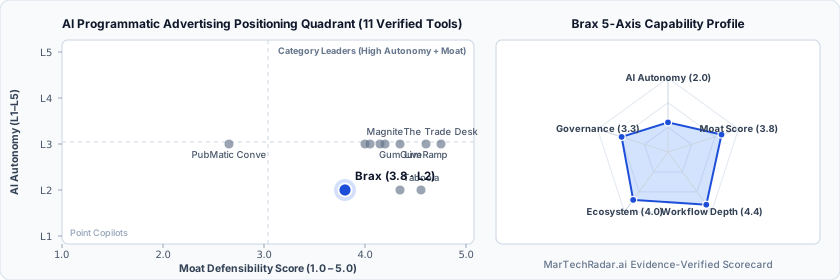
Brax in-depth review, pricing & architecture analysis
Editor sign-off: Oct 14, 2026. How profiles are made.
What is Brax? Overview & background
Operating within fragmented ad exchanges, native media buyers face operational sprawl across isolated network portals. Headquartered in Vancouver, British Columbia, and established in 2014, Brax addresses this overhead by centralizing multi-channel native ad campaign management. Later acquired by Wishpond, the vendor targets growth marketing teams, performance agencies, and digital publishers executing high-velocity programmatic discovery campaigns across disparate content distribution channels.
How Brax works: architecture & workflow
At its technical core, Brax functions as an API orchestration layer connecting programmatic distribution networks including Taboola, Outbrain, and Revcontent. The platform ingests real-time ad performance metrics and conversion signals, normalizing schemas across networks into a unified analytical store. Its algorithmic rules engine triggers conditional actions, executing automated bid adjustments, budget pacing, and publisher-level blacklisting based on calculated return thresholds, alongside native workflow integrations for Slack and Google Analytics.
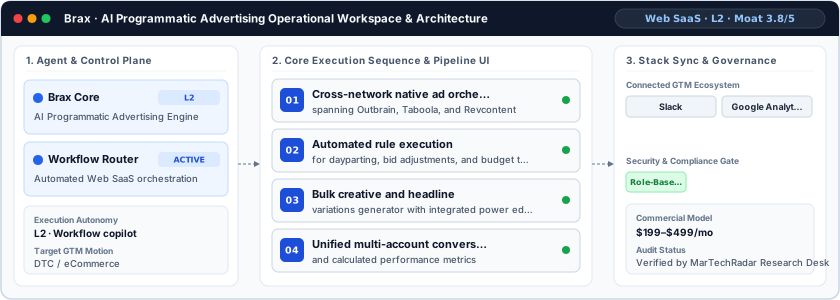
Brax limitations, drawbacks & risks
Operational considerations and platform boundaries include:
- API Sync Latency: External native ad network APIs introduce telemetry polling delays, which can hinder sub-minute bid adjustments during sudden cost-per-click spikes.
- Creative Ingestion Constraints: Creative validation relies on disparate partner specifications, causing occasional rejection cycles when pushing high-volume headline and image matrices simultaneously.
- Narrow Network Footprint: Orchestration capabilities remain tightly bound to sponsored discovery feeds, offering zero programmatic utility across audio, connected TV, or walled-garden ecosystems.
Brax pricing, plans & cost breakdown
Brax deploys a tiered software subscription model structured around managed ad spend. Standard subscriptions begin on the Starter tier at $199 per month for up to $10,000 in monthly ad spend, while the Business tier at $499 per month supports media allocations up to $50,000 per month, applying a 2% overage surcharge when monthly network spend thresholds are exceeded.
| Plan / Tier | Verified Price & Billing | Target Seat / Scale Fit | Included Scope & Contract Terms |
|---|---|---|---|
| Starter | $199/mo | Unlimited seats | Manage $10,000 |
| Business | $499/mo | Unlimited seats | Manage $50,000 |
| Enterprise | $1499/mo | Unlimited seats | Manage $250,000 |
How Brax compares vs. competitors & alternatives
Unlike AdRoll, which functions as an end-to-end retargeting DSP, Brax operates as a workflow orchestration layer rather than an ad inventory bidder within the AI Programmatic Advertising segment. Compared to contextual intelligence platforms like GumGum or identity graph backbones like LiveRamp, Brax bypasses proprietary targeting telemetry. It is purpose-built for media buyers who require multi-account rule automation across content discovery networks rather than full-funnel contextual infrastructure.
Direct competitors & market radar
Top algorithmic competitors based on category positioning, capability overlap, and ICP alignment.
Frequently asked questions about Brax
How much does Brax cost in 2026?
Brax pricing: $199–$499/mo. No free plan is publicly disclosed. Published tiers: Starter ($199/mo); Business ($499/mo); Enterprise ($1499/mo). Brax deploys a tiered software subscription model structured around managed ad spend.
What are the top Brax alternatives in AI Programmatic Advertising?
Verified AI Programmatic Advertising alternatives include LiveRamp (From $20,000/yr), AdRoll (Free plan · $36/mo), Revcontent (Custom / enterprise pricing), Teads (Custom / enterprise pricing). Unlike AdRoll, which functions as an end-to-end retargeting DSP, Brax operates as a workflow orchestration layer rather than an ad inventory bidder within the AI Programmatic Advertising segment.
What are the main limitations and trade-offs of Brax?
Operational considerations and platform boundaries include: API Sync Latency: External native ad network APIs introduce telemetry polling delays, which can hinder sub-minute bid adjustments during sudden cost-per-click spikes. Walk away if your workflow cannot tolerate API sync latency: External native ad network APIs introduce telemetry polling delays, which can hinder sub-minute bid adjustments during sudden cost-per-click spikes.
Verified sources & evidence trail
- Official product domain: https://brax.io
- Commercial pricing verification: https://www.brax.io/pricing
- Verified corporate entity profiles (
sameAs): LinkedIn Company Profile · Crunchbase Entity Record - First-party governance & documentation links: Terms · Privacy
- Editor sign-off: Oct 14, 2026 (how profiles are made).
