LiveRamp Review (2026): AI Programmatic Advertising Pricing, Pros & Cons
Bottom line
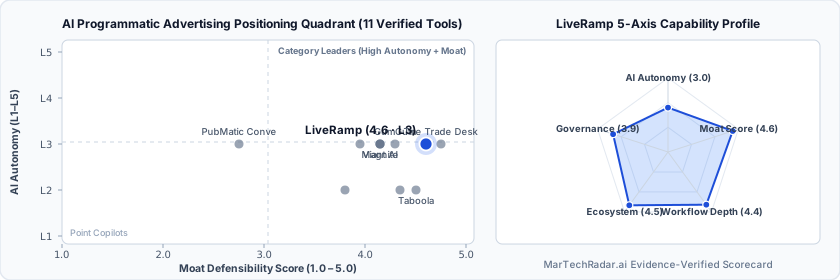
LiveRamp is a Web SaaS tool for AI Programmatic Advertising (Programmatic DSP/SSP & Contextual AdTech) in AdTech & Paid Media. Pricing: From $20,000/yr. Best suited to DTC / eCommerce and Enterprise Brands. Editor ratings: AI autonomy L3 (conditional automation); moat score 4.6/5.0 (Proprietary moat (category leader)). Fact-checked by MarTechRadar Research Desk on Oct 12, 2026.
Enterprise data collaboration and identity resolution platform connecting customer data to media ecosystems via pseudonymized RampID linkages.
Is LiveRamp worth it in 2026? Buyer fit & when to walk away
Choose LiveRamp if (Best Fit)
- Target ICP & Stack Fit: You operate as DTC / eCommerce and Enterprise Brands requiring a Web SaaS deployment for AI Programmatic Advertising, with verified ecosystem connectivity for Snowflake, Webflow, Twilio Segment.
- L3 Architecture & Defensibility: LiveRamp maintains an extensive deterministic offline-to-online identity graph embedded across major ad networks, DSPs, cloud data warehouses, and data clean rooms, creating immense switching friction.
- Commercial Model Fit: Your procurement budget aligns with From $20,000/yr.
Walk away from LiveRamp if (Deal-Breakers)
- Walk away if your workflow cannot tolerate graph sync latency: Batch-based identity synchronization schedules across external programmatic platforms induce latency windows, preventing real-time intra-hour CRM audience updates.
- Walk away if addressability drop-off is a deal-breaker for your team: Match rates decline significantly when enterprise customer databases lack standardized postal or authenticated email inputs, weakening downstream programmatic scale.
LiveRamp pricing, free plan & scorecard at a glance
| Pricing | From $20,000/yrVendor pricing page |
|---|---|
| Free plan | No / not disclosed |
| Delivery | Web SaaS |
| Audience | DTC / eCommerce, Enterprise Brands |
| AI autonomy level | L3 · Conditional automationEditor-verified |
| Moat tier & score | 4.6 / 5.0 · Proprietary moat (category leader)Editor-verified |
| Funding | AcquiredAcquired by Publicis Groupe |
| Total funding | $16M |
| Founders | Auren Hoffman, Dan Scudder, Manish Shah, Travis May |
| Company size | 1,001-5,000 employees |
| Ecosystem integrations | Snowflake, Webflow, Twilio Segment |
| Governance & docs | Trust & Security ↗ · API & Docs ↗ · Privacy ↗ |
| Headquarters | San Francisco, CA |
| Founded | 2011 |
| Last verified | Oct 12, 2026 |
LiveRamp pros & cons: strengths vs. operational limitations
Pros: core strengths & capabilities
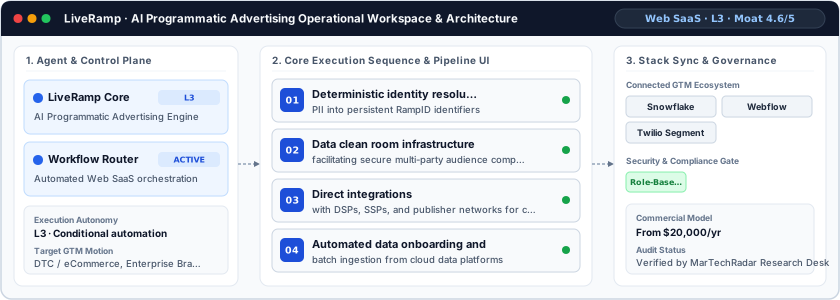
- Deterministic identity resolution converting: PII into persistent RampID identifiers
- Data clean room infrastructure: facilitating secure multi-party audience computations
- Direct integrations: with DSPs, SSPs, and publisher networks for cookieless targeting
- Automated data onboarding and batch ingestion from cloud data platforms
Cons: operational limitations & risks
- Graph Sync Latency: Batch-based identity synchronization schedules across external programmatic platforms induce latency windows, preventing real-time intra-hour CRM audience updates.
- Addressability Drop-off: Match rates decline significantly when enterprise customer databases lack standardized postal or authenticated email inputs, weakening downstream programmatic scale.
- Clean Room Computational Overhead: Executing multi-party differential privacy queries within partner environments incurs high data-warehouse compute costs and complex SQL query tuning requirements.
LiveRamp TCO & deal-breaker stress test
Simulate 12-month stepped TCO, hidden cost multipliers, contract lock-in exposure, and stack failure modes using only facts verified by MarTechRadar Research Desk on 2026-10-12 · Capture SHA 73a54c82.
LiveRamp triggers high-severity friction under your 5-seat / $800/mo constraints. Benchmark the verified subtrack alternatives below before committing.
- Moat Score
- 4.6 / 5.0
- AI Autonomy
- L3
- Free Tier / Trial
- None disclosed
Triggered audit signals & failure modes
- Budget Ceiling Breached ($1,667/mo vs. $800/mo cap)Verified Pricing Ledger
At 5 seats, LiveRamp's verified entry floor (From $20,000/yr) exceeds your $800/mo budget before add-ons or overages.
- Annual Contract Lock-in Risk DetectedFact-checked by MarTechRadar Research Desk
LiveRamp licenses its infrastructure through consumption-aligned enterprise contracts starting From $20,000/year. Pricing scales based on cumulative record volumes onboarded into the identity graph, total RampID translations executed, and downstream destination sync endpoints.
- Primary Operational Bottleneck: Graph Sync LatencyAudit by MarTechRadar Research Desk
Batch-based identity synchronization schedules across external programmatic platforms induce latency windows, preventing real-time intra-hour CRM audience updates.
Test a custom LiveRamp budget or stack constraint
Lower 5-seat floor (~$36/mo vs. $20,000 / yr upfront) · Transparent self-serve entry without mandatory annual lock-in
Lower 5-seat floor (~$199/mo vs. $20,000 / yr upfront) · Transparent self-serve entry without mandatory annual lock-in
LiveRamp integrations, API, security & compliance stack
LiveRamp AI moat & AI Programmatic Advertising positioning
LiveRamp maintains an extensive deterministic offline-to-online identity graph embedded across major ad networks, DSPs, cloud data warehouses, and data clean rooms, creating immense switching friction.
LiveRamp in-depth review, pricing & architecture analysis
Editor sign-off: Oct 12, 2026. How profiles are made.
What is LiveRamp? Overview & background
Architectured as a central data connectivity layer for modern adtech stacks, LiveRamp addresses the structural decoupling of enterprise customer records from real-time programmatic ad networks. Headquartered in San Francisco, CA, and founded in 2011 with $16M in early venture funding prior to subsequent corporate transitions, the platform is engineered for enterprise marketing operations, programmatic media traders, and data analytics leaders. It translates disparate first-party identifier silos into stable cross-platform linkages without relying on third-party tracking cookies.
How LiveRamp works: architecture & workflow
At its architectural core, LiveRamp deploys an automated identity resolution pipeline. First-party customer attributes—including hashed emails, mobile ad identifiers (MAIDs), and physical addresses—are ingested via cloud storage, direct database connectors, or clean room environments. The system executes deterministic and probabilistic matching against its enterprise identity graph, transmuting raw records into pseudonymized RampID tokens. These tokens synchronize downstream into programmatic bidstreams, DSP endpoints, and publisher supply paths to orchestrate targeted media activations and closed-loop attribution models, alongside native workflow integrations for Snowflake and Webflow.
LiveRamp limitations, drawbacks & risks
Operational considerations and platform boundaries include:
- Graph Sync Latency: Batch-based identity synchronization schedules across external programmatic platforms induce latency windows, preventing real-time intra-hour CRM audience updates.
- Addressability Drop-off: Match rates decline significantly when enterprise customer databases lack standardized postal or authenticated email inputs, weakening downstream programmatic scale.
- Clean Room Computational Overhead: Executing multi-party differential privacy queries within partner environments incurs high data-warehouse compute costs and complex SQL query tuning requirements.
LiveRamp pricing, plans & cost breakdown
LiveRamp licenses its infrastructure through consumption-aligned enterprise contracts starting From $20,000/year. Pricing scales based on cumulative record volumes onboarded into the identity graph, total RampID translations executed, and downstream destination sync endpoints. Enterprise tiers expand toward dedicated data clean room nodes and higher ingestion thresholds.
How LiveRamp compares vs. competitors & alternatives
While AdRoll focuses on self-serve mid-market retargeting campaigns, GumGum provides cookieless contextual computer-vision categorization, and Outbrain Smartlogic directs predictive native content feeds, LiveRamp operates upstream as the foundational data graph and identity layer within the AI Programmatic Advertising segment. It is built specifically for large enterprise brands and media publishers managing complex customer repositories that require deterministic audience activation across walled gardens and independent ad networks.
Direct competitors & market radar
Top algorithmic competitors based on category positioning, capability overlap, and ICP alignment.
Frequently asked questions about LiveRamp
How much does LiveRamp cost in 2026?
LiveRamp pricing: From $20,000/yr. No free plan is publicly disclosed. LiveRamp licenses its infrastructure through consumption-aligned enterprise contracts starting From $20,000/year.
What are the top LiveRamp alternatives in AI Programmatic Advertising?
Verified AI Programmatic Advertising alternatives include AdRoll (Free plan · $36/mo), Scowtt (Custom / enterprise pricing), GumGum (Custom / enterprise pricing), Taboola (Custom / enterprise pricing). While AdRoll focuses on self-serve mid-market retargeting campaigns, GumGum provides cookieless contextual computer-vision categorization, and Outbrain Smartlogic directs predictive native content feeds, LiveRamp operates upstream as the foundational data graph and identity layer within the AI Programmatic Advertising segment.
What are the main limitations and trade-offs of LiveRamp?
Operational considerations and platform boundaries include: Graph Sync Latency: Batch-based identity synchronization schedules across external programmatic platforms induce latency windows, preventing real-time intra-hour CRM audience updates. Walk away if your workflow cannot tolerate graph sync latency: Batch-based identity synchronization schedules across external programmatic platforms induce latency windows, preventing real-time intra-hour CRM audience updates.
Verified sources & evidence trail
- Official product domain: https://liveramp.com
- Commercial pricing verification: https://liveramp.com/pricing
- Verified corporate entity profiles (
sameAs): LinkedIn Company Profile · Crunchbase Entity Record - First-party governance & documentation links: Trust & Security · API & Docs · Privacy
- Editor sign-off: Oct 12, 2026 (how profiles are made).
