Seedtag Review (2026): AI Programmatic Advertising Pricing, Pros & Cons
Bottom line
Seedtag is a Web SaaS tool for AI Programmatic Advertising (Programmatic DSP/SSP & Contextual AdTech) in AdTech & Paid Media. Pricing: Custom / enterprise pricing. Best suited to DTC / eCommerce and Enterprise Brands. Editor ratings: AI autonomy L3 (conditional automation); moat score 4.2/5.0 (Proprietary moat). Fact-checked by MarTechRadar Research Desk on Oct 12, 2026.
Privacy-first contextual AI advertising platform analyzing text and visual content across web environments to deliver cookieless programmatic ad placements.
Is Seedtag worth it in 2026? Buyer fit & when to walk away
Choose Seedtag if (Best Fit)
- Target ICP & Stack Fit: You operate as DTC / eCommerce and Enterprise Brands requiring a Web SaaS deployment for AI Programmatic Advertising, with verified ecosystem connectivity for HubSpot, Twilio Segment.
- L3 Architecture & Defensibility: Proprietary Liz AI engine combining computer vision and multilingual natural language processing to extract granular contextual sentiment and brand-safety signals without third-party cookies.
- Commercial Model Fit: Your procurement budget aligns with Custom / enterprise pricing.
Walk away from Seedtag if (Deal-Breakers)
- Walk away if you need published self-serve pricing: Seedtag is sold by custom quote.
- Walk away if your workflow cannot tolerate multimodal parsing overhead: Simultaneous analysis of dynamic video assets and text introduces millisecond latency constraints, occasionally narrowing eligible programmatic real-time bidding windows on high-velocity inventory.
- Walk away if dynamic paywall traversal is a deal-breaker for your team: Publisher environments protected by strict paywalls or client-side JavaScript rendering can obstruct the crawler pipeline, resulting in unclassified page contexts.
Seedtag pricing, free plan & scorecard at a glance
| Pricing | Custom / enterprise pricing |
|---|---|
| Free plan | No / not disclosed |
| Delivery | Web SaaS |
| Audience | DTC / eCommerce, Enterprise Brands |
| AI autonomy level | L3 · Conditional automationEditor-verified |
| Moat tier & score | 4.2 / 5.0 · Proprietary moatEditor-verified |
| Funding | Series C+ |
| Total funding | $301.2MBacked by Advent International |
| Founders | Albert Riera, Jorge Poyatos, Pablo López Torres |
| Company size | 501-1,000 employees |
| Ecosystem integrations | HubSpot, Twilio Segment |
| Governance & docs | Privacy ↗ |
| Headquarters | New York, NY |
| Founded | 2014 |
| Last verified | Oct 12, 2026 |
Seedtag pros & cons: strengths vs. operational limitations
Pros: core strengths & capabilities
- Liz contextual AI analyzing: multimodal text and imagery simultaneously
- Cookieless audience targeting aligned: with real-time editorial sentiment
- Dynamic in-image, in-video, and custom display ad placement injection
- Automated brand suitability and semantic safety classification
Cons: operational limitations & risks
- Multimodal Parsing Overhead: Simultaneous analysis of dynamic video assets and text introduces millisecond latency constraints, occasionally narrowing eligible programmatic real-time bidding windows on high-velocity inventory.
- Dynamic Paywall Traversal: Publisher environments protected by strict paywalls or client-side JavaScript rendering can obstruct the crawler pipeline, resulting in unclassified page contexts.
- Walled-Garden Incompatibility: Because the platform relies on open-web publisher integrations and visual ad injection, contextual classification cannot be executed natively inside closed mobile app ecosystems.
Seedtag TCO & deal-breaker stress test
Simulate 12-month stepped TCO, hidden cost multipliers, contract lock-in exposure, and stack failure modes using only facts verified by MarTechRadar Research Desk on 2026-10-12.
Seedtag triggers high-severity friction under your 5-seat / $800/mo constraints. Benchmark the verified subtrack alternatives below before committing.
- Moat Score
- 4.2 / 5.0
- AI Autonomy
- L3
- Free Tier / Trial
- None disclosed
Triggered audit signals & failure modes
- Opaque Enterprise Quoting vs. SMB/Mid-Market BudgetVerified Pricing Ledger
Seedtag does not disclose a public self-serve floor (Custom / enterprise pricing). Buyers with a $800/mo cap face high sales-qualification friction.
- Sales-Gated Contract TermsFact-checked by MarTechRadar Research Desk
Commercial pricing is available on request through tailored enterprise sales quotes based on organizational scale and seats.
- Primary Operational Bottleneck: Multimodal Parsing OverheadAudit by MarTechRadar Research Desk
Simultaneous analysis of dynamic video assets and text introduces millisecond latency constraints, occasionally narrowing eligible programmatic real-time bidding windows on high-velocity inventory.
Test a custom Seedtag budget or stack constraint
Lower 5-seat floor (~$199/mo vs. Custom Quote) · Transparent self-serve entry without mandatory annual lock-in
Verified AI Programmatic Advertising peer (Custom / enterprise pricing · Moat 4.3/5.0)
Seedtag integrations, API, security & compliance stack
Seedtag AI moat & AI Programmatic Advertising positioning
Proprietary Liz AI engine combining computer vision and multilingual natural language processing to extract granular contextual sentiment and brand-safety signals without third-party cookies.
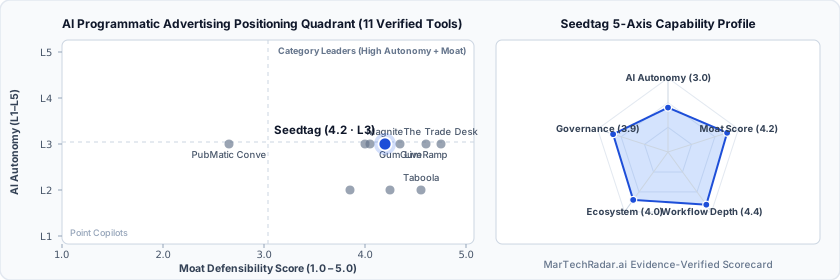
Seedtag in-depth review, pricing & architecture analysis
Editor sign-off: Oct 12, 2026. How profiles are made.
What is Seedtag? Overview & background
Backed by $301.2M in total funding to accelerate privacy-compliant advertising solutions, Seedtag was founded in 2014 and maintains its primary operational headquarters in New York, NY. Established by founders seeking to bypass third-party identifiers, the platform targets global media planning agencies, brand marketing directors, and enterprise publishers requiring signal-rich contextual targeting. Seedtag provides an automated contextual ad insertion layer designed to operate entirely without persistent user trackers.
How Seedtag works: architecture & workflow
At the architectural core of Seedtag is Liz, an artificial intelligence engine that conducts concurrent natural language processing and computer vision analysis across web inventory. Operating at an L3 autonomy profile, Liz scrapes editorial text, metadata, and embedded imagery to construct real-time semantic graphs of publisher web pages. This multimodal pipeline parses sentiment, categorical taxonomy, and brand-safety parameters before mapping eligible ad placements directly over contextual visual nodes. Media execution integrates into programmatic bidding exchanges where bids trigger against Liz-verified topic clusters rather than historical device telemetry, alongside native workflow integrations for HubSpot.
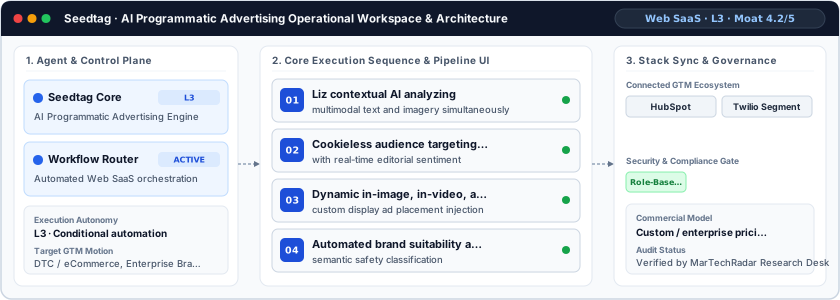
Seedtag limitations, drawbacks & risks
Operational considerations and platform boundaries include:
- Multimodal Parsing Overhead: Simultaneous analysis of dynamic video assets and text introduces millisecond latency constraints, occasionally narrowing eligible programmatic real-time bidding windows on high-velocity inventory.
- Dynamic Paywall Traversal: Publisher environments protected by strict paywalls or client-side JavaScript rendering can obstruct the crawler pipeline, resulting in unclassified page contexts.
- Walled-Garden Incompatibility: Because the platform relies on open-web publisher integrations and visual ad injection, contextual classification cannot be executed natively inside closed mobile app ecosystems.
Seedtag pricing, plans & cost breakdown
Commercial pricing is available on request through tailored enterprise sales quotes based on organizational scale and seats. Media investment models operate through direct managed-service insertion orders or custom programmatic programmatic guaranteed and private marketplace deals arranged via sales teams, with zero self-service tiers provided.
| Plan / Tier | Verified Price & Billing | Included Scope & Contract Terms |
|---|---|---|
| Enterprise / Custom | Custom quote | Custom-quoted plan; terms come from the vendor's sales team. |
How Seedtag compares vs. competitors & alternatives
Within modern programmatic ad platforms, Seedtag benchmarks directly against GumGum, LiveRamp, and AdRoll within the AI Programmatic Advertising segment. While LiveRamp relies heavily on authenticated identity graphs and AdRoll focuses on cross-channel retargeting, Seedtag replaces user identification with real-time semantic analysis. Relative to GumGum's visual classification engine, Seedtag deploys tighter integration across European and North American publisher pools. The technology fits enterprise media holding groups and global consumer brands requiring post-cookie compliance without sacrificing ad placement precision.
Direct competitors & market radar
Top algorithmic competitors based on category positioning, capability overlap, and ICP alignment.
Frequently asked questions about Seedtag
Does Seedtag publish pricing or require an enterprise quote?
Seedtag pricing: Custom / enterprise pricing. No free plan is publicly disclosed. Commercial pricing is available on request through tailored enterprise sales quotes based on organizational scale and seats.
What are the top Seedtag alternatives in AI Programmatic Advertising?
Verified AI Programmatic Advertising alternatives include Brax ($199–$499/mo), Teads (Custom / enterprise pricing), TripleLift (Custom / enterprise pricing), Loud Intelligence (Custom / enterprise pricing). Within modern programmatic ad platforms, Seedtag benchmarks directly against GumGum, LiveRamp, and AdRoll within the AI Programmatic Advertising segment.
What are the main limitations and trade-offs of Seedtag?
Operational considerations and platform boundaries include: Multimodal Parsing Overhead: Simultaneous analysis of dynamic video assets and text introduces millisecond latency constraints, occasionally narrowing eligible programmatic real-time bidding windows on high-velocity inventory. Walk away if you need published self-serve pricing: Seedtag is sold by custom quote.
Verified sources & evidence trail
- Official product domain: https://seedtag.com
- Commercial pricing verification: Verified against official vendor pricing policy (Custom / enterprise pricing)
- Verified corporate entity profiles (
sameAs): LinkedIn Company Profile · Crunchbase Entity Record - First-party governance & documentation links: Privacy
- Editor sign-off: Oct 12, 2026 (how profiles are made).
