Scibids AI Review (2026): Marketing Attribution Pricing, Pros & Cons
Bottom line
Scibids AI is a Web SaaS tool for Marketing Attribution (Multi-Touch Attribution & eCommerce Dashboards) in Analytics & Attribution. Pricing: Custom / enterprise pricing. Best suited to DTC / eCommerce and Enterprise Brands. Editor ratings: AI autonomy L3 (conditional automation); moat score 1.7/5.0 (Thin wrapper). Fact-checked by MarTechRadar Research Desk on Oct 16, 2026.
Algorithmic programmatic optimization engine that dynamically calculates custom bid values across demand-side platforms using privacy-compliant machine.
Is Scibids AI worth it in 2026? Buyer fit & when to walk away
Choose Scibids AI if (Best Fit)
- Target ICP & Stack Fit: You operate as DTC / eCommerce and Enterprise Brands requiring a Web SaaS deployment for Marketing Attribution.
- L3 Architecture & Defensibility: Proprietary bid-valuation algorithms integrated directly into major DSP APIs, driving algorithmic bidding without relying on third-party tracking cookies or persistent user identifiers.
- Commercial Model Fit: Your procurement budget aligns with Custom / enterprise pricing.
Walk away from Scibids AI if (Deal-Breakers)
- Walk away if you need published self-serve pricing: Scibids AI is sold by custom quote.
- Walk away if your workflow cannot tolerate dsp API rate limits and latency: Bid model synchronizations depend on external DSP API endpoint throughput, which can introduce latency bottlenecks during rapid campaign pacing adjustments.
- Walk away if conversion data sparsity is a deal-breaker for your team: Algorithmic bid valuation degrades in accuracy when applied to low-volume niche campaigns that fail to generate sufficient conversion signals for statistical significance.
Scibids AI pricing, free plan & scorecard at a glance
| Pricing | Custom / enterprise pricing |
|---|---|
| Free plan | No / not disclosed |
| Delivery | Web SaaS |
| Audience | DTC / eCommerce, Enterprise Brands |
| AI autonomy level | L3 · Conditional automationEditor-verified |
| Moat tier & score | 1.7 / 5.0 · Thin wrapperEditor-verified |
| Funding | Undisclosed |
| Headquarters | United States |
| Last verified | Oct 16, 2026 |
Scibids AI pros & cons: strengths vs. operational limitations
Pros: core strengths & capabilities
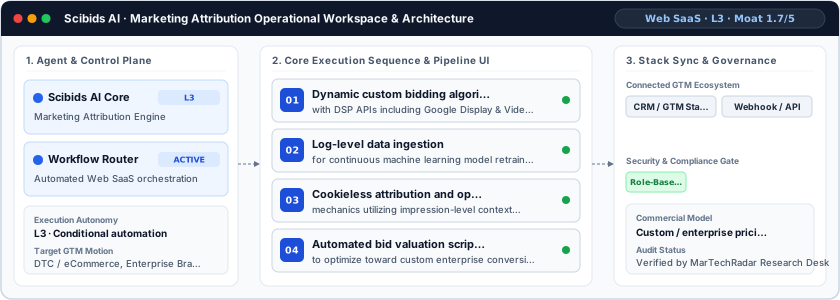
- Dynamic custom bidding algorithms integrated: with DSP APIs including Google Display & Video 360 and The Trade Desk
- Log-level data ingestion: for continuous machine learning model retraining and spend reallocation
- Cookieless attribution and optimization: mechanics utilizing impression-level context and programmatic metadata
- Automated bid valuation scripts designed: to optimize toward custom enterprise conversion KPIs
Cons: operational limitations & risks
- DSP API Rate Limits and Latency: Bid model synchronizations depend on external DSP API endpoint throughput, which can introduce latency bottlenecks during rapid campaign pacing adjustments.
- Conversion Data Sparsity: Algorithmic bid valuation degrades in accuracy when applied to low-volume niche campaigns that fail to generate sufficient conversion signals for statistical significance.
- Attribution Model Dependencies: The system relies heavily on clean upstream conversion definitions; incorrect tag governance or tracking pixel outages will contaminate bid-pricing algorithms.
Scibids AI TCO & deal-breaker stress test
Simulate 12-month stepped TCO, hidden cost multipliers, contract lock-in exposure, and stack failure modes using only facts verified by MarTechRadar Research Desk on 2026-10-16.
Scibids AI triggers high-severity friction under your 5-seat / $800/mo constraints. Benchmark the verified subtrack alternatives below before committing.
- Moat Score
- 1.7 / 5.0
- AI Autonomy
- L3
- Free Tier / Trial
- None disclosed
Triggered audit signals & failure modes
- Opaque Enterprise Quoting vs. SMB/Mid-Market BudgetVerified Pricing Ledger
Scibids AI does not disclose a public self-serve floor (Custom / enterprise pricing). Buyers with a $800/mo cap face high sales-qualification friction.
- Sales-Gated Contract TermsFact-checked by MarTechRadar Research Desk
Scibids AI delivers its technology through a bespoke enterprise contract structure rather than self-service software tiers. Commercial pricing is available on request through tailored enterprise sales quotes based on organizational scale and seats.
- Primary Operational Bottleneck: DSP API Rate Limits and LatencyAudit by MarTechRadar Research Desk
Bid model synchronizations depend on external DSP API endpoint throughput, which can introduce latency bottlenecks during rapid campaign pacing adjustments.
Test a custom Scibids AI budget or stack constraint
Lower 5-seat floor (~$39/mo vs. Custom Quote) · Transparent self-serve entry without mandatory annual lock-in
Offers a free tier (Free plan · Usage-based pricing) · Transparent self-serve entry without mandatory annual lock-in
Scibids AI AI moat & Marketing Attribution positioning
Proprietary bid-valuation algorithms integrated directly into major DSP APIs, driving algorithmic bidding without relying on third-party tracking cookies or persistent user identifiers.
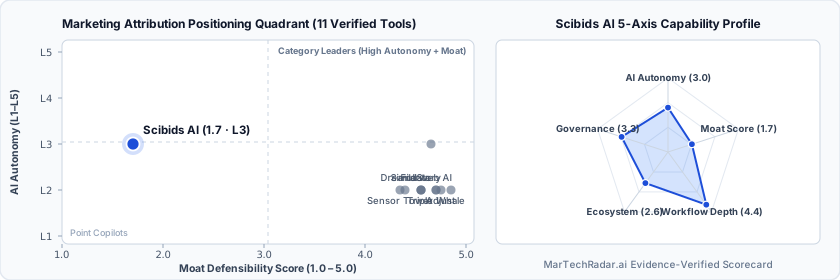
Scibids AI in-depth review, pricing & architecture analysis
Editor sign-off: Oct 16, 2026. How profiles are made.
What is Scibids AI? Overview & background
Headquartered in the United States, Scibids AI develops algorithmic optimization infrastructure engineered to replace manual bid management across digital advertising ecosystems. The platform targets programmatic traders, media directors, and performance marketing leads who require automated valuation models embedded directly into their demand-side platforms. Rather than relying on rigid platform heuristics, the system injects machine learning directly into programmatic bidding pipelines to align media spend with enterprise measurement objectives.
How Scibids AI works: architecture & workflow
At its technical foundation, Scibids AI acts as a decisioning layer between customer data pipelines and demand-side platforms like DV360 and The Trade Desk. The system ingests log-level ad exchange data, impression metadata, and downstream conversion feeds. Processing these inputs through supervised predictive algorithms, it computes dynamic bid adjustments for each programmatic auction. Operating at conditional autonomy, the platform generates updated bid valuations via automated API webhooks, eliminating manual pacing adjustments and rule-based spreadsheet updates.
Scibids AI limitations, drawbacks & risks
Operational considerations and platform boundaries include:
- DSP API Rate Limits and Latency: Bid model synchronizations depend on external DSP API endpoint throughput, which can introduce latency bottlenecks during rapid campaign pacing adjustments.
- Conversion Data Sparsity: Algorithmic bid valuation degrades in accuracy when applied to low-volume niche campaigns that fail to generate sufficient conversion signals for statistical significance.
- Attribution Model Dependencies: The system relies heavily on clean upstream conversion definitions; incorrect tag governance or tracking pixel outages will contaminate bid-pricing algorithms.
Scibids AI pricing, plans & cost breakdown
Scibids AI delivers its technology through a bespoke enterprise contract structure rather than self-service software tiers. Commercial pricing is available on request through tailored enterprise sales quotes based on organizational scale and seats. Contracts typically incorporate annual platform commitments linked to aggregate programmatic media volume running through the bidding algorithms, alongside dedicated technical support and custom integration scopes.
| Plan / Tier | Verified Price & Billing | Included Scope & Contract Terms |
|---|---|---|
| Enterprise / Custom | Custom quote | Custom-quoted plan; terms come from the vendor's sales team. |
How Scibids AI compares vs. competitors & alternatives
Compared to direct category competitors like Adverity and Fivetran, Scibids AI functions as an alternative focused on reliable workflow execution and transparent unit economics within the Marketing Attribution segment.
Direct competitors & market radar
Top algorithmic competitors based on category positioning, capability overlap, and ICP alignment.
Frequently asked questions about Scibids AI
Does Scibids AI publish pricing or require an enterprise quote?
Scibids AI pricing: Custom / enterprise pricing. No free plan is publicly disclosed. Scibids AI delivers its technology through a bespoke enterprise contract structure rather than self-service software tiers.
What are the top Scibids AI alternatives in Marketing Attribution?
Verified Marketing Attribution alternatives include Scowtt (Custom / enterprise pricing), Fivetran (Free plan · Usage-based pricing), CaliberMind (Pricing not disclosed), Corvera (Pricing not disclosed). Compared to direct category competitors like Adverity and Fivetran, Scibids AI functions as an alternative focused on reliable workflow execution and transparent unit economics within the Marketing Attribution segment.
What are the main limitations and trade-offs of Scibids AI?
Operational considerations and platform boundaries include: DSP API Rate Limits and Latency: Bid model synchronizations depend on external DSP API endpoint throughput, which can introduce latency bottlenecks during rapid campaign pacing adjustments. Walk away if you need published self-serve pricing: Scibids AI is sold by custom quote.
Verified sources & evidence trail
- Official product domain: https://scibids.com
- Commercial pricing verification: Verified against official vendor pricing policy (Custom / enterprise pricing)
- Editor sign-off: Oct 16, 2026 (how profiles are made).
