Roark Review (2026): AI Calling Pricing, Pros & Cons
Bottom line
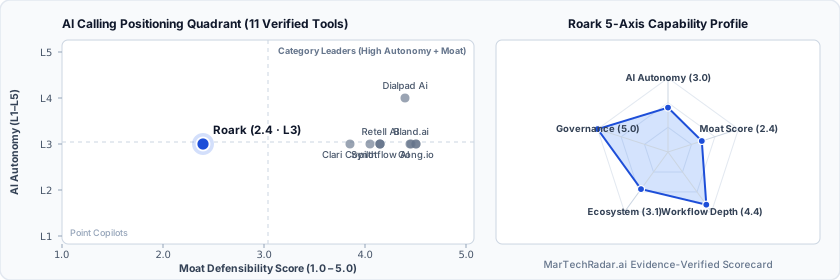
Roark is a Web SaaS tool for AI Calling (Conversational Voice Calling Agents) in AI SDR & Outbound. Pricing: Free plan · $500–$4,000/mo · Enterprise plan. Best suited to B2B Marketers, Revenue Operations and Growth Teams. Editor ratings: AI autonomy L3 (conditional automation); moat score 2.4/5.0 (Workflow-embedded). Fact-checked by MarTechRadar Research Desk on Oct 27, 2026.
Audio-native Voice AI testing, simulation replay, and 500+ metric production evaluation platform backed by Y Combinator.
Is Roark worth it in 2026? Buyer fit & when to walk away
Choose Roark if (Best Fit)
- Target ICP & Stack Fit: You operate as B2B Marketers, Revenue Operations and Growth Teams requiring a Web SaaS deployment for AI Calling.
- L3 Architecture & Defensibility: Roark builds a differentiated voice AI observability moat by scoring live and simulated calls across 500+ audio-native metrics, replaying real caller personas/accents, integrating with Vapi/Retell/LiveKit/Pipecat, and securing $500K in Y Combinator Pre-Seed backing.
- Commercial Model Fit: Your procurement budget aligns with Free plan · $500–$4,000/mo · Enterprise plan and want a self-serve free tier for zero-cost initial validation.
Walk away from Roark if (Deal-Breakers)
- Walk away if your team is at early validation stage with a <$250/mo tool budget (Roark starts at Free plan · $500–$4,000/mo · Enterprise plan before seat or usage expansion).
- Walk away if your workflow cannot tolerate primary operational trade-off: In practical enterprise deployments, the primary trade-off is that Roark bills simulation minutes plus underlying voice provider pass-through costs ($0.15/min on Pay-As-You-Go down to $0.05/min on Enterprise), meaning high-frequency CI/CD stress tests across thousands of minutes require committed monthly volume tiers to optimize unit economics.
- Walk away if functional scope boundary is a deal-breaker for your team: Roark is not built for standalone voice agent creation, outbound cold-email sequencing, or social media ad creative generation.
Roark pricing, free plan & scorecard at a glance
| Pricing | Free plan · $500–$4,000/mo · Enterprise planVendor pricing page |
|---|---|
| Free plan | Yes |
| Delivery | Web SaaS |
| Audience | B2B Marketers, Revenue Operations, Growth Teams |
| AI autonomy level | L3 · Conditional automationEditor-verified |
| Moat tier & score | 2.4 / 5.0 · Workflow-embeddedEditor-verified |
| Funding | Pre-seed |
| Total funding | $500KBacked by Y Combinator |
| Founders | Daniel Gauci, James Zammit |
| Company size | 11-50 employees |
| Compliance & governance | SOC 2, HIPAA |
| Headquarters | San Francisco, California, United States |
| Founded | 2025 |
| Last verified | Oct 27, 2026 |
Roark pros & cons: strengths vs. operational limitations
Pros: core strengths & capabilities
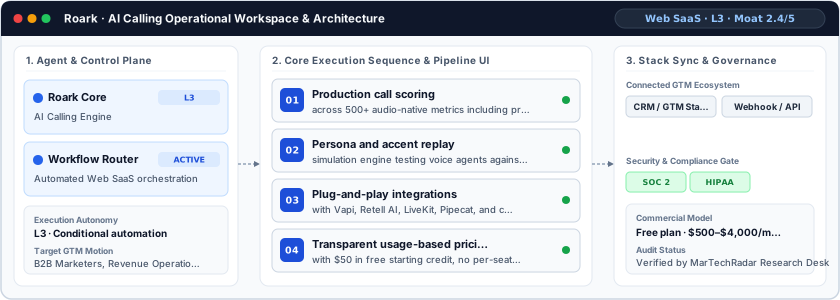
- Production call scoring: across 500+ audio-native metrics including pronunciation accuracy, turn-taking latency, acoustic glitches, and task completion
- Persona and accent replay: simulation engine testing voice agents against realistic caller interruptions and acoustic environments before release
- Plug-and-play integrations: with Vapi, Retell AI, LiveKit, Pipecat, and custom telephony stacks under SOC 2 Type II and HIPAA BAA compliance
- Transparent usage-based pricing: with $50 in free starting credit, no per-seat licenses, and no per-metric surcharges
Cons: operational limitations & risks
- Primary Operational Trade-Off: In practical enterprise deployments, the primary trade-off is that Roark bills simulation minutes plus underlying voice provider pass-through costs ($0.15/min on Pay-As-You-Go down to $0.05/min on Enterprise), meaning high-frequency CI/CD stress tests across thousands of minutes require committed monthly volume tiers to optimize unit economics.
- Functional Scope Boundary: Roark is not built for standalone voice agent creation, outbound cold-email sequencing, or social media ad creative generation.
- Deployment & Governance Considerations: Additionally, regulated healthcare and enterprise organizations requiring custom volume commitments, invoiced billing, and dedicated SLA support should evaluate the Team ($500/month) or Enterprise ($4,000+/month) plans.
Roark TCO & deal-breaker stress test
Simulate 12-month stepped TCO, hidden cost multipliers, contract lock-in exposure, and stack failure modes using only facts verified by MarTechRadar Research Desk on 2026-10-27 · Capture SHA 3f16e5d7.
Roark aligns with your 5-seat / $800/mo profile. Review the walk-away triggers and contract levers below before deployment.
- Moat Score
- 2.4 / 5.0
- AI Autonomy
- L3
- Free Tier / Trial
- Free plan
Triggered audit signals & failure modes
- Published Self-Serve Entry FloorVerified Pricing Ledger
Roark publishes a transparent entry point (Free plan · $500–$4,000/mo · Enterprise plan) with a free tier for initial validation before committing.
- Primary Operational Bottleneck: Deployment & Governance ConsiderationsAudit by MarTechRadar Research Desk
Additionally, regulated healthcare and enterprise organizations requiring custom volume commitments, invoiced billing, and dedicated SLA support should evaluate the Team ($500/month) or Enterprise ($4,000+/month) plans.
Test a custom Roark budget or stack constraint
Lower 5-seat floor (~$100/mo vs. From $500 / mo)
Lower 5-seat floor (~$150/mo vs. From $500 / mo)
Roark integrations, API, security & compliance stack
Roark AI moat & AI Calling positioning
Roark builds a differentiated voice AI observability moat by scoring live and simulated calls across 500+ audio-native metrics, replaying real caller personas/accents, integrating with Vapi/Retell/LiveKit/Pipecat, and securing $500K in Y Combinator Pre-Seed backing.
Roark in-depth review, pricing & architecture analysis
Audited by MarTechRadar Research Desk (Evidence-Ledger Verified) on Oct 27, 2026.
What is Roark? Overview & background
Roark is an audio-native quality assurance, simulation, and evaluation platform engineered for teams running production Voice AI agents. Founded in 2025 by Daniel Gauci and James Zammit and headquartered in San Francisco, California, the Y Combinator (Winter 2025) company operates with 11 to 50 employees and has raised $500K in Pre-Seed funding from Y Combinator. Positioned explicitly as a dedicated QA and evals layer rather than another voice agent builder, Roark integrates with Vapi, Retell, LiveKit, and Pipecat to help teams catch what breaks in production and ship fixes with empirical evidence, capturing searches for roark voice ai evals, roark ai pricing, and audio native voice agent monitoring.
How Roark works: architecture & workflow
At the technical core of Roark is an audio-first evaluation loop that inspects both the raw acoustic waveform and conversational flow of every phone call across more than 500 specialized metrics. Unlike transcript-only evaluators that miss mispronounced medical or financial terms, awkward overlapping speech, or dead air, Roark measures pronunciation accuracy, turn-taking cadence, sentiment trajectories, and tool-call correctness on every live call. When a production call exposes a weakness, teams can replay the exact caller persona, regional accent, and background noise profile in Roark's simulation engine to validate prompt or model changes before deploying to customers.
Roark limitations, drawbacks & risks
Operational considerations and platform boundaries include:
- Primary Operational Trade-Off: In practical enterprise deployments, the primary trade-off is that Roark bills simulation minutes plus underlying voice provider pass-through costs ($0.15/min on Pay-As-You-Go down to $0.05/min on Enterprise), meaning high-frequency CI/CD stress tests across thousands of minutes require committed monthly volume tiers to optimize unit economics.
- Functional Scope Boundary: Roark is not built for standalone voice agent creation, outbound cold-email sequencing, or social media ad creative generation.
- Deployment & Governance Considerations: Additionally, regulated healthcare and enterprise organizations requiring custom volume commitments, invoiced billing, and dedicated SLA support should evaluate the Team ($500/month) or Enterprise ($4,000+/month) plans.
Roark pricing, plans & cost breakdown
Pay-As-You-Go starting at $0 with $50 free credit ($0.15/min simulation, $0.02–$0.04/min metric evaluation), Team at $500/month ($0.10/min simulation), and Enterprise from $4,000+/month ($0.05/min simulation). On its official pricing page (roark.ai/pricing), Roark charges no seat licenses and no per-metric tax across three tiers: Pay-As-You-Go at $0 to start with $50 in free credit (no card required, $0.15/min simulation rate plus provider costs), Team at $500/month (where the entire $500 is spent as usage at a reduced $0.10/min simulation rate for teams running roughly 3,300+ minutes/month), and Enterprise from $4,000+/month committed usage (dropping simulation rates to $0.05/min).
| Plan / Tier | Verified Price & Billing | Target Seat / Scale Fit | Included Scope & Contract Terms |
|---|---|---|---|
| Free / Sandbox | $0 | 1–2 seats (Evaluation) | Entry free tier with capped usage or feature quotas for initial workflow testing. |
| Team | $500/mo | 1–2 seats | Verified $500/mo Team tier from vendor pricing schedule. |
| Enterprise / Custom | Custom quote | 15–50+ seats (Enterprise SLA) | Sales-negotiated annual contract for custom volume, SSO/RBAC governance, and dedicated SLA. |
| Contract Watchout: Credit & Usage Burn Multiplier | Workflows on Roark consume metered credits or usage quotas; voice/media minutes, multi-step synthesis, or high-frequency runs can exhaust base allocations and trigger mid-cycle top-up packs. | ||
How Roark compares vs. competitors & alternatives
In the voice AI evaluation and observability space, Roark competes with Coval, Cekura, and Hamming AI. Compared to platforms that charge per-seat fees or limit the number of evaluation metrics scored per call on entry tiers, Roark differentiates itself through its 500+ audio-native metric library (including pronunciation scoring), $50 no-card free credit, and zero seat or metric surcharges. Voice AI engineers running Vapi, Retell, LiveKit, or Pipecat in production should evaluate Roark.
Frequently asked questions about Roark
How much does Roark cost in 2026?
Roark pricing: Free plan · $500–$4,000/mo · Enterprise plan. A permanent free plan is available. Published tiers: Free / Sandbox ($0); Team ($500/mo); Enterprise / Custom (Custom quote). Pay-As-You-Go starting at $0 with $50 free credit ($0.15/min simulation, $0.02–$0.04/min metric evaluation), Team at $500/month ($0.10/min simulation), and Enterprise from $4,000+/month ($0.05/min simulation).
What are the top Roark alternatives in AI Calling?
Verified AI Calling alternatives include Coval ($100–$4,500/mo · Enterprise plan), Cekura (Free plan · From $30/seat/mo · Enterprise plan), Hamming AI (Custom / enterprise pricing), Phonely AI (Custom / enterprise pricing). In the voice AI evaluation and observability space, Roark competes with Coval, Cekura, and Hamming AI.
Verified sources & evidence trail
- Official product domain: https://roark.ai
- Commercial pricing verification: https://roark.ai/pricing
- Verified corporate entity profiles (
sameAs): LinkedIn Company Profile · Crunchbase Entity Record - Editorial audit sign-off: Audited by MarTechRadar Research Desk (Evidence-Ledger Verified) on Oct 27, 2026.
