Cekura Review (2026): AI Calling Pricing, Pros & Cons
Bottom line
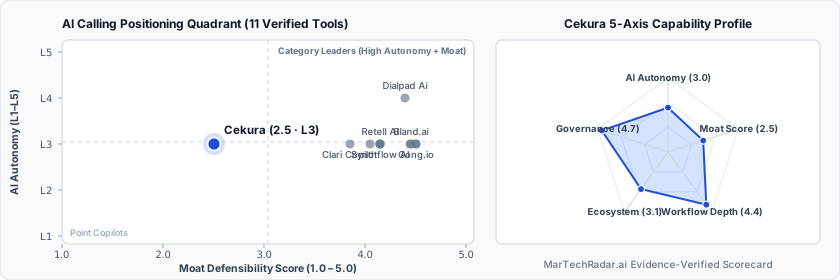
Cekura is a Web SaaS tool for AI Calling (Conversational Voice Calling Agents) in AI SDR & Outbound. Pricing: Free plan · From $30/seat/mo · Enterprise plan. Best suited to B2B Marketers, Revenue Operations and Growth Teams. Editor ratings: AI autonomy L3 (conditional automation); moat score 2.5/5.0 (Workflow-embedded). Fact-checked by MarTechRadar Research Desk on Oct 27, 2026.
Automated QA, adversarial simulation, and production call monitoring platform built for enterprise Voice AI and Chat AI agents.
Is Cekura worth it in 2026? Buyer fit & when to walk away
Choose Cekura if (Best Fit)
- Target ICP & Stack Fit: You operate as B2B Marketers, Revenue Operations and Growth Teams requiring a Web SaaS deployment for AI Calling.
- L3 Architecture & Defensibility: Cekura commands a strong voice AI reliability moat through its closed-loop simulation-to-production remediation engine, adversarial red-teaming suite, Deloitte enterprise adoption, and $2.9M in Seed funding backed by Y Combinator, Pioneer Fund, and Flex Capital.
- Commercial Model Fit: Your procurement budget aligns with Free plan · From $30/seat/mo · Enterprise plan and want a self-serve free tier for zero-cost initial validation.
Walk away from Cekura if (Deal-Breakers)
- Walk away if your workflow requires uncapped enterprise volume on the Free plan · From $30/seat/mo · Enterprise plan entry plan without upgrading tiers.
- Walk away if your workflow cannot tolerate primary operational trade-off: In practical enterprise deployments, the primary trade-off is that Cekura is a specialized QA, evaluation, and observability layer for conversational agents rather than a telephony carrier or outbound sales contact database.
- Walk away if functional scope boundary is a deal-breaker for your team: Cekura is not built for static display ad generation, B2B email list scraping, or e-commerce shopping cart recovery.
Cekura pricing, free plan & scorecard at a glance
| Pricing | Free plan · From $30/seat/mo · Enterprise planVendor pricing page |
|---|---|
| Free plan | Yes |
| Delivery | Web SaaS |
| Audience | B2B Marketers, Revenue Operations, Growth Teams |
| AI autonomy level | L3 · Conditional automationEditor-verified |
| Moat tier & score | 2.5 / 5.0 · Workflow-embeddedEditor-verified |
| Funding | Seed |
| Total funding | $2.9MBacked by Y Combinator, Pioneer Fund, Flex Capital, Team Ignite Ventures, Imagination Capital |
| Founders | Shashij Gupta, Sidhant Kabra, Tarush Agarwal |
| Company size | 2-10 employees |
| Compliance & governance | HIPAA |
| Headquarters | San Francisco, California, United States |
| Founded | 2024 |
| Last verified | Oct 27, 2026 |
Cekura pros & cons: strengths vs. operational limitations
Pros: core strengths & capabilities
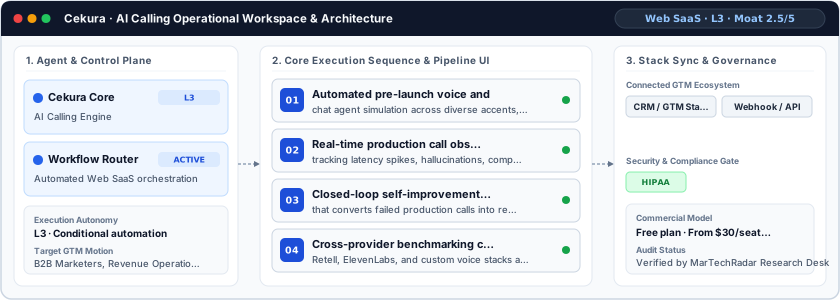
- Automated pre-launch voice and: chat agent simulation across diverse accents, background noise profiles, and adversarial red-teaming scenarios
- Real-time production call observability: tracking latency spikes, hallucinations, compliance breaches, and tool-calling failures
- Closed-loop self-improvement engine: that converts failed production calls into reproducible regression evals and suggests prompt fixes
- Cross-provider benchmarking comparing Vapi,: Retell, ElevenLabs, and custom voice stacks across 40+ standardized evaluation scenarios
Cons: operational limitations & risks
- Primary Operational Trade-Off: In practical enterprise deployments, the primary trade-off is that Cekura is a specialized QA, evaluation, and observability layer for conversational agents rather than a telephony carrier or outbound sales contact database.
- Functional Scope Boundary: Cekura is not built for static display ad generation, B2B email list scraping, or e-commerce shopping cart recovery.
- Deployment & Governance Considerations: Additionally, healthcare and regulated financial teams requiring a signed HIPAA BAA, Data Processing Agreement (DPA), 50 concurrent simulation calls, and 90-day log retention must upgrade from the Pay-As-You-Go tier to the $500/month Startup Plan or a custom Enterprise contract.
Cekura TCO & deal-breaker stress test
Simulate 12-month stepped TCO, hidden cost multipliers, contract lock-in exposure, and stack failure modes using only facts verified by MarTechRadar Research Desk on 2026-10-27 · Capture SHA da57ddac.
Cekura aligns with your 5-seat / $800/mo profile. Review the walk-away triggers and contract levers below before deployment.
- Moat Score
- 2.5 / 5.0
- AI Autonomy
- L3
- Free Tier / Trial
- Free plan
Triggered audit signals & failure modes
- Published Self-Serve Entry FloorVerified Pricing Ledger
Cekura publishes a transparent entry point (Free plan · From $30/seat/mo · Enterprise plan) with a free tier for initial validation before committing.
- Linear Per-Seat Scaling (5 Seats × $30/seat/mo)Commercial Model Audit
Base license scales linearly with operator headcount ($150/mo for 5 seats on Entry Per-Seat Tier).
- Primary Operational Bottleneck: Deployment & Governance ConsiderationsAudit by MarTechRadar Research Desk
Additionally, healthcare and regulated financial teams requiring a signed HIPAA BAA, Data Processing Agreement (DPA), 50 concurrent simulation calls, and 90-day log retention must upgrade from the Pay-As-You-Go tier to the $500/month Startup Plan or a custom Enterprise contract.
Test a custom Cekura budget or stack constraint
Lower 5-seat floor (~$100/mo vs. $150 / mo)
Fits within $800/mo budget (Free plan · $500–$4,000/mo · Enterprise plan)
Cekura integrations, API, security & compliance stack
Cekura AI moat & AI Calling positioning
Cekura commands a strong voice AI reliability moat through its closed-loop simulation-to-production remediation engine, adversarial red-teaming suite, Deloitte enterprise adoption, and $2.9M in Seed funding backed by Y Combinator, Pioneer Fund, and Flex Capital.
Cekura in-depth review, pricing & architecture analysis
Audited by MarTechRadar Research Desk (Evidence-Ledger Verified) on Oct 27, 2026.
What is Cekura? Overview & background
Cekura (formerly Vocera AI) is an automated quality assurance, simulation testing, and production observability platform purpose-built for enterprise Voice AI and Chat AI customer agents. Founded in 2024 by Shashij Gupta, Sidhant Kabra, and Tarush Agarwal and headquartered in San Francisco, California, the Y Combinator (Fall 2024) company operates with 2 to 10 employees and has raised $2.9M in Seed funding backed by Y Combinator, Pioneer Fund, Flex Capital, Team Ignite Ventures, and Imagination Capital. Trusted by enterprise teams including Deloitte, Cekura serves as the reliability layer for conversational AI deployments, capturing high-intent buyer searches for voice ai agent testing platform, cekura pricing, and automated qa for vapi and retell agents.
How Cekura works: architecture & workflow
At the technical core of Cekura is a closed-loop evaluation and self-improvement architecture linking pre-deployment simulation with live production telemetry. Before a voice agent goes live, Cekura stress-tests it against synthetic callers with varied regional accents, interruptions, background noise, and adversarial red-teaming prompts to probe for jailbreaks, PII leaks, and off-script behavior. Once in production, Cekura monitors live calls across providers like Vapi, Retell, and ElevenLabs; whenever a call fails or violates compliance rules, the platform flags the incident, reproduces the exact failure mode inside a sandbox simulation, suggests a prompt or workflow patch, and re-runs the regression gate automatically.
Cekura limitations, drawbacks & risks
Operational considerations and platform boundaries include:
- Primary Operational Trade-Off: In practical enterprise deployments, the primary trade-off is that Cekura is a specialized QA, evaluation, and observability layer for conversational agents rather than a telephony carrier or outbound sales contact database.
- Functional Scope Boundary: Cekura is not built for static display ad generation, B2B email list scraping, or e-commerce shopping cart recovery.
- Deployment & Governance Considerations: Additionally, healthcare and regulated financial teams requiring a signed HIPAA BAA, Data Processing Agreement (DPA), 50 concurrent simulation calls, and 90-day log retention must upgrade from the Pay-As-You-Go tier to the $500/month Startup Plan or a custom Enterprise contract.
Cekura pricing, plans & cost breakdown
Pay-As-You-Go starting at $0 first user free ($0.25/voice testing min, $0.05/monitored call min, $30/mo per extra seat), Startup Plan at $500/month (~2,000 testing mins, ~10,000 monitored calls, 10 seats, signed BAA/DPA), and Custom Enterprise. On its official pricing page (cekura.ai/pricing), Cekura offers transparent usage-based tiers: Pay-As-You-Go with $0 for the first user (no credit card required), $0.25 per voice testing minute, $0.05 per monitored call, 10 concurrent calls, 30-day log retention, and $30/month per additional seat; a Startup Plan at $500/month (month-to-month, including approximately 2,000 minutes of voice testing, 10,000 monitored calls, 50 concurrent calls, 10 seats, and a signed BAA and DPA); and Custom Enterprise plans.
| Plan / Tier | Verified Price & Billing | Target Seat / Scale Fit | Included Scope & Contract Terms |
|---|---|---|---|
| Free / Sandbox | $0 | 1–2 seats (Evaluation) | Entry free tier with capped usage or feature quotas for initial workflow testing. |
| Enterprise / Custom | Custom quote | 15–50+ seats (Enterprise SLA) | Sales-negotiated annual contract for custom volume, SSO/RBAC governance, and dedicated SLA. |
| Contract Watchout: Per-Seat Linear Scaling | Cekura prices licenses on a per-user/seat basis (Free plan · From $30/seat/mo · Enterprise plan); expanding from 2 to 15+ operators multiplies base recurring spend linearly. | ||
How Cekura compares vs. competitors & alternatives
In the voice AI evaluation and conversational observability market, Cekura competes with Hamming AI, Coval, and Roark, alongside voice agent platforms with basic built-in analytics such as Retell AI and Vapi. Compared to manual QA teams listening to random call recordings in spreadsheets, Cekura differentiates itself through its automated failure-to-eval reproduction loop, cross-platform voice benchmarking, and $0.25/minute pay-as-you-go accessibility. Engineering and CX teams scaling production voice agents should evaluate Cekura.
Frequently asked questions about Cekura
How much does Cekura cost in 2026?
Cekura pricing: Free plan · From $30/seat/mo · Enterprise plan. A permanent free plan is available. Published tiers: Free / Sandbox ($0); Enterprise / Custom (Custom quote). Pay-As-You-Go starting at $0 first user free ($0.25/voice testing min, $0.05/monitored call min, $30/mo per extra seat), Startup Plan at $500/month (~2,000 testing mins, ~10,000 monitored calls, 10 seats, signed BAA/DPA), and Custom Enterprise.
What are the top Cekura alternatives in AI Calling?
Verified AI Calling alternatives include Retell AI (Usage-based pricing), Coval ($100–$4,500/mo · Enterprise plan), Roark (Free plan · $500–$4,000/mo · Enterprise plan), Hamming AI (Custom / enterprise pricing). In the voice AI evaluation and conversational observability market, Cekura competes with Hamming AI, Coval, and Roark, alongside voice agent platforms with basic built-in analytics such as Retell AI and Vapi.
Verified sources & evidence trail
- Official product domain: https://www.cekura.ai
- Commercial pricing verification: https://www.cekura.ai/pricing
- Verified corporate entity profiles (
sameAs): LinkedIn Company Profile · Crunchbase Entity Record - Editorial audit sign-off: Audited by MarTechRadar Research Desk (Evidence-Ledger Verified) on Oct 27, 2026.
