Relight AI Review (2026): AI Product Photography Pricing, Pros & Cons
Bottom line
Relight AI is a Web SaaS tool for AI Product Photography (Product Photography & AI Retouching) in Visual & Creative Media. Pricing: Custom / enterprise pricing. Best suited to DTC / eCommerce. Editor ratings: AI autonomy L2 (workflow copilot); moat score 1.8/5.0 (Thin wrapper). Fact-checked by MarTechRadar Research Desk on Oct 15, 2026.
AI-assisted relighting engine utilizing neural inverse rendering, surface normal estimation, and depth mapping to adjust studio lighting on product visuals.
Is Relight AI worth it in 2026? Buyer fit & when to walk away
Choose Relight AI if (Best Fit)
- Target ICP & Stack Fit: You operate as DTC / eCommerce requiring a Web SaaS deployment for AI Product Photography.
- L2 Architecture & Defensibility: Relight AI's technical moat centers on specialized neural inverse rendering algorithms that deconstruct 2D images into albedo, depth, and surface normal maps without requiring physical 3D scans. However, absent proprietary hardware partnerships or broad enterprise asset integrations, its defensibility remains vulnerable to general-purpose diffusion models with native spatial relighting conditioning.
- Commercial Model Fit: Your procurement budget aligns with Custom / enterprise pricing.
Walk away from Relight AI if (Deal-Breakers)
- Walk away if you need published self-serve pricing: Relight AI is sold by custom quote.
- Walk away if your workflow cannot tolerate high-frequency surface reflection artifacts: Complex reflective surfaces such as polished chrome, transparent glass, and fine jewelry distort neural normal predictions, often creating patchy specular highlights or unrealistic shadow boundaries.
- Walk away if batch rendering latency at high resolutions is a deal-breaker for your team: Processing ultra-high-resolution print assets exceeding 30 megapixels creates compute bottlenecks, forcing downsampling during intermediate normal extraction that degrades micro-texture sharpness.
Relight AI pricing, free plan & scorecard at a glance
| Pricing | Custom / enterprise pricing |
|---|---|
| Free plan | No / not disclosed |
| Delivery | Web SaaS |
| Audience | DTC / eCommerce |
| AI autonomy level | L2 · Workflow copilotEditor-verified |
| Moat tier & score | 1.8 / 5.0 · Thin wrapperEditor-verified |
| Funding | Pre-seed |
| Company size | 2-10 employees |
| Headquarters | United States |
| Last verified | Oct 15, 2026 |
Relight AI pros & cons: strengths vs. operational limitations
Pros: core strengths & capabilities
- Neural surface normal estimation: to calculate 3D geometric orientation across 2D asset surfaces
- Monocular depth mapping: for accurate spatial light falloff and occlusion management
- Synthetic directional light-source positioning: with variable intensity, falloff, and color temperature
- Diffuse albedo separation: to prevent highlight blowout while preserving underlying material textures
Cons: operational limitations & risks
- High-frequency surface reflection artifacts: Complex reflective surfaces such as polished chrome, transparent glass, and fine jewelry distort neural normal predictions, often creating patchy specular highlights or unrealistic shadow boundaries.
- Batch rendering latency at high resolutions: Processing ultra-high-resolution print assets exceeding 30 megapixels creates compute bottlenecks, forcing downsampling during intermediate normal extraction that degrades micro-texture sharpness.
- Absence of real-time multi-angle synchronization: The system re-illuminates single images in isolation; multi-angle product carousels require manual coordinate alignment across views to prevent mismatched shadow lengths across sequential product frames.
Relight AI TCO & deal-breaker stress test
Simulate 12-month stepped TCO, hidden cost multipliers, contract lock-in exposure, and stack failure modes using only facts verified by MarTechRadar Research Desk on 2026-10-15.
Relight AI triggers high-severity friction under your 5-seat / $800/mo constraints. Benchmark the verified subtrack alternatives below before committing.
- Moat Score
- 1.8 / 5.0
- AI Autonomy
- L2
- Free Tier / Trial
- None disclosed
Triggered audit signals & failure modes
- Opaque Enterprise Quoting vs. SMB/Mid-Market BudgetVerified Pricing Ledger
Relight AI does not disclose a public self-serve floor (Custom / enterprise pricing). Buyers with a $800/mo cap face high sales-qualification friction.
- Sales-Gated Contract TermsFact-checked by MarTechRadar Research Desk
Relight AI provides commercial access exclusively through custom enterprise quotes based on organizational seat counts, catalog throughput volumes, and compute bandwidth requirements.
- Primary Operational Bottleneck: High-frequency surface reflection artifactsAudit by MarTechRadar Research Desk
Complex reflective surfaces such as polished chrome, transparent glass, and fine jewelry distort neural normal predictions, often creating patchy specular highlights or unrealistic shadow boundaries.
Test a custom Relight AI budget or stack constraint
Lower 5-seat floor (~$99/mo vs. Custom Quote) · Transparent self-serve entry without mandatory annual lock-in
Lower 5-seat floor (~$5/mo vs. Custom Quote) · Transparent self-serve entry without mandatory annual lock-in
Relight AI AI moat & AI Product Photography positioning
Relight AI's technical moat centers on specialized neural inverse rendering algorithms that deconstruct 2D images into albedo, depth, and surface normal maps without requiring physical 3D scans. However, absent proprietary hardware partnerships or broad enterprise asset integrations, its defensibility remains vulnerable to general-purpose diffusion models with native spatial relighting conditioning.
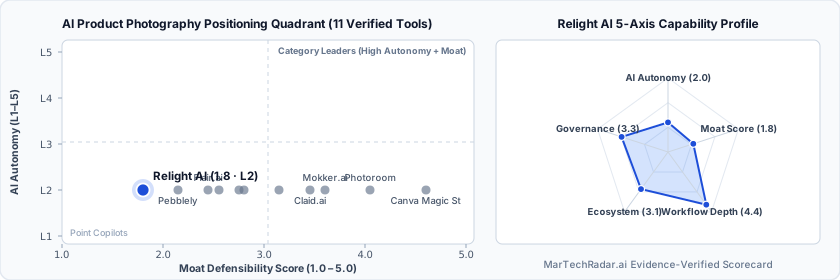
Relight AI in-depth review, pricing & architecture analysis
Editor sign-off: Oct 15, 2026. How profiles are made.
What is Relight AI? Overview & background
In visual commerce pipelines, catalog updates frequently stall when merchandise images photographed under mismatched studio conditions cannot achieve visual uniformity across digital storefronts. Headquartered in the United States, Relight AI addresses this operational hurdle for creative production leads, catalog merchandising teams, and digital asset managers. The platform re-engineers lighting consistency across two-dimensional commercial photography by reconstructing spatial geometry directly from raster pixels. Within digital asset management and production ecosystems, the software operates as a focused post-production utility designed to eliminate costly physical re-shoots caused by divergent illumination, mismatched color temperatures, or uneven shadow angles.
How Relight AI works: architecture & workflow
Under the hood, the processing pipeline relies on neural inverse rendering to decompose a standard 2D image into intrinsic components: base albedo, monocular depth, and surface normal vectors. Convolutional networks predict geometric contours and material reflectance, generating an intermediate 3D mesh proxy from flat imagery. Users position virtual omnidirectional or directional light sources within a simulated coordinate space, dictating luminance, angle, and chromaticity. The system recalculates specular reflections, shadow cast trajectories, and ambient occlusion using spherical harmonic illumination models. This task-automation workflow runs server-side inference on distributed GPU clusters, outputting re-lit assets that preserve native textures without manual layer masking.
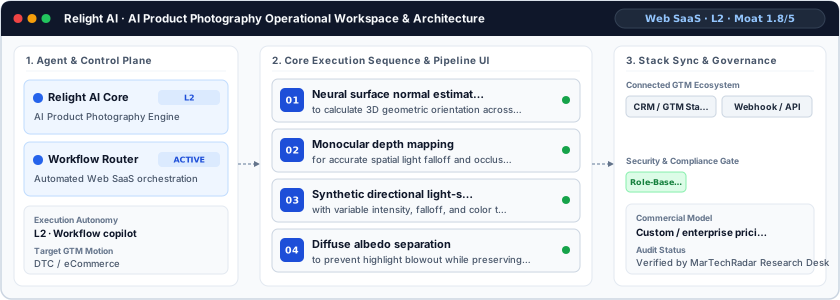
Relight AI limitations, drawbacks & risks
Operational considerations and platform boundaries include:
- High-frequency surface reflection artifacts: Complex reflective surfaces such as polished chrome, transparent glass, and fine jewelry distort neural normal predictions, often creating patchy specular highlights or unrealistic shadow boundaries.
- Batch rendering latency at high resolutions: Processing ultra-high-resolution print assets exceeding 30 megapixels creates compute bottlenecks, forcing downsampling during intermediate normal extraction that degrades micro-texture sharpness.
- Absence of real-time multi-angle synchronization: The system re-illuminates single images in isolation; multi-angle product carousels require manual coordinate alignment across views to prevent mismatched shadow lengths across sequential product frames.
Relight AI pricing, plans & cost breakdown
Relight AI provides commercial access exclusively through custom enterprise quotes based on organizational seat counts, catalog throughput volumes, and compute bandwidth requirements. Organizations must contact the vendor's direct sales team to establish service level agreements, custom API concurrency thresholds, and tailored enterprise licensing arrangements. Pricing is available on request through tailored enterprise sales quotes, with custom enterprise tiers, subscription plans, and seat licenses structured around organizational scale and monthly workflow volume.
| Plan / Tier | Verified Price & Billing | Included Scope & Contract Terms |
|---|---|---|
| Enterprise / Custom | Custom quote | Custom-quoted plan; terms come from the vendor's sales team. |
How Relight AI compares vs. competitors & alternatives
Within the product photography and visual retouching landscape, Relight AI competes alongside Blunge, Caimera, and Clova. While Blunge focuses primarily on synthetic generative background replacement and Clova integrates relighting into broad visual AI toolkits, Relight AI isolates light-field adjustments through neural normal reconstruction. Caimera delivers end-to-end synthetic asset generation, whereas Relight AI targets post-capture corrections on existing physical photography. The solution fits mid-market and enterprise retail brands that retain vast archival catalogs requiring visual normalization across multi-vendor digital marketplaces without generating fully synthetic imagery.
Frequently asked questions about Relight AI
Does Relight AI publish pricing or require an enterprise quote?
Relight AI pricing: Custom / enterprise pricing. No free plan is publicly disclosed. Relight AI provides commercial access exclusively through custom enterprise quotes based on organizational seat counts, catalog throughput volumes, and compute bandwidth requirements.
What are the top Relight AI alternatives in AI Product Photography?
Verified AI Product Photography alternatives include Booth.ai (Custom / enterprise pricing), Sume (Usage-based pricing), Erase.bg (From $5 usage-based · Enterprise plan), Figcel (Free plan · $99–$199/mo). Within the product photography and visual retouching landscape, Relight AI competes alongside Blunge, Caimera, and Clova.
What are the main limitations and trade-offs of Relight AI?
Operational considerations and platform boundaries include: High-frequency surface reflection artifacts: Complex reflective surfaces such as polished chrome, transparent glass, and fine jewelry distort neural normal predictions, often creating patchy specular highlights or unrealistic shadow boundaries. Walk away if you need published self-serve pricing: Relight AI is sold by custom quote.
Verified sources & evidence trail
- Official product domain: https://relight.ai
- Commercial pricing verification: Verified against official vendor pricing policy (Custom / enterprise pricing)
- Verified corporate entity profiles (
sameAs): LinkedIn Company Profile - Editor sign-off: Oct 15, 2026 (how profiles are made).
