Canva Magic Studio Review (2026): AI Product Photography Pricing, Pros & Cons
Bottom line
Canva Magic Studio is a Web SaaS tool for AI Product Photography (Product Photography & AI Retouching) in Visual & Creative Media. Pricing: Custom / enterprise pricing. Best suited to DTC / eCommerce, Enterprise Brands and Creators / Solo. Editor ratings: AI autonomy L2 (workflow copilot); moat score 4.6/5.0 (Proprietary moat (category leader)). Fact-checked by MarTechRadar Research Desk on Oct 15, 2026.
Suite of generative AI design tools integrated into Canva, offering automated background replacement, generative fill, and visual asset adaptation.
Is Canva Magic Studio worth it in 2026? Buyer fit & when to walk away
Choose Canva Magic Studio if (Best Fit)
- Target ICP & Stack Fit: You operate as DTC / eCommerce, Enterprise Brands and Creators / Solo requiring a Web SaaS deployment for AI Product Photography.
- L2 Architecture & Defensibility: Deep distribution within an established collaborative design ecosystem, unified multi-modal editing pipelines, and direct integration between synthetic image generation and vector publishing canvases.
- Commercial Model Fit: Your procurement budget aligns with Custom / enterprise pricing and want a self-serve free tier for zero-cost initial validation.
Walk away from Canva Magic Studio if (Deal-Breakers)
- Walk away if you need published self-serve pricing: Canva Magic Studio is sold by custom quote.
- Walk away if your workflow cannot tolerate high-resolution raster compression: Generative infill and synthesis operations enforce strict pixel-dimension caps, compressing high-resolution commercial photography down to standard web formats during multi-layer compositing.
- Walk away if fine-grained boundary hallucination is a deal-breaker for your team: Automated subject segmentation degrades when processing semi-translucent product surfaces, delicate textures, or intricate shadow gradients, requiring manual mask clean-up.
Canva Magic Studio pricing, free plan & scorecard at a glance
| Pricing | Custom / enterprise pricingVendor pricing page |
|---|---|
| Free plan | Yes |
| Delivery | Web SaaS |
| Audience | DTC / eCommerce, Enterprise Brands, Creators / Solo |
| AI autonomy level | L2 · Workflow copilotEditor-verified |
| Moat tier & score | 4.6 / 5.0 · Proprietary moat (category leader)Editor-verified |
| Funding | Undisclosed |
| Governance & docs | Trust & Security ↗ · API & Docs ↗ · Terms ↗ · Privacy ↗ |
| Headquarters | Australia |
| Founded | 2012 |
| Last verified | Oct 15, 2026 |
Canva Magic Studio pros & cons: strengths vs. operational limitations
Pros: core strengths & capabilities
- Magic Eraser and Magic Grab: for semantic object extraction and repositioning
- Magic Switch: for cross-format visual restructuring and automated asset resizing
- Generative fill and text-to-image: synthesis embedded directly within raster canvas workflows
- Brand kit controls enforcing: automated color and typography governance across generated imagery
Cons: operational limitations & risks
- High-Resolution Raster Compression: Generative infill and synthesis operations enforce strict pixel-dimension caps, compressing high-resolution commercial photography down to standard web formats during multi-layer compositing.
- Fine-Grained Boundary Hallucination: Automated subject segmentation degrades when processing semi-translucent product surfaces, delicate textures, or intricate shadow gradients, requiring manual mask clean-up.
- Batch Throughput Latency: Lacking programmatic headless API ingestion for bulk SKU retouching, operations demand manual canvas-by-canvas execution that slows multi-catalog e-commerce pipelines.
Canva Magic Studio TCO & deal-breaker stress test
Simulate 12-month stepped TCO, hidden cost multipliers, contract lock-in exposure, and stack failure modes using only facts verified by MarTechRadar Research Desk on 2026-10-15 · Capture SHA 67714bdb.
Canva Magic Studio is viable for 5 seats, but requires commercial or technical verification on the flagged items below.
- Moat Score
- 4.6 / 5.0
- AI Autonomy
- L2
- Free Tier / Trial
- Free plan
Triggered audit signals & failure modes
- Opaque Enterprise Quoting vs. SMB/Mid-Market BudgetVerified Pricing Ledger
Canva Magic Studio does not disclose a public self-serve floor (Custom / enterprise pricing). Buyers with a $800/mo cap face high sales-qualification friction.
- Published Self-Serve Entry FloorVerified Pricing Ledger
Canva Magic Studio publishes a transparent entry point (Custom / enterprise pricing) with a free tier for initial validation before committing.
- Primary Operational Bottleneck: High-Resolution Raster CompressionAudit by MarTechRadar Research Desk
Generative infill and synthesis operations enforce strict pixel-dimension caps, compressing high-resolution commercial photography down to standard web formats during multi-layer compositing.
Test a custom Canva Magic Studio budget or stack constraint
Lower 5-seat floor (~$75/mo vs. Custom Quote)
Lower 5-seat floor (~$10/mo vs. Custom Quote)
Canva Magic Studio AI moat & AI Product Photography positioning
Deep distribution within an established collaborative design ecosystem, unified multi-modal editing pipelines, and direct integration between synthetic image generation and vector publishing canvases.
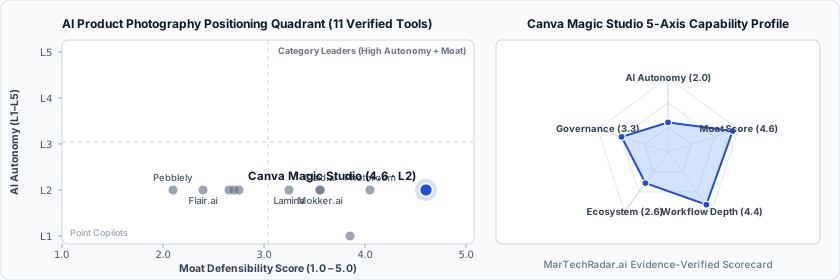
Canva Magic Studio in-depth review, pricing & architecture analysis
Editor sign-off: Oct 15, 2026. How profiles are made.
What is Canva Magic Studio? Overview & background
Canva Magic Studio serves digital marketing teams and creative production units tasked with generating high-volume e-commerce and promotional imagery without specialized graphic design software. Headquartered in Australia, Canva consolidated its generative capabilities into this centralized suite to resolve workflow fragmentation between image capture and final asset distribution. Operating under an L2 autonomy model, the system facilitates human-guided creative orchestration, allowing operators to execute complex visual manipulations through conversational prompts and contextual editing widgets directly within active creative documents.
How Canva Magic Studio works: architecture & workflow
Under the hood, the architecture couples WebGL-accelerated canvas rendering with cloud-hosted diffusion models and multimodal transformation engines. When an operator initiates asset retouching, the system isolates foreground elements via automated semantic edge-detection algorithms, decoupling layers for selective manipulation. The pipeline coordinates inpainting and generative expansion requests through distributed inference endpoints, passing contextual mask coordinates alongside textual directives. Transformations retain layer vector properties, enabling non-destructive compositional adjustments, automated background neutralization, and typography alignment without leaving the primary editor environment.
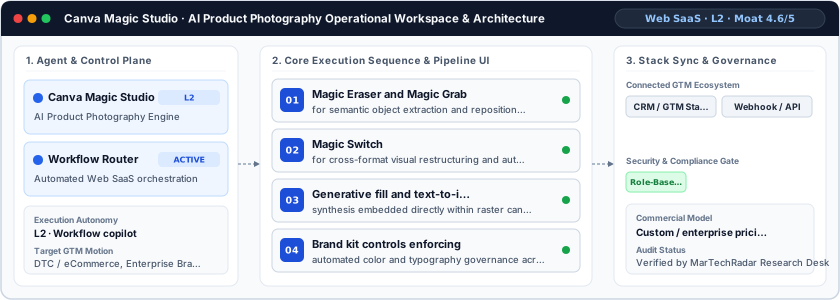
Canva Magic Studio limitations, drawbacks & risks
Operational considerations and platform boundaries include:
- High-Resolution Raster Compression: Generative infill and synthesis operations enforce strict pixel-dimension caps, compressing high-resolution commercial photography down to standard web formats during multi-layer compositing.
- Fine-Grained Boundary Hallucination: Automated subject segmentation degrades when processing semi-translucent product surfaces, delicate textures, or intricate shadow gradients, requiring manual mask clean-up.
- Batch Throughput Latency: Lacking programmatic headless API ingestion for bulk SKU retouching, operations demand manual canvas-by-canvas execution that slows multi-catalog e-commerce pipelines.
Canva Magic Studio pricing, plans & cost breakdown
Canva Magic Studio utilizes a hybrid commercial model structured around usage allowances. Access begins with a free tier at $0 per month, which grants limited generation credits for core retouching features. Scaled commercial usage requires upgrades to Pro or Enterprise tiers, which provision higher operational compute limits, shared brand control governance, and custom deployment options for corporate design teams.
| Plan / Tier | Verified Price & Billing | Included Scope & Contract Terms | |
|---|---|---|---|
| Free / Sandbox | $0 | Free plan or free tier offered by the vendor. | |
| Enterprise / Custom | Custom quote | Custom-quoted plan; terms come from the vendor's sales team. | |
| Contract Watchout: Annual Billing Headline vs. Monthly Premium | The vendor pricing page advertises an annual-billing discount (Save 16%); month-to-month billing carries a higher effective monthly rate. | ||
How Canva Magic Studio compares vs. competitors & alternatives
Compared to specialized product photography platforms like Blunge, Caimera, and clova, Canva Magic Studio prioritizes broad canvas utility over dedicated automated catalog staging. While Blunge and Caimera deliver specialized photorealistic 3D lighting simulation and clova focuses on high-volume automated SKU retouching, Canva excels in downstream document layout, multi-channel resizing, and collaborative vector integration. The platform remains optimal for distributed marketing teams requiring versatile, non-technical creative assembly rather than dedicated studio-grade batch rendering engines.
Direct competitors & market radar
Top algorithmic competitors based on category positioning, capability overlap, and ICP alignment.
Frequently asked questions about Canva Magic Studio
Does Canva Magic Studio publish pricing or require an enterprise quote?
Canva Magic Studio pricing: Custom / enterprise pricing. A permanent free plan is available. Published tiers: Free / Sandbox ($0); Enterprise / Custom (Custom quote). Canva Magic Studio utilizes a hybrid commercial model structured around usage allowances. Access begins with a free tier at $0 per month, which grants limited generation credits for core retouching features.
What are the top Canva Magic Studio alternatives in AI Product Photography?
Verified AI Product Photography alternatives include HelloCreator (Custom / enterprise pricing), Moda (Free plan · $30–$100/seat/mo), Caimera ($15–$117/seat/mo), Blunge ($10–$20/mo). Compared to specialized product photography platforms like Blunge, Caimera, and clova, Canva Magic Studio prioritizes broad canvas utility over dedicated automated catalog staging.
What are the main limitations and trade-offs of Canva Magic Studio?
Operational considerations and platform boundaries include: High-Resolution Raster Compression: Generative infill and synthesis operations enforce strict pixel-dimension caps, compressing high-resolution commercial photography down to standard web formats during multi-layer compositing. Walk away if you need published self-serve pricing: Canva Magic Studio is sold by custom quote.
Verified sources & evidence trail
- Official product domain: https://canva.com/magic
- Commercial pricing verification: https://www.canva.com/pricing/
- First-party governance & documentation links: Trust & Security · API & Docs · Terms · Privacy
- Editor sign-off: Oct 15, 2026 (how profiles are made).
